
Neutral Golf Grip: How to Hold the Club for Better Control

Quick Answer
A neutral golf grip places both hands on the club without rotating them excessively toward or away from the target. For most right-handed golfers, a useful starting point is seeing roughly two knuckles on the lead hand, holding the club mainly in the fingers, and letting the thumb-index creases point generally toward the trail shoulder. A neutral grip gives you a balanced starting position for controlling the clubface and hitting straighter golf shots.
Neutral Grip Checkpoints
- Lead hand: The grip runs diagonally through the fingers rather than sitting deep in the palm.
- Knuckles: Around two visible lead-hand knuckles is a useful starting reference for many golfers.
- Trail hand: It covers the lead thumb without sitting excessively under or on top of the handle.
- Hand creases: The thumb-index “V” shapes generally point toward the trail shoulder area.
- Grip pressure: Hold securely without creating obvious tension in your hands, wrists, or forearms.
Quick Test
- Take your normal setup, look down at your hands, then compare their rotation with the checkpoints above before changing your swing.
I treat the grip as the first checkpoint whenever my ball flight changes without an obvious reason. It is the only connection between your hands and the golf club.
A neutral golf grip is not a promise of perfectly straight shots. It is a practical baseline that makes clubface problems easier to diagnose and correct.
In This Guide
What Is a Neutral Golf Grip?
A neutral golf grip is a hand position that sits between a strong grip and a weak grip. Neither hand is rotated excessively around the handle.
Think of it as a reference position rather than a universal law. Hand size, wrist mobility, anatomy, and swing pattern can change what neutral looks like for you.
Definition: A neutral golf grip positions the hands so they can support a reasonably square clubface without requiring excessive hand rotation through impact.
What should a neutral grip look like?
For a right-handed golfer, the left hand is the lead hand. For a left-handed golfer, reverse all left-right references in this guide.
- Lead hand: The handle crosses diagonally from near the base of the little finger toward the index finger.
- Visible knuckles: Roughly two is a practical checkpoint, not a mandatory number.
- Lead thumb: It rests slightly to the trail side of the handle rather than wrapping far around it.
- Trail palm: It sits over the lead thumb so the hands work as one unit.
- Trail hand: It should not disappear far underneath the club or rotate dramatically over the top.
I prefer these checkpoints over obsessing about one exact “V” angle. Moving your hands forward at address can change how those creases appear without changing the grip itself.
That distinction matters. A golfer can copy a photograph perfectly and still have a grip that does not match their anatomy or delivery.
The goal is functional control. Titleist’s golf instruction material also emphasizes using the grip to help deliver the clubface squarely rather than treating hand placement as an isolated pose.
You can review broader instruction resources through PGA of America when you want professional coaching support.
Section Takeaway: A neutral grip is a balanced reference point between strong and weak. Use visual checkpoints, but judge the grip by how your hands and clubface work together.
How Do You Make a Neutral Golf Grip?
Build the grip one hand at a time. Start with the clubface square to your target before placing your hands on the handle.
Step 1: Place the club in your lead-hand fingers
Hold the club in front of you with the face square. Let the handle run diagonally across the fingers instead of burying it across the center of your palm.
This position allows your fingers to secure the club while keeping the wrist mobile.
Step 2: Close the lead hand
Wrap the fingers first, then allow the heel pad of the hand to sit on top of the grip. Your thumb should rest slightly off-center toward the trail side.
Look down from your normal address position. Around two visible knuckles gives many golfers a sensible neutral starting point.
Step 3: Add the trail hand
Place the trail hand so its palm covers the side of the lead thumb. Avoid rotating the trail palm far underneath the handle.
The two hands should feel connected. They should not behave like separate clamps fighting for control.
Step 4: Choose how the fingers connect
You can use an overlap, interlock, or ten-finger grip. None automatically makes your grip neutral or non-neutral.
- Overlap grip: The trail little finger rests over the gap between two lead-hand fingers.
- Interlocking grip: The trail little finger and lead index finger interlock.
- Ten-finger grip: All ten fingers contact the handle without overlapping or interlocking.
Choose the method that keeps your hands comfortable and connected. Golfers with smaller hands often find an interlock or ten-finger grip easier to secure.
Step 5: Check your complete setup
Your grip does not work independently from posture and alignment. A poor stance can make a good grip feel wrong.
If your setup changes from club to club, review these common golf stance mistakes before repeatedly changing your hand position.
Pro tip: If your wrists, fingers, elbows, or shoulders feel strained after changing your grip, ask a certified PGA professional to check it in person.
Section Takeaway: Build the grip through the fingers, connect the hands, and check it from your normal address position. Do not force your hands into a painful textbook shape.
Neutral vs Strong vs Weak Golf Grip: What Is the Difference?

The words strong and weak describe hand rotation, not how tightly you squeeze the club. This terminology causes plenty of confusion among newer golfers.
| Grip Type | Lead-Hand Appearance | Trail-Hand Position | Common Clubface Tendency |
|---|---|---|---|
| Weak | Fewer knuckles visible | More on top | Can make an open face easier for some golfers |
| Neutral | Often around two knuckles | Balanced around the handle | Balanced reference for face control |
| Strong | More knuckles visible | More underneath | Can make a closed face easier for some golfers |
A strong grip is not automatically wrong. Many excellent players use hand positions that would be described as stronger than neutral.
The same applies to a weak grip. Your swing must be considered as a complete system.
Why start with neutral?
Neutral gives a beginner a simpler baseline. If the ball then consistently curves, you can diagnose grip, path, alignment, and contact without starting from an extreme hand position.
I find this especially useful when a golfer has collected several swing tips. Returning the grip to a reasonable baseline removes one variable.
The club itself must also conform to applicable equipment rules. The USGA and The R&A publish the governing equipment and playing rules.


How Tight Should a Neutral Golf Grip Be?
A neutral grip should feel secure without making your forearms rigid. Grip position and grip pressure are separate issues.
You can place your hands perfectly and still create trouble by squeezing too hard.
- Too light: The handle may shift during the swing.
- Too tight: Forearm tension can restrict wrist movement and disturb rhythm.
- Useful feel: Secure enough to control the club while keeping your arms responsive.
I use a simple test before hitting balls. I grip firmly, then reduce pressure until the tension in my forearms disappears without the club feeling loose.
A numerical pressure scale can help, but do not treat “4 out of 10” or “6 out of 10” as a measured specification. Different golfers interpret those numbers differently.
Your grip size matters too. A handle that feels unusually large, small, slick, or worn can change how much pressure you use.
A clubfitter can check grip diameter and club specifications if comfort remains a problem. Do not try to compensate for unsuitable equipment by squeezing harder.
Can a Neutral Golf Grip Fix a Slice or Hook?
A neutral grip can help when an excessively weak or strong grip contributes to your curve. It cannot fix every slice or hook by itself.
Ball flight depends on clubface angle, swing path, strike location, speed, and equipment. Diagnose the pattern before making a large grip change.
If you slice the golf ball
A golfer with a weak grip may struggle to return the face square. Moving gradually toward neutral can remove that extreme.
However, slices can also come from swing path and heel contact. Use this guide on why beginners slice the golf ball before assuming your hands cause everything.
If you hook the golf ball
A strong grip can help close the face, but too much rotation may contribute to a severe left miss for a right-handed golfer. Returning closer to neutral is a useful test.
If the ball keeps curving hard after the change, check the complete pattern in this golf hook diagnosis and fix guide.
Change the grip in small amounts
Large grip changes can make the club feel completely unfamiliar. Rotate your hands only a small amount, then hit several controlled shots.
- Record where the ball starts.
- Record which direction it curves.
- Check heel, center, or toe contact.
- Keep the target and club the same.
- Change only one variable at a time.
Pro tip: Persistent slices and hooks can have several causes. A certified instructor can check face angle, path, grip, and strike together instead of guessing from one symptom.
Section Takeaway: Neutralizing an extreme grip can improve clubface control, but grip alone does not determine ball flight. Diagnose your start line, curve, and contact first.
How Should You Practice a Neutral Golf Grip?
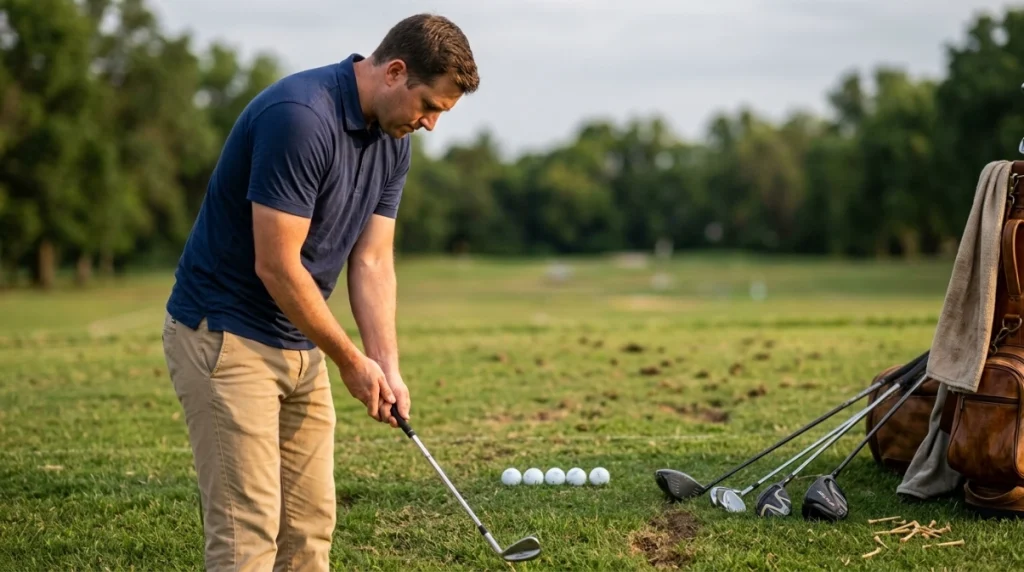
Practice the hand position at low speed before trusting it with a driver. A new grip often feels strange simply because it is unfamiliar.
Use the five-ball checkpoint drill
- Choose a wedge or short iron.
- Set the clubface square to a clear target.
- Build your neutral grip slowly.
- Hit five half-swings at comfortable speed.
- Track start direction, curve, and contact.
Do not rebuild the grip between every bad shot. Look for a pattern across the group.
Practice without a ball
You can rehearse your grip at home with a club in a safe area. Place your hands, release them, and rebuild the position repeatedly.
This removes ball-flight anxiety. It also makes the new hand placement easier to reproduce at the range.
Progress from short clubs to long clubs
A driver magnifies face-control problems because of its length and low loft. Start with shorter clubs before increasing speed.
- Stage 1: Wedge half-swings.
- Stage 2: Short-iron three-quarter swings.
- Stage 3: Mid-iron normal swings.
- Stage 4: Hybrid or fairway wood.
- Stage 5: Driver at controlled speed.
Consistency comes from repetition, not from hitting hundreds of rushed balls. A structured schedule like this realistic golf practice plan is more useful than constantly changing your grip.
New players should also connect the grip with posture, alignment, and basic contact. My broader beginner guide to starting golf explains how those fundamentals fit together.
For another visual explanation of grip fundamentals, Titleist provides a verified instruction resource on how to grip the golf club.
Section Takeaway: Rehearse the grip slowly, begin with shorter clubs, and judge changes across groups of shots. Build speed only after the position becomes repeatable.
Neutral Golf Grip FAQs
How many knuckles should I see with a neutral golf grip?
About two lead-hand knuckles is a useful starting point for many golfers. It is not an absolute rule because hand shape, wrist position, and address position change what you see.
Where should the V point on a neutral golf grip?
The creases between the thumb and index finger generally point toward the trail-shoulder area. Use this together with knuckle visibility and palm position instead of relying on the V alone.
Is a neutral golf grip best for beginners?
It is an excellent starting reference because it avoids an extreme strong or weak position. Beginners can then learn how grip, clubface, alignment, and swing path influence ball flight.
Does a neutral grip prevent a slice?
No. It can help if an excessively weak grip leaves the face open, but a slice can also come from an out-to-in path, heel contact, alignment, or other swing factors.
Can you play good golf with a strong grip?
Yes. A strong grip is not automatically a fault. Skilled golfers can match stronger hand positions with their wrist action, body rotation, path, and clubface delivery.
Should the golf club sit in the fingers or palm?
For a conventional full-swing grip, the handle should generally run more through the fingers of the lead hand than deep across the center of the palm. That position helps the fingers secure the club while preserving wrist mobility.
Should I use the same neutral grip with every club?
Your basic full-swing grip can remain similar with drivers, irons, and wedges. Putting is different because golfers often use specialized hand positions designed for face control and reduced wrist action.
Final Takeaway: Build a Grip You Can Repeat
A neutral golf grip gives you a clean starting point for controlling the clubface. Place the handle through the fingers, connect the hands naturally, avoid excessive rotation, and keep pressure secure without unnecessary tension.
Do not chase a photograph-perfect grip. Use the checkpoints, hit controlled shots, and let repeatable ball flight tell you whether the position works.
If your grip still feels uncomfortable or your ball flight remains unpredictable, have a qualified golf professional watch you hit shots. A small personalized adjustment is usually more useful than forcing your hands into an arbitrary position.