
Maximum Measuring Distance of Golf Rangefinders Explained
Quick Answer
The maximum measuring distance of a golf rangefinder varies by model, with many laser devices advertising maximum ranges of roughly 600 to 1,300 yards or more under favorable conditions. However, the distance at which a device can reliably lock onto a golf flag is usually much shorter than its maximum range against larger, more reflective targets. For most golfers, flag-locking reliability, optical clarity, and practical accuracy matter more than the biggest yardage number on the box.
What determines the useful range?
- Advertised range: The manufacturer’s stated maximum under specified conditions, which may involve large targets rather than golf flags.
- Flag-locking distance: The practical distance at which the device can distinguish the flagstick from trees and other background objects.
- Target size: A flagstick presents a much smaller laser target than a clubhouse, hillside, or broad tree trunk.
- Weather and visibility: Fog, rain, haze, and atmospheric conditions can reduce dependable readings.
- Optics and stabilization: Clear magnification, a steady grip, and effective targeting features help you acquire the intended target.
- Course requirements: A reliable flag reading at ordinary approach-shot distances is more useful than a distant reading you rarely need.
How to check a rangefinder before buying
- Compare the stated maximum range with the manufacturer’s separate flag-target or pin-locking specifications.
- Check whether the manufacturer specifies accuracy, target conditions, and any limitations.
- Test readings against known course markers when possible, and repeat readings to confirm consistency.
A golf rangefinder’s maximum measuring distance tells you how far its laser may reach, not necessarily how far away it can reliably identify a flagstick. Understanding that difference helps you choose equipment that suits your course, playing style, and budget.
When comparing golf rangefinder distance specifications, I focus on the practical details behind the numbers. This guide explains advertised range, flag-locking performance, environmental limits, and the features worth checking before buying a laser rangefinder in 2026.
In This Guide
- What is the maximum distance of a golf rangefinder?
- Why is flag-locking distance shorter than advertised range?
- How do rangefinder distance specifications compare?
- What affects a rangefinder’s measuring distance?
- How much range do golfers actually need?
- How can you test a rangefinder’s usable range?
- Golf rangefinder distance FAQs
What Is the Maximum Distance of a Golf Rangefinder?
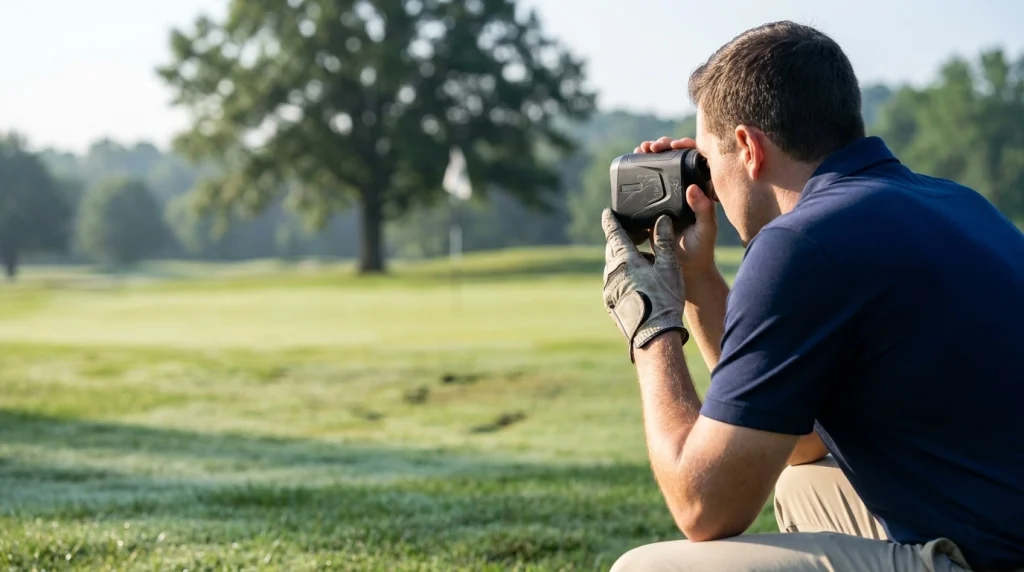
The maximum measuring distance of a golf rangefinder is the farthest distance at which its manufacturer says the device can measure a target under specified conditions. Many laser golf rangefinders advertise maximum ranges around 600–1,300 yards, although some models claim more.
These figures describe different products and testing conditions, not a universal performance standard. Always check the specifications for the particular model you intend to buy.
What does maximum measuring distance mean?
A laser rangefinder sends a pulse of light toward a target and measures the returned signal to estimate the distance. The device then displays the calculated distance, usually in yards or meters.
Maximum measuring distance is the longest distance at which the instrument can produce a reading from a suitable target. The target’s size, reflectivity, visibility, and position can influence whether the laser returns a usable signal.
A large building or broad hillside may return enough light for a reading at a distance where a narrow flagstick does not. That’s why two different targets can produce very different results with the same device.
Why do manufacturers advertise different maximum ranges?
Manufacturers design rangefinders for different users, price points, and target-acquisition needs. Their stated distances may reflect different optical systems, laser electronics, target conditions, or testing methods.
- Entry-level models: May offer sufficient range for ordinary golf shots without emphasizing extreme-distance measurements.
- Midrange models: Often combine longer advertised range with features such as flag-locking assistance and improved optics.
- Premium models: May offer longer maximum range, enhanced displays, stabilization, or additional distance-measuring functions.
These are general product categories rather than fixed technical standards. Price alone doesn’t guarantee better flag acquisition or more dependable readings.
Does a longer maximum range mean better accuracy?
No. Maximum range and measurement accuracy describe different aspects of performance.
A rangefinder might measure a large target hundreds of yards away while struggling to isolate a small flagstick at a shorter distance. Another device with a lower advertised maximum might provide a clearer display and more dependable flag readings for everyday golf.
When reviewing specifications, check the stated measurement accuracy separately from the maximum range. For background on equipment and the rules governing golf, consult the USGA’s official website.
Section Takeaway: The advertised maximum tells you the potential reach of a rangefinder, not its guaranteed distance for every target. Look for separate evidence of flag-locking performance and measurement accuracy.
Why Is Flag-Locking Distance Shorter Than Advertised Range?
Flag-locking distance is usually shorter than advertised maximum range because a flagstick presents a small target with limited reflective surface. A rangefinder must receive enough returning laser light to distinguish the flag from nearby trees, bunkers, or the landscape behind the green.
This difference is one of the most important details to understand when comparing golf laser rangefinders. A manufacturer may advertise a long maximum distance while listing a much shorter range for golf flags.
How do large targets differ from golf flags?
A large, reflective target can return a strong signal over a greater distance than a narrow flagstick. Target size, surface characteristics, alignment, and surrounding objects all influence the reading.
For a practical example, consider a rangefinder with a 1,300-yard maximum range but a separately stated 300-yard flag range. Both figures can be valid because they describe different targets and operating conditions.
One documented example is the Bushnell Hybrid laser/GPS manual, which specifies a maximum range of 1,300 yards to a highly reflective object and 300 yards to a golf flag. Its stated ranging accuracy is ±1 yard. These are specifications for that particular device, not universal figures for every rangefinder. Read the manufacturer’s manual for the exact details.
What does pin-locking or flag-lock technology do?
Pin-locking features help a rangefinder identify the flagstick rather than a background object. Depending on the model, the device may use signal processing, target-priority logic, vibration feedback, or a combination of these features.
- Target priority: Helps the device select a nearby target instead of a more distant background.
- Vibration feedback: Signals that the device has detected a target according to its locking logic.
- Optical magnification: Makes it easier to aim at a narrow flagstick.
- Target scanning: Lets the golfer check different objects or sweep across a scene, depending on the model.
These features improve usability, but they don’t guarantee a successful lock at every distance. A vibration confirms the device’s detection process, not that every reading is correct under all conditions.
Why does background clutter make readings harder?
When a flag sits in front of trees, a hillside, or buildings, a rangefinder may acquire the background instead. This problem becomes more noticeable when the flag is small in the viewfinder or the golfer’s hands move during aiming.
Try aiming at the lower portion of the flagstick and taking several readings. If the results vary considerably, stabilize the device and repeat the measurement before choosing a club.
Section Takeaway: A rangefinder’s flag range is a more useful buying specification than its maximum range against a large target. Prioritize reliable target acquisition over headline yardage.
How Do Golf Rangefinder Distance Specifications Compare?
Golf rangefinder specifications make more sense when you compare maximum target range, flag range, and stated accuracy separately. These measurements answer different questions and shouldn’t be treated as interchangeable.
What should you compare on the specification sheet?
The following table uses the published specifications of one documented model and illustrative buying categories. The categories are practical shopping examples, not verified performance ranges for every device in each price class.
| Specification or category | Distance or value | What it tells you |
|---|---|---|
| Bushnell Hybrid maximum range | 1,300 yards | Maximum range to a highly reflective object, according to its manual. |
| Bushnell Hybrid golf flag range | 300 yards | The manufacturer’s stated range for a golf flag. |
| Bushnell Hybrid ranging accuracy | ±1 yard | The stated measurement tolerance under the manufacturer’s specifications. |
| Everyday golfer’s buying check | Verify the individual model | Compare flag range, accuracy, optics, and targeting features before buying. |
| Long-distance or open-course use | Assess the actual requirement | Consider long approach shots, open sightlines, and occasional distant targets. |
The three numerical specifications in this table come from the same manufacturer’s manual. The final two rows are purchasing guidance, not claims that a particular range is guaranteed for an entire product category.
Laser rangefinder vs. GPS golf rangefinder
A laser rangefinder measures the distance to a target you aim at, while a GPS golf device estimates distances using mapped course data and your location. Some hybrid devices combine both technologies.
| Feature | Laser rangefinder | GPS golf device |
|---|---|---|
| Measurement method | Laser aimed at a visible target | Location and mapped course data |
| Flag measurement | Direct measurement when the flag can be acquired | Depends on available mapping and device features |
| Line of sight | Required for the intended laser target | Not required to view a mapped course point |
| Maximum distance | Limited by laser performance and target conditions | Not directly comparable to laser target range |
GPS devices don’t have a comparable laser maximum-range specification because they calculate distances differently. Their usefulness depends on location accuracy, map quality, and the course information available.
Section Takeaway: Compare like with like. A laser’s maximum target range, flag range, and accuracy are separate specifications, while GPS distance measurements work on a different principle.
What Affects a Rangefinder’s Measuring Distance?
A golf rangefinder’s usable distance depends on the target, weather, visibility, optics, and the golfer’s ability to hold the device steady. Even a model with impressive published specifications may struggle when several unfavorable conditions occur together.
How do weather and visibility affect laser range?
Fog, heavy rain, haze, and airborne particles can weaken or scatter the laser signal. Poor visibility also makes it harder to see and aim at the intended target through the viewfinder.
- Fog: Suspended water droplets can interfere with the returning signal and obscure the target.
- Heavy rain: Water droplets along the line of sight may make readings less dependable.
- Haze: Reduced contrast can make a distant flag difficult to identify.
- Bright conditions: Strong sunlight or glare may make aiming and viewing the display less comfortable, depending on the optics.
These effects vary by device and conditions, so there isn’t one universal yardage reduction for bad weather. If a reading seems inconsistent, take another measurement rather than relying on a questionable result.
How much do optics and magnification matter?
Optical magnification helps you see the flagstick and place the aiming point accurately. Clear glass, suitable coatings, and a readable display can make distant targets easier to acquire.
Higher magnification doesn’t automatically produce longer laser range. It can also make hand movements appear more pronounced, so optical quality and ease of aiming matter alongside magnification.
Can hand movement reduce effective range?
Yes, movement can make it harder to keep the laser on a narrow target. A slight shift toward nearby foliage or the background may prevent the rangefinder from returning the flag’s distance.
For steadier readings, try this simple technique:
- Hold the rangefinder with both hands when practical.
- Brace your arms against your body for support.
- Center the flagstick in the viewfinder before measuring.
- Use the device’s targeting assistance if available.
- Repeat the measurement if the result doesn’t match the situation.
A steady grip won’t change the instrument’s rated maximum range, but it can improve your ability to use the available range effectively.
Do batteries and lens condition affect readings?
A low battery can affect operation on some electronic devices, while dirty, scratched, or fogged optics can make the target harder to see. These are worth checking before assuming the rangefinder has reached its performance limit.
Keep the lenses clean with a suitable microfiber cloth, protect the device from impacts, and follow the manufacturer’s battery and storage instructions. Avoid using abrasive materials or applying cleaning fluid directly to the lens unless the manual specifically permits it.
Section Takeaway: Maximum range is only one part of real-world performance. Good visibility, clean optics, stable aiming, and a suitable target all help you obtain dependable readings.
How Much Range Do Golfers Actually Need?
Most recreational golfers should prioritize dependable readings across their normal playing distances rather than buying a rangefinder solely for an extreme maximum range. The right specification depends on the courses you play, the shots you face, and whether you need to measure distant hazards or other landmarks.
What range is practical for everyday golf?
For many golfers, a device that reliably measures flags at the distances they encounter during approach shots is more useful than one with a much longer advertised maximum. A flag range of around 250–300 yards may cover many common approach-shot situations, although individual needs vary.
That figure is a practical buying reference, not a guarantee that every model with the same rating will lock onto every flag at that distance. Always check the exact flag specification and consider the conditions in which you play.
Should beginners buy a long-range golf rangefinder?
Beginners generally benefit more from simple operation, a clear display, dependable flag acquisition, and consistent readings than from an exceptionally long maximum range. A straightforward device can help build confidence in yardage decisions without adding unnecessary complexity.
Mid-handicap and low-handicap golfers may place greater value on fast target acquisition, stabilization, or slope measurement, depending on their needs. Competitive players should also check the applicable rules before using advanced features during a round.
When is extra range useful?
A longer advertised range can be useful when you regularly play wide-open courses, encounter distant targets, or want to measure landmarks beyond normal flag distances. It can also offer flexibility when assessing course features during practice.
However, measuring a distant tree doesn’t tell you the exact distance to the flag. Always aim at the specific target relevant to your shot and confirm that the rangefinder has acquired it correctly.
Which specifications deserve the most attention?
When comparing models in 2026, I would evaluate these features in order of practical importance:
- Flag range: Check the manufacturer’s stated distance for a golf flag, not just a reflective target.
- Accuracy: Review the stated tolerance and any conditions attached to it.
- Optical clarity: Make sure the display and magnification suit your eyesight.
- Target acquisition: Look for useful flag-locking assistance and clear feedback.
- Handling: Consider weight, grip, button placement, and ease of aiming.
- Additional functions: Decide whether slope, stabilization, or GPS integration would help your game.
Remember that slope features require special care in competition. Under Rule 4.3a of the Rules of Golf, players must not use a distance-measuring device to gauge elevation changes or access prohibited playing recommendations during a round, and a committee may adopt a Local Rule prohibiting distance-measuring devices altogether.
Check the current rules and competition conditions through The R&A’s official website and the USGA before playing.
Section Takeaway: Choose enough dependable flag range for your normal shots, then weigh accuracy, optics, and ease of use. Extra range is a bonus when it serves a real need.
How Can You Test a Rangefinder’s Usable Range?
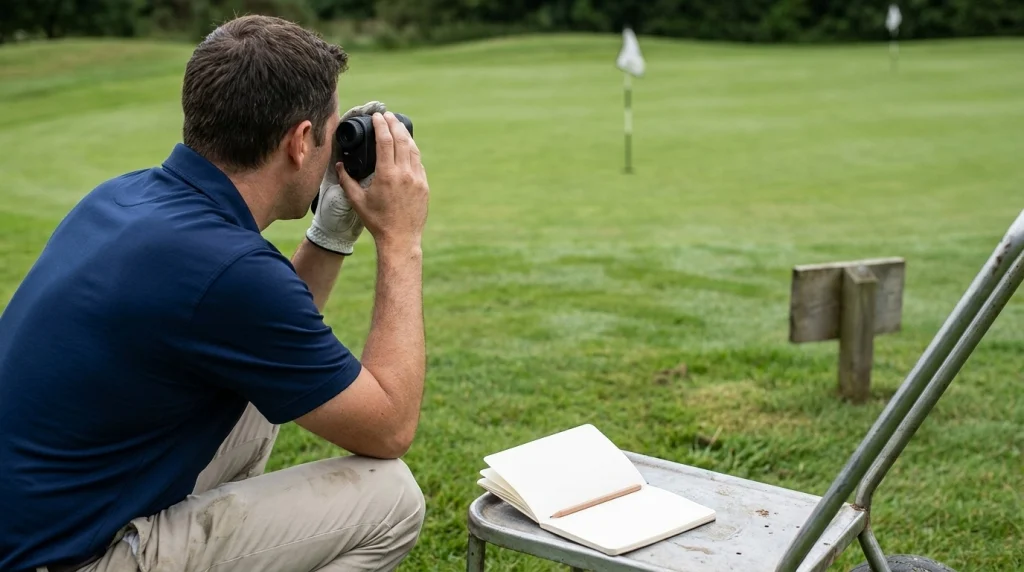
You can evaluate a golf rangefinder’s practical performance by checking its readings against known distances and testing how reliably it acquires different targets. A few controlled checks are more informative than repeatedly aiming at distant objects without confirming what the device measures.
How should you check distance accuracy?
Start with a clearly visible target at a known distance, such as a course marker or a measured practice area. Compare the displayed reading with the known distance, taking care to measure from the correct position.
- Read the manufacturer’s instructions and confirm the device is operating normally.
- Choose a stationary target with a known distance.
- Take several readings from the same position.
- Record the results and compare them with the known measurement.
- Repeat the check with another target and distance when practical.
Use a reliable reference measurement rather than assuming a marker’s position or a visual estimate is exact. Also remember that your test may not reproduce the manufacturer’s laboratory or field conditions.
How can you test flag-locking reliability?
Choose a visible flagstick and take several readings under ordinary playing conditions. Check whether the device consistently returns the flag’s distance instead of the trees or ground behind it.
If the readings vary, steady your hands, reposition the aiming point, and repeat the test. You can also compare performance with and without available target-priority features to understand how they affect operation.
What should you record during testing?
Keep a simple log that separates target acquisition from numerical accuracy. This helps you identify whether the problem comes from aiming, target selection, visibility, or inconsistent measurements.
- Target type and approximate distance.
- Weather and visibility conditions.
- Number of successful flag locks.
- Consistency across repeated readings.
- Any errors or difficulty identifying the intended target.
Never assume a rangefinder is defective simply because it can’t reach its advertised maximum against a flagstick. That figure may apply to a larger, more reflective target.
Section Takeaway: Test accuracy against known distances and flag-locking against actual flags. These checks reveal far more about golf-course usability than the maximum range alone.
Golf Rangefinder Distance FAQs
What is the longest range of a golf laser rangefinder?
Some golf laser rangefinders advertise maximum distances of 1,000 yards or more, and certain models specify ranges around 1,300 yards. These figures generally refer to suitable targets rather than guaranteed flag-locking distance. Check the manufacturer’s specifications for the exact model.
Can a golf rangefinder measure a flag at 400 yards?
It depends on the model and conditions. A rangefinder may measure a large target at 400 yards but fail to acquire a narrow flagstick at the same distance. Check the manufacturer’s stated flag range before expecting reliable measurements at that yardage.
Why does my rangefinder measure trees but not the flag?
Trees offer a much larger target than a flagstick, making it easier for the laser to return a measurable signal. The flag may also blend into the background or move in the wind. Stabilize the device, aim carefully, and repeat the reading.
Does 6x magnification increase measuring distance?
No. Magnification affects how large the target appears through the optics, not the laser’s rated maximum measuring distance. Clear optics can make aiming easier, but effective range still depends on target characteristics, the device’s electronics, and environmental conditions.
Are golf rangefinders accurate at their maximum distance?
Not necessarily for every target. A manufacturer may state a measurement tolerance under specified conditions, but the maximum range may apply only to a suitable reflective target. Accuracy specifications and target-acquisition limits should be considered separately.
Is a 1,000-yard rangefinder better than a 600-yard model?
Not automatically. A 1,000-yard model may offer more reach for distant targets, but a 600-yard model could better suit your needs if it provides reliable flag readings, clear optics, and consistent measurements. Compare the complete specifications rather than one number.
Does slope affect the maximum measuring distance?
Slope doesn’t automatically determine a laser rangefinder’s maximum distance. Some models measure line-of-sight distance and calculate an adjusted yardage using elevation information. Such calculations are separate from the laser’s ability to acquire the target, and slope features may be restricted during competition.
Final takeaway: The maximum measuring distance of a golf rangefinder describes its potential reach, not guaranteed performance on every flagstick. Compare flag range, stated accuracy, target-locking features, and real-world usability before making your choice.
If you’re comparing golf rangefinders, start with the distances you routinely face on the course. A device that acquires the flag consistently and gives dependable readings is usually a more practical choice than one selected for maximum yardage alone.