
How to Start Playing Golf: A Practical Beginner’s Guide
Starting golf can feel more complicated than it needs to be. You may wonder which clubs to buy, where to practice, whether you need lessons, and what to do during your first round.
The good news is that you do not need expensive equipment or a perfect swing to begin. Learning how to start playing golf is mainly about building a few basic skills, understanding course etiquette, and gaining confidence through short, focused practice sessions.
This guide explains the complete beginner process, from choosing equipment and learning the swing to visiting a course and deciding when professional help is worthwhile.
Quick Answer
To start playing golf, visit a driving range, borrow or rent a few clubs, and practice basic putting, chipping, and half-swings. Learn essential safety and etiquette rules before playing a beginner-friendly nine-hole course. Avoid buying an expensive full set until you understand your swing, goals, and equipment needs.
How to Start Playing Golf Step by Step
1. Decide What You Want From Golf
Your reason for learning will influence how you practice and how much equipment you need.
You may want to:
- Play casually with friends or coworkers
- Participate in business or charity events
- Improve your fitness and spend more time outdoors
- Join a local golf league
- Work toward a handicap
- Become a competitive amateur golfer
A casual player may be satisfied with occasional range sessions and nine-hole rounds. Someone interested in regular competition will eventually need structured lessons, properly fitted equipment, and more detailed knowledge of the rules.
Start with a simple goal: Become comfortable hitting the ball, putting, and completing nine holes at a reasonable pace.
2. Learn the Basic Golf Terms
You do not need to memorize every golf term before your first practice session. However, understanding a few common words will make lessons and course instructions easier to follow.
- Tee box: The starting area of a hole
- Fairway: The closely cut area leading toward the green
- Rough: Longer grass beside the fairway
- Green: The short-grass area containing the hole
- Par: The expected number of strokes for a skilled golfer to complete a hole
- Birdie: One stroke under par
- Bogey: One stroke over par
- Putt: A rolling shot played on or near the green
- Chip: A short shot that travels briefly through the air before rolling
- Penalty area: An area where special relief rules may apply
Beginners can use the free USGA Rules 101 course to learn common playing situations without reading the entire rulebook at once. (USGA Rules)
3. Begin at a Driving Range
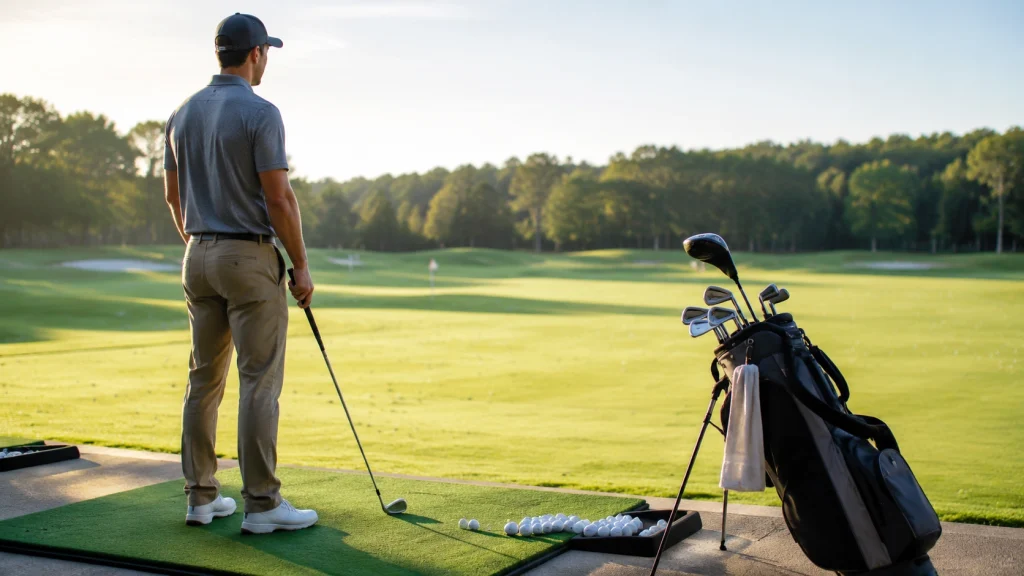
A driving range is usually the least stressful place to start. You can practice without worrying about keeping up with other groups or counting every shot.
Ask the facility whether it offers:
- Club rentals
- Beginner lessons
- Practice balls
- Putting and chipping areas
- Covered or heated hitting bays
- Beginner clinics
For your first session, take only a wedge, a mid-iron such as a 7-iron, and a putter. A driver is exciting to hit, but shorter clubs are generally easier to control.
Begin with small swings. Try to make clean contact rather than hitting the ball as far as possible.
4. Practice Putting and Chipping First
A large portion of golf is played close to the hole. Putting and chipping are also easier for beginners to practice safely.
Spend approximately half of your early practice time on:
- Short putts from three to six feet
- Long putts focused on distance control
- Basic chip shots from just outside the green
- Small wedge swings
- Simple landing-point practice
For example, place a towel several yards onto the practice green and try to land chip shots on it. The goal is not to hit the ball directly into the hole. The goal is to control where the ball lands and how far it rolls.
5. Learn a Simple Golf Swing
A beginner golf swing does not need to look perfect. It needs to be balanced, repeatable, and safe.
Grip
Hold the club securely without squeezing it as hard as possible. Excessive grip pressure can make your arms tense and reduce clubhead control.
A neutral grip should allow both hands to work together. Your lead hand—left hand for a right-handed golfer—sits above the trail hand.
Stance
Stand with your feet approximately shoulder-width apart for a mid-iron. Use a slightly narrower stance for short shots and a wider stance for the driver.
Keep your weight balanced across both feet.
Posture
Bend forward from your hips rather than rounding your upper back. Flex your knees slightly and let your arms hang naturally.
You should feel athletic and stable, not stiff.
Backswing and Downswing
Turn your shoulders while keeping your balance. You do not need a long backswing.
Begin the downswing smoothly. Avoid using only your arms to attack the ball. Let your body rotation and arms work together.
Finish
After contact, allow your body to rotate toward the target. A balanced finish is often a sign that the swing was controlled.
Do not practice full-speed swings near another person. Make sure the area behind, beside, and in front of you is clear before swinging.
Expert Tip: Practice at 50% to 70% speed until you can make regular contact. A shorter, balanced swing will help you improve faster than repeatedly swinging as hard as possible.
What Golf Equipment Does a Beginner Need?
You are allowed to carry fewer than 14 clubs. The USGA club rules set 14 as the maximum during a round, not the minimum. (USGA)
A practical beginner set may contain:
- Driver or fairway wood
- Hybrid
- 7-iron
- 9-iron
- Pitching wedge
- Sand wedge
- Putter
A half set is often enough for learning. Fewer clubs can make decisions easier and reduce the initial cost.
Beginner Golf Cost Guide
The following figures are approximate planning ranges. Actual prices depend on location, equipment condition, course type, and instructor experience.
| Golf expense | Approximate planning range | Beginner advice |
|---|---|---|
| Driving-range session | $15–$40 | Rent clubs before buying |
| Nine-hole green fee | $20–$70 | Look for off-peak or walking rates |
| Group beginner clinic | $25–$75 per session | Good low-cost introduction |
| Private golf lesson | $60–$175 per session | Best for correcting specific problems |
| Used beginner club set | $150–$500 | Inspect grips, shafts, and clubheads |
| New starter set | $300–$800 | Choose forgiveness over premium branding |
| Golf shoes | $50–$150 | Optional at first if athletic shoes provide grip |
| Glove, balls, tees, and accessories | $30–$80 | Avoid premium balls while learning |
New Versus Used Clubs
Used clubs can offer excellent value, especially when you are still developing your swing.
Check used clubs for:
- Cracked or badly dented clubheads
- Loose clubheads
- Bent or damaged shafts
- Smooth, hardened, or torn grips
- Rust that affects the grooves
- Incorrect club length
- Shaft flex that feels unusually stiff or heavy
Avoid buying old clubs only because they are inexpensive. Poorly fitted or damaged equipment can make learning harder.
Golf Balls
Beginners frequently lose balls, so premium tour-level models are rarely necessary.
Choose an affordable ball with:
- A durable cover
- A soft or medium feel
- A highly visible color when needed
- A price that will not make every lost ball frustrating
Use the same ball model when possible. Consistency helps you recognize how your shots normally fly and roll.
Clothing and Shoes
Most public courses require a shirt, shorts or pants, and suitable footwear. Dress codes vary, so check the course website or call before arriving.
Golf shoes are helpful but not essential for your first range session. Clean athletic shoes with stable traction can be sufficient.


Take a Beginner Lesson Early
You can learn basic ideas from videos, but a qualified instructor can see problems that are difficult to diagnose yourself.
One early lesson can help you establish:
- A functional grip
- Proper alignment
- Safe posture
- Basic ball position
- A balanced swing
- Realistic practice priorities
Ask the instructor to give you one or two drills rather than changing everything at once. Too many swing thoughts can make practice confusing.
Group clinics are useful for learning basic skills at a lower cost. Private lessons provide more personalized feedback.
Play a Beginner-Friendly Course
Your first round does not need to be 18 holes on a long championship course.
Start with one of the following:
- Par-3 course
- Short executive course
- Nine-hole course
- Quiet late-afternoon tee time
- Beginner league or supervised playing lesson
Short courses let you practice real golf without facing long forced carries, difficult hazards, or a four-hour commitment.
Choose the Correct Tees
The correct tees are based more on your hitting distance than your age or gender. Playing from shorter tees makes approach shots more manageable and can improve enjoyment and pace.
The USGA’s guidance on choosing the best tees uses 7-iron distance as a practical starting point for selecting an appropriate course length. (USGA)
There is no benefit in choosing tees that make every hole unnecessarily difficult. Move back only when you can reach greens comfortably, maintain pace, and enjoy the challenge.
Learn Basic Golf Etiquette and Safety
Golf etiquette protects players, preserves the course, and keeps groups moving.
Be Ready to Play
Prepare while another golfer is hitting, provided you are not distracting them. Choose your club, check the distance, and plan your shot in advance.
The USGA recommends keeping pre-shot routines efficient and being ready when it is your turn. (USGA)
Know When to Shout “Fore”
Shout “Fore!” immediately when your ball may hit or come close to another person. Do not wait to see where it lands.
Cover your head and turn away when you hear someone else shout the warning.
Respect the Course
- Repair ball marks on greens
- Replace or fill divots when required
- Rake bunkers after use
- Keep carts away from restricted areas
- Avoid standing on another player’s putting line
- Follow all posted cart and weather instructions
Keep Up With the Group Ahead
You do not need to rush every shot, but you should remain reasonably close to the group ahead.
During casual beginner rounds, consider picking up the ball after reaching a reasonable maximum score on a hole. Move to the next tee and try again.
Allow Faster Groups to Play Through
When there is open space ahead and another group is repeatedly waiting behind you, let them pass at a safe and convenient point.
A Simple Four-Week Beginner Practice Plan

Week 1: Contact and Putting
Practice twice for 30–45 minutes.
Focus on:
- Short putts
- Basic grip and posture
- Half-swings with a wedge
- Clean contact
Week 2: Direction and Chipping
Add:
- Alignment practice
- Chip shots
- 7-iron half-swings
- Distance control on long putts
Week 3: Longer Clubs
Introduce:
- Hybrid or fairway wood
- Three-quarter swings
- Basic target selection
- Pre-shot routine
Do not add the driver until you can control a shorter club reasonably well.
Week 4: Play Nine Holes
Choose a short course and forward tees. Track only a few simple goals:
- Number of penalty shots
- Number of putts
- Whether you kept pace
- Which clubs felt dependable
- One skill to practice next
Do not judge your potential based on your first score. Beginners commonly hit poor shots, lose balls, and need several attempts to escape difficult areas.
When to Get Help From a Golf Pro or Fitter
Consider booking a lesson when:
- You repeatedly miss the ball
- Contact remains painful or uncomfortable
- Your shots curve severely with most clubs
- You cannot identify why the ball flies inconsistently
- Online tips create more confusion
- You want to build good fundamentals before practicing heavily
A club fitting may be worthwhile when:
- Standard clubs feel too long or short
- You are unusually tall or short
- You have physical limitations
- Your current clubs are extremely heavy, stiff, or inconsistent
- You can make repeatable contact and want to buy a long-term set
A complete fitting is not always necessary on your first day. Beginners whose swings are changing quickly may benefit more from an initial lesson and a basic equipment evaluation.
However, do not ignore obvious fit problems. Clubs that are dramatically too long, too short, too heavy, or too stiff can interfere with posture and contact.
Tracking Your Progress
At first, improvement should not be measured only by score.
Look for progress such as:
- More solid contact
- Fewer lost balls
- Better distance control
- Improved balance
- Fewer penalty shots
- More confidence on the course
- Faster decisions before each shot
After you begin playing regularly, a handicap can help measure your demonstrated ability and allow golfers of different levels to compete more fairly. In the United States, the USGA Handicap Index guidance explains that an initial index can be established after posting scores totaling 54 holes. (USGA)
Common Mistakes Golfers Should Avoid
- Buying expensive clubs immediately: Learn what feels comfortable before making a major purchase.
- Practicing only with the driver: Putting, chipping, and wedges have a major effect on scoring.
- Swinging at maximum speed: Excessive effort often reduces balance and contact.
- Using too many swing tips: Work on one priority at a time.
- Playing tees that are too long: Choose a course length that matches your current distance.
- Ignoring pace of play: Prepare early and move promptly between shots.
- Standing too close to another golfer: Stay outside the swinging area and watch the direction of play.
- Expecting instant consistency: Golf requires repeated practice across different lies and conditions.
- Keeping every score during a slow hole: In casual play, pick up when necessary and protect the group’s pace.
- Practicing through pain: Stop when a movement causes sharp or repeated discomfort and have your technique checked.
FAQs
Is golf difficult to learn?
Golf has a challenging learning curve because small changes in contact can affect the ball significantly. However, most beginners can learn to putt, chip, and complete short holes after a few focused practice sessions.
Do I need lessons before playing golf?
Lessons are not mandatory, but one beginner lesson can prevent common grip, posture, and alignment problems. A playing lesson is especially useful before your first full course round.
How many golf clubs does a beginner need?
A beginner can start with six or seven clubs. A driver or fairway wood, hybrid, two irons, wedge, sand wedge, and putter can cover most early situations.
Should a beginner buy new or used golf clubs?
Either can work. Used clubs usually offer better value while your preferences are developing. New starter sets provide convenience and consistent condition but may cost more.
Can I play golf without owning clubs?
Yes. Many driving ranges and courses rent clubs. You can also borrow clubs, although players should avoid sharing clubs during formal competition when doing so would violate equipment rules.
How often should a beginner practice golf?
Two focused sessions per week can produce steady improvement. Sessions of 30–60 minutes are usually more productive than occasional, exhausting practice sessions with no clear goal.
When should I start keeping a handicap?
Start when you are completing rounds regularly and want to track progress or play fairly against golfers of different abilities. You do not need a handicap to begin practicing or enjoying casual golf.
Conclusion
Learning how to start playing golf becomes much easier when you take the process one step at a time. Begin at a driving range, use a small number of forgiving clubs, learn putting and chipping, and build a balanced swing before worrying about distance.
Play your first rounds on short courses from forward tees. Follow basic safety, etiquette, and pace-of-play expectations. Most importantly, avoid spending heavily until you understand your needs.
Schedule a beginner practice session, rent or borrow a few clubs, and focus on making simple, controlled contact. Your first goal is not a perfect score—it is becoming comfortable enough to enjoy your next shot.