
Golf Beginner Checklist: Everything You Need Before Your First Round

Starting golf can feel more complicated than it should. You may wonder which clubs to buy, what to wear, how many balls to carry, which rules matter, and whether you are ready to play on a real course.
This Golf Beginner Checklist removes that uncertainty. It covers the essential equipment, clothing, basic skills, safety rules, course etiquette, practice priorities, and pre-round preparation every new golfer should understand.
You do not need expensive equipment or a perfect swing to begin. You need suitable gear, a basic plan, realistic expectations, and enough awareness to play safely without slowing down the course.
Quick Answer
A complete Golf Beginner Checklist should include beginner-friendly clubs, golf balls, tees, a glove, comfortable shoes, weather protection, basic swing and putting practice, knowledge of essential rules, and a simple pre-round plan. Start with only the equipment you need, learn safe course behavior, and choose shorter tees while building confidence.
Golf Beginner Checklist at a Glance
Before your first full round, make sure you have:
- A beginner-friendly set of essential clubs
- A comfortable golf bag
- At least 9–12 golf balls
- Wooden or plastic tees
- A golf glove
- Comfortable golf or athletic shoes
- Weather-appropriate clothing
- Water, sunscreen, and a small towel
- A ball marker and divot repair tool
- Basic knowledge of safety and etiquette
- Some practice with putting, chipping, and half-swings
- A tee time at a beginner-friendly course or shorter set of tees
You do not need to complete every technical milestone before playing. You only need enough control and awareness to keep yourself and other golfers safe.
1. Choose a Simple Beginner Golf Club Set
Many new golfers assume they need a full bag of specialized clubs. They do not.
The Rules of Golf allow a player to carry no more than 14 clubs during a round, but 14 is a maximum—not a beginner requirement. The official USGA equipment rules also require clubs and balls used in regulated play to conform to the rules. (USGA)
A beginner can comfortably learn with seven to ten clubs.
Recommended Beginner Club Setup
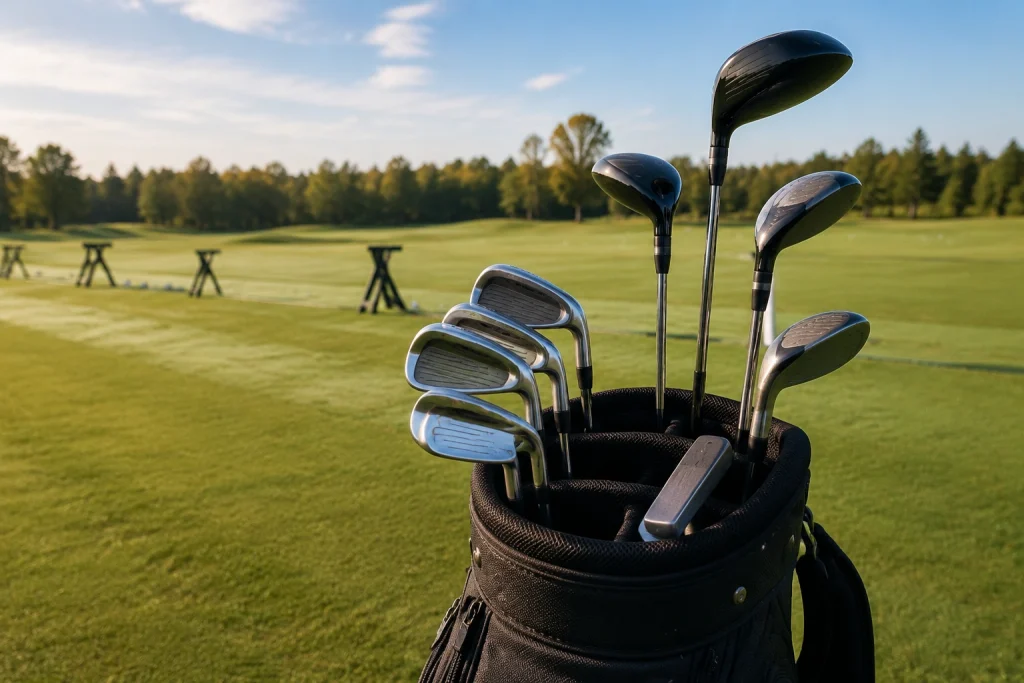
A practical starter set may include:
- Driver: For long tee shots once you can make controlled contact
- Fairway wood: Easier than a long iron for longer shots
- Hybrid: A forgiving replacement for difficult long irons
- 6-iron or 7-iron: Useful for learning basic full swings
- 8-iron or 9-iron: For shorter approach shots
- Pitching wedge: For short approaches and basic chips
- Sand wedge: Helpful from bunkers and around the green
- Putter: Used on the putting green
A half-set can be enough for your first lessons and practice sessions. Fewer choices often make club selection easier.
Prioritize Forgiveness Over Appearance
Beginner clubs should help you launch the ball even when contact is imperfect. Look for:
- Larger clubheads
- Cavity-back irons
- Wider iron soles
- Hybrids instead of 3- or 4-irons
- Drivers with higher loft
- Lightweight shafts
- Grips that fit comfortably in your hands
Avoid choosing clubs because they look like equipment used by professional players. Advanced “players’ irons” usually have smaller sweet spots and offer less help on off-center strikes.
New, Used, or Rental Clubs?
| Option | Best for | Main benefit | Main limitation |
|---|---|---|---|
| Rental clubs | First lesson or trial session | Lowest commitment | Fit and condition may vary |
| Used beginner clubs | Budget-conscious golfers | Good value | Inspect grips, shafts, and clubfaces |
| New package set | Golfers ready to continue | Complete and convenient | Some clubs may need upgrading later |
| Individually fitted clubs | Golfers with unusual measurements or consistent swings | Better personal fit | Higher initial cost |
Renting is sensible when you are still deciding whether you enjoy golf. Once you are practicing regularly, a used set or beginner package set can offer better consistency.
Before buying secondhand equipment, check the USGA conforming club and ball lists when tournament eligibility or formal competition matters. (USGA)
Warning: Do not automatically buy extra-stiff shafts, low-lofted drivers, or compact irons because an experienced golfer recommends them. Equipment should match your speed, strength, height, and ability.


2. Pack the Essential Golf Accessories
Clubs are only part of your Golf Beginner Checklist. A few inexpensive accessories can make your first round more comfortable and organized.
Golf Balls
Carry at least 9–12 balls for an early round. Beginners often lose balls in water, trees, long grass, or out-of-bounds areas.
Choose affordable two-piece or “distance” balls rather than premium tour models. Beginner-friendly balls are generally durable and provide useful distance without making every lost ball feel expensive.
Do not spend heavily on premium balls until you can keep the same ball in play for several holes.
Tees
Carry a mixture of:
- Longer tees for the driver
- Medium tees for woods or hybrids
- Short tees for irons on par-3 holes
Tees are inexpensive, easy to lose, and frequently broken. Keep more than you expect to use.
Golf Glove
A glove can improve grip and reduce rubbing or blisters. Most right-handed golfers wear a glove on the left hand, while left-handed golfers normally wear one on the right.
The glove should feel snug without restricting finger movement. Replace it when it becomes hard, slippery, torn, or stretched.
Towel
Attach a small towel to your bag. Use it to clean:
- Mud from clubfaces
- Moisture from grips
- Sand from wedges
- Dirt from golf balls
Clean grooves improve consistency, especially on short shots.
Ball Marker and Divot Repair Tool
Use a ball marker when lifting your ball on the putting green. A coin works, but a dedicated marker is easier to manage.
A divot repair tool is used to repair ball marks on the green. Repairing damage helps protect the course and shows consideration for the golfers playing behind you.
3. Wear Comfortable and Course-Appropriate Clothing
Golf clothing does not need to be expensive. It should allow free movement and suit the weather.
A basic outfit may include:
- Collared or course-approved shirt
- Flexible shorts or trousers
- Comfortable socks
- Golf shoes or stable athletic shoes
- Hat or visor
- Light rain jacket when needed
Check the facility’s dress code before arriving. Some public courses are relaxed, while private or resort courses may have stricter requirements.
Do Beginners Need Golf Shoes?
Golf shoes are helpful but not always necessary for an initial range session. Clean athletic shoes with stable soles may be acceptable.
Consider golf shoes when:
- You play regularly
- The ground is wet or uneven
- Your feet slide during the swing
- You need more support while walking
Avoid shoes with aggressive non-golf spikes that could damage putting greens.
Prepare for Sun and Weather
Pack:
- Sunscreen
- Drinking water
- Sunglasses
- A hat
- Rain gloves or a rain jacket
- An extra towel
- A light sweater for changing temperatures
Stop playing and follow course instructions when lightning is nearby. Golf clubs, open ground, isolated trees, and exposed areas create serious risks during thunderstorms.
4. Learn the Basic Golf Skills Before Your First Round
You do not need a technically perfect swing. However, you should practice enough to make the course experience safer and less stressful.
Start With Putting
Putting is one of the easiest parts of golf to practice and one of the fastest ways to reduce unnecessary strokes.
Practice:
- Short putts from three to five feet
- Controlling distance on long putts
- Starting the ball on your intended line
- Reading simple uphill and downhill slopes
Your first goal is not to hole every putt. It is to avoid repeatedly sending the ball far past the hole.
Practice Chipping
A chip is a short shot played near the green. It usually flies a short distance and then rolls toward the hole.
Use a pitching wedge, 9-iron, or 8-iron. Practice landing the ball on a chosen spot rather than trying to hit directly at the cup.
Build a Controlled Half-Swing
Beginners often swing too hard. Start with a waist-high backswing and a balanced finish.
A shorter swing helps you learn:
- Centered contact
- Balance
- Clubface control
- Direction
- Basic distance awareness
Once contact becomes reliable, gradually lengthen the swing.
Learn a Basic Tee Shot
You do not have to use a driver immediately. A hybrid, fairway wood, or mid-iron may keep the ball in play more consistently.
For your first rounds, a shorter shot in the fairway is usually more useful than a longer shot in trouble.
Expert Tip: Practice from the hole backward. Learn short putts first, then chips, short iron shots, and finally longer swings. Beginners often improve faster when they build control before chasing distance.
5. Understand Essential Rules and Safety
You do not need to memorize the entire rulebook before playing. Learn the situations you will encounter most often.
The official R&A Rules of Golf provide the full rules, while the R&A’s beginner resources explain common situations in a more accessible format. (Randa)
Rules Beginners Should Recognize
Learn the basics of:
- Playing the ball as it lies
- Identifying your ball
- Taking relief from penalty areas
- Handling a lost ball or out-of-bounds shot
- Dropping a ball correctly
- Marking and replacing a ball on the green
- Avoiding loose impediments or conditions that affect your stroke
- Counting penalty strokes honestly
For a casual beginner round, tell your playing partners that you are learning. They can help you apply rules without turning every situation into a lengthy discussion.
Follow the 14-Club Limit
You may carry fewer than 14 clubs, but you should not carry more during a rules-compliant round.
For a beginner, this is rarely a problem because a smaller set is usually more practical.
Confirm the Area Is Clear Before Swinging
Before every practice swing or stroke:
- Check behind and beside you
- Make sure nobody is close to the clubhead
- Confirm the group ahead is out of range
- Avoid swinging toward roads, buildings, carts, or people
- Warn others immediately by shouting “Fore!” if a ball may hit them
The R&A emphasizes that players should make sure nobody is positioned where the club, ball, stones, or other objects could strike them. (Randa)
6. Learn Basic Golf Etiquette and Pace of Play
Etiquette helps everyone enjoy the course. A beginner who plays safely, respects the property, and keeps moving is usually welcome even when scoring poorly.
Be Ready When It Is Your Turn
Prepare while another golfer is playing, provided you can do so without distracting them.
You can:
- Check your distance
- Choose your club
- Put on your glove
- Visualize the shot
- Take one controlled practice swing
In casual stroke play, groups often use “ready golf,” meaning a prepared player may play first when it is safe and agreed upon. The R&A supports ready golf when it does not endanger, distract, or interfere with another player. (Randa)
Keep Up With the Group Ahead
Your correct position is generally behind the group ahead—not simply ahead of the group behind.
To maintain pace:
- Limit practice swings
- Watch every shot until it stops
- Help playing partners locate balls
- Carry an extra ball in your pocket
- Record scores near the next tee
- Park the cart or bag toward the next hole
- Pick up after reaching your agreed maximum score
You do not have to finish every hole during an informal beginner round. Picking up after several unsuccessful attempts can protect pace and reduce frustration.
Care for the Course
Remember to:
- Repair ball marks
- Replace or fill divots as instructed
- Rake bunkers
- Avoid dragging your feet on greens
- Keep carts away from restricted areas
- Follow all cart-path signs
- Take litter with you
Good course care matters more than having a low score.
7. Choose the Right Course and Tees
Your first course should match your current ability.
Good beginner options include:
- A driving range
- A short-game practice area
- A par-3 course
- An executive course
- A nine-hole course
- A full course with forward tees
Avoid choosing the longest tees because of age, gender, or what other golfers are playing.
The USGA’s guidance on choosing the best tees for your game recommends matching tee selection to hitting distance rather than identity or tradition. (USGA)
Playing shorter tees can:
- Reduce forced carries
- Make approach shots more manageable
- Improve pace
- Lower frustration
- Create more opportunities to use different clubs
- Make the round more enjoyable
Moving forward is not “cheating.” It is a practical way to play a course that suits your present distance.
8. Follow a Simple Pre-Round Routine
Arrive 30–45 minutes before your tee time when possible. Rushing from the parking lot to the first tee can create unnecessary tension.
Beginner Pre-Round Checklist
- Check in at the golf shop.
- Confirm the starting tee and local rules.
- Organize balls, tees, glove, marker, and repair tool.
- Apply sunscreen and fill your water bottle.
- Make a few gentle stretches.
- Hit a small number of wedges or short irons.
- Hit several controlled longer shots.
- Practice a few chips.
- Finish with short and long putts.
- Reach the first tee several minutes early.
Do not hit a large bucket of balls immediately before playing. The purpose of a warm-up is to prepare your body and observe your ball flight—not rebuild your swing.
9. Set Realistic Goals for Your First Rounds
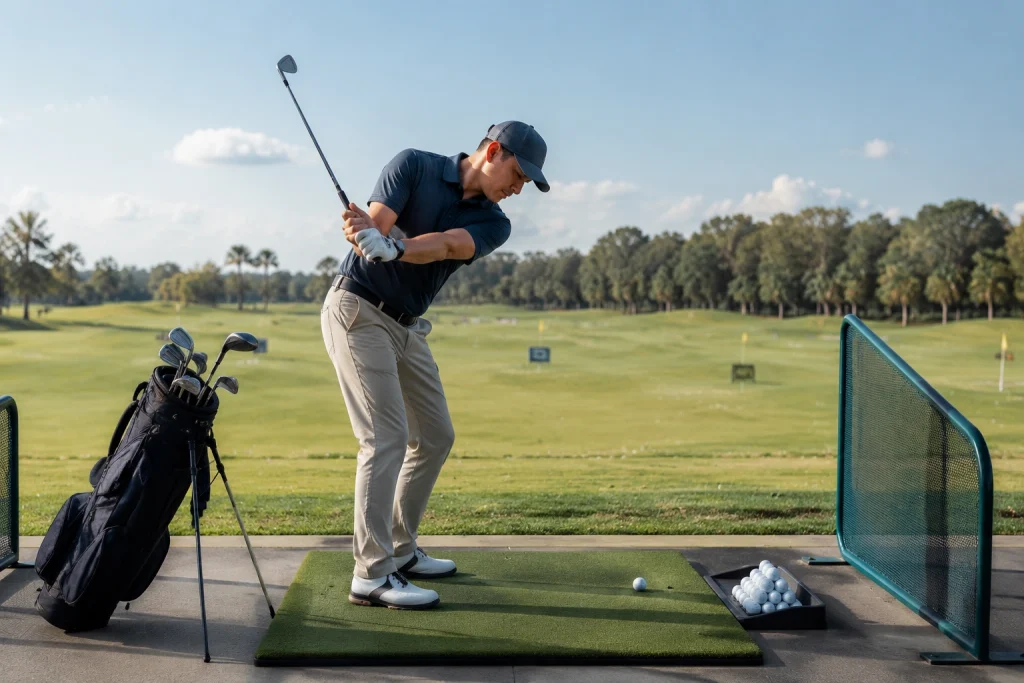
Your first goal should not be a specific score. Focus on actions you can control.
Useful beginner goals include:
- Make safe contact
- Keep a balanced finish
- Get the ball onto the green
- Avoid unnecessary penalties
- Complete the round at a reasonable pace
- Repair course damage
- Stay calm after poor shots
- Learn one useful lesson from each hole
Golf improvement is rarely a straight line. One good shot does not mean every following shot will be good, and one bad hole does not ruin the round.
Track simple progress markers such as:
- Fewer lost balls
- More solid iron contact
- Better putting distance
- Fewer shots from bunkers
- More tee shots kept in play
- Improved confidence with course etiquette
When to Get Help From a Golf Pro or Fitter
A lesson can prevent months of practicing an inefficient movement. Consider professional instruction when:
- You repeatedly miss the ball
- Contact causes pain
- Nearly every shot curves severely
- You cannot understand grip, stance, or alignment
- Online tips create more confusion
- You feel unsafe using longer clubs
- Your progress has stopped despite regular practice
The PGA of America offers a PGA Coach search for golfers seeking beginner clinics, individual instruction, or improvement programs. Beginner coaching commonly covers grip, swing fundamentals, short-game skills, etiquette, and basic rules. (PGA of America)
When Equipment Fitting Is Worthwhile
A fitting becomes particularly useful when:
- You are much taller or shorter than average
- Standard clubs feel too long or too short
- Your grip size causes hand discomfort
- You have limited mobility
- You consistently strike the ground far behind the ball
- You are ready to invest in clubs for several seasons
- Your swing has become repeatable enough to compare equipment
A beginner fitting does not need to be an expensive tour-level session. Even a basic check of club length, grip size, shaft weight, loft, and lie angle can prevent obvious mismatches.
Seek instruction first when the main problem is inconsistent technique. Seek fitting help when the equipment clearly affects posture, comfort, contact, or ball flight.
Common Mistakes Golfers Should Avoid
- Buying advanced clubs too early: Smaller clubheads and demanding shafts can make learning harder.
- Swinging at maximum effort: Extra force often reduces balance and centered contact.
- Practicing only with the driver: Putting, chipping, and wedges strongly influence beginner scores.
- Copying several swing tips at once: Work on one clear change before adding another.
- Playing tees that are too long: Excessive distance can slow play and make every hole frustrating.
- Ignoring golfers ahead: Never hit until the landing area is safely clear.
- Searching too long for every lost ball: Follow the permitted search time and keep an extra ball ready.
- Walking through another player’s putting line: Move around the expected path between the ball and hole.
- Failing to repair course damage: Replace divots, rake bunkers, and repair ball marks.
- Buying premium balls immediately: Durable, affordable balls are usually more practical while losses are frequent.
- Expecting rapid scoring improvement: Early progress often appears first in contact, control, confidence, and pace.
FAQs
What equipment does a beginner golfer really need?
A beginner needs several forgiving clubs, a putter, golf balls, tees, a glove, comfortable shoes, a bag, a towel, a ball marker, and weather protection. A complete 14-club set is not necessary.
How many golf clubs should a beginner carry?
Seven to ten clubs are normally enough to begin. A driver or fairway wood, hybrid, several irons, a wedge, and a putter can cover most situations without creating too many choices.
Should a beginner buy new or used golf clubs?
Used clubs are a good choice when they are in suitable condition and fit your basic measurements. Check the shafts, grips, clubfaces, and overall length before buying. Rental clubs are better when you are only trying the game.
How many golf balls should a beginner bring?
Bring at least 9–12 balls for an early round. Carry more when the course has heavy rough, water hazards, wooded areas, or several forced carries.
Should beginners use a driver?
Beginners can use a driver, but they do not have to. A fairway wood, hybrid, or iron may produce a more controlled tee shot. Add the driver when you can swing it safely and keep more shots in play.
How much should a beginner practice before playing a course?
Practice enough to understand safety, make basic contact, putt, chip, and move efficiently. A lesson, several range visits, and a short-course experience can help, but you do not need a perfect swing before playing.
Is a golf lesson worth it for a complete beginner?
Yes. A beginner lesson can establish a safer grip, setup, and swing pattern before poor habits become difficult to change. Group clinics can be a comfortable and more affordable starting point.
Conclusion
A useful Golf Beginner Checklist is not a shopping list filled with expensive equipment. It is a practical plan for starting the game safely, comfortably, and confidently.
Begin with a small set of forgiving clubs. Pack the essential accessories, learn putting and short shots, understand basic rules, choose suitable tees, and respect the pace and condition of the course. Spend money gradually as your commitment and skill become clearer.
Your best next step is simple: arrange a beginner lesson or range session, prepare the items on this checklist, and begin with controlled shots rather than maximum distance. Good golf starts with safe habits, realistic expectations, and equipment that makes the game easier to learn.