
How Accurate Are Golf Rangefinders in Real Conditions?

Quick Answer
Golf rangefinders can provide highly precise distance measurements in real playing conditions, but accuracy depends on the device, target visibility, aiming stability, and weather. Laser models measure the distance to the object they lock onto, while GPS devices estimate distances using mapped course data. A reliable reading still needs to be interpreted alongside elevation, wind, lie, and the actual shot you intend to play.
What affects real-world accuracy?
- Target selection: Locking onto a tree behind the green instead of the flag produces the wrong distance for your shot.
- Hand movement: Shaky aim can make it harder to acquire the intended target consistently.
- Weather conditions: Rain, fog, glare, and poor visibility can make laser targeting more difficult.
- Course mapping: GPS readings depend on the quality and accuracy of the course map and your device’s positioning.
- Elevation changes: A measured distance may not reflect how far a shot plays uphill or downhill.
- Device condition: A clean lens, adequate battery power, and correct settings help prevent avoidable problems.
How to check your reading
- Compare measurements: Take repeated readings of the same target and compare them with course markers or a trusted GPS device.
- Confirm the target: Check that the reading refers to the flag, hazard, or landing area you actually intend to measure.
Golf rangefinder accuracy matters when you’re choosing a club, carrying a shot over a bunker, or trying to leave a manageable putt. In this guide, I’ll explain what these devices measure, why readings sometimes vary, and how to judge their reliability on an actual course.
The goal isn’t simply to find a number on the display. It’s to understand when that number is trustworthy and when the conditions call for a second check.
In This Guide
- How accurate are golf rangefinders in practice?
- What does a golf rangefinder actually measure?
- What affects accuracy on the golf course?
- Are laser rangefinders more accurate than GPS?
- How can you test your rangefinder’s accuracy?
- How can you get more reliable readings?
- Golf rangefinder accuracy FAQs
How accurate are golf rangefinders in practice?
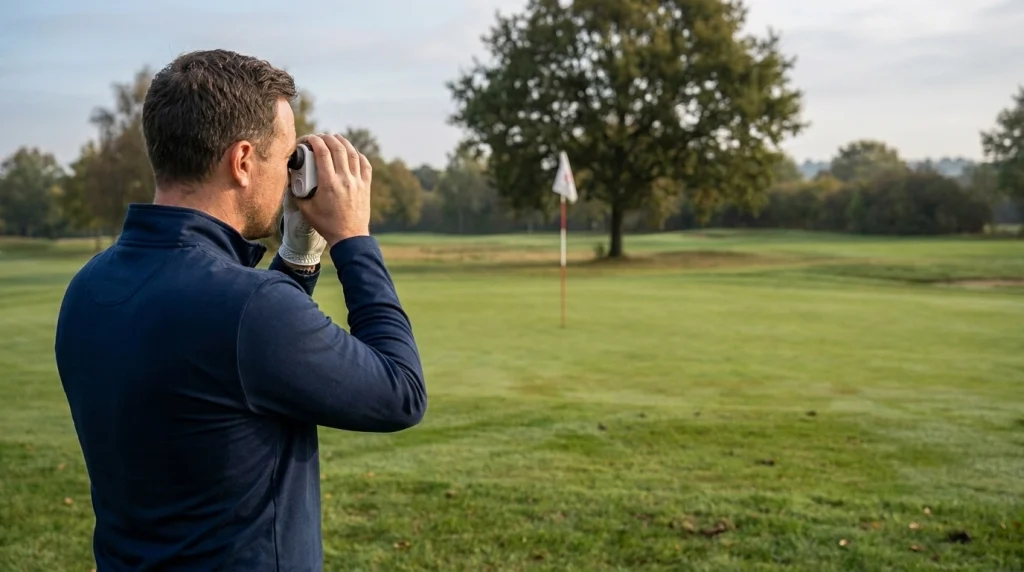
A good golf rangefinder can deliver precise distance readings when you aim correctly and the target is easy to identify. However, a manufacturer’s accuracy specification doesn’t guarantee every reading will be equally reliable on a windy, wet, or visually cluttered hole.
What does accuracy mean for a golfer?
Golf rangefinder accuracy describes how closely a measured distance matches the true distance to the intended target. Precision describes how consistently the device repeats that measurement under similar conditions.
Those two qualities are related, but they’re not identical. A device can repeatedly display the same incorrect target distance if it locks onto the wrong object.
For example, imagine the flag is 145 yards away and a tree behind the green is 162 yards away. A stable reading of 162 yards can be perfectly consistent while still being useless for selecting your approach club.
How much difference matters on the course?
A small measurement difference doesn’t automatically cause a poor shot. Club selection, strike quality, wind, lie, and landing position all influence where the ball finishes.
Still, distance errors become more consequential when you’re approaching a tight green or carrying a hazard. Knowing whether your target is 145 or 162 yards can change your club choice and intended trajectory.
Use this practical distinction when assessing a device:
- Measurement reliability: Does it repeatedly return a similar distance to the same target?
- Target reliability: Does it identify the flag or feature you intended to measure?
- Playing relevance: Does the number help you choose a sensible shot after accounting for conditions?
These are separate questions. A useful rangefinder needs to perform well on the first two, while the golfer remains responsible for the third.
Should you trust every displayed number?
No device should be treated as infallible. If a reading differs noticeably from a known yardage marker or your usual measurements, repeat the shot and confirm the target before choosing a club.
For a first-time buyer, consistency and ease of aiming often matter more than an impressive maximum range printed on the packaging.
What does a golf rangefinder actually measure?
A golf rangefinder measures the distance between the device and a selected target, or estimates distances to mapped course locations, depending on its technology. It doesn’t automatically calculate every factor that determines how far your golf ball will travel.
How does a laser rangefinder measure distance?
A laser rangefinder sends a pulse of light toward a target and uses the returning signal to calculate the distance. Because light travels at a known speed, the device can determine how far away the target sits.
The reading depends on which object the device detects. A flagstick, bunker edge, tree, and distant building can all produce different distances from the same position.
Many golf models include optical magnification and a flag-locking feature. Some also use vibration or visual signals to confirm that the device has acquired a likely flag target.
What is the difference between measured distance and playing distance?
Measured distance is the physical distance to the target, while playing distance describes how far a shot effectively plays after relevant conditions are considered. An uphill approach can play longer than its measured yardage, while a downhill shot can play shorter.
Consider a hypothetical 150-yard approach to an elevated green. Your laser may report 150 yards, but you might need to select a club that carries farther than 150 yards to reach the intended landing area.
That adjustment comes from your understanding of the elevation and conditions, not necessarily from the basic laser measurement itself. Slope-enabled models can estimate elevation-adjusted yardage, but that figure remains an aid rather than a guarantee of the result.
What do GPS rangefinders measure?
GPS golf devices estimate your position and use digital course maps to calculate distances to mapped features. Depending on the model, they may show the front, center, and back of the green, along with hazards and layup points.
Unlike a laser, GPS doesn’t require a direct line of sight to the flag. However, the usefulness of its readings depends on positioning quality and how accurately the course features appear on the map.
For a deeper explanation of course features and target selection, see this guide to understanding golf hole layouts.
What affects golf rangefinder accuracy on the course?
Target visibility, aiming stability, environmental conditions, and device quality all influence how reliably a rangefinder provides a useful number. The biggest practical problem isn’t always a faulty measurement; it can be measuring the wrong object or misinterpreting the result.
1. Target size and background clutter
A flagstick presents a much smaller target than a broad tree or bunker face. When trees sit directly behind the flag, a device may detect the background instead of the pin.
Flag-locking technology can help, but it doesn’t remove every targeting challenge. Confirm the displayed distance and any lock indicator before trusting an unexpected reading.
2. Hand movement and aiming technique
Small movements through the eyepiece can make it harder to keep a laser aligned with a narrow flagstick. This becomes more noticeable when you’re ranging distant targets or using a device with limited optical clarity.
Brace your elbows against your body, hold the unit with both hands if comfortable, and aim at a stable part of the flagstick. If the reading seems inconsistent, take another measurement rather than guessing.
3. Rain, fog, glare, and changing light
Weather and visibility can affect how easily a laser acquires its target. Fog, heavy rain, glare, and low-contrast backgrounds can make a flag harder to identify, even when the electronics continue to function.
GPS has a different set of limitations. Tree cover, difficult satellite reception, and positioning errors may affect the device’s location estimate, while outdated course maps can produce incorrect distances to specific features.
4. Elevation, wind, and turf conditions
Elevation changes affect how a shot plays, but a basic line-of-sight reading doesn’t explain that difference. Wind direction, wind strength, temperature, lie quality, and green firmness also influence the shot you should attempt.
For example, a 170-yard shot into a strong headwind may require more club than a calm 170-yard shot. The laser can measure the target accurately without accounting for that wind.
Always distinguish between a precise distance measurement and a precise prediction of ball flight. The second requires more information and sound course judgment.
5. Lens condition, battery, and device quality
A dirty lens can reduce viewing clarity, while a low battery may cause operational problems depending on the model. Damaged optics, loose components, or an aging device can also undermine confidence in the results.
- Clean the lens using a suitable microfiber cloth.
- Check the battery level before starting your round.
- Inspect the housing and buttons for damage.
- Confirm the correct measurement units and mode.
- Keep the device protected from moisture beyond its rated resistance.
**Section takeaway:** A reliable reading depends on more than the device’s advertised specification. Target selection, visibility, and correct interpretation are just as important.
Are laser rangefinders more accurate than GPS?
Laser and GPS rangefinders solve slightly different problems, so neither technology wins in every situation. A laser is useful for measuring a visible target directly, while GPS provides convenient distances to mapped features without requiring you to aim at each one.
The right choice depends on whether you prioritize direct flag measurements, broad course information, or a combination of both.
| Comparison | Laser rangefinder | GPS golf device |
|---|---|---|
| How it measures | Laser distance to a selected target | Positioning plus mapped course data |
| Flag measurement | Direct, when the flag is visible and acquired | Depends on available mapped green data |
| Hidden hazards | Limited without line of sight | Useful when hazards are mapped |
| Main accuracy concern | Target acquisition and aiming | Positioning and map quality |
| Weather and visibility | Poor visibility can hinder targeting | Can work without seeing the flag |
| Best use | Exact distances to visible targets | Quick green and course-feature distances |
When should you choose a laser?
A laser rangefinder is a strong choice if you regularly want the distance to the flag, a bunker lip, a tree, or another visible landmark. It can be especially useful on unfamiliar courses where you need a specific distance rather than a general yardage to the green.
Its main trade-off is the need to aim carefully. A distant or obscured flag can take longer to acquire than a large, easy-to-see target.
When is GPS the better option?
GPS can be more convenient when you want front, middle, and back green distances quickly. It also helps you estimate distances to mapped hazards and landing areas without pointing a device at them.
Before relying on GPS at a new course, check whether the course map is available and current. If a particular hazard or green feature isn’t mapped correctly, the displayed distance may not match the course as it exists today.
Is a hybrid rangefinder worth considering?
A hybrid device combines laser measurements with GPS course information. It can offer the convenience of mapped yardages alongside direct measurements to the flag or other visible targets.
For golfers who regularly play different courses, that combination can be practical. It also introduces more features to manage, so simpler equipment may be preferable if you mainly want quick flag distances.
For an overview of the trade-offs, read this guide to choosing useful golf accessories.
**Section takeaway:** Choose laser for direct target measurements, GPS for mapped course information, or a hybrid if you regularly need both. Check the specific model’s specifications rather than assuming all devices have the same precision.
How can you test your golf rangefinder’s accuracy?
You can check a rangefinder’s consistency using a known distance, repeated readings, and a comparison with another reliable measuring method. A simple test won’t establish laboratory-grade accuracy, but it can reveal obvious targeting problems or inconsistent results.
Step 1: Find a suitable reference distance
Choose a safe, stable target at a distance you can verify independently. A measured practice area or a clearly documented distance between fixed points is more useful than an approximate estimate based on visual judgment.
Course markers can help, but confirm what they represent. A marker may indicate distance to the center of the green rather than the flag’s current location.
Step 2: Take repeated readings
Stand in the same location and measure the same target several times. Keep your stance steady, aim at the same point, and record the results instead of relying on memory.
- Check whether the readings cluster closely together.
- Repeat the test on a second target with good visibility.
- Try a more distant target if it can be measured safely and independently.
- Note any difficulty locking onto the intended object.
If readings vary, first check your aiming technique and target selection. Only then consider whether the device itself may have a problem.
Step 3: Compare with an independent measurement
Compare the laser’s results with a verified distance or a suitable GPS device, accounting for the fact that both methods have different sources of error. The comparison is meaningful only if both devices measure the same endpoints.
For instance, a laser reading to the flag cannot be compared fairly with a GPS reading to the center of the green. The two devices may both be functioning correctly while displaying different distances.
Step 4: Repeat in different conditions
Test again in bright light and overcast conditions, if possible. You can also compare readings on open targets and targets surrounded by trees to assess how easily the device acquires what you intend to measure.
Don’t deliberately expose the device to heavy rain or other conditions outside its rated limits. A practical test should check normal use, not risk damaging the equipment.
What if your rangefinder disagrees with course markers?
First, confirm that you’re comparing distances to the same location. Tee markers and sprinkler heads may use different reference points, and the flag’s position changes from day to day.
If the difference remains unexplained, check the device manual, battery, lens, and measurement mode. If repeated tests against a trustworthy reference still show a consistent discrepancy, contact the manufacturer or consider professional assessment.
**Section takeaway:** Test consistency and target acquisition separately, then compare against a verified reference. Don’t label a device inaccurate until you have ruled out mismatched targets and measurement points.
How can you get more reliable readings during a round?
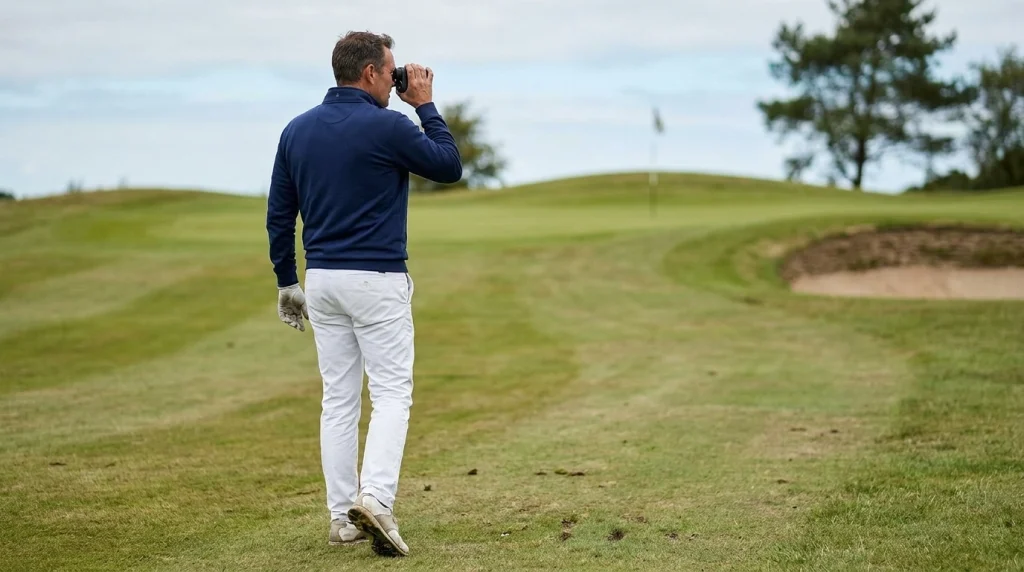
The best way to improve rangefinder reliability is to make each measurement deliberate and repeatable. A few seconds spent confirming the target can prevent a poor club choice based on a misleading number.
Use a consistent aiming routine
- Stand where you intend to play the shot.
- Identify the exact target before raising the device.
- Hold the rangefinder steadily and aim at the flagstick or feature.
- Wait for the measurement or target-lock signal.
- Repeat the reading if it seems unusual.
Consistency matters more than rushing. Once the routine becomes familiar, checking a distance should take very little extra time.
Measure the right target, not just the flag
The flag isn’t always the best target for every shot. When a bunker guards the green or a fairway narrows near your landing area, measuring the hazard or a safe landing point can provide more useful information.
Think about where you want the ball to finish before choosing which distance to measure. A precise flag reading doesn’t automatically make an aggressive target the smartest play.
Account for slope and shot conditions
Use the measured yardage as your starting point, then consider elevation, wind, lie, temperature, and your own carry distances. Your normal carry distance is the distance the ball travels through the air, which is different from total distance after it rolls.
A ball sitting in thick rough may not launch or spin like one sitting on a clean fairway lie. A good distance measurement cannot compensate for those differences.
Check settings before competition
Under Rule 4.3a, the Rules of Golf generally allow distance-measuring devices unless a Committee adopts a local rule prohibiting them. However, using a device to measure elevation changes or access prohibited playing recommendations can breach the rules.
Check the current guidance from the USGA’s distance-measuring device FAQs and The R&A’s Rule 4 guidance before competitive play. Your event’s committee and local rules determine what you may use.
For more on how rangefinders fit into competitive golf, the PGA TOUR website provides additional golf news and tournament coverage.
**Section takeaway:** Build a repeatable aiming routine, verify unusual numbers, and account for playing conditions separately. Reliable yardage is one input into a good decision, not a promise of a perfect shot.
Golf rangefinder accuracy FAQs
Are golf rangefinders accurate to within one yard?
Some models advertise accuracy within approximately one yard under specified conditions, but that figure isn’t universal. Real-world performance depends on the model, target, visibility, and correct aiming, so check the manufacturer’s published specifications and verify readings against a reliable reference.
Can a golf rangefinder give the wrong distance?
Yes. A laser can lock onto a tree behind the flag, while GPS can provide an inaccurate distance if the device’s position or course map is incorrect. Repeating the measurement and confirming the target can help identify the source of the discrepancy.
Does rain affect golf rangefinder accuracy?
Rain and fog can make it harder for a laser to acquire a clear target, particularly when the flag is distant or difficult to distinguish. GPS devices don’t need a visible flag, but they still depend on positioning quality, map accuracy, and the device’s operating limits.
Is GPS more accurate than a laser rangefinder?
Neither technology is automatically more accurate in every situation. A laser measures a visible target directly, while GPS estimates distances using mapped course features and positioning data. The better choice depends on the target you need to measure and the conditions on the course.
Does slope compensation improve rangefinder accuracy?
Slope compensation estimates how a change in elevation affects playing distance. It can help with club selection on uphill and downhill shots, but it doesn’t change the basic line-of-sight distance into a guarantee of ball-flight results. Check competition rules before using slope features.
How often should I check my rangefinder’s accuracy?
Check it when you first buy it, after a significant impact, or whenever readings become inconsistent. You don’t need to perform a full test before every round, but keeping the lens clean, monitoring the battery, and confirming unusual readings are sensible habits.
Can an expensive rangefinder measure distances more accurately?
Higher-priced models may offer better optics, faster target acquisition, stronger flag-lock feedback, or added GPS features. Price alone doesn’t guarantee better measurement accuracy, however, so compare published specifications, usability, warranty coverage, and the features you will genuinely use.
Final takeaway: trust the measurement, then use your judgment
Golf rangefinders can provide dependable distances in real conditions when you select the right target and use the device correctly. Laser models are especially useful for visible targets, while GPS devices make mapped course distances easier to access.
Before buying, focus on reliable target acquisition, clear optics, comfortable handling, and performance that suits the courses you play. Features such as slope compensation or GPS mapping are worthwhile only when they solve a real problem for your game.
Want to improve your course decisions? Start by learning your typical carry distances, checking unusual yardages, and choosing sensible landing targets rather than aiming at the flag automatically.
A rangefinder gives you better information. Your course management turns that information into better decisions.