
Golf Slice Explained: Causes, Ball Flight, and Simple Fixes

Quick Answer
A golf slice is a shot that curves sharply away from the golfer’s dominant side. For a right-handed golfer, it bends right because the clubface is open relative to the swing path at impact. Improving your grip, clubface control, alignment, and swing path can reduce it. A qualified instructor from the PGA of America can confirm the exact cause.
Common Signs and Causes
- Open clubface: The face points right of the swing path at impact for a right-handed golfer.
- Out-to-in path: The club travels across the target line instead of approaching from inside it.
- Weak grip: The hand position can make closing the clubface harder.
- Poor alignment: Aiming farther left often makes the cutting motion worse.
- Heel contact: Driver strikes near the heel can add more slice spin.
How to Confirm It
- Use foot spray on the clubface and record your swing from behind the target line.
A slice can turn a promising tee shot into a search through trees. I’ve found that the fastest improvement comes from understanding the ball flight before changing the swing.
This guide explains what a slice is, why it happens, and which fixes are worth testing first. It also covers equipment, practice drills, and on-course adjustments.
In This Guide
What Is a Slice in Golf?

A golf slice is a shot that curves too far from left to right for a right-handed golfer. A left-handed golfer’s slice curves from right to left.
The curve comes from the relationship between the clubface and swing path at impact. The clubface points away from the path, which tilts the ball’s spin axis.
Definition: The swing path is the direction the clubhead travels through impact. The clubface angle is the direction the face points at that moment.
What does a slice look like?
A typical slice may begin near the target before bending hard to one side. Some sliced shots start left and then curve right.
Common signs include:
- A large sideways curve during flight
- Lost distance with the driver
- A high, weak ball flight
- Frequent contact near the driver’s heel
- Divots pointing left of the target for right-handed golfers
A slice isn’t defined by where the ball finishes alone. Its starting direction and curve reveal what happened at impact.
Why does a slice lose distance?
A slicing clubface often adds unwanted loft. It can also produce excess spin and a glancing strike.
That combination sends energy across the ball instead of through it. The shot may climb quickly, drift sideways, and land with little roll.
Wind makes the problem more obvious. A left-to-right wind can push a right-handed golfer’s slice even farther offline.
Section Takeaway: A slice results from an open clubface relative to the swing path. Watch both the starting line and curve when diagnosing it.
What Is the Difference Between a Slice, Fade, Push, and Hook?
A slice and fade curve in the same direction, but they differ in size and control. A push flies right without the same strong curve.
These descriptions assume a right-handed golfer. Reverse the directions for a left-handed player.
| Shot Shape | Typical Start | Curve | Usual Impact Pattern |
|---|---|---|---|
| Slice | Left, straight, or right | Strong curve right | Face open to path |
| Fade | Slightly left | Small curve right | Face slightly open to path |
| Push | Right | Little curve | Face and path both right |
| Pull | Left | Little curve | Face and path both left |
| Hook | Left, straight, or right | Strong curve left | Face closed to path |
A controlled fade can be useful because its curve is predictable. A slice becomes a problem when the curve is large, weak, or difficult to repeat.
The starting line also matters. The clubface has the strongest influence on where the ball begins, while face-to-path difference shapes its curve.
Why Do Golfers Slice the Ball?
Most slices come from an open clubface, an out-to-in path, or both. Grip, alignment, body movement, and strike location can create those conditions.
1. The clubface stays open
An open clubface is the central ingredient in a slice. If it remains open relative to the path, the ball curves toward the golfer’s trail side.
A weak grip, cupped lead wrist, or poor release can leave the face open. Trying to lift the ball can do the same.
2. The swing path moves from outside to inside
An out-to-in swing cuts across the target line. Golfers often call this “coming over the top.”
The shoulders may start the downswing too quickly. The club then moves outward before traveling left through impact for a right-handed player.
3. The grip makes face control difficult
A grip placed too much in the palms can limit wrist movement. A weak lead-hand position may also encourage an open face.
Don’t rotate both hands sharply to the right as a permanent repair. That can replace the slice with a hook.
4. Aiming left makes the path worse
Many right-handed slicers aim farther left to avoid trouble on the right. This can pull the shoulders open and promote a steeper cutting path.
The ball may start farther left, but it can still curve right. I prefer using an alignment stick before changing my aim.
5. The ball position is too far forward
A driver is normally played forward in the stance. However, placing it beyond the lead heel can make contact occur after the club starts moving left.
An extreme forward position may also leave the face open. Move the ball only in small steps while testing.
6. Heel contact adds more curve
Driver strikes near the heel can create extra fade or slice movement through gear effect. Even a reasonable swing may produce a poor result.
Strike location should therefore be checked before rebuilding the swing. Foot spray provides a quick, low-cost test.
Section Takeaway: Don’t assume every slice has one cause. Check clubface control, path, setup, and strike location before choosing a fix.


How Do You Diagnose Your Slice?
Start with evidence from the ball and clubface. Avoid making several swing changes based on one bad shot.
Read the starting direction
Watch where the ball begins compared with your target. Then note how strongly it curves.
- Starts left, curves right: The path may travel left while the face remains open to it.
- Starts straight, curves right: The face may point near the target but remain open to the path.
- Starts right, curves farther right: The clubface may be open to both the target and path.
Check the strike pattern
Apply a light coat of foot spray to the driver face. Hit five balls and inspect the marks.
Repeated heel contact needs attention. Stand a little farther away or test a slower swing before changing mechanics.
Record two camera angles
Place a phone behind your hands on the target line. A second face-on recording can show ball position and body movement.
Record normal swings rather than staged slow motions. Compare several shots because one swing can mislead you.
Use a simple diagnosis order
- Confirm your target and alignment.
- Note the ball’s starting direction.
- Watch the amount of curve.
- Inspect the clubface strike.
- Review the grip and ball position.
- Check the swing path on video.
The USGA publishes equipment standards and other guidance about the game. Equipment that meets the rules can still produce different results because of fit and impact delivery.
Pro tip: Ask a certified instructor to review your grip and impact pattern if pain or repeated compensations affect your swing.
How Do You Fix a Golf Slice?
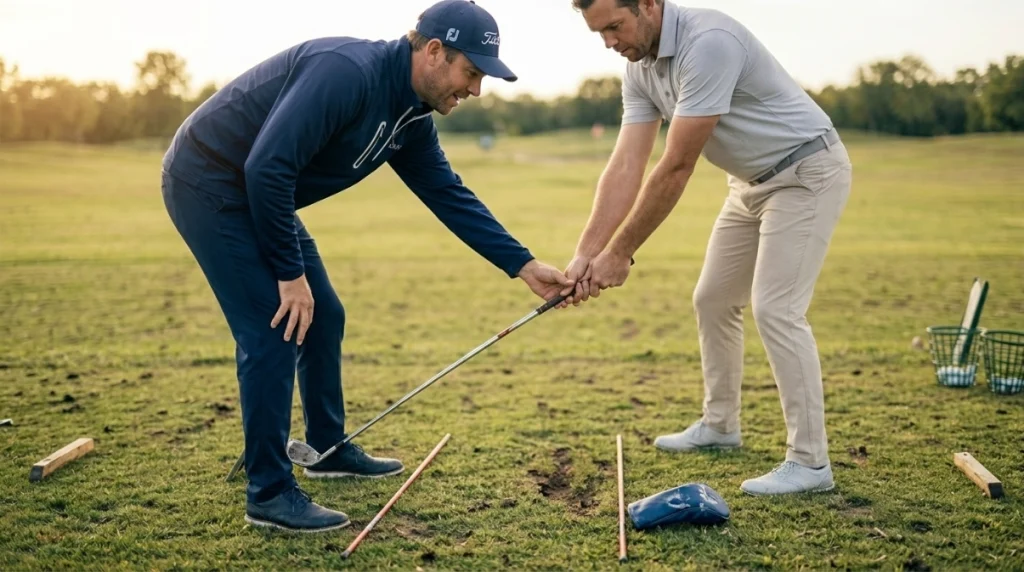
Fix the clubface before making a large swing-path change. A better path won’t produce straight shots if the face remains wide open.
Step 1: Build a neutral grip
Place the grip more through the fingers than the palms. Let the hands sit together without squeezing tightly.
For many right-handed golfers, seeing about two lead-hand knuckles provides a useful starting point. Hand shape varies, so treat that as a checkpoint.
Step 2: Square the setup
Lay one alignment stick along the target line. Place another parallel to it near your toes.
Set the clubface first. Then align your feet, knees, hips, and shoulders without forcing them left.
Step 3: Practice closing the face
Make waist-high swings with a short iron. Feel the lead wrist stay flatter as the club approaches impact.
Begin at half speed. Your goal is solid contact and a straighter start, not maximum distance.
Step 4: Improve the swing path
Place a headcover outside and slightly behind the ball. Swing without touching it.
This gives the club space to approach from inside the target line. Move the object farther away if it changes your motion too sharply.
Step 5: Use the split-hand drill
Separate your hands by about two inches on the grip. Make small swings and feel the trail hand help the clubface turn.
Return to a normal grip after several repetitions. The drill should create awareness, not become your full swing.
Step 6: Progress from short to long clubs
A driver magnifies face and strike problems. Start with a wedge or short iron before adding speed.
- Hit 10 half-swings with a wedge.
- Hit 10 smooth shots with a 7-iron.
- Hit five shots with a hybrid.
- Finish with five drivers at controlled speed.
Change only one variable during each group. That makes the results easier to understand.
The PGA’s verified slice coaching tips also warn against simply aiming farther left. Better aim cannot correct a poor face-to-path relationship.
Pro tip: A PGA professional can measure face angle, path, strike, and launch data during one session.
Section Takeaway: Start with grip and clubface control. Add alignment, path, and speed only after the ball begins on a more useful line.
Can Golf Equipment Help Reduce a Slice?
Equipment can reduce the effect of a slice, but it cannot fully repair poor impact. A suitable driver may make the miss smaller and more playable.
Higher loft
More driver loft can improve launch for some golfers. However, adding loft through an adjustable hosel may also change the face presentation.
Test settings with a launch monitor when possible. Don’t assume the highest setting will automatically fly straight.
Draw-biased weighting
A draw-biased driver places more weight toward the heel. This design can help some golfers close the face and reduce rightward curve.
Major brands such as Ping, Callaway, TaylorMade, Cobra, Titleist, Mizuno, and Srixon offer forgiving options. Model names and adjustment systems change, so compare current specifications.
Shaft length and flex
A shorter driver can improve center contact and face control. Cutting a shaft changes swing weight, so consult a fitter first.
Shaft flex describes how much the shaft bends during the swing. Flex labels aren’t standardized across every manufacturer.
Golf ball choice
A different golf ball may change launch and total spin. It won’t remove the tilted spin axis created by an open face.
Choose a ball for your complete game, including approach shots and putting. The R&A provides information about golf’s rules and equipment standards.
When should you get fitted?
Consider a fitting if contact varies across the face or your driver feels difficult to control. Bring your normal swing and current club.
A fitter can compare:
- Clubhead speed
- Ball speed
- Launch angle
- Spin rate
- Face angle and swing path
- Strike location
- Shaft length and flex
Pro tip: Use a certified club fitter for changes involving shaft length, head weight, or adjustable settings.
Section Takeaway: Forgiving, draw-biased equipment may limit a slice. Lasting improvement still depends on face control and centered contact.
Frequently Asked Questions
Does a strong grip fix a slice?
A slightly stronger grip may help the clubface close, but it isn’t a guaranteed cure. Excessive hand rotation can create hooks or poor contact. Check the ball flight after each small grip adjustment.
Why do I slice only my driver?
The driver has less loft and a longer shaft than most clubs. Those features can magnify face-angle errors and off-center contact. Tee height, ball position, and heel strikes may also contribute.
Can standing too close to the ball cause a slice?
Yes. Standing too close can restrict the hands and encourage heel contact or an outside path. However, standing too far away can create other problems. Check posture and strike marks before moving.
Can a slice be caused by swinging too hard?
Extra speed can disrupt balance, sequence, and clubface control. Test several swings at about 70 percent effort. If the curve shrinks, rebuild speed gradually while keeping the same contact.
Should I aim left when I slice?
Aiming left may offer a temporary on-course allowance, but it can deepen an out-to-in path. Use it only as a short-term strategy when necessary. Work toward a square setup during practice.
How long does it take to fix a golf slice?
The timeline depends on the cause and practice quality. A setup error may improve in one session. A long-standing path or face-control issue can require several weeks of focused practice.
Is a slice caused by sidespin?
Golf balls don’t carry a separate kind of pure sidespin. The club’s impact conditions tilt the spin axis, causing the flight to curve. A larger tilt generally produces more sideways movement.
Build a Straighter Ball Flight
A slice becomes easier to fix once you stop treating it as one mystery move. The starting line, curve, and strike pattern provide useful clues.
Begin with the clubface and grip. Then check alignment, swing path, contact, and equipment in that order.
Use slow swings and change one factor at a time. If the pattern remains unclear, a lesson or fitting can save hours of guessing.
Your next practice session has one goal: collect evidence before changing your swing.