
Common Grip Mistakes: 8 Golf Grip Errors and How to Fix Them

Quick Answer
The most common grip mistakes are squeezing too hard, holding the club too much in the palms, rotating either hand too far, separating the hands, and changing your grip between shots. A sound golf grip should feel secure without making your hands, wrists, and forearms stiff. The PGA of America’s grip guidance also stresses hand position, pressure, and proper grip size.
Common grip mistakes to check first
- Too much pressure: Tight hands can restrict wrist movement and add tension to your swing.
- Grip in the palms: This can make natural wrist hinging harder.
- Hands too strong: Excessive hand rotation can encourage a closed clubface for some golfers.
- Hands too weak: Too much rotation toward the target can make face control difficult.
- Poor hand connection: Gaps between the hands can make them work independently.
- Inconsistent setup: Rebuilding the grip differently on every shot creates another moving part.
Quick verification
- Grip the club, make a small waggle, and check whether your wrists and forearms still feel free.
- Then rebuild the grip and see whether your hands return to the same position without forcing them.
A golf swing can become complicated fast, but the hands give me one of the simplest places to start. When contact or direction suddenly gets worse, I like to check the grip before changing the swing itself.
That matters because your hands are your connection to the club. Small grip errors can change how freely your wrists move and how easily you control the clubface.
In This Guide
What Are the Most Common Grip Mistakes in Golf?
The biggest grip mistakes usually involve pressure, placement, rotation, or consistency. They often create compensations before the club has moved very far.
Definition: A golf grip is both the handle material on the shaft and the way a golfer positions the hands around that handle. In swing instruction, “your grip” usually means the position, connection, and pressure of your hands.
I like to separate grip problems from swing problems whenever possible. If the club starts in your hands poorly, changing your backswing may only hide the original issue.
- Squeezing too hard: Creates excess tension in the hands and forearms.
- Holding the club in the palms: Can restrict wrist mobility.
- Turning the lead hand too far: Changes the relationship between your hands and clubface.
- Misplacing the trail hand: Can cause one hand to dominate the other.
- Leaving a gap between the hands: Makes it harder for them to act as one unit.
- Using the wrong grip size: Can make a comfortable, repeatable hold harder to find.
- Changing the grip every swing: Makes consistent clubface control harder.
- Ignoring worn grips: Encourages extra pressure when the handle feels slick.
The USGA Equipment Rules describe a club grip as material intended to help a player obtain a firm hold and prevent slipping or twisting. That basic purpose is worth remembering.
You need enough control to keep the club secure. You do not need to squeeze it as though someone is trying to pull it away.
Section Takeaway: Most grip problems start with excess tension, poor hand placement, or an inconsistent setup. Check those basics before rebuilding your golf swing.
Are You Holding the Golf Club Too Tightly?

Many golfers grip the club harder than they think. Extra pressure can spread from the fingers into the forearms, elbows, and shoulders.
I notice this most when a golfer is worried about direction. The instinct is to control the club harder, but the extra tension can make the motion feel less natural.
How tight should your golf grip be?
There is no perfect pressure number for every golfer. A useful practice method is to create your own 1-to-10 scale.
- Grip the club as tightly as you comfortably can and call that a 10.
- Loosen your hands until the club is almost too loose and call that a 1.
- Move toward the middle until the club feels secure but your forearms stay soft.
- Make a small waggle and notice whether the clubhead moves freely.
- Hit several half shots while keeping that same pressure.
A 2026 PGA of America coaching article uses a similar pressure drill and suggests settling around 4 on a 1-to-10 practice scale. Treat that number as a training reference rather than a law.
Signs that you may be squeezing too hard
- Your forearms feel rigid before the takeaway.
- Your shoulders rise as you address the ball.
- Your waggle looks short or stiff.
- You feel tiredness in your hands after a short range session.
- You struggle to sense the weight of the clubhead.
- Your pressure increases when you try to swing harder.
One test I like is simple. Take your normal grip, relax it slightly, and see whether your wrists suddenly feel easier to move.
If they do, tension may have been part of the problem. Keep enough pressure to control the club throughout the swing.
Pro tip: If changing grip pressure causes pain, numbness, or major swing changes, work with a qualified PGA or LPGA professional rather than forcing a position.
Section Takeaway: Your grip should feel secure, not rigid. A small reduction in pressure can often make the wrists and arms move more freely.
Are You Holding the Club Too Much in Your Palms?
For many full-swing grips, placing too much of the handle through the palms makes wrist hinging harder. The fingers usually provide a more functional place to support the club.
This mistake is easy to miss because a palm-heavy grip can feel secure. Secure does not always mean efficient.
Where should the club sit in the lead hand?
The exact position varies with hand shape and grip style. In general, the handle should run more through the fingers than straight across the center of the palm.
Your lead-hand heel pad should help support the club. You should still be able to hinge the wrist without feeling locked.
What about the trail hand?
The trail hand should also connect through the fingers rather than being slapped flat over the handle. Its palm can then settle over the lead-hand thumb.
This helps the two hands work together. It also reduces the temptation to control the swing with the trail palm alone.
Golf Digest’s three-step grip checklist specifically recommends placing the trail-hand grip in the fingers and checking whether the lead wrist can hinge naturally.
| Grip Check | Common Mistake | Better Check |
|---|---|---|
| Lead hand | Handle sits deep across the palm | Support the handle with the fingers and heel pad |
| Trail hand | Palm dominates the handle | Let the fingers support the grip first |
| Wrist motion | Hinge feels restricted | Reposition the handle and retest mobility |
| Grip pressure | Club feels secure only when squeezed | Aim for control with softer forearms |
My favorite check does not require hitting a ball. Build your grip, raise the club slightly, and make a gentle wrist hinge.
If the clubface twists dramatically or the wrist feels blocked, rebuild your grip. Make one adjustment at a time.
Section Takeaway: A palm-heavy grip can feel safe while limiting wrist freedom. Let the fingers support more of the handle and test your wrist mobility.

Is Your Golf Grip Too Strong or Too Weak?
A “strong” or “weak” grip describes hand rotation, not how tightly you hold the club. That distinction causes a lot of confusion for newer golfers.
For a right-handed golfer, a stronger lead-hand position generally means the hand is rotated farther clockwise around the handle. A weaker position means it is rotated more toward the target.
Why does grip rotation matter?
Your hand position influences how your wrists move and how the clubface behaves during the swing. Too much rotation in either direction can force you to make compensations.
A strong grip does not automatically cause a hook. A weak grip does not automatically cause a slice.
Your swing path, wrist conditions, strike location, and clubface angle also matter. That is why I avoid trying to diagnose ball flight from grip position alone.
| Grip Position | What It Means | Possible Issue |
|---|---|---|
| Too strong for your swing | Hands are rotated farther away from the target | You may struggle to keep the face from closing |
| More neutral | Hands sit between the two extremes | Often a useful starting point for testing |
| Too weak for your swing | Hands are rotated farther toward the target | You may struggle to square the face naturally |
Do you need a perfectly neutral grip?
No. Golfers have different arm structures, hand shapes, wrist movements, and swing patterns.
The goal is a repeatable grip that supports your impact pattern. Copying another golfer’s exact hand position can create a new problem.
I prefer gradual changes. Rotate a hand only a small amount, hit several controlled shots, and watch both starting direction and curve.
Pro tip: If you are making a major strong-to-weak or weak-to-strong grip change, have a certified instructor check your clubface and swing path at the same time.
Section Takeaway: Strong and weak describe hand rotation, not pressure. Your best grip is the position that lets you control the clubface without constant compensation.
Are Your Hands Connected Correctly on the Club?
Your hands should feel like a pair rather than two separate controls. A poor connection often makes one hand dominate the swing.
You can connect the hands with an overlapping, interlocking, or ten-finger grip. None is automatically correct for every golfer.
Overlap grip
In an overlap grip, the trail-hand little finger rests over the area between the lead-hand index and middle fingers. Many golfers find this connection comfortable.
Interlocking grip
With an interlock, the trail little finger and lead index finger link together. Some golfers prefer it because the hands can feel closely connected.
Ten-finger grip
In a ten-finger grip, all fingers contact the handle. It can be comfortable for beginners, juniors, or golfers who simply prefer that feel.
The mistake is not choosing the “wrong” style from those three. The bigger problem is leaving the hands disconnected or forcing a connection that creates tension.
Check your trail-hand position
A trail hand placed too far underneath or on top of the handle can change how the clubface behaves. It can also make that hand feel too active.
Build the lead hand first. Then add the trail hand without twisting the club or disturbing the original position.
- Check that both hands feel connected.
- Keep the trail palm from separating from the lead-hand thumb area.
- Make sure neither thumb is squeezing excessively.
- Check that the wrists can still move.
- Rebuild the grip instead of adjusting it during the backswing.
Grip size also matters here. A handle that feels unusually thick or thin may make a natural connection harder to maintain.
That does not mean every golfer needs a standard grip. Hand size, preference, and swing pattern all influence grip fitting.
Section Takeaway: Overlap, interlock, and ten-finger grips can all work. What matters most is creating a comfortable connection that lets both hands function together.
How Can You Fix Common Golf Grip Mistakes?
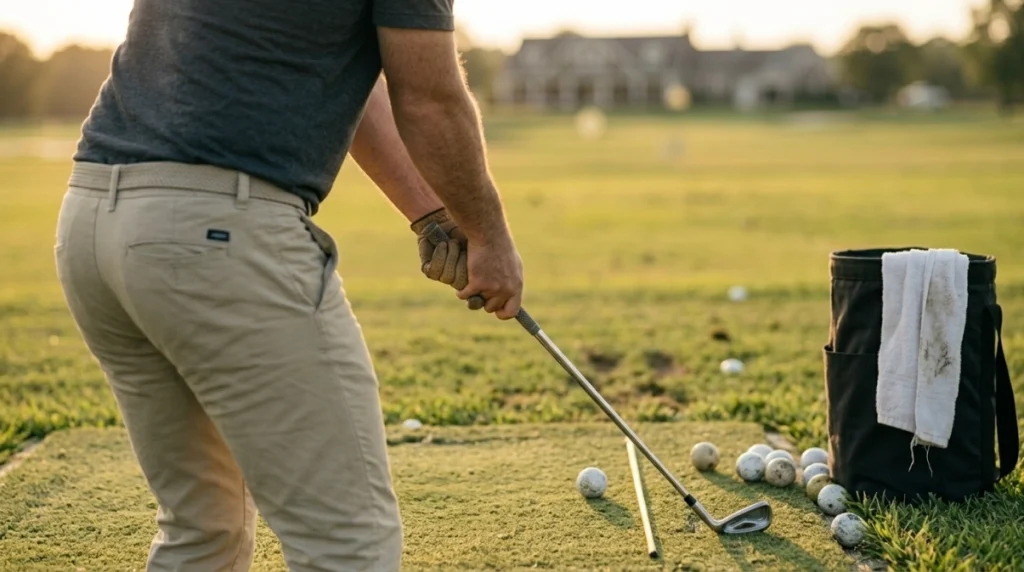
Fix your grip before worrying about full-speed swings. Slow practice makes it easier to notice pressure, placement, and hand rotation.
I would rather hit ten careful half shots with a repeatable grip than fifty full swings with a different grip each time.
Use this grip reset routine
- Set the clubface first. Aim the face where you intend before placing your hands.
- Add the lead hand. Let the fingers and heel pad support the handle.
- Check wrist movement. Make sure the lead wrist can hinge without feeling trapped.
- Add the trail hand. Connect it without changing the lead-hand position.
- Reduce excess pressure. Keep the club secure while relaxing the forearms.
- Make a small waggle. Look for free movement rather than stiffness.
- Hit a half shot. Focus on contact and starting direction.
- Rebuild from scratch. Do not simply shuffle your fingers between balls.
Do not change everything at once
If your grip has been in the same position for years, a good change may initially feel strange. Strange does not automatically mean wrong.
Change one variable first. I usually start with either pressure or lead-hand placement.
Check the condition of your actual club grips
A technically good hand position cannot solve a slick, hardened, or badly worn handle. Old grips may encourage you to squeeze harder simply to keep control.
Clean your grips according to the manufacturer’s directions and inspect them for wear. Replace them when they no longer provide dependable traction.
Make sure your equipment remains conforming
Standard golf grips have equipment requirements under the Rules of Golf. The R&A and USGA jointly govern equipment standards used in the game.
This usually is not an issue with ordinary retail grips. It matters more when unusual modifications, molded training features, or nonstandard equipment enter the picture.
Give the change enough practice
Grip changes can affect the clubface immediately. That means your old swing compensations may no longer produce the same result.
Start with short shots, then move to mid-irons. Add the driver after the new position becomes easier to repeat.
Pro tip: A PGA or LPGA professional can see whether the grip is the cause of your miss or merely one part of a larger clubface and swing-path pattern.
Section Takeaway: Rebuild the grip slowly, change one variable at a time, and test with controlled shots. Consistency matters more than forcing your hands into a textbook picture.
Frequently Asked Questions About Common Grip Mistakes
What is the biggest golf grip mistake?
One of the most common mistakes is gripping the club with too much tension. Excess pressure can stiffen the hands and forearms, making it harder to move the wrists freely and sense the clubhead during the swing.
Can a bad golf grip cause a slice?
A grip can contribute to a slice if it makes controlling the clubface harder, but it is not the only cause. Swing path, face angle, strike location, and wrist movement can also affect a sliced shot.
Can gripping the club too tightly cause poor contact?
It can contribute to poor contact because excessive tension may change how your arms and wrists move. However, fat, thin, heel, and toe strikes can have several causes, so grip pressure should be checked alongside setup and swing motion.
Should a golf club be held in the fingers or palms?
For a conventional full-swing grip, much of the handle is normally supported through the fingers, with the lead-hand heel pad also helping secure it. A grip placed too deeply through the palms can make natural wrist hinging more difficult.
Is a strong golf grip bad?
No. A strong grip is not automatically a bad grip. Some golfers play well with more hand rotation, while others need a more neutral position. Problems start when the grip forces repeated compensations to control the clubface.
How do I know if my golf grip is correct?
A useful grip feels secure, repeatable, and comfortable while allowing normal wrist movement. You should be able to rebuild it consistently and swing without excessive forearm tension. Ball flight and clubface control provide further clues.
How often should I check my golf grip?
I like to check it at the start of every practice session and whenever a familiar ball-flight problem suddenly appears. Grip position can drift slowly, so a quick reset is often easier than trying to fix several swing compensations later.
Final takeaway: Common grip mistakes look small, but they can influence everything that follows. Start with pressure, finger placement, hand rotation, and connection before making a major swing change.
Build the grip the same way on every shot. Then let your ball flight tell you whether another adjustment is needed.