
How to Hit the Ball Straight: A Simple Golf Guide

Quick Answer
To hit the golf ball straight, aim the clubface first, align your body parallel to the target line, and use a balanced swing. Your clubface and swing path must point in nearly the same direction at impact. You can also use trusted PGA instruction resources to find professional coaching.
Six Quick Steps
- Pick a target: Choose one small object instead of aiming at the whole fairway.
- Aim the face: Point the clubface directly at your chosen target.
- Align your body: Set your feet, knees, hips, and shoulders parallel to the target line.
- Use a neutral grip: Hold the club securely without twisting the face open or closed.
- Swing in balance: Use a smooth tempo and finish with most of your weight on your lead foot.
- Check the result: Use the ball’s starting direction and curve to identify what needs fixing.
I spent years trying to steer the ball down the fairway. That only made my swing tight and my misses larger.
A straighter shot came from improving my aim, clubface control, and balance. This guide explains the same simple process from setup through impact.
In This Guide
- What Makes a Golf Ball Fly Straight?
- How Should You Set Up to Hit the Ball Straight?
- What Swing Changes Help You Hit Straighter Shots?
- Which Drills Help You Hit the Ball Straight?
- Should You Use the Same Technique With Every Club?
- How Do You Fix a Slice, Hook, Push, or Pull?
- Frequently Asked Questions
What Makes a Golf Ball Fly Straight?
A golf ball flies straight when the clubface and swing path are closely matched at impact. The face largely controls the starting direction, while the relationship between face and path creates curve.
Definition: Swing path is the direction the clubhead travels through impact. Clubface angle is the direction the face points when it meets the ball.
Imagine a straight line running from the ball to your target. A neutral shot needs the clubhead moving near that line with the face pointing near it.
The match does not need to be perfect. Even skilled players produce small draws and fades rather than perfectly straight shots.
Why does the ball start right or left?
For a right-handed golfer, an open clubface tends to start the ball right. A closed face tends to start it left.
The opposite directions apply to a left-handed golfer. This is why the ball’s initial flight provides useful feedback.
Why does the ball curve?
The ball curves when the face points in a different direction from the club’s path. A large difference creates more sideways spin and a larger curve.
- Face open to path: The shot tends to fade or slice.
- Face closed to path: The shot tends to draw or hook.
- Face near the path: The shot flies with little curve.
Centered contact matters too. Heel and toe strikes can change the flight, especially with a driver.
I therefore check the strike before rebuilding my swing. Foot spray or impact tape makes the contact point easy to see.
Section Takeaway: A straight shot needs three things working together: a suitable clubface angle, a matching swing path, and centered contact.
How Should You Set Up to Hit the Ball Straight?
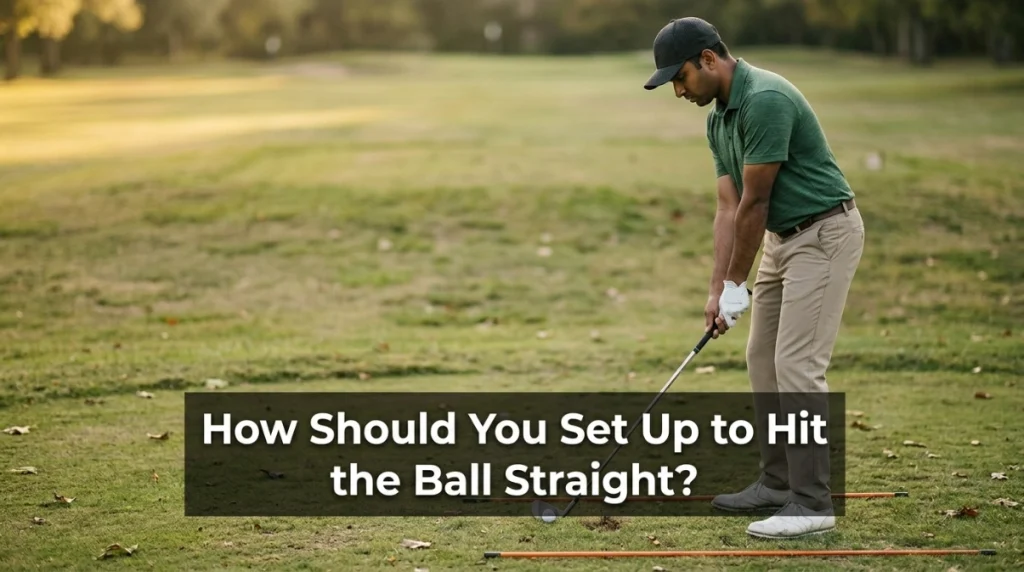
A reliable setup gives the club a better chance to return square. Start with the clubface, then build your stance around it.
Choose a small target
“The fairway” is too wide to create a clear picture. Pick a tree branch, bunker edge, distant sign, or patch of grass instead.
Next, find an intermediate target about two or three feet ahead of the ball. A leaf or discolored blade of grass works well.
Aim the clubface before your feet
Stand behind the ball and picture a line running through your intermediate target. Set the clubface at a right angle to that line.
Then place your feet. Your toe line should run parallel to the ball-to-target line, like two railway tracks.
- Clubface: Points toward the target.
- Feet: Run parallel and slightly left for a right-handed golfer.
- Knees and hips: Match the foot line.
- Shoulders: Stay parallel instead of pointing across the ball.
A common mistake is aiming both the clubface and feet at the target. That can point the face one way and the body another.
Use a neutral grip
Your grip affects how easily the face opens and closes. Hold the club mainly through the fingers, not deep in both palms.
For a right-handed player, the lead hand usually shows about two knuckles at address. Both hands should work together without squeezing hard.
I use a grip pressure near five on a scale of ten. A tight grip makes my forearms rigid and slows the release.
Set the correct ball position
Ball position changes where the club meets the ball within the swing arc. Use the following positions as practical starting points.
| Club | Starting Ball Position | Typical Contact Goal |
|---|---|---|
| Wedge | Near the center | Ball first, then turf |
| Short or mid-iron | Center to one ball forward | Slight downward strike |
| Hybrid or fairway wood | One to two balls forward | Shallow or slightly downward strike |
| Driver | Inside the lead heel | Level or upward strike |
These positions are starting points, not fixed laws. Your build and swing pattern can require a small change.
Section Takeaway: Aim the clubface first, align your body parallel, and choose a ball position suited to the club.
What Swing Changes Help You Hit Straighter Shots?
A smooth, balanced motion usually produces better direction than a hard swing. You need control of the face more than extra effort.
Start the club back as one unit
Move your chest, arms, and club together during the first part of the backswing. Avoid snapping the club far inside with your hands.
When the shaft reaches parallel to the ground, the clubhead should stay near your hand line. The face should not look extremely open or shut.
Turn instead of swaying
Rotate your upper body while keeping pressure inside your trail foot. A large sideways sway makes the low point harder to control.
You do not need a huge shoulder turn. Stop when you can maintain balance and your posture.
Begin down with your lower body
Start the downswing by shifting pressure toward your lead foot. Let your hips begin turning while your arms fall naturally.
Avoid throwing your shoulders toward the ball. That move often sends the club outside the ideal path.
Swing through the ball
The ball is not the finish line. Keep turning until your chest faces the target and your trail heel leaves the ground.
Hold the finish for three seconds. If you stumble, reduce your speed until you can finish in balance.
- Good finish: Most pressure rests on the lead foot.
- Stable posture: Your body remains tall and balanced.
- Full turn: Your chest and belt buckle face the target.
- Relaxed arms: The club finishes without forced steering.
I often make three slow practice swings before hitting. That short routine removes tension and gives me a clear motion to copy.
Pro tip: If a swing change causes pain or feels unnatural, stop and consult a certified PGA professional or qualified medical provider.
Section Takeaway: Use a connected takeaway, controlled turn, pressure shift, and balanced finish. Speed should come after control.


Which Drills Help You Hit the Ball Straight?
The best drills give immediate feedback about alignment, path, or face control. Start slowly with a wedge or short iron.
1. The alignment-stick drill
Place one alignment stick on the ground along your target line. Put a second stick parallel to it near your toes.
Aim the clubface with the first stick and align your body with the second. Remove the sticks before making any swing that could strike them.
2. The start-line gate
Choose two markers about three feet in front of the ball. Leave a gate wide enough for a low shot to pass through safely.
Try to start five balls through the gate. This tests clubface control without asking you to chase a perfect flight.
3. The feet-together drill
Set your feet only a few inches apart and hit gentle half-swings. A narrow stance limits excess body movement and improves balance.
Begin with ten balls at half speed. Widen your stance once the contact becomes steady.
4. The nine-to-three drill
Picture a clock facing you. Swing your lead arm to about nine o’clock, then finish with your trail arm near three o’clock.
This short motion lets you feel how the body and arms move through impact. Keep the pace smooth.
5. The three-ball progression
Hit the first ball with a half-swing, the second at three-quarter speed, and the third with your normal swing. Keep the same target for all three.
If direction worsens with speed, return to the slowest reliable motion. Build speed only while keeping your balance.
- Hit five wedge shots at half speed.
- Hit five short-iron shots at three-quarter speed.
- Hit five mid-iron shots at normal speed.
- Finish with five drives at controlled speed.
Practice quality matters more than volume. Twenty focused balls can teach more than a large bucket hit without a target.
Section Takeaway: Use feedback drills and increase speed in stages. Do not practice the same poor shot at full power.
Should You Use the Same Technique With Every Club?
The core goal stays the same, but setup and contact change by club. A driver should not be struck exactly like a wedge.
How to hit an iron straight
Place the ball near the center for a short iron and slightly forward for a mid-iron. Keep your chest centered and pressure balanced at address.
Your low point should occur beyond the ball. That produces ball-first contact before the club brushes the turf.
How to hit a driver straight
Play the ball near your lead heel and tee it high enough for part of the ball to sit above the crown. Add a small tilt away from the target.
Focus on centered contact instead of maximum speed. A shorter backswing often helps when the fairway is narrow.
The driver’s curved face creates a gear effect on off-center hits. Heel contact can add fade spin, while toe contact can add draw spin.
How to hit a hybrid or fairway wood straight
Play the ball forward of center but behind the driver position. Let the club sweep through with a shallow strike.
Do not try to lift the ball. The club’s loft supplies the height when the contact is solid.
Can equipment make you hit straighter?
Equipment can reduce a miss, but it cannot repair poor aim or contact. The right lie angle, shaft length, shaft flex, and grip size can make the face easier to control.
Lie angle describes how the shaft sits relative to the sole. A poor fit can make the face point away from your intended line at impact.
A clubfitter can measure these details instead of guessing. Golf equipment must also follow the standards published by the USGA and The R&A.
Section Takeaway: Keep the same balanced motion, but adjust ball position and contact goals for each club.
How Do You Fix a Slice, Hook, Push, or Pull?
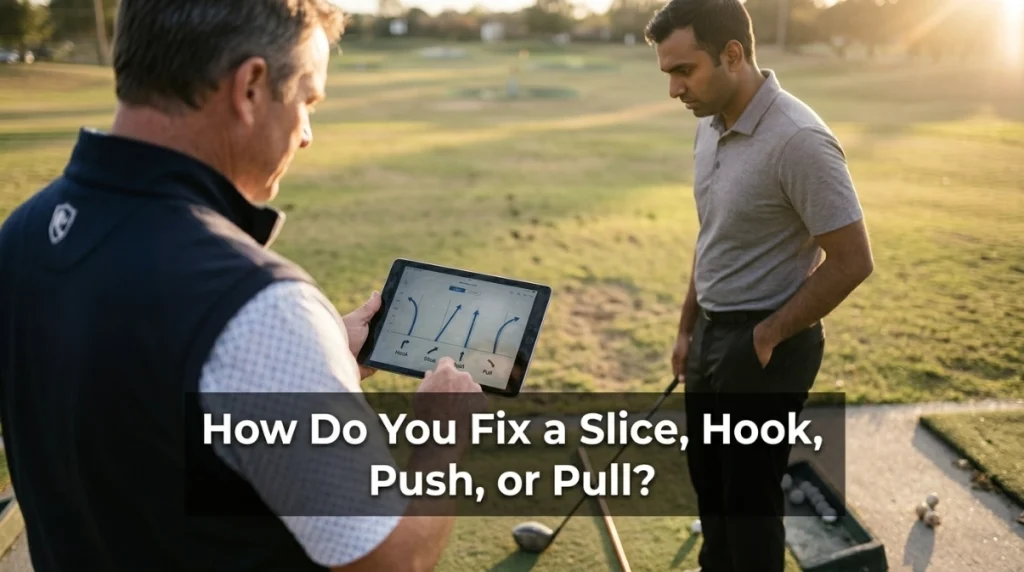
Start by identifying where the ball begins and how it curves. That flight pattern tells you more than the final resting place.
| Shot Pattern | Common Cause | First Check |
|---|---|---|
| Slice | Face open relative to path | Grip, face angle, and heel contact |
| Hook | Face closed relative to path | Strong grip and fast hand rotation |
| Push | Face and path moving right | Body alignment and face direction |
| Pull | Face and path moving left | Shoulder alignment and downswing path |
If the ball slices
Check that your grip is not too weak and your shoulders are not aimed left. Then make half-swings while feeling the clubface return square.
Also inspect the strike. Repeated heel contact can make driver shots curve farther right.
If the ball hooks
Check for a strong grip with both hands turned too far away from the target. Slow your hand action and keep rotating through the shot.
Do not hold the face open as a quick fix. That can replace the hook with a block or slice.
If the ball pushes
Confirm your feet and shoulders are not aimed right. The face may match that rightward path, creating a straight shot in the wrong direction.
If the ball pulls
Check whether your shoulders point left or open too early. Use the alignment-stick drill and make controlled swings.
Change one item at a time. When I change my grip, aim, and swing together, I cannot tell which adjustment helped.
Section Takeaway: Read the starting direction first and the curve second. Use that evidence to select one small correction.
Frequently Asked Questions
Why can’t I hit a golf ball straight?
Your clubface and swing path probably do not match at impact. Poor alignment, off-center contact, an unsuitable grip, or excess swing speed can increase the miss. Check your aim and strike before making a major swing change.
Should I try to hit every golf shot perfectly straight?
No. A small, predictable draw or fade is often easier to manage than a perfectly straight ball. Your main goal should be a repeatable starting line and a curve that stays within a safe area.
Does a stronger grip help you hit straight?
A slightly stronger grip may help a golfer who leaves the face open. However, turning the hands too far can close the face and cause a hook. Use grip changes in small steps.
Why do I hit straight on the range but not on the course?
The range gives you repeated shots from flat ground. A course adds pressure, uneven lies, hazards, and changing targets. Use a consistent pre-shot routine and choose a clear target before every shot.
Should I swing slower to hit the ball straight?
A controlled swing often improves balance and contact. You do not need to swing slowly forever, but reducing effort can reveal whether speed causes your miss. Increase speed only when you can hold the finish.
What is the easiest club to hit straight?
A short iron is usually easier because it has more loft and a shorter shaft. Start with a wedge or 9-iron, then move through the bag as your contact improves.
Can lessons help me hit straighter?
Yes. A certified instructor can check your grip, alignment, clubface, path, and contact. Even one lesson may reveal a setup problem that is difficult to see without video or launch-monitor data.
Your next step: Take a wedge and two alignment sticks to the range. Hit 20 controlled shots while tracking the starting direction, curve, and strike. Work on one pattern at a time, then carry that simple routine onto the course.