Penalty Strokes in Golf: Rules, Examples, and How to Count Them
Quick Answer
A penalty stroke is added to your score when you take certain relief options or break a Rule of Golf. Common examples include hitting into a penalty area, losing a ball, going out of bounds, or declaring a ball unplayable. The official USGA Rules and Clarifications determine whether the result is one stroke, the general penalty, loss of hole, or disqualification.
Common Penalty Situations
- Penalty area: Add one stroke when taking relief outside a red or yellow penalty area.
- Lost ball: Add one stroke and play again from where you made the previous stroke.
- Out of bounds: Use the same stroke-and-distance procedure as a lost ball.
- Unplayable ball: Add one stroke for any standard unplayable-ball relief option.
- General penalty: Add two strokes in stroke play or lose the hole in match play.
Before You Add a Stroke
- Confirm whether free relief, a Local Rule, or an exception applies.
Penalty strokes can turn an ordinary hole into a confusing scorecard puzzle. I’ve seen golfers count the same lost tee shot as three, four, and even five before reaching the next tee.
This guide explains what the penalties mean, when they apply, and how to calculate your score correctly. It follows the Rules of Golf in effect as of 2026.
In This Guide
What Is a Penalty Stroke in Golf?
A penalty stroke is an extra stroke added to a golfer’s score under a specific Rule. It can result from taking penalty relief or committing a Rules breach.
The penalty isn’t always punishment for bad behavior. In many situations, it is simply the price of moving the ball away from trouble.
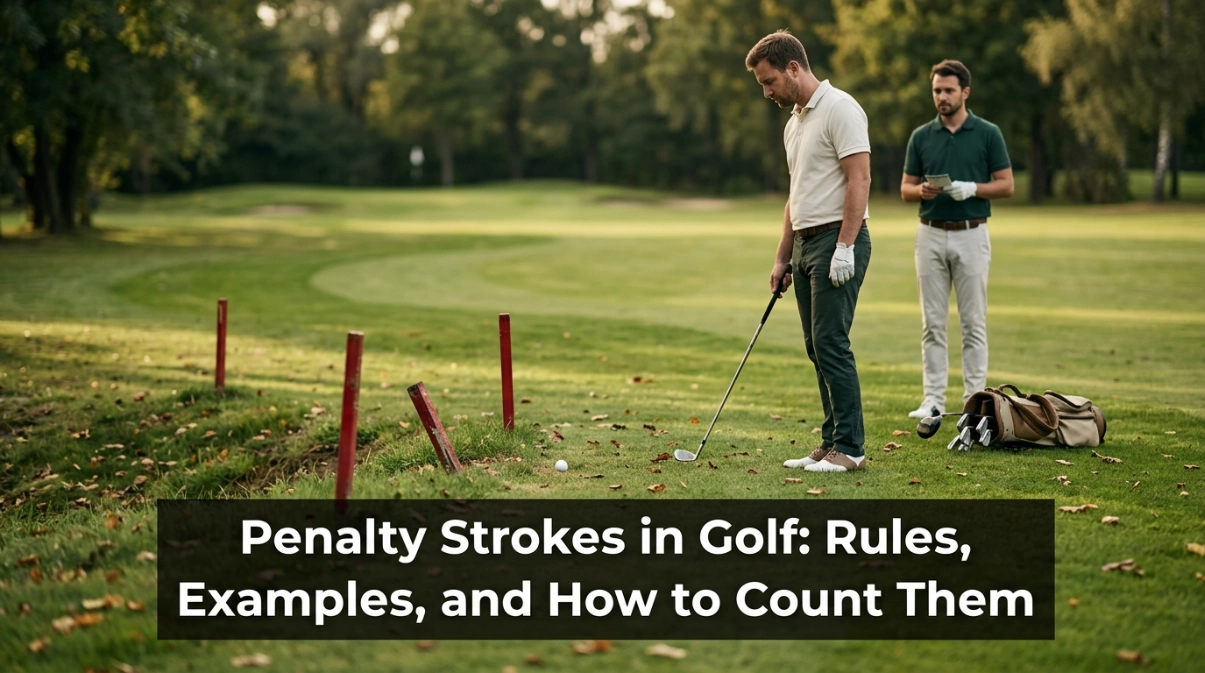
For example, suppose your second shot enters a red penalty area. You choose lateral relief, add one penalty stroke, and make your next stroke from the relief area.
- First stroke: Your tee shot.
- Second stroke: The shot that entered the penalty area.
- Third stroke: The penalty stroke.
- Fourth stroke: Your next swing after dropping.
The penalty counts even though you did not swing the club for it. That detail causes many scoring mistakes among new golfers.
Why does golf use penalties?
Penalties remove an advantage a player could gain by ignoring a Rule. They also create a consistent way to continue when normal play has been interrupted.
A ball behind a boundary fence cannot remain in play. Stroke-and-distance relief restores the sequence by returning you to the location of your previous stroke.
A penalty area works differently. Its marked boundary provides reference points for permitted relief procedures.
Section Takeaway: A penalty stroke is recorded like a stroke even though no swing occurred. Always count the shot into trouble, the penalty, and the next shot separately.
What Are the Different Levels of Golf Penalties?
The Rules use one-stroke penalties, the general penalty, and disqualification. The general penalty changes according to the playing format.
In stroke play, the general penalty is two strokes. In match play, it means loss of hole.
| Penalty Level | Stroke Play | Match Play | Typical Example |
|---|---|---|---|
| One-stroke penalty | Add one stroke | Add one stroke | Taking penalty-area relief |
| General penalty | Add two strokes | Loss of hole | Playing a wrong ball |
| Disqualification | Player is disqualified | Player is disqualified | Serious misconduct |
Can several penalties apply to one incident?
Sometimes penalties combine, while other times the Rules limit multiple penalties arising from related acts. The answer depends on whether the acts were connected and whether an intervening event occurred.
Don’t guess during a competition. Tell the Committee exactly what happened and in what order.
In casual play, state the facts before checking the applicable Rule. Small details such as making another stroke can change the ruling.
What happens when a player does not know the Rule?
A player remains responsible for applying their own penalties. Not knowing a Rule does not normally cancel its result.
That sounds severe, but you don’t need to memorize every clause. Learning the most common situations prevents most problems.
Section Takeaway: “Two-stroke penalty” normally means the general penalty in stroke play. The equivalent penalty in match play is usually loss of hole.
Which Situations Cause Penalty Strokes?

Penalty areas, lost balls, out-of-bounds shots, and unplayable balls create many everyday penalties. Procedural breaches can also cost strokes.
| Situation | Normal Penalty | What to Do |
|---|---|---|
| Ball in a penalty area | One stroke when taking relief | Use an available option under Rule 17 |
| Ball lost outside a penalty area | One stroke plus distance | Play again from the previous spot |
| Ball out of bounds | One stroke plus distance | Play again from the previous spot |
| Unplayable ball | One stroke for standard options | Choose stroke-and-distance, back-on-the-line, or lateral relief |
| Playing a wrong ball | General penalty | Correct the mistake in stroke play |
| Playing from a wrong place | Usually the general penalty | Determine whether a serious breach occurred |
Lost ball and out of bounds
A ball becomes lost when it is not found within three minutes after the player or caddie begins searching. A ball is out of bounds only when all of it lies beyond the course boundary.
Under Rule 18, the standard procedure is stroke and distance. Add one penalty stroke and play from where you made the previous stroke.
If your tee shot might be lost outside a penalty area or out of bounds, announce and play a provisional ball. This can prevent a long walk back.
Unplayable ball
You may declare your ball unplayable anywhere except inside a penalty area. You don’t need another player’s permission.
The three standard choices under Rule 19 each cost one penalty stroke:
- Stroke and distance: Play from where the previous stroke was made.
- Back on the line: Keep the ball’s original spot between the hole and your chosen drop point.
- Lateral relief: Drop within two club-lengths of the ball’s spot, no nearer the hole.
Special restrictions apply in bunkers. Taking back-on-the-line relief outside a bunker under the extra option costs two penalty strokes.
Accidentally moving your ball
Moving your ball at rest can cause one penalty stroke when you caused the movement. You must normally replace the ball on its original spot.
Several exceptions apply. There is no penalty for accidentally moving the ball during a reasonable search or while taking certain permitted actions on the putting green.
Section Takeaway: Identify where the ball lies before choosing relief. Penalty areas, bunkers, boundaries, and the general area follow different procedures.

How Do You Count Penalty Strokes?
Count every stroke made at the ball, then insert each penalty stroke required by the Rules. Your next physical swing receives the next number in the sequence.
Lost tee shot example
You hit your first shot out of bounds. You return to the tee under stroke and distance.
- The original tee shot counts as stroke one.
- The stroke-and-distance penalty counts as stroke two.
- Your replacement tee shot is stroke three.
- Your next shot from the fairway is stroke four.
Golfers often say they are “hitting three off the tee.” That phrase includes the original swing and the penalty stroke.
Penalty-area example
Your approach shot is your second stroke and enters a red penalty area. You take lateral relief.
- Your tee shot was stroke one.
- The shot into the penalty area was stroke two.
- Relief adds penalty stroke three.
- Your next swing is stroke four.
Provisional-ball example
You hit a tee shot toward thick woods and properly announce a provisional. The provisional tee shot is made under stroke and distance.
If the original is lost, the provisional becomes the ball in play. The provisional tee shot counts as your third stroke.
If you find the original in bounds within three minutes, you must abandon the provisional. Strokes made at the provisional before that point do not count.
Optional Local Rule example
Some courses use the alternative Local Rule for a lost ball or one that is out of bounds. It allows relief near the fairway for two penalty strokes instead of returning to the previous spot.
After a lost tee shot, you would drop and play your fourth stroke. This Local Rule is not automatically available, so check the scorecard or ask the Committee.
Section Takeaway: Say the sequence aloud when uncertain: shot, penalty, next shot. This simple habit prevents most scorecard errors.
How Do Red and Yellow Penalty Areas Differ?

Both red and yellow penalty areas offer stroke-and-distance and back-on-the-line relief for one penalty stroke. Red areas also provide lateral relief.
| Relief Option | Yellow Area | Red Area |
|---|---|---|
| Play the ball as it lies | Yes, no penalty | Yes, no penalty |
| Stroke and distance | Yes, one stroke | Yes, one stroke |
| Back on the line | Yes, one stroke | Yes, one stroke |
| Lateral relief within two club-lengths | No | Yes, one stroke |
For back-on-the-line and lateral relief, use the estimated point where the ball last crossed the penalty area’s edge. Don’t use the spot where the ball finished.
You may also play the ball from inside the area without a penalty. The current Rules generally allow you to ground your club and remove loose impediments there.
The ball must be known or virtually certain to be inside the penalty area. A splash alone may not prove this if the ball could be lost in nearby rough.
Review the official penalty-area relief options when the crossing point or drop location is unclear.
Section Takeaway: Red markings add a lateral-relief option. Yellow markings do not, but both colors allow stroke-and-distance and back-on-the-line relief.
When Do You Get Free Relief?
Free relief is available only when a Rule provides it. Common cases include abnormal course conditions and certain movable or immovable obstructions.
Examples may include:
- Ground under repair marked by the Committee.
- Temporary water affecting the ball, stance, or intended swing.
- An animal hole affecting the ball, stance, or swing.
- An immovable obstruction, such as a cart path.
- A movable obstruction, such as a rake.
- A ball embedded in its own pitch mark in the general area.
Free relief does not mean dropping wherever you prefer. You usually find the nearest point of complete relief and measure the required relief area.
What does “nearest point of complete relief” mean?
It is the estimated point nearest the ball where the condition no longer interferes. The point must meet the Rule’s location requirements and cannot be nearer the hole.
The nearest point might create a poor lie or awkward stance. Free relief guarantees relief from the condition, not a clear shot.
When is relief not free?
You don’t receive free relief merely because a tree, bush, boundary object, or bad lie blocks your stroke. These are normal challenges of the course.
Relief from a boundary object is not normally available. An out-of-bounds fence is different from an immovable obstruction.
If the ball is playable but the situation is undesirable, you may use unplayable-ball relief for one penalty stroke. Choose the option that gives you a legal and practical next shot.
Section Takeaway: Free relief removes interference from a condition covered by a Rule. It does not promise a better lie, line, or angle.
How Can You Avoid Preventable Penalties?

Many penalties come from incorrect procedures rather than poor shots. A short pre-round check can protect your score.
- Mark your ball: Use a unique identification mark to avoid playing a wrong ball.
- Read Local Rules: Check the scorecard and posted notices before starting.
- Announce provisionals: Clearly use the word “provisional” before playing another ball.
- Watch crossing points: Note where a ball last crossed a penalty area’s edge.
- Measure carefully: Confirm the reference point, club-length limit, and no-nearer-the-hole requirement.
- Count clubs: A player may normally carry no more than 14 clubs.
- Protect your scorecard: In stroke play, check each hole score before returning the card.
I use a simple routine when a ball enters trouble: identify the course area, find the reference point, and list the available options. Only then do I lift or drop a ball.
That pause takes less than a minute. It has saved me from dropping on the wrong side of a path and using the wrong crossing point.
During a formal competition, call a referee when one is available. A player in stroke play may also use the two-ball procedure under Rule 20.1c(3) when genuinely uncertain about the correct action.
Pro tip: Ask a PGA professional or qualified rules official to demonstrate dropping and relief-area procedures. Seeing the reference points on a real course makes the Rules much easier to remember.
Section Takeaway: Don’t touch the ball until you know which Rule applies. Correct identification and a careful drop prevent many avoidable penalties.
Frequently Asked Questions
Is a lost ball a one-stroke or two-stroke penalty?
A lost ball normally requires one penalty stroke plus loss of distance. You must play again from the previous spot, so a lost tee shot makes your replacement tee shot your third stroke.
What is the penalty for hitting a ball out of bounds?
The standard penalty is stroke and distance. Add one penalty stroke and play from where you made the previous stroke. An optional Local Rule may allow fairway-side relief for two penalty strokes when the Committee has adopted it.
How many penalty strokes do you get for a water hazard?
The Rules now call these marked locations penalty areas. Taking relief outside one normally costs one penalty stroke, although you may play the ball as it lies without a penalty when that is allowed and practical.
Is a double hit a penalty in golf?
No additional penalty applies when a single stroke accidentally hits the ball more than once. Count only the stroke you made and play the ball from where it comes to rest.
Can you declare any ball unplayable?
You may declare your ball unplayable anywhere except inside a penalty area. Standard relief costs one penalty stroke, although taking the special back-on-the-line option outside a bunker costs two penalty strokes.
What is the penalty for playing the wrong ball?
The general penalty applies: two strokes in stroke play or loss of hole in match play. In stroke play, you must correct the mistake by playing the correct ball or otherwise proceeding properly before teeing off on the next hole.
Do air swings count as strokes?
Yes, if you intended to strike the ball. A deliberate swing that misses counts as a stroke, but a practice swing made without intent to strike the ball does not.
Final Takeaway
Most everyday golf penalties become manageable once you learn four situations: penalty areas, lost balls, out-of-bounds shots, and unplayable balls.
Remember the counting formula: include the shot into trouble, add the required penalty, and number your next swing. When details remain unclear, check the official Rule or ask the Committee before continuing.
Keep this guide available for your next round. A correct ruling protects your score and keeps play moving.