
Water Hazard Rules in Golf: Red vs. Yellow Penalty Areas

Quick Answer
Golf’s current rules call water hazards “penalty areas.” Under Rule 17 for penalty areas, you may play the ball as it lies without a penalty or take relief for one penalty stroke.
Your Main Options
- Play it: Hit the ball from inside the penalty area without adding a penalty stroke.
- Stroke and distance: Add one stroke and play again from the previous spot.
- Back on the line: Add one stroke and drop behind the area on the required reference line.
- Lateral relief: For a red penalty area, add one stroke and drop within two club-lengths of the crossing point.
- Check local rules: A course may provide a dropping zone or another approved option.
Before You Drop
- Identify where the ball last crossed the penalty-area edge—not where it finally stopped.
Water can turn a routine golf hole into a confusing rules problem. I’ve seen more arguments about the correct dropping spot than about whether a ball entered the pond.
This guide explains the water hazard rules in plain language. You’ll learn the difference between red and yellow markings, how to take relief, and how to avoid costly penalties.
In This Guide
- What Is a Water Hazard Called Under the Current Golf Rules?
- What Is the Difference Between Red and Yellow Penalty Areas?
- What Relief Options Do You Have From a Penalty Area?
- How Do You Drop a Ball Correctly Near Water?
- What Happens When You Cannot Find the Ball?
- What Water Hazard Rule Mistakes Should You Avoid?
- Frequently Asked Questions
What Is a Water Hazard Called Under the Current Golf Rules?
A water hazard is now called a penalty area. Rule 17 covers these areas and the relief available when a ball enters one.
A penalty area is any body of water or another area that the Committee defines as such. It may contain water, but water is not required.
Why did the terminology change?
The term “penalty area” replaced the older “water hazard” language when the modernized Rules took effect in 2019. The change lets Committees mark areas such as dense vegetation, desert, lava rock, or deep ravines under the same rule.
The concept is broader now. However, many golfers still use “water hazard” in casual conversation.
How is the edge defined?
Red or yellow stakes and painted lines normally identify a penalty area. When both appear, the painted line defines the actual edge.
- Painted line: The outside edge of the line marks the penalty-area boundary.
- Stakes only: The edge runs between the outside points of the stakes at ground level.
- Ball status: A ball is in the area when any part of it touches or lies above its edge.
- Stakes: Red and yellow penalty-area stakes are movable obstructions unless the Committee declares otherwise.
The edge extends both upward and downward. A ball can therefore be above the boundary while caught in grass or branches.
Can you play from inside a penalty area?
Yes. You may play the ball as it lies without adding a penalty stroke.
You may ground your club, take practice swings, and remove loose impediments under the normal rules. Those actions are no longer automatically prohibited merely because the ball is in a penalty area.
You still cannot improve the conditions affecting your stroke. For example, you cannot bend growing branches aside or build a stance in the mud.
Section Takeaway: A penalty area can include water or difficult land. The markings—not the presence of water—determine whether Rule 17 applies.
What Is the Difference Between Red and Yellow Penalty Areas?
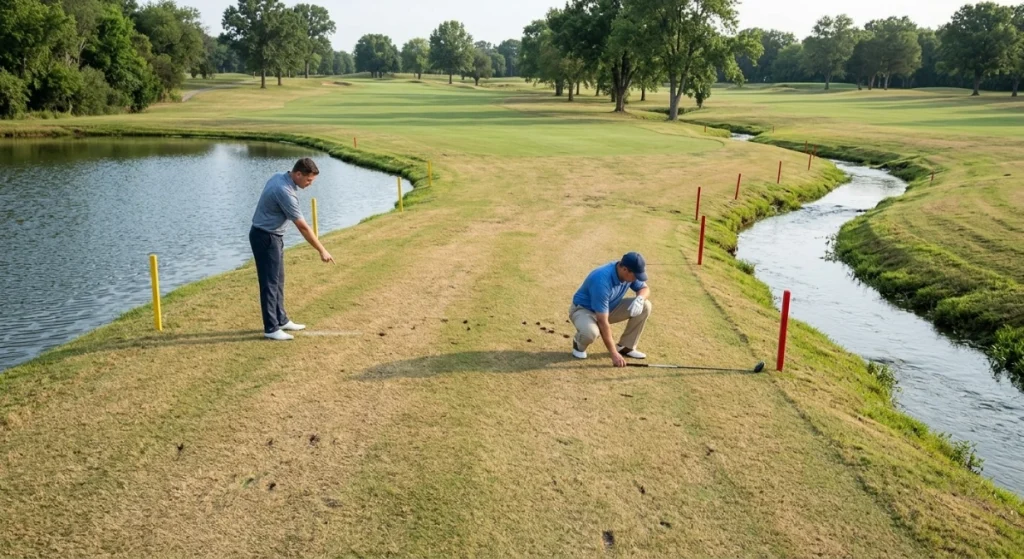
A yellow penalty area provides two penalty-relief choices. A red penalty area provides the same choices plus lateral relief.
Each relief option costs one penalty stroke. Playing the original ball from inside the area costs nothing.
| Option | Yellow Area | Red Area | Penalty |
|---|---|---|---|
| Play the ball as it lies | Yes | Yes | None |
| Stroke-and-distance relief | Yes | Yes | One stroke |
| Back-on-the-line relief | Yes | Yes | One stroke |
| Two-club-length lateral relief | No | Yes | One stroke |
Why are some areas yellow?
Yellow markings commonly appear where water crosses the line of play. A pond in front of a par-3 green is a typical example.
The Committee may use yellow markings to preserve the challenge of carrying the water. Lateral relief could otherwise let a player drop on the green side after a ball crossed that bank and rolled backward.
Why are most penalty areas red?
Red penalty areas often run beside a hole. Lateral relief gives the player a practical place to continue without returning far behind the obstacle.
The relief reference point is where the ball last crossed the edge. It is not the point closest to where the ball lies in the water.
Section Takeaway: Red provides one extra choice—two-club-length lateral relief. Always check the marking color before lifting or dropping a ball.
What Relief Options Do You Have From a Penalty Area?
You can play the ball as it lies or use an available one-stroke relief option. Your best choice depends on the lie, the marking color, and the next shot.
Option 1: Play the ball as it lies
This option carries no penalty. It can work when the ball sits in shallow water, firm mud, or playable grass inside the boundary.
Check the lie before entering. A heroic recovery rarely makes sense when deep mud could cause a fall or damage your club.
Option 2: Take stroke-and-distance relief
Add one penalty stroke and play from where the previous stroke was made. The procedure changes slightly according to that previous location.
- Teeing area: You may tee the replacement ball anywhere inside the teeing area.
- General area, bunker, or penalty area: Drop within one club-length of the estimated previous spot.
- Putting green: Place the ball on the previous spot.
This option is always available. It may also be the only practical choice when the crossing point offers no usable relief.
Option 3: Take back-on-the-line relief
Add one penalty stroke and identify where the ball last crossed the boundary. Keep that point between the hole and your chosen dropping spot.
You may move as far backward on that line as you wish. You cannot move sideways away from the line before selecting the spot.
The ball must first touch the course on the chosen line when dropped. That point creates a relief area measuring one club-length in every direction, subject to the rule’s limits.
Option 4: Take lateral relief from a red area
Add one penalty stroke and use the last crossing point as your reference point. Drop within two club-lengths of it, no nearer the hole.
The ball must remain outside the same penalty area. You cannot automatically drop on the opposite bank.
Example: Counting the score
Imagine your second shot enters a red penalty area. You take lateral relief and then play the dropped ball.
- Your tee shot was stroke one.
- The shot into the water was stroke two.
- Taking relief adds stroke three.
- Your next swing is stroke four.
This count often confuses new golfers. The penalty stroke is added before the next stroke is made.
Section Takeaway: Every standard penalty-area relief choice adds one stroke. Red areas offer lateral relief, while both colors allow stroke-and-distance and back-on-the-line relief.
How Do You Drop a Ball Correctly Near Water?

Drop the ball straight down from knee height. It must first strike the ground inside the correct relief area and finish inside that area.
- Confirm the color: Look for red or yellow lines and stakes.
- Find the crossing point: Estimate where the ball last crossed the penalty-area edge.
- Select an option: Choose stroke and distance, back on the line, or red-area lateral relief.
- Measure correctly: Use the longest club in your bag other than a putter.
- Drop from knee height: Stand upright and release the ball straight down.
- Check the result: Confirm that the ball first touched and remained in the relief area.
When must you drop again?
You must drop a second time when the ball first touches outside the relief area. The same applies when it finishes outside after a valid drop.
Other redrop situations include the ball rolling nearer the hole than allowed or returning into the same penalty area.
When do you place the ball?
If a correctly redropped ball again finishes outside the relief area, place it where it first touched the ground on the second drop. If it will not stay there, follow the placement procedure in Rule 14.2.
Marking the reference point with a tee helps. I use another tee to show the outer edge when the terrain slopes toward the water.
What if you drop in the wrong place?
You may correct the mistake without penalty before playing the ball. Once you play from a wrong place, the general penalty may apply.
- Match play: Loss of hole.
- Stroke play: Two penalty strokes.
- Serious breach: In stroke play, failing to correct a serious breach can lead to disqualification.
Section Takeaway: Establish the reference point before measuring. A correct knee-height drop must first land and finish inside the relief area.
What Happens When You Cannot Find the Ball?
You may use penalty-area relief without finding the ball only when it is known or virtually certain that the ball finished there. Otherwise, the ball is treated as lost.
Known or virtually certain means the available evidence leaves almost no reasonable doubt. Seeing the ball splash provides strong evidence.
Evidence that supports penalty-area relief
- Several players saw the ball enter the water.
- A splash or movement in the water was clearly visible.
- The terrain provides no realistic place outside the area for the ball to finish.
- A spectator, marshal, or another outside influence confirms where it went.
A ball merely flying toward a pond is not always enough. Thick rough, trees, or bushes outside the boundary can create reasonable doubt.
What if you are not virtually certain?
The ball becomes lost if it is not found within the three-minute search period. You must then take stroke-and-distance relief under Rule 18.
You cannot use the estimated water-crossing point simply because it offers a better drop. That error can lead to playing from a wrong place.
Can you play a provisional ball?
You may play a provisional when the original ball might be lost outside a penalty area. You must announce that it is provisional before making the stroke.
A provisional is generally not allowed when the ball could only be in the penalty area. However, a specific Local Rule may authorize one for a particular penalty area.
Section Takeaway: You do not need to retrieve the ball when its presence in the penalty area is known or virtually certain. If reasonable doubt remains, apply the lost-ball rule instead.
What Water Hazard Rule Mistakes Should You Avoid?

The most common errors involve the crossing point, relief color, and drop location. A quick rules check can prevent a two-stroke penalty.
- Using the wrong point: Base relief on where the ball last crossed the edge, not where it stopped.
- Treating yellow like red: Two-club-length lateral relief is unavailable from a yellow penalty area.
- Dropping on the opposite side: Opposite-side relief is not a standard Rule 17 option.
- Dropping at shoulder height: The current procedure requires a drop from knee height.
- Assuming every pond is marked: A Committee can define an unmarked body of water as a red penalty area, but confirm the course’s guidance.
- Taking unplayable-ball relief: Rule 19 does not provide unplayable-ball relief inside a penalty area.
- Claiming ordinary free relief: You normally receive no free relief from an abnormal course condition or embedded ball within a penalty area.
- Ignoring a no-play zone: You must not play a ball lying in a no-play zone.
Check the Local Rules
Read the scorecard, notice board, or tournament rules sheet before starting. Courses may establish dropping zones or special relief procedures for particular holes.
A Local Rule can also provide opposite-side relief for a specified red penalty area. Never assume that option applies without checking.
Use the safest scoring strategy
Playing from water may save a penalty stroke, but it can create a much bigger number. Mud, an unstable stance, and a steep bank reduce your chance of clean contact.
I usually take relief when the ball sits below the waterline or near a slippery edge. One predictable penalty stroke beats two failed recovery attempts.
Pro tip: Ask a PGA professional or certified instructor to demonstrate relief options during an on-course lesson. Seeing the reference lines on real terrain makes the rule easier to remember.
Section Takeaway: Never guess at a relief procedure during competition. Confirm the marking color, last crossing point, and Local Rules before dropping.
Frequently Asked Questions
How many penalty strokes do you receive for hitting into water?
Taking relief from a penalty area normally adds one penalty stroke. No penalty applies if you play the original ball as it lies inside the area.
Can you ground your club in a water hazard?
Yes. Under the current Rules, you may ground your club and take practice swings in a penalty area. You still cannot improve your lie, intended stance, swing area, or line of play.
Can you remove loose impediments from a penalty area?
Yes. You may remove loose impediments such as leaves, stones, and detached twigs. If removing one causes your ball to move, the applicable ball-moved penalty and replacement requirements may apply.
Can you clean a ball taken from a penalty area?
Yes. Once you properly lift or substitute a ball while taking penalty relief, you may clean it before dropping. You may also use another conforming ball.
Do you drop where the ball entered the water?
Relief is based on where the ball last crossed the penalty-area edge. For lateral relief from a red area, drop within two club-lengths of that point and no nearer the hole.
Can you drop closer to the hole?
No. Penalty-area relief cannot place the ball nearer the hole than the relevant reference point allows. If the ball rolls nearer the hole than permitted, you must drop again.
Can you use the opposite side of a red penalty area?
Not under the standard relief options. Opposite-side relief is available only when the Committee has adopted a specific Local Rule for that penalty area.
Final Takeaway
Remember one simple distinction: yellow offers two one-stroke relief options, while red adds lateral relief. You may also play the ball as it lies without penalty.
Before dropping, locate the last crossing point and check the course’s Local Rules. For authoritative diagrams and current wording, review the USGA penalty-area guidance and the Rules of Golf from The R&A.