
What Clubs Do Beginners Need? A Simple Starter Set Guide

Buying golf clubs for the first time can feel unnecessarily complicated. Full sets contain different woods, hybrids, irons, and wedges, yet many beginners do not know which clubs they will actually use.
So, what clubs do beginners need? Most new golfers can learn and play comfortably with 8–11 well-chosen clubs. You need enough options to handle drives, fairway shots, short approaches, bunker shots, and putts—but you do not need every club allowed under the rules.
This guide explains which clubs deserve a place in a beginner’s bag, what each one does, how much to spend, and when professional fitting is worth considering.
Quick Answer
Most beginners need a driver or fairway wood, one hybrid, a few forgiving irons, a pitching wedge, a sand wedge, and a putter. A practical starter bag contains 8–11 clubs. This setup covers the main shots while keeping club selection simple, affordable, and easier to learn.
How Many Golf Clubs Does a Beginner Need?
A beginner does not need a complete 14-club set. Although the USGA’s rules on golf clubs allow a player to carry as many as 14 conforming clubs, carrying fewer is perfectly acceptable.
Starting with 8–11 clubs often makes learning easier. You have fewer decisions to make, and you can become comfortable with each club before adding specialized options.
A sensible beginner set might include:
- Driver
- 5-wood
- 4- or 5-hybrid
- 6-iron
- 7-iron
- 8-iron
- 9-iron
- Pitching wedge
- Sand wedge
- Putter
That produces a useful 10-club setup. Golfers who want an even simpler bag can remove the driver or 6-iron while they develop a consistent swing.
Recommended Beginner Golf Club Setup
| Club | Main purpose | Beginner priority | Why it helps |
|---|---|---|---|
| Driver | Long tee shots | Useful but optional initially | Provides maximum distance when struck well |
| 5-wood | Tee and fairway shots | High | Easier to launch than many lower-lofted woods |
| 4- or 5-hybrid | Long fairway and rough shots | Essential | More forgiving than a long iron |
| 6-iron | Medium-to-long approach shots | Optional | Adds distance between the hybrid and shorter irons |
| 7-iron | Medium approach shots and practice | Essential | Versatile and relatively easy to learn |
| 8-iron | Controlled approach shots | High | Useful for shorter targets |
| 9-iron | Short approach shots | Essential | Easier to launch with good control |
| Pitching wedge | Short approaches and chips | Essential | Covers many shots near the green |
| Sand wedge | Bunkers and higher short shots | Essential | Helps launch the ball from sand and rough |
| Putter | Rolling the ball on the green | Essential | Used on almost every hole |
The best beginner bag is not the one with the most clubs. It is the one that gives you clear distance choices without unnecessary duplication.


The Essential Clubs Explained

Putter
The putter is the one club every golfer needs. It is designed to roll the ball across the green rather than lift it into the air.
Beginners usually benefit from a mallet-style putter because its larger head can feel stable and provide useful alignment help. A blade putter is smaller and may suit golfers who prefer a lighter, simpler appearance.
Choose a putter that:
- Feels comfortable at address
- Allows your eyes to sit naturally over or just inside the ball
- Is easy to aim
- Does not feel excessively heavy or light
- Gives you confidence from short range
Do not buy a putter based only on appearance. Test several shapes if possible.
Pitching Wedge
A pitching wedge is used for short approach shots, lower chips, and controlled swings near the green. It normally comes with an iron set and is one of the most versatile clubs in the bag.
Beginners should practice both full and partial swings with it. Learning to hit one club at different distances is often more useful than immediately buying several specialized wedges.
Sand Wedge
A sand wedge has more loft and a wider sole than a pitching wedge. That design helps the club move through sand, thick grass, and softer ground.
A sand wedge is useful for:
- Greenside bunker shots
- Short pitches that need more height
- Shots from thick rough
- Chips that must stop relatively quickly
A model around 54–56 degrees is common, but the correct choice depends on the loft of your pitching wedge and the course conditions you normally face.
Short and Mid-Irons
Most beginners should carry at least a 7-iron, 8-iron, and 9-iron. A 6-iron can be added if it produces a useful distance between the hybrid and 7-iron.
Look for cavity-back or game-improvement irons. These clubs place more weight around the edges of the head, making off-center strikes less punishing.
Avoid starting with compact blades or “player’s irons.” They can offer skilled golfers precise control, but their smaller sweet spots make consistent contact more difficult.
Hybrid
A hybrid combines features of a wood and an iron. Its wider sole, lower center of gravity, and larger head can make it easier to launch than a traditional 3-, 4-, or 5-iron.
For many beginners, a 4- or 5-hybrid is one of the most useful clubs available. It can be played from the fairway, light rough, or tee.
A hybrid is not automatically perfect for everyone. Some golfers hit fairway woods more confidently, while others prefer irons. Test the club from realistic lies before deciding.
Fairway Wood
A 5-wood is generally easier for a beginner to launch than a 3-wood because it has more loft and often a slightly shorter shaft.
It can serve two important purposes:
- A controlled alternative to the driver from the tee
- A distance club for long fairway shots
Beginners do not necessarily need both a 3-wood and a 5-wood. The two clubs may travel similar distances until swing speed and contact improve.
Driver
The driver is built for maximum distance from the tee. Its large head offers substantial forgiveness, but its long shaft and low loft can make it difficult to control.
A beginner can carry a driver, but it does not have to be the first club used on every hole. If the driver produces severe slices or frequent lost balls, a 5-wood or hybrid may keep more shots in play.
Choose a driver with:
- A large, forgiving head
- Enough loft to launch the ball comfortably
- An appropriate shaft flex
- Adjustable features that are simple to understand
- A shaft length you can control
Do not assume that a stiffer shaft produces more distance. A shaft that is too stiff may make launching and squaring the clubface more difficult.
Can Beginners Use a Half Set?
Yes. A half set is one of the smartest ways to begin.
A minimal setup could include:
- 5-wood
- 5-hybrid
- 7-iron
- 9-iron
- Pitching wedge
- Sand wedge
- Putter
You could add a driver as the eighth club once you are ready to practice longer tee shots.
A half set costs less, weighs less, and reduces uncertainty on the course. The limitation is wider distance gaps. For example, you may occasionally need to make a shorter swing with one club because the ideal club is not in your bag.
That is rarely a serious problem for a new golfer. Consistent contact matters more than covering every possible distance.
Expert Tip: Before adding a club, record how far your current clubs carry on solid strikes. Buy another club only when you find a meaningful distance gap or a shot your existing set cannot handle.
Beginner Boxed Sets vs Building a Set
Boxed Starter Set
A boxed set normally includes most clubs, a golf bag, and sometimes headcovers. It is a convenient choice for someone who wants to begin playing without researching every component.
Benefits include:
- Lower initial cost
- Matching club design
- Immediate course-ready setup
- Simple purchasing process
Possible limitations include:
- Fewer shaft, length, and grip choices
- Inconsistent component quality in very cheap sets
- Clubs you may eventually replace
- Limited fitting options
Typical recreational starter packages may cost approximately $250–$600, although prices vary by brand, materials, and included clubs.
Building a Set Individually
Building a mixed set allows you to select each club based on comfort and performance. You might buy a used driver, a new hybrid, forgiving irons, and a putter that suits your eye.
Benefits include:
- Greater control over club selection
- Easier customization
- Better opportunity to buy higher-quality used clubs
- No need to pay for clubs you will not use
The main disadvantages are time and complexity. A mixed beginner set can also develop awkward distance gaps if the lofts are not checked.
A thoughtfully assembled used or mixed set may cost around $400–$900, but premium components can raise that figure considerably.
What to Look for When Buying Beginner Clubs
Forgiveness
Forgiveness describes how well a club maintains useful distance and direction when contact misses the center of the face.
Look for larger clubheads, perimeter weighting, wider soles, and moderate offset. These features cannot correct every swing problem, but they can make ordinary mishits more playable.
Correct Shaft Flex
Shaft flex affects how a club feels and responds during the swing. Common categories include ladies, senior, regular, stiff, and extra stiff, although flex standards can vary between manufacturers.
Many beginners fit into a lighter regular or senior-flex shaft, but swing speed alone does not tell the whole story. Tempo, release pattern, strength, and strike quality also matter.
Club Length and Lie Angle
Clubs that are too long or too short can influence posture and contact. Lie angle describes how the clubhead sits relative to the ground at impact.
Your height provides a starting point, but arm length, posture, and swing motion are also important. Very tall or short golfers should be especially careful about buying a standard set without testing it.
Grip Size and Condition
A grip should feel secure without forcing you to squeeze tightly. Grips that are worn, cracked, shiny, or unusually hard can slip and reduce control.
Used clubs can offer excellent value, but budget for replacement grips when necessary. Regripping an otherwise solid set may be more sensible than purchasing lower-quality new clubs.
Distance Gapping
Each club should serve a distinct purpose. Two clubs that travel nearly the same distance create unnecessary duplication.
A beginner’s gaps will not be perfectly consistent, so focus on general patterns. If your hybrid and 5-wood repeatedly carry the same distance, you probably do not need both yet.
New vs Used Golf Clubs for Beginners
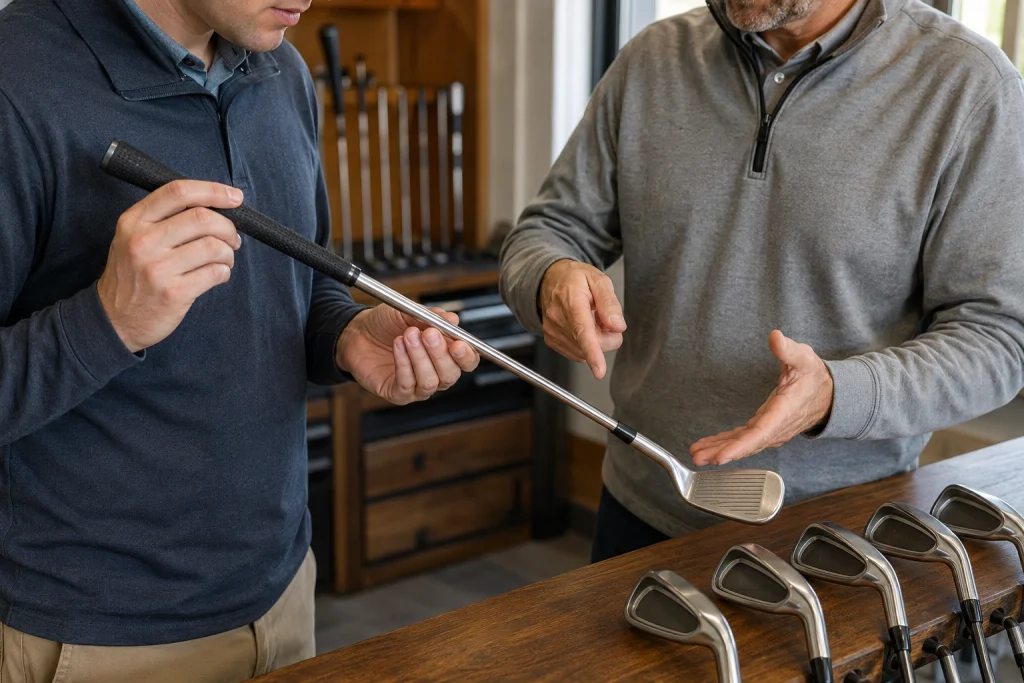
Used clubs can be an excellent choice when they are structurally sound and appropriately fitted. Cosmetic scratches usually do not affect normal performance.
Inspect used clubs for:
- Cracks or dents in wood and hybrid heads
- Deep damage on clubfaces
- Bent or badly rusted shafts
- Loose clubheads
- Splitting, slick, or hardened grips
- Missing pieces from adjustable hosels
- A set containing mismatched shaft flexes
Never continue using a cracked graphite shaft. Damaged graphite can splinter and may cause injury. Ask a repair technician to inspect it.
New clubs provide warranties, fresh grips, and access to current fitting options. However, a new club is not automatically more suitable than a well-maintained model from a few seasons earlier.
When to Get Help From a Golf Pro or Fitter
You do not need an expensive full fitting before hitting your first golf ball. If you are still exploring the sport, borrowing clubs or using a basic starter set may be more practical.
Professional help becomes valuable when:
- Standard clubs feel clearly too long or short
- You cannot launch your woods or irons
- Most shots curve severely despite lessons and practice
- You experience hand, wrist, elbow, shoulder, or back discomfort
- You are unusually tall or short
- You want to invest in clubs for several years
- Your swing has become repeatable enough to compare equipment
A fitter can assess club length, shaft weight, flex, lie angle, loft, grip size, and distance gaps. The PGA of America’s explanation of proper club fitting also highlights the importance of matching equipment to the golfer rather than assuming one standard setup works for everyone.
A lesson may be more helpful than new equipment when the main issue is basic contact, setup, or swing direction. You can find qualified instruction through the PGA coach directory.
Equipment can support a workable swing, but it cannot replace sound fundamentals.
A Smart Order for Building Your Set
If you do not want to buy every club at once, use this order:
- Start with a putter, pitching wedge, 7-iron, hybrid, and 5-wood. These clubs let you practice putting, short shots, iron contact, and longer swings.
- Add a 9-iron and sand wedge. They provide more options around the green.
- Add an 8-iron and possibly a 6-iron. Use them to create smoother distance gaps.
- Add a driver when you are ready to practice tee shots. Do not rush this purchase solely because other golfers carry one.
- Fill measurable gaps later. A gap wedge, additional hybrid, or fairway wood should solve a real on-course need.
This approach keeps costs under control and prevents the bag from filling with clubs that perform the same job.
Common Mistakes Golfers Should Avoid
- Buying all 14 clubs immediately. More clubs can create confusion without improving performance.
- Choosing advanced irons for their appearance. Compact blades are usually less forgiving than game-improvement irons.
- Buying a stiff shaft to “grow into.” The wrong flex can make the club harder to launch and control.
- Ignoring club length. Poorly sized equipment may encourage uncomfortable posture and inconsistent contact.
- Carrying several long irons. Most beginners hit hybrids more consistently from fairway and rough.
- Buying only by brand or price. An expensive club is poor value when it does not fit your swing.
- Ignoring used-club damage. Cracked graphite, loose heads, and badly worn grips require repair or replacement.
- Adding clubs without checking distances. Every new club should fill a useful gap.
- Expecting equipment to fix technique. Lessons and structured practice may create greater improvement.
- Exceeding the 14-club limit in competition. Count your clubs before an official round and confirm that they conform to the applicable equipment rules.
FAQs
Do beginners need a driver?
No. A beginner can use a 5-wood or hybrid from the tee while learning. However, a forgiving driver can be worth adding because it offers more distance and helps develop tee-shot skills.
Should a beginner carry a 3-iron or 4-iron?
Usually not. Long irons require reliable speed and centered contact. A 4- or 5-hybrid is generally easier to launch and more useful from imperfect lies.
Is a 7-iron enough for learning golf?
A 7-iron is an excellent practice club because it is manageable and versatile. It is not enough for a complete round, though. You will also need a putter, wedge, and at least one longer club.
Do beginners need both a pitching wedge and sand wedge?
Yes, in most cases. The pitching wedge handles lower approaches and chips, while the sand wedge provides more loft for bunkers, rough, and higher short shots.
Is a complete boxed set good for a beginner?
A boxed set is convenient and often affordable. Choose one with forgiving clubs, appropriate shaft flex, usable grips, and a sensible selection rather than simply choosing the set with the highest club count.
Are used golf clubs suitable for beginners?
Yes. Used clubs can provide better quality for the same budget. Check the heads, shafts, grips, and hosels carefully, and confirm that the club length and shaft flex are reasonable for you.
How long should beginner golf clubs last?
A sound set can last many years. Replace clubs when they are damaged, badly worn, poorly fitted, or no longer provide useful distance gaps—not simply because newer models become available.
Conclusion
So, what clubs do beginners need? Start with a manageable combination of a wood, hybrid, forgiving irons, pitching wedge, sand wedge, and putter. For most new golfers, 8–11 clubs provide enough versatility without unnecessary cost or confusion.
Prioritize forgiveness, comfortable club length, sensible shaft flex, healthy grips, and clear distance gaps. Consider used equipment or a starter package when your budget is limited, and seek professional help if standard clubs feel uncomfortable or you are preparing to make a long-term investment.
Build your bag around the shots you can play now, practice with each club, and add new equipment only when it solves a genuine need.