
Lost Ball Rule in Golf: Penalty, Search Time, and What to Do

Quick Answer
Under the lost ball rule, your ball becomes lost when you cannot find and identify it within three minutes after you or your caddie starts searching. You normally add one penalty stroke and play another ball from where you made the previous stroke, known as stroke-and-distance relief. Beginners can avoid delays by following a practical golf beginner checklist before each round.
What to Do Immediately
- Start the clock: You have three minutes once you or your caddie begins searching.
- Identify the ball: Check your personal mark rather than assuming a similar ball is yours.
- Return to the spot: If the ball is lost, play again from the location of your previous stroke.
- Add one stroke: The penalty stroke combines with the distance you lose by returning.
- Check local rules: A course may allow a two-stroke fairway-side alternative under Model Local Rule E-5.
Best Prevention
- Announce and play a provisional ball when the original might be lost outside a penalty area.
I’ve watched many casual rounds slow down because nobody knew when a ball officially became lost. The rule is simpler once you separate the search limit, penalty, and provisional-ball procedure.
This guide explains each part in everyday language. It also covers scoring examples, penalty areas, and the optional local rule some courses use in 2026.
In This Guide
What Is the Lost Ball Rule in Golf?
A lost ball is a ball that has not been found and identified within three minutes after the player or their caddie begins searching. This definition comes from Rule 18.2 of the Rules of Golf.
The three-minute limit applies even when you feel certain the ball landed somewhere on the course. Seeing its general landing area does not extend your search time.
When does the three-minute search begin?
The clock starts when you or your caddie begins looking in the suspected area. It does not necessarily begin when you leave the tee or hit the shot.
Other players may help without starting your clock before you arrive, provided neither you nor your caddie has started searching. The official Rule 18 guidance from The R&A explains the search and identification requirements.
What if you find a ball just before time expires?
You must promptly determine whether it is yours. If a ball is found within three minutes, the rules allow a reasonable additional period to reach and identify it.
- Found and identified in time: The ball remains in play.
- Found in time but not promptly checked: It may become lost when the permitted identification period ends.
- Found after three minutes: It is already lost and cannot be played.
- Wrong ball found: Searching may continue if time remains.
Marking your ball with dots, initials, or a simple line makes identification faster. The habit matters when several players use the same model and number.
Can you declare your ball lost?
No. Saying “I declare it lost” does not change the ball’s status under the rules.
A ball becomes lost through the rule’s conditions, including an unsuccessful three-minute search. It also stops being the ball in play after you correctly put another ball into play under stroke and distance.
Section Takeaway: You have three minutes to find and identify the ball. A verbal declaration alone cannot make it lost.
What Should You Do After Losing a Golf Ball?
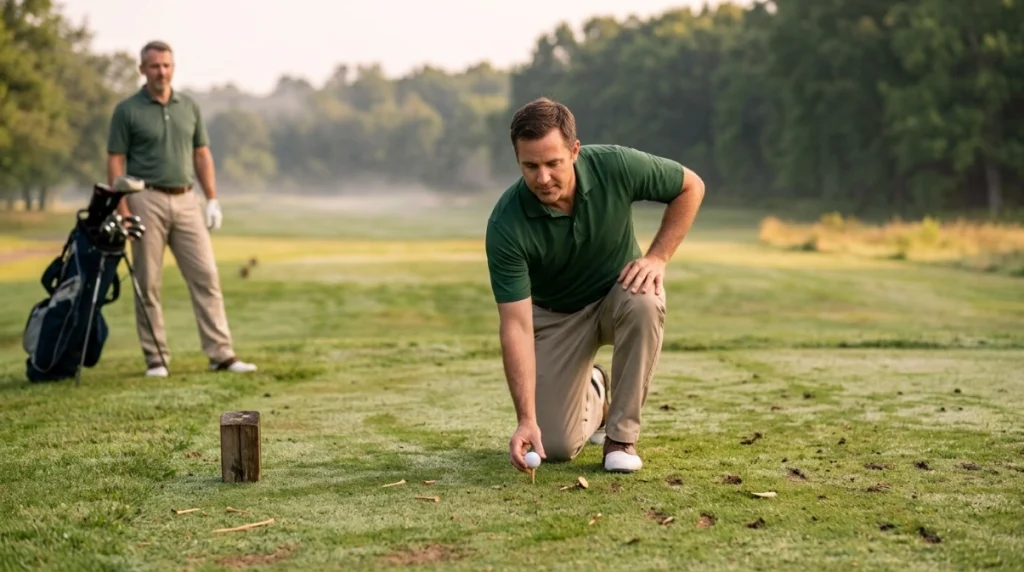
Under the standard rule, take stroke-and-distance relief. Add one penalty stroke and play the original ball or another ball from where you made the previous stroke.
“Distance” means you must give up the ground gained by the lost shot. This is why the result often feels like a two-stroke setback on the scorecard.
How do you play from the previous spot?
The correct procedure depends on where you made the previous stroke. Rule 14.6 controls how you replay it.
- From the teeing area: You may play from anywhere within that teeing area and may tee the ball.
- From the general area: Drop a ball within one club-length of the estimated previous spot, no nearer the hole.
- From a bunker: Drop within one club-length of the previous spot, and the ball must remain in that bunker.
- From a penalty area: Drop within one club-length of the previous spot inside the same penalty area.
- From the putting green: Place a ball on the estimated previous spot.
Understanding the course’s playing areas is easier after learning the basic parts of a golf course. The distinction affects how you return a ball to play.
How do you count the penalty?
Suppose your drive is not found. The drive counts as stroke one, and the penalty counts as stroke two.
Your next shot from the tee is stroke three. Golfers often summarize this situation as “hitting three from the tee.”
| Situation | Required Action | Penalty | Next Stroke After a Lost Tee Shot |
|---|---|---|---|
| Standard lost-ball rule | Play again from the previous spot | One stroke plus distance | Stroke three from the tee |
| Provisional becomes ball in play | Continue with the provisional | One stroke plus distance | Provisional tee shot was stroke three |
| Model Local Rule E-5 applies | Drop in the defined relief area | Two strokes | Usually stroke four after the drop |
Learning standard golf terms also makes these rulings easier to discuss with playing partners. This guide to essential golf terminology covers the common language.
Section Takeaway: The normal penalty is one stroke plus the loss of distance. After losing a tee shot, your replayed tee shot is stroke three.
When Should You Play a Provisional Ball?
Play a provisional when your original ball might be lost outside a penalty area or might be out of bounds. It saves you from walking back after an unsuccessful search.
I use one whenever a drive disappears into deep rough and nobody has a clear reference point. That small decision can save several minutes without changing the eventual ruling.
How do you announce a provisional correctly?
Before making the stroke, clearly tell another player that you are playing a provisional ball. The safest words are, “I’m playing a provisional.”
Saying “I’ll hit another” does not clearly communicate your intent. Without a proper announcement, the second ball can immediately become your ball in play under stroke and distance.
- Tell your marker, opponent, or another player that the ball is provisional.
- Use a ball with a different number or identification mark.
- Play it from the correct location under Rule 14.6.
- Search for the original for no longer than three minutes.
- Continue with the correct ball after determining the original’s status.
When must you abandon the provisional?
If you find the original ball in bounds within the permitted time, you must abandon the provisional. This remains true when the provisional lies in a much better position.
The provisional becomes the ball in play when the original is lost, out of bounds, or when you play the provisional from a point nearer the hole than the original ball’s estimated location.
You cannot use a provisional when the original ball is known to be in a penalty area and nowhere else. In that case, proceed under the penalty-area rule.
Pro tip: Ask a PGA professional or qualified rules official to demonstrate provisional-ball scenarios if you play competitions.
Section Takeaway: Announce the provisional before hitting it. Use it only when the original might be lost outside a penalty area or out of bounds.


Is a Lost Ball Treated Like a Ball in a Penalty Area?
No. A ball lost outside a penalty area normally requires stroke-and-distance relief, while a ball known or virtually certain to be in a penalty area offers other relief choices.
“Known or virtually certain” requires strong evidence about what happened. A guess based only on the ball’s direction is not enough.
When can you use penalty-area relief without finding the ball?
You may use Rule 17 when evidence makes it known or virtually certain that the missing ball entered the penalty area. The required confidence level is much higher than “it probably went in.”
- Strong evidence: You saw the ball splash or several players watched it cross the marked edge.
- Weak evidence: The shot flew toward water, but deep rough also lies beside it.
- Required result: Without sufficient certainty, treat the ball as lost under Rule 18.
The official Rule 17 penalty-area guidance explains the available relief options. Those choices depend on the penalty area’s color and crossing point.
What if someone moved your ball?
You may substitute another ball without a lost-ball penalty when it is known or virtually certain that an outside influence moved it. Spectators, animals, and another player are common examples.
The same principle can apply when the ball is missing in an abnormal course condition or movable obstruction. Each situation has its own replacement or relief procedure.
Players who understand the layout of a golf hole can identify boundaries and penalty areas more confidently. Always check the scorecard and course notices before starting.
Section Takeaway: A missing ball near water is not automatically in a penalty area. You need strong evidence before using Rule 17 instead of the lost-ball rule.
Can You Drop Near the Fairway Instead of Going Back?
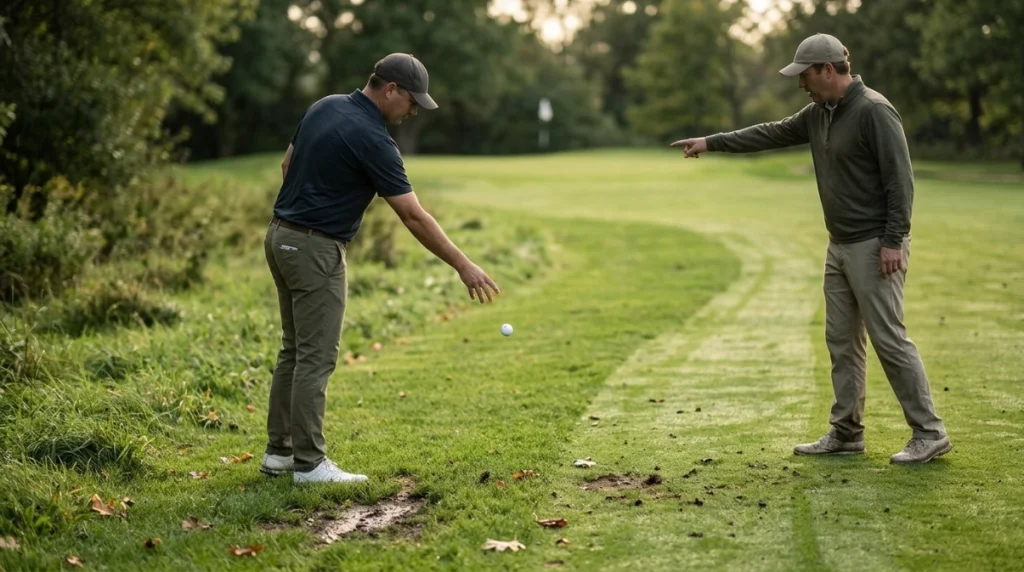
Only when the committee has adopted Model Local Rule E-5. It allows an alternative drop for a ball lost outside a penalty area or known or virtually certain to be out of bounds.
This is not a universal rule. Check the scorecard, notice board, tournament sheet, or golf shop before relying on it.
How does Model Local Rule E-5 work?
The player estimates where the ball was lost or crossed the boundary. They then identify the nearest fairway reference point that is not nearer the hole.
The relief area generally extends between lines drawn from the hole through those reference points. It also includes up to two club-lengths outside the defined lines, subject to the rule’s limits.
- Penalty: Add two strokes.
- Drop location: Use the broad relief area defined by the local rule.
- Purpose: Keep play moving when returning to the previous spot would cause delay.
- Restriction: Do not use it for a ball known or virtually certain to be in a penalty area.
- Provisional limitation: You cannot use it for the original ball after playing a provisional, although it may apply to a lost provisional.
The USGA explanation of Model Local Rule E-5 includes the complete relief-area concept. Committees often use this option for general play rather than elite competition.
The two-stroke penalty creates a result similar to returning and replaying under stroke and distance. After a lost drive, you would usually drop and prepare to play stroke four.
Section Takeaway: A fairway-side drop is available only when Model Local Rule E-5 is in effect. It carries two penalty strokes, not one.
Which Lost-Ball Mistakes Cause Extra Penalties?
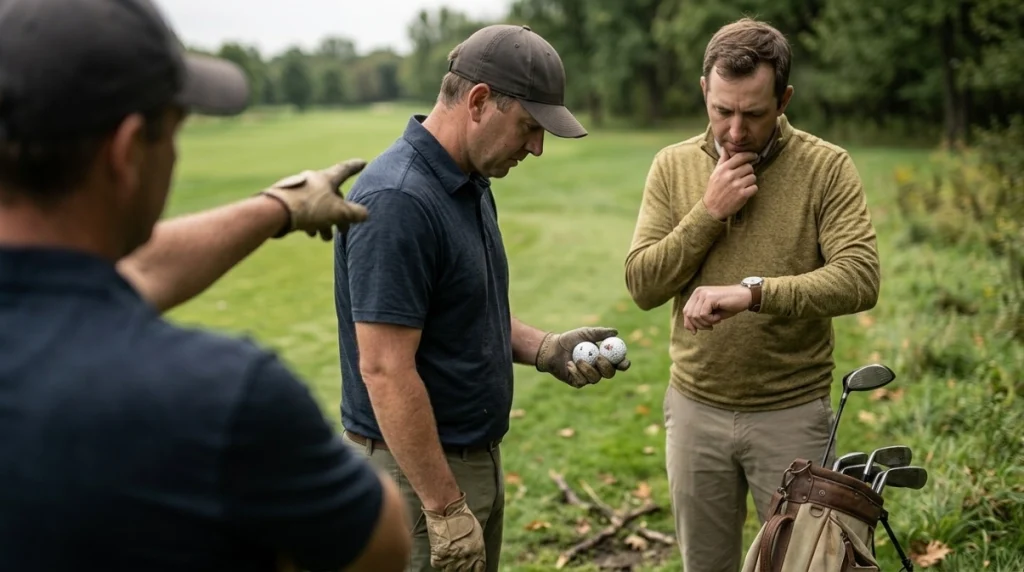
The costliest mistakes involve playing the wrong ball or from the wrong place. A quick conversation with your marker can prevent both problems.
- Searching too long: The original ball is lost once the three-minute limit expires.
- Playing a late discovery: A ball found after the limit cannot become the ball in play again.
- Dropping beside the rough: This is not allowed unless an applicable local rule provides that option.
- Failing to announce a provisional: The second ball may become the ball in play immediately.
- Playing the provisional too far forward: It becomes the ball in play after a stroke nearer the hole than the original’s estimated position.
- Assuming water: Penalty-area relief requires knowledge or virtual certainty.
- Playing a similar ball: In stroke play, playing a wrong ball brings the general penalty and the mistake must be corrected.
How can you prevent lost-ball problems?
Watch every shot until it stops and choose a fixed reference point. A tree trunk, bunker edge, or yardage marker works better than a vague patch of rough.
Ask playing partners to watch when visibility is poor. Then carry an extra marked ball where you can reach it quickly.
For beginners, the biggest improvement comes from developing predictable contact rather than chasing maximum distance. These tips on hitting the golf ball straighter can reduce searches from the tee.
Keep pace without putting yourself at risk. Follow basic golf-course safety practices and never search where another group may hit toward you.
Section Takeaway: Mark your ball, watch its full flight, and announce provisional balls clearly. Never invent a convenient drop when the local rules do not allow one.
Lost Ball Rule FAQ
How long can you search for a lost golf ball?
You have three minutes after you or your caddie begins searching. If a possible ball is found within that time, you receive a reasonable period to reach it and promptly confirm its identity.
Is the penalty for a lost ball one stroke or two?
The standard penalty is one stroke plus distance. You also return to the previous location, so a lost tee shot means your next tee shot is stroke three. Model Local Rule E-5 instead applies two penalty strokes.
Can you drop where you think the ball was lost?
Not under the standard lost-ball rule. You must return to the previous stroke’s location unless the committee has adopted Model Local Rule E-5 or another rule applies to what happened.
Can you play a ball found after three minutes?
No. Once the permitted search time ends, the original ball is lost. Finding it later does not restore its status, even when you have not yet played the replacement ball.
What happens if another golfer finds your ball?
The ball counts as found if anyone locates it within your three-minute search period. You must then promptly reach it and confirm that it is yours using its brand, number, or identifying mark.
Can you declare a ball lost and play the provisional?
You cannot make a ball lost merely by declaring it. If the original is found in bounds within three minutes before the provisional becomes the ball in play, you must continue with the original.
Does a lost ball count toward your handicap score?
Yes. Apply the proper penalty while recording the hole. For handicap posting, any maximum-hole adjustment is handled afterward under the applicable handicap rules, not by ignoring the lost-ball penalty during play.
Play the Lost Ball Rule Without Slowing the Course
Remember three points: search for no more than three minutes, use stroke and distance when the ball is lost, and announce a provisional before playing it. Those steps resolve most lost-ball situations.
Check local rules before every round because Model Local Rule E-5 changes your available relief. When the facts remain unclear in competition, ask a rules official before making another stroke.