
Parts of a Golf Course: A Simple Guide for Beginner and Intermediate Golfers

If you are new to golf, a course can feel confusing at first. You hear words like tee box, fairway, rough, bunker, green, and penalty area, but it is not always clear what each part means or how it affects your shot.
Understanding the parts of a golf course helps you play smarter, follow the rules, choose the right club, and feel more comfortable during a round. It also helps you understand scorecards, course signs, and advice from playing partners or golf pros.
This guide explains the main areas of a golf course in plain English. You will learn what each part does, how it affects strategy, and what beginner golfers should watch out for.
Quick Answer
The main parts of a golf course are the teeing area, fairway, rough, bunkers, penalty areas, putting green, fringe, hole, flagstick, and general area. Each part affects how you aim, choose clubs, manage risk, and follow golf rules during a round.
What Are the Main Parts of a Golf Course?
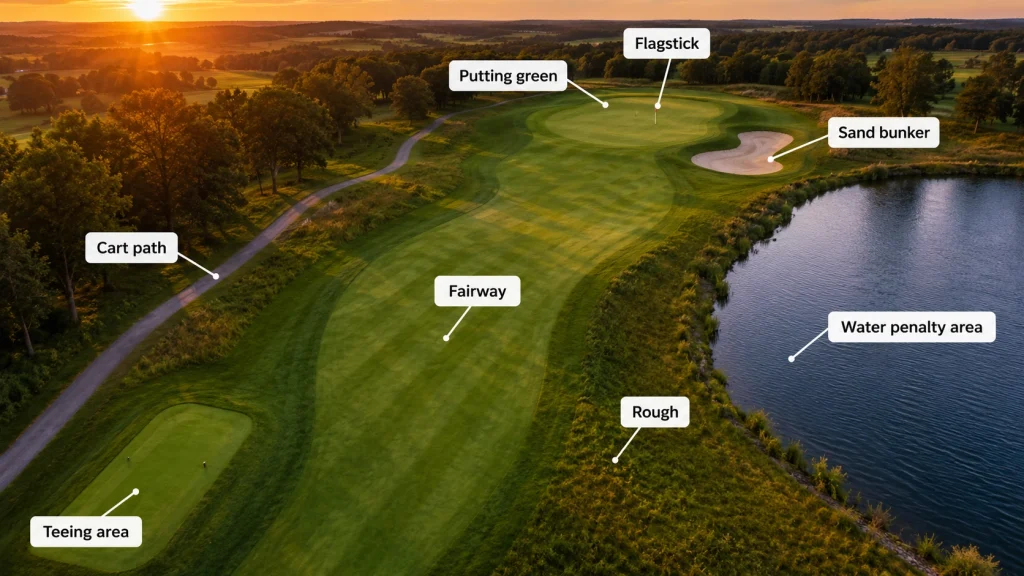
A golf course is made up of several playing areas and supporting features. In the official Rules of Golf, the course is divided into five defined areas: the teeing area, bunkers, penalty areas, the putting green, and the general area. The USGA explains these areas in its official guide to the areas of the course.
For everyday golfers, it helps to break the course down even further. Most holes include a starting area, a landing area, trouble spots, and a finishing area.
| Part of the Course | Main Purpose | What Golfers Should Know |
|---|---|---|
| Teeing area | Where each hole begins | You must start between the tee markers |
| Fairway | Best landing area after the tee shot | Shorter grass makes the next shot easier |
| Rough | Longer grass beside the fairway | Shots are harder to control |
| Bunker | Sand-filled hazard area | Requires a different swing and setup |
| Penalty area | Water or marked trouble area | May add penalty strokes if your ball goes in |
| Putting green | Short grass around the hole | Designed for putting |
| Fringe | Slightly longer grass around the green | You can putt, chip, or bump-and-run |
| Hole and flagstick | Final target | The flagstick helps you see the cup |
| Cart paths and course signs | Movement and guidance | Follow local course rules for safety and care |
The Teeing Area
The teeing area is where you start each hole. Many golfers call it the “tee box,” but the official term is teeing area. It is usually marked by two tee markers, and your ball must be played from between them or behind them within the allowed depth.
According to the USGA’s teeing area rules guidance, the teeing area is one of the five defined areas of the course. For beginners, the most important point is simple: do not tee your ball in front of the markers.
Choosing the Right Tee Markers
Most courses have several tee options. They may be marked by color, yardage, or name. Longer tees make the hole harder because you have more distance to cover.
Beginner and intermediate golfers should choose tees based on comfort, not ego.
Good signs you are playing the right tees include:
- You can reach most par 4s in two or three reasonable shots.
- You are not hitting long clubs into every green.
- You can keep pace with the group ahead.
- You enjoy the round instead of feeling rushed or overwhelmed.
Beginner warning: Playing tees that are too far back can make golf less fun and slow down the course for everyone.


The Fairway
The fairway is the closely cut grass between the teeing area and the green. It is the ideal landing zone for most tee shots on par 4s and par 5s.
Fairway grass is shorter than rough, so the ball sits cleaner. This makes it easier to strike the ball solidly with irons, hybrids, and fairway woods.
Why the Fairway Matters
A ball in the fairway gives you more control. You can usually predict how the club will contact the ball and how much spin you might get.
From the fairway, you may be able to:
- Aim more directly at the green
- Use more clubs confidently
- Control distance better
- Avoid heavy grass twisting the clubface
- Make cleaner contact
That does not mean you need to hit every fairway to play well. Many recreational golfers miss fairways often. The goal is to miss in safer places and avoid big trouble.
The Rough
The rough is the longer grass around the fairway and green. It acts as a natural penalty for missing the ideal target area.
Some rough is light and easy to play from. Other rough is thick, deep, and difficult. The longer the grass, the more it can grab the club and reduce control.
How to Play From the Rough
When your ball is in the rough, focus on getting it back in play. Do not always try the heroic shot.
Practical rough strategy:
- Check how deep the ball is sitting.
- Choose a club with enough loft.
- Expect less spin and less control.
- Make a firm, balanced swing.
- Aim for a safe target.
Key idea: From heavy rough, a simple shot back to the fairway is often smarter than trying to reach the green.
The Putting Green
The putting green is the smooth, closely cut area around the hole. This is where you usually use your putter.
Greens are designed to be firm, smooth, and fast enough for the ball to roll. They can also have slopes, ridges, tiers, and subtle breaks that affect direction.
Parts of the Green
The green includes several important details:
- Cup or hole: The final target.
- Flagstick: The pole that helps you see the hole from a distance.
- Green surface: The short grass where the ball rolls.
- Ball marks: Small dents caused by approach shots.
- Slope and break: The way the green tilts and turns the ball.
Repairing ball marks is part of good golf etiquette. It keeps the green smooth for other players.
The PGA of America’s beginner guide to golf etiquette, rules, and glossary is a helpful resource for newer golfers who want to understand basic course behavior, pace, and common terms.
Putting Green Etiquette
On the green, small actions matter.
Always try to:
- Avoid stepping on another player’s putting line.
- Mark your ball when it is in someone’s way.
- Repair your ball mark.
- Be ready when it is your turn.
- Avoid dragging your feet on the green.
Fair-play warning: Damaging the green, ignoring ball marks, or walking across putting lines can frustrate other golfers and damage the course.
The Fringe or Apron
The fringe, sometimes called the apron, is the slightly longer grass around the putting green. It is shorter than rough but longer than the green.
The fringe gives you options. Depending on the lie and distance, you can putt, chip, or use a bump-and-run shot.
For beginners, putting from the fringe is often the safest choice when there is no thick grass or obstacle in the way. A putter keeps the stroke simple and reduces the chance of hitting the ball thin or heavy.
Bunkers
Bunkers are sand-filled areas placed around fairways and greens. Many golfers call them sand traps, but the official term is bunker.
Bunkers are designed to challenge accuracy and decision-making. A fairway bunker may affect your second shot. A greenside bunker tests your short-game skill.
Fairway Bunkers vs Greenside Bunkers
Fairway bunkers are usually farther from the green. The goal is often to make clean contact and advance the ball safely.
Greenside bunkers are close to the putting green. These shots usually require a higher, softer shot that lands gently.
| Bunker Type | Main Challenge | Smart Beginner Strategy |
|---|---|---|
| Fairway bunker | Clean ball contact | Use enough loft and focus on solid contact |
| Greenside bunker | Getting height and softness | Open the clubface slightly and splash the sand |
| Deep bunker | Steep lip or awkward stance | Take your medicine and escape safely |
| Wet bunker | Firm sand | Use less bounce and avoid sliding too much under the ball |
Beginner warning: Do not try to hit a low-lofted club over a high bunker lip unless you are confident. Getting out in one shot is usually the priority.
Penalty Areas
Penalty areas are parts of the course where a lost or difficult ball may lead to a penalty stroke. These areas are often water, creeks, ponds, wetlands, or marked natural areas.
Penalty areas are usually marked with red or yellow stakes or lines.
Red vs Yellow Penalty Areas
The color of the penalty area affects your relief options.
In simple terms:
- Yellow penalty areas often sit between you and the hole.
- Red penalty areas are often along the side of a hole.
- Red areas usually offer an extra lateral relief option.
You do not need to memorize every rule on day one, but you should know that penalty areas can change how you proceed after a bad shot.
Important: When unsure, ask a playing partner, course official, or golf pro before moving your ball in competition.
The General Area
The general area is the rest of the course that is not the teeing area, bunker, penalty area, or putting green of the hole you are playing.
This includes:
- Fairways
- Rough
- Trees and natural grass areas
- Areas around the green that are not part of the putting green
- Most open playing ground
The phrase “general area” appears often in the Rules of Golf. For casual players, it simply means most of the normal course where your ball might come to rest.
The Hole, Cup, and Flagstick
The hole is the small cup cut into the putting green. The flagstick stands in the hole so golfers can see the target from the fairway or tee.
Modern rules allow players to leave the flagstick in while putting, unless a local rule or event condition says otherwise. Many recreational golfers leave it in for longer putts and remove it for shorter ones.
Use the flagstick as a distance and direction guide, but do not aim at every flag. Sometimes the smart target is the middle of the green, especially when the hole is near a bunker, slope, or water.
Cart Paths, Yardage Markers, and Course Signs
Not every important part of a golf course is a playing surface. Course features also help with safety, navigation, and pace of play.
Common course features include:
- Cart paths: Paved or gravel paths for golf carts.
- Yardage markers: Signs or plates showing distance to the green.
- Sprinkler heads: Often marked with yardage.
- Out-of-bounds stakes: Usually white stakes or lines.
- Ground under repair: Areas marked for maintenance or protection.
- Directional signs: Help golfers move from hole to hole.
Safety warning: Always watch for other golfers, maintenance staff, carts, and nearby homes. Never hit until the group ahead is safely out of range.
How Course Parts Affect Strategy
Knowing the parts of a golf course is not just about vocabulary. It helps you make better decisions.
A smart golfer studies the hole before swinging. You want to know where the safe miss is, where trouble starts, and what shot gives you the best chance at a good score.
For example:
- On a narrow hole, a hybrid or fairway wood may be safer than driver.
- If water guards the green, aiming for the wide side may save strokes.
- From deep rough, laying up may be smarter than forcing a long shot.
- On a firm green, landing the ball short may help it release toward the hole.
- From a fairway bunker, escaping cleanly may matter more than distance.
The USGA’s Course Rating and Slope Rating resource explains how course difficulty is measured for handicap purposes. While beginners do not need to study rating systems deeply, it helps to understand that different courses and tee boxes can play much harder than their yardage suggests.
Expert Tip
Expert Tip:
Before every tee shot, pick a safe target, not just a long target. Look at the fairway, rough, bunkers, penalty areas, and green angle. A boring shot to a safe area often saves more strokes than a risky shot toward trouble.
Beginner-Friendly Course Management Checklist
Use this simple process when you stand on the tee or prepare for an approach shot.
- Find the trouble first. Look for water, bunkers, out-of-bounds, trees, or deep rough.
- Choose a safe target. Aim where a normal miss still leaves a playable shot.
- Pick the right club. Do not always choose the longest club.
- Think about your next shot. Golf is easier when you leave yourself a comfortable angle.
- Stay within your skill level. Avoid shots you rarely practice.
- Respect pace of play. Be ready, move efficiently, and keep up with the group ahead.
When to Get Help From a Golf Pro or Fitter

You do not need a professional lesson to learn basic course parts. But a golf pro can help when course design keeps causing the same mistakes.
Consider getting help from a golf pro if:
- You often lose balls in the same type of area.
- You do not know which club to hit from different lies.
- You struggle badly from bunkers or rough.
- You do not understand how to aim on doglegs or narrow holes.
- Your short game breaks down around the green.
- You feel nervous about etiquette or rules during group play.
A club fitter may also help if equipment makes course management harder. For example, if your driver is too long, shaft flex is wrong, or wedges do not fit your swing, certain parts of the course may feel harder than they should.
Honest advice: A lesson is usually more useful than buying new clubs if your main issue is decision-making, contact, or short-game technique.
Common Mistakes Golfers Should Avoid
Many beginner and intermediate golfers lose strokes because they misunderstand the course. These mistakes are common, but they are fixable.
- Playing from tees that are too long: This makes every hole harder and can slow down play.
- Aiming only at the flag: Sometimes the middle of the green is the smarter target.
- Using driver on every par 4 or par 5: Accuracy may matter more than distance.
- Trying hero shots from rough or trees: A safe recovery often saves strokes.
- Ignoring bunker lips: Make sure your club has enough loft to escape.
- Not knowing penalty area options: Guessing can lead to wrong drops or extra strokes.
- Walking across putting lines: This is poor etiquette and can affect another player’s putt.
- Forgetting to repair ball marks: Always leave the green in good condition.
- Driving carts where they are not allowed: Follow signs and protect wet or sensitive turf.
- Not checking yardage markers: Guessing distance often leads to poor club selection.
FAQs
What are the five official areas of a golf course?
The five official areas are the teeing area, bunkers, penalty areas, the putting green, and the general area. Everyday golfers also use terms like fairway, rough, fringe, and cart path to describe specific parts of the course.
What is the difference between the fairway and the rough?
The fairway has shorter grass and is easier to play from. The rough has longer grass and makes it harder to control distance, spin, and direction.
Is the fringe part of the green?
The fringe is not usually considered part of the putting green. It is the slightly longer grass around the green. You can often putt from it, but it does not play exactly like the green.
What is a bunker in golf?
A bunker is a prepared sand area that challenges your shot. Greenside bunkers are near the green, while fairway bunkers are farther away. Both require careful club choice and clean technique.
What do red and yellow stakes mean on a golf course?
Red and yellow stakes usually mark penalty areas. Yellow penalty areas often sit across the line of play, while red penalty areas are commonly along the side of a hole. Relief options can differ, so check the rules or ask a pro if unsure.
Why do golf courses have different tee boxes?
Different tee boxes let golfers play the course at different lengths. This helps beginners, seniors, juniors, women, men, and skilled players choose a yardage that fits their game.
What part of the course should beginners focus on most?
Beginners should focus on the teeing area, fairway, rough, bunkers, and putting green first. These areas affect most shots and help new golfers understand basic strategy, rules, and etiquette.
Conclusion
Learning the parts of a golf course makes the game easier to understand and more enjoyable to play. Once you know the teeing area, fairway, rough, bunkers, penalty areas, fringe, and putting green, you can make smarter choices on every hole.
The best next step is simple: during your next round, pause before each shot and identify the safest target based on the course area in front of you. Choose clubs and shot types that match your skill level, not just the perfect shot you hope to hit.
Play the right tees, respect the course, protect the greens, and ask a golf pro for help when the same course problems keep costing you strokes. Smart course awareness is one of the fastest ways to play better golf without changing your entire swing.