
Embedded Ball Rule in Golf: Free Relief, Exceptions, and How to Drop

Quick Answer
Under the Embedded Ball Rule, Rule 16.3, you normally get free relief when your ball is embedded in its own pitch-mark in the general area and part of the ball sits below ground level. You may drop the original ball or another ball within one club-length of the spot directly behind the embedded ball, no nearer the hole. The official USGA Rule 16 guidance explains the procedure.
Check these five things first
- Own pitch-mark: The ball must be embedded from your previous stroke.
- Below ground: Part of the ball must be below the level of the ground.
- General area: Relief normally applies in fairway, rough, and other parts of the general area.
- Free relief: Rule 16.3 does not add a penalty stroke when properly used.
- Local Rules: Check the scorecard or competition notice because a Committee can restrict embedded-ball relief.
I’ve seen the embedded ball rule cause confusion because golfers often treat every ball sitting deep in wet grass as “plugged.” The actual test is more precise, and knowing it can prevent both bad lies and unnecessary penalties.
This guide explains what counts as an embedded ball, where free relief applies, how to drop correctly, and the exceptions that matter during a round.
In This Guide
What Is the Embedded Ball Rule in Golf?
The Embedded Ball Rule is Rule 16.3 of the Rules of Golf. It gives a player free relief when a ball meets the definition of embedded and lies in an eligible part of the course.
As of 2026, the default rule applies throughout the general area rather than only on closely mown fairway grass.
Definition: A golf ball is embedded when it is in its own pitch-mark created by the player’s previous stroke and part of the ball lies below the level of the ground.
The phrase general area is important. It covers most of the golf course where you normally play shots.
- Fairways are part of the general area.
- Rough is part of the general area.
- Trees, natural ground, and many native-grass areas can be part of it.
- Bunkers and penalty areas are not part of the general area.
- The putting green and teeing area of the hole being played are separate defined areas.
The USGA’s general-area guidance is useful because it explains why fairway and rough are treated together for many Rules.
That distinction fixes one of golf’s most persistent misconceptions. Your ball does not have to plug in a fairway to qualify.
When Is a Golf Ball Considered Embedded?
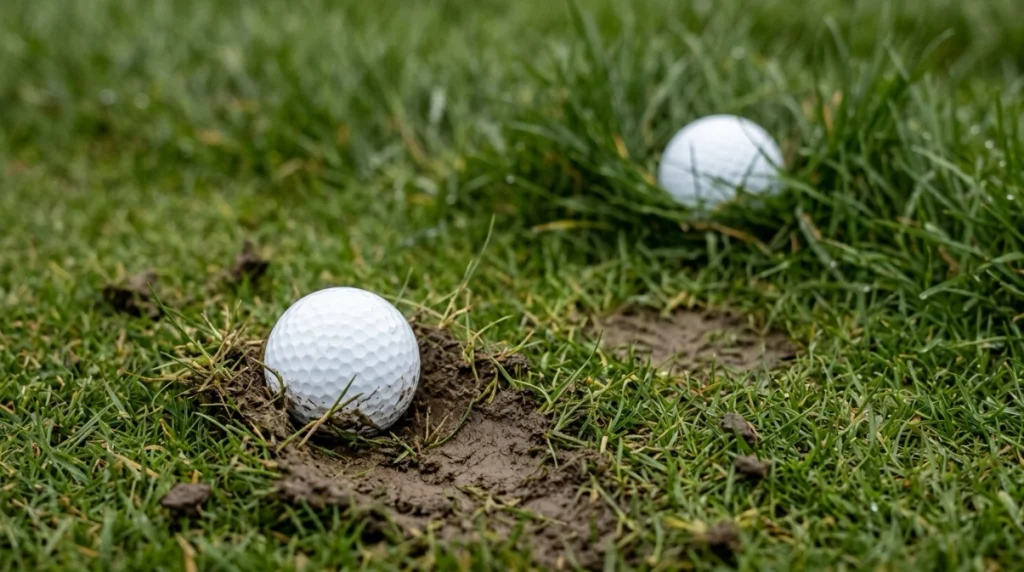
A ball is embedded only when three basic conditions line up. A muddy or buried-looking lie is not enough by itself.
- Your previous stroke created the pitch-mark. The ball must be sitting in its own impact mark.
- Part of the ball is below ground level. Grass can remain between the ball and the soil.
- The location qualifies for relief. In most cases, that means the ball lies in the general area.
Does the ball have to touch the soil?
No. A ball can meet the definition even when grass or loose material lies between the ball and the soil.
The key test is whether part of the ball sits below the normal level of the ground.
What if the ball is just sitting deep in the rough?
A ball resting down between long blades of grass is not automatically embedded. If no part of it is below ground level in its own pitch-mark, Rule 16.3 does not apply.
This is the check I find most useful on wet courses. Look at the ground level first rather than judging the lie by how much of the ball you can see.
Can you lift the ball to check?
Yes, when you reasonably believe the ball may lie in a condition allowing free relief and you cannot determine that without lifting it. Rule 16.4 allows you to mark the spot and lift the ball to inspect the situation.
Do not clean the ball while checking unless the Rules subsequently allow cleaning because you take relief. The USGA ball-handling procedure explains this restriction.
- Mark the ball’s position before lifting it to check.
- Inspect only what you need to determine whether relief applies.
- Avoid wiping mud from the ball during that inspection.
- If relief is not available, replace the ball as required.
Where Do You Get Free Relief for an Embedded Ball?
Rule 16.3 normally gives free relief for an embedded ball anywhere in the general area. That includes rough as well as fairway.
Other defined course areas work differently, so the location of the ball should be your first check.
| Ball Location | Rule 16.3 Free Relief? | What to Know |
|---|---|---|
| Fairway | Yes | Ball must meet the embedded definition. |
| Rough | Yes | Rough is part of the general area. |
| Wooded/general-area ground | Usually yes | Other Rule 16.3 exceptions can still apply. |
| Sand in general area not cut to fairway height or less | No | This is a specific Rule 16.3 exception. |
| Bunker | No | A bunker is a separate defined area. |
| Penalty area | No | Rule 16.3 does not provide embedded-ball relief there. |
| Putting green | Different procedure | Mark, lift and clean the ball, repair the damage, and replace it. |
The rough is where this rule often saves golfers. A high approach can plug several yards off the fairway after heavy rain and still qualify for free relief.
Section Takeaway: Rule 16.3 is not a fairway-only rule. If your ball is genuinely embedded in the general area, rough normally qualifies too.


How Do You Take Embedded Ball Relief?
Once you establish that Rule 16.3 applies, the relief procedure is simple. The reference point is the spot in the general area directly behind where the ball is embedded.
- Confirm the ball qualifies. Make sure it is in its own pitch-mark with part below ground level.
- Identify the reference point. Use the spot immediately behind the embedded ball.
- Measure one club-length. Your relief area extends one club-length from that reference point.
- Keep the relief area legal. It must remain in the general area and cannot be nearer the hole than the reference point.
- Drop a ball correctly. You may use the original ball or another ball.
How high should you drop the ball?
Drop it straight down from knee height. It must fall through the air without touching you or your equipment before striking the ground.
The ball must first hit the ground inside the relief area and eventually come to rest inside that same relief area.
What if the dropped ball rolls outside the relief area?
Drop it again. If a correctly dropped ball again comes to rest outside the relief area, the Rules provide a placement procedure based on where the second drop first touched the ground.
- Drop from knee height.
- Drop inside the defined relief area.
- Do not deliberately spin, roll, or throw the ball.
- Make sure the ball finishes inside the relief area.
A useful habit is to use a tee to identify the reference point before measuring. It makes the one-club-length boundary easier to visualize without changing the relief procedure.
Section Takeaway: Start from the spot directly behind the embedded ball, measure one club-length, and make sure the dropped ball stays in the legal relief area.
When Is Embedded Ball Relief Not Allowed?
Free relief is not automatic simply because the ball is buried. Rule 16.3 contains specific limits, and a Committee can add another through a Local Rule.
1. The ball is embedded in certain sand
There is no Rule 16.3 relief when the ball is embedded in sand in part of the general area that is not cut to fairway height or less.
This can matter around sandy waste-style areas that are still classified as general area rather than bunkers.
2. Another condition makes the stroke clearly unreasonable
You cannot use the embedded ball condition to escape a lie where something else already makes a normal stroke clearly unreasonable.
A typical Rules example is a ball buried near a bush where the bush independently makes a stroke impossible.
3. The ball is not in its own pitch-mark
A ball pushed into the ground by someone stepping on it does not qualify as embedded under Rule 16.3. Neither does every ball that becomes buried for a reason unrelated to its own pitch-mark from your previous stroke.
- A deep grassy lie without a pitch-mark does not qualify.
- A ball pressed into soft soil by an outside action does not qualify under the embedded definition.
- A ball buried in a bunker does not receive Rule 16.3 relief.
- A ball embedded in a penalty area does not receive Rule 16.3 relief.
4. A Local Rule limits relief
A Committee may use Model Local Rule F-2 to limit embedded-ball relief. One version restricts free relief to parts of the general area cut to fairway height or less.
That is why I always check the Local Rules before assuming a plugged ball in deep rough qualifies during competition.
The current USGA Rules clarifications include the available Model Local Rule language.
Section Takeaway: Confirm both the standard Rule and the course’s Local Rules. A valid embedded ball under normal Rule 16.3 may be treated differently when Model Local Rule F-2 is in force.
What Embedded Ball Rule Mistakes Should You Avoid?
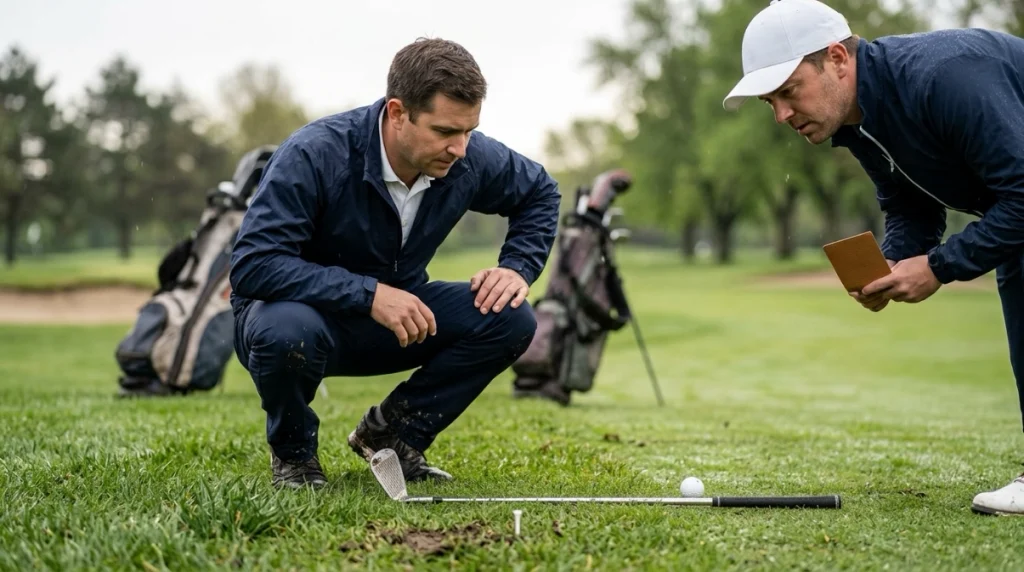
Most mistakes happen before the drop. Golfers misidentify the lie, misunderstand the general area, or choose the wrong reference point.
Mistake 1: Calling every buried lie “embedded”
Imagine a ball disappearing into thick, wet rough without breaking the ground surface. That may be an awful lie, but Rule 16.3 requires part of the ball to sit below ground level in its own pitch-mark.
Mistake 2: Assuming relief only applies in the fairway
The normal Rule now covers the general area. That means a properly embedded ball in rough can qualify unless a Local Rule restricts relief.
Mistake 3: Measuring from the ball instead of behind it
The reference point is the spot directly behind where the ball is embedded. Your one-club-length relief area is measured from that point.
Mistake 4: Cleaning a ball while only checking the lie
If you lift the ball under Rule 16.4 only to determine whether relief exists, do not automatically wipe it clean. Cleaning when the Rules do not allow it can result in a penalty.
Mistake 5: Playing after the ball rolls outside the relief area
A dropped ball must come to rest in the required relief area. Playing it from outside can become a wrong-place breach.
The penalty for playing from a wrong place under Rule 16.3 is the general penalty.
- Match play: Loss of hole.
- Stroke play: Two penalty strokes.
When I run through an embedded-ball situation, I use the same order every time: pitch-mark, ground level, course area, Local Rule, then drop. That sequence removes most uncertainty before the ball is lifted.
Section Takeaway: Identify the condition before worrying about the drop. Most Rule 16.3 errors begin with an incorrect assumption about whether the ball qualified at all.
Embedded Ball Rule FAQ
Do you get free relief from an embedded ball in the rough?
Yes, under the normal Embedded Ball Rule. Rough is part of the general area, so free relief is normally available when the ball is embedded in its own pitch-mark and part of it lies below ground level.
Is a plugged ball the same as an embedded ball?
Golfers often use “plugged ball” as an informal term for an embedded ball. For Rules purposes, however, the ball must meet the formal Rule 16.3 definition rather than simply looking buried or sitting deep in grass.
Do you get relief from an embedded ball in a bunker?
No. A bunker is not part of the general area, so Rule 16.3 does not provide free embedded-ball relief there. You may play the ball as it lies or consider another Rule that applies to your situation.
Can I clean an embedded ball after lifting it?
If you are taking permitted Rule 16.3 relief, you may substitute another ball, so cleaning the original is not an issue for the relief procedure. If you lift only to check whether relief applies, cleaning is restricted unless you then take relief.
How many club-lengths do you get for an embedded ball?
The Rule 16.3 relief area is one club-length from the reference point immediately behind where the ball was embedded. The relief area must stay in the general area and cannot be nearer the hole.
Can a Local Rule change embedded-ball relief?
Yes. A Committee may adopt Model Local Rule F-2 and restrict free relief, including limiting it to areas cut to fairway height or less. Check the scorecard, notice board, tournament sheet, or Committee instructions before playing.
What happens if I take embedded-ball relief incorrectly?
Correct the mistake before playing whenever the Rules allow you to do so. If you play from a wrong place in breach of Rule 16.3, the general penalty is loss of hole in match play or two penalty strokes in stroke play.
The R&A Rule 16 reference provides another official source for checking the embedded ball procedure and its exceptions.
My simplest advice is to remember three words: pitch-mark, below, general area. If those conditions are satisfied, check for an exception or Local Rule, establish the point directly behind the ball, and take your free relief carefully.
Learning that short sequence makes Rule 16.3 much easier to handle when wet conditions turn an ordinary approach shot into a plugged lie.