
Out of Bounds Rules in Golf: Penalties, Relief, and Common Mistakes

Quick Answer
A golf ball is out of bounds only when the entire ball lies beyond the course boundary. Under Rule 18.2, the standard procedure is stroke-and-distance relief: add one penalty stroke and play again from where you made the previous stroke.
What to do immediately
- Check the whole ball: Any part touching or overhanging the course side of the boundary means the ball remains in bounds.
- Use stroke and distance: Add one penalty stroke and return to the location of your previous stroke.
- Play a provisional: Announce and play one before going forward when the original ball might be out of bounds.
- Check local rules: Some courses use Model Local Rule E-5, which offers an alternative for two penalty strokes.
- Count correctly: A tee shot out of bounds followed by a replacement from the tee means your next stroke is your third.
Before using an alternative procedure
- Read the scorecard or ask the Committee whether the local rule is in effect.
Out-of-bounds situations can turn one loose swing into a confusing scorecard discussion. I’ve seen golfers add the wrong penalty, drop beside a white stake, or treat out of bounds like a red penalty area.
This guide explains the complete out of bounds rules in plain language. It covers boundaries, penalties, provisional balls, local rules, scoring examples, and the mistakes that cause bigger penalties.
In This Guide
What Is Considered Out of Bounds in Golf?
A ball is out of bounds when all of it lies beyond the boundary edge of the course. If any part remains on the course side, the ball is in bounds.
This definition comes from Rule 18.2a. It applies to a stationary ball, so where the ball finishes matters.
How courses mark a boundary
Courses commonly define out of bounds with white stakes, white lines, walls, fences, roads, or another clearly identified edge. The Committee should identify unusual boundaries through local rules.
- White stakes: The boundary runs between the course-side points of adjacent stakes at ground level.
- White line: The course-side edge of the line defines the boundary, and the line itself is out of bounds.
- Wall or fence: The course-side face at ground level normally defines the edge.
- Course edge: The Committee may define the boundary using a road, curb, ditch, or property line.
Boundary stakes and boundary fences are not normal obstructions. You don’t receive free relief merely because one affects your stance or swing.
You also must not move a boundary stake to create room. Doing so can lead to the general penalty if you fail to restore the conditions before playing.
What if the ball touches the boundary line?
A ball touching the course side of a boundary line remains in bounds. It is also in bounds when part of it overhangs the boundary edge above the ground.
I find it helpful to crouch and view the ball along the line between two stakes. Looking from directly above can make a close call harder to judge.
Can you stand out of bounds to hit an in-bounds ball?
Yes. Your feet and body may be out of bounds while you play a ball that rests in bounds.
The ball’s position determines its status. Your stance does not change an in-bounds ball into an out-of-bounds ball.
Section Takeaway: The entire ball must cross the boundary before it is out. White boundary objects generally provide no free relief.
What Is the Penalty for Hitting Out of Bounds?

The standard penalty is stroke and distance. You add one penalty stroke and play a ball from the place where you made the previous stroke.
The “distance” part means losing the ground gained by your original shot. That is why the practical cost often feels like two strokes.
How stroke and distance works
Suppose your tee shot crosses a white-stake boundary. That swing counts as stroke one, and the penalty becomes stroke two.
You return to the teeing area and play stroke three. You may tee the replacement ball anywhere inside that teeing area.
| Situation | Procedure | Next Stroke |
|---|---|---|
| Tee shot goes out of bounds | Add one stroke and play again from the teeing area | Third |
| Second shot goes out of bounds | Add one stroke and replay from the previous spot | Fourth |
| Provisional replaces an out-of-bounds tee shot | Continue with the provisional | Fourth after one provisional shot |
| E-5 local-rule relief after a tee shot | Drop in the permitted relief area and add two strokes | Fourth |
Where do you replay the shot?
The procedure depends on the area where you made the previous stroke. Rule 14.6 explains how to replay from each area.
- Teeing area: Play anywhere within that teeing area, and teeing the ball is allowed.
- General area or penalty area: Drop within one club-length of the previous spot, in the same course area and no nearer the hole.
- Bunker: Drop within one club-length of the previous spot and remain in that bunker.
- Putting green: Place the ball on the exact previous spot, estimating it when necessary.
Under the standard rule, you cannot drop beside the point where the ball crossed the boundary. That option exists only when an applicable local rule permits it.
Section Takeaway: Count the original stroke, add one penalty stroke, and replay from the previous location. A replacement tee shot is stroke three.
When Should You Play a Provisional Ball?
Play a provisional ball when your original might be out of bounds or lost outside a penalty area. It saves you from walking back after an unsuccessful search.
You must play it before another ball becomes the ball in play under stroke and distance. Announce your intention clearly before making the stroke.
How to announce and play it correctly
- State your intention: Say “I’m playing a provisional ball” or use equally clear words.
- Identify the ball: Mention its brand, number, or identifying mark.
- Play from the proper place: Follow the stroke-and-distance procedure for your previous location.
- Search for the original: You normally have three minutes after you or your caddie begins searching.
- Choose the correct ball: Continue with the original if it is found in bounds within the allowed time.
Saying “I’ll hit another” may not clearly announce a provisional. That second ball can immediately become your ball in play under stroke and distance.
When does the provisional become the ball in play?
The provisional becomes the ball in play when the original is lost, confirmed out of bounds, or abandoned under the rule. It also takes over when you play it from nearer the hole than the original ball’s estimated location.
If you find the original in bounds within three minutes, you must abandon the provisional. Its strokes and any penalties involving only that provisional normally don’t count.
During one round, I watched a player find his original just inside the stakes after hitting a perfect provisional. He still had to play the original from a poor lie.
That choice isn’t optional. You cannot select the better ball once the original is found in bounds on time.
Pro tip: Ask a PGA professional or certified rules official to demonstrate provisional-ball scenarios during a playing lesson.
Section Takeaway: Clearly announce a provisional before hitting it. If the original is found in bounds within three minutes, the original remains your ball.

Can You Drop Near Where the Ball Went Out?
Normally, no. You may drop near the boundary only when the Committee has adopted Model Local Rule E-5.
This alternative adds two penalty strokes. It is designed to improve pace of play when a golfer did not play a provisional.
How the E-5 alternative works
The player estimates where the ball crossed the boundary or became lost. A matching fairway reference point is then identified, no nearer the hole.
The relief area generally extends between lines running from the hole through those reference points. It also reaches up to two club-lengths outside those lines, subject to the rule’s limits.
- Penalty: Add two strokes rather than one.
- Result after a tee shot: Drop and play the fourth stroke.
- Purpose: Avoid returning to the tee or previous location.
- Availability: Use it only when the Committee has adopted it.
- Restriction: It is unavailable after you have played a provisional ball.
The USGA’s stroke-and-distance guidance explains the purpose and limits of this alternative. Check the scorecard, notice board, tournament sheet, or golf shop before relying on it.
E-5 is commonly suited to general play. Committees usually avoid it in competitions limited to highly skilled players.
Section Takeaway: Dropping near the boundary is not an automatic option. Confirm that Model Local Rule E-5 applies before using the two-stroke alternative.
Out of Bounds vs. a Penalty Area: What Changes?
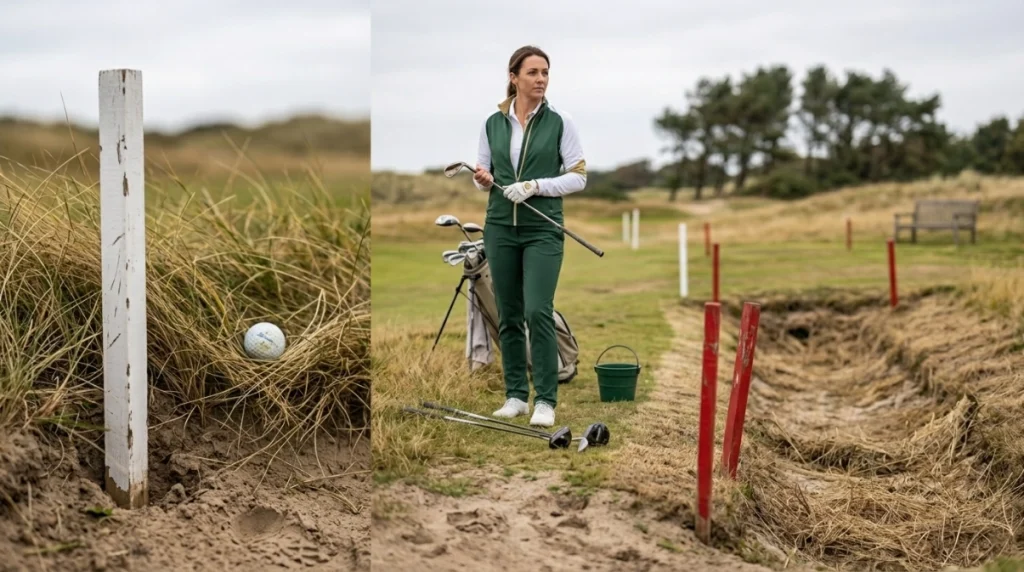
Out of bounds lies outside the course and normally requires stroke and distance. A penalty area remains part of the course and provides extra relief choices.
Color offers the fastest clue. Courses generally use white for out of bounds, yellow for yellow penalty areas, and red for red penalty areas.
| Feature | Out of Bounds | Penalty Area |
|---|---|---|
| Typical marking | White stakes or lines | Red or yellow stakes and lines |
| Standard penalty relief | Stroke and distance | One-stroke relief under Rule 17 |
| Lateral relief | Not under the standard rule | Available for a red penalty area |
| Playing the ball as it lies | Not allowed from out of bounds | Usually allowed when playable |
The R&A’s Rule 17 describes relief from penalty areas. For a red penalty area, the options may include stroke and distance, back-on-the-line relief, and lateral relief.
Don’t decide by looking for water. A dry ditch can be a penalty area, while a property fence beside water can define out of bounds.
Which Out-of-Bounds Mistakes Should You Avoid?
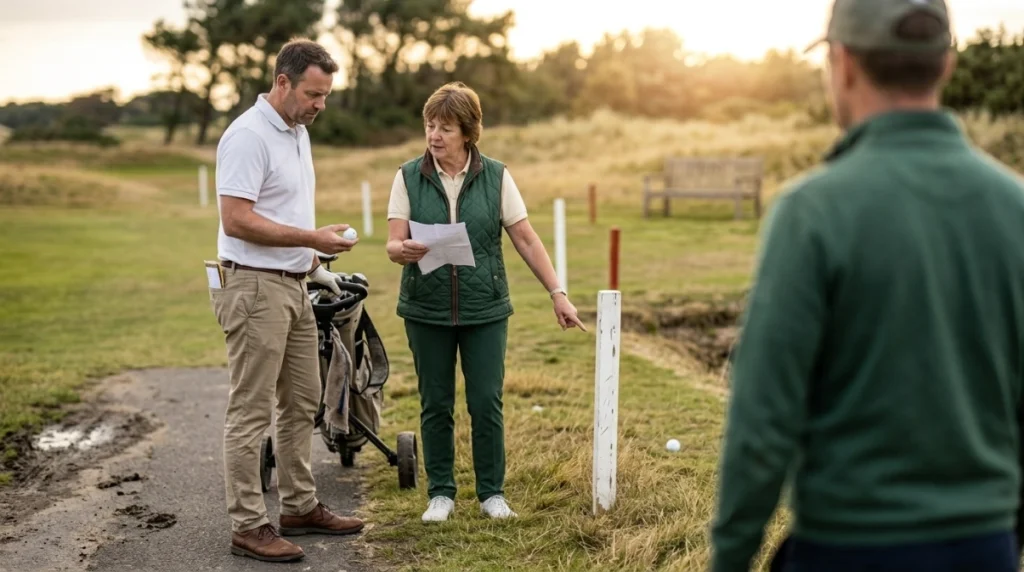
The most damaging mistakes usually happen after the original shot. A correct penalty can grow when a golfer plays from the wrong place or uses the wrong ball.
- Taking a one-stroke lateral drop: Standard out-of-bounds relief requires replaying from the previous location.
- Forgetting the original shot: A replayed tee shot after an out-of-bounds drive is stroke three, not stroke two.
- Failing to announce a provisional: Clearly use the word “provisional” or another unmistakable statement.
- Moving a white stake: Boundary objects are not movable obstructions.
- Playing the original after it is lost: A ball not found within the three-minute search time is lost, even if discovered later.
- Choosing between two balls: You must use the original when it is found in bounds within time and the provisional has not already taken over.
- Assuming E-5 applies: The Committee must adopt the local rule before you may use it.
What if you play an out-of-bounds ball?
A ball lying out of bounds is not on the course. Playing it is treated as playing a wrong ball rather than continuing correctly with your ball in play.
In stroke play, the general penalty is two strokes, and you must correct the mistake before starting the next hole. Failure to correct it can lead to disqualification.
In match play, the general penalty is loss of hole. The exact outcome can depend on the sequence, so involve the Committee promptly.
How to prevent scoring disputes
Before the round, read the local rules and identify unusual internal boundaries. The official USGA Rules Hub is also a useful reference for current interpretations.
- Mark every ball with a unique identification mark.
- Announce the brand and number of a provisional.
- Start the three-minute search time accurately.
- Ask another player to confirm close boundary decisions.
- Record a rules question before leaving the scoring area.
Section Takeaway: Most extra penalties are preventable. Announce provisional balls clearly, verify local rules, and never treat white stakes like red stakes.
Frequently Asked Questions
Is out of bounds a one-stroke or two-stroke penalty?
The standard rule adds one penalty stroke and requires you to replay from the previous location. Because you also lose the distance of the original shot, golfers often describe the total effect as “stroke and distance.” Model Local Rule E-5 uses a two-stroke penalty with an alternative drop.
Is a ball on a white line out of bounds?
A white boundary line is itself out of bounds. However, the ball remains in bounds if any part touches or overhangs the course side of the line.
Can I hit a golf ball that is beyond the white stakes?
No. A ball entirely beyond the boundary is out of bounds and cannot be played. Take stroke-and-distance relief unless an adopted local rule provides another procedure.
Can I move a white out-of-bounds stake?
No. White boundary stakes are boundary objects, not movable obstructions. You receive no free relief from them, and moving one to improve your stroke can result in a penalty unless you restore the conditions correctly.
Can I declare my golf ball lost?
No. A verbal declaration does not make a ball lost. It becomes lost through events defined by the Rules, including not being found within three minutes or another ball becoming the ball in play under stroke and distance.
What happens if my ball crosses out of bounds and returns in bounds?
A ball’s final resting position normally determines whether it is out of bounds. If it finishes in bounds, it is generally in play, although a specific local rule involving a road or internal boundary may change the result.
Can I play a provisional for a ball in a penalty area?
Not when the ball is known to be in the penalty area. A provisional is allowed when the ball might be lost outside a penalty area or out of bounds, including situations where both a penalty area and another possible location are involved.
Know the Boundary Before You Swing
Out of bounds is simple once you remember the core rule: the entire ball must be outside, and the normal relief is stroke and distance. A clearly announced provisional often prevents the slow walk back.
Before every round, check the local rules for unusual boundaries and Model Local Rule E-5. That one-minute check can protect your score and keep the group moving.