Golf Setup Mistakes: Common Errors and How to Fix Them
Quick Answer
The most common golf setup mistakes are poor ball position, incorrect stance width, bad posture, excessive knee bend, poor alignment, and incorrect distance from the ball. These errors can make a decent swing produce inconsistent contact, slices, pulls, or thin and fat shots. I recommend checking your setup before changing your swing mechanics because small address changes can create big differences in ball striking.
Common Setup Errors
- Wrong ball position: Moving the ball too far forward or backward changes the point of contact.
- Poor alignment: Your feet can look square while your shoulders aim well left or right.
- Bad posture: Standing too upright or crouching too much restricts natural movement.
- Wrong stance width: A stance that’s too narrow or wide can hurt balance and consistency.
- Wrong ball distance: Standing too close or far away changes your swing path and contact point.
- Excessive tension: Tight hands, arms, and shoulders can make the takeaway and downswing harder to repeat.
Quick Check
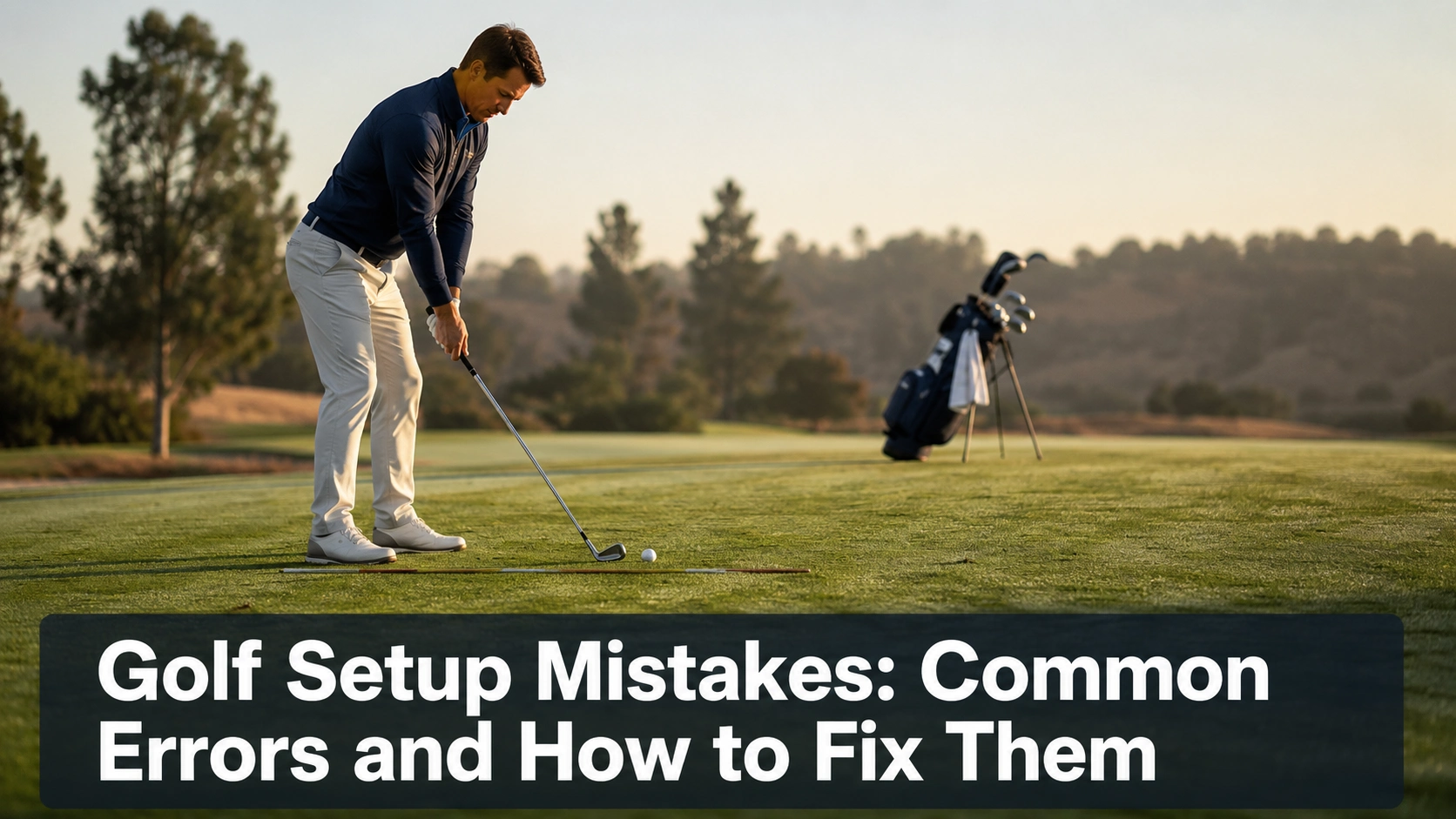
- Use a club on the ground: Place a club along your target line and check whether your feet, hips, and shoulders match your intended direction.
I’ve learned that many swing problems start before the club ever moves. A golfer can spend an hour changing the takeaway when the real issue is simply poor setup.
This guide breaks down the biggest golf setup mistakes I see, how each one affects the shot, and the simple checks I use before changing mechanics.
In This Guide
- What Is a Good Golf Setup?
- Is Your Ball Position Causing Problems?
- Why Does Golf Alignment Go Wrong?
- How Do Posture and Stance Affect Your Swing?
- Are You Standing the Wrong Distance From the Ball?
- Which Setup Mistakes Change With Different Clubs?
- How Can You Check Your Golf Setup?
- Golf Setup Mistakes FAQ
What Is a Good Golf Setup?
A good golf setup puts your body and club in a position that allows the swing to move naturally toward the target. It includes posture, stance width, ball position, alignment, distance from the ball, grip, and body balance.
The key is consistency. You don’t need a perfect-looking address position, but you do need a setup that supports repeatable contact.
What does golf setup mean?
Golf setup is the position you create before starting the backswing. It determines where the club begins, where your body is balanced, and how the club can approach the ball.
I think of setup as the starting line for the swing. If that starting line changes from shot to shot, the swing has to compensate.
- Posture: Your hips and knees should allow you to balance comfortably.
- Stance: Your feet provide the base for the movement.
- Ball position: The ball needs to match the club and shot you’re playing.
- Alignment: Your body should support the intended target line.
- Distance: The club should sit naturally behind the ball without excessive reaching.
- Grip: Your hands should control the club without unnecessary tension.
Why does setup matter so much?
Your setup influences the path, low point, face delivery, balance, and quality of contact. That’s why a small address error can show up as a much larger ball-flight problem.
Before rebuilding a swing, I prefer to eliminate the simple variables first. Setup is one of the easiest places to start.
Section Takeaway: A repeatable setup gives your swing a repeatable starting point. Fix address errors before chasing complicated swing changes.
Is Your Ball Position Causing Problems?

Ball position is one of the most common golf setup mistakes because golfers often use one position for every club. The correct position changes as club length, swing direction, and intended shot change.
Ball position isn’t about memorizing one exact spot. It’s about creating a consistent relationship between the ball and your swing.
What happens when the ball is too far forward?
A ball that’s too far forward can cause contact to occur later in the swing than intended. Depending on the club and swing, that can contribute to pushes, slices, thin contact, or inconsistent strikes.
With irons, excessive forward ball position can also move the ball away from the preferred low-point relationship.
What happens when the ball is too far back?
A ball that’s too far back can encourage earlier contact and alter the club’s delivery. Players may see pulls, hooks, low shots, or inconsistent compression.
It can also encourage golfers to manipulate the clubface because they sense the ball is not where they expect it.
Should ball position change for different clubs?
Yes. Club length and the intended swing influence where the ball should sit relative to your stance.
| Club Category | Typical Setup Pattern | Main Setup Priority |
|---|---|---|
| Driver | Forward within the stance | Stable base and consistent strike |
| Fairway wood | Forward of center | Clean contact and balanced setup |
| Mid iron | Around the center area | Consistent low point |
| Short iron | Near the center | Control and centered contact |
| Wedge | Near the center | Strike and distance control |
These are useful starting patterns rather than universal measurements. Your swing, club design, shot shape, and playing conditions can justify adjustments.
For rules and equipment questions, the R&A Equipment Rules provide the governing framework for conforming golf equipment.
Section Takeaway: Don’t force every club into the same ball position. Match the ball position to the club and the shot you’re trying to produce.
Why Does Golf Alignment Go Wrong?
Golf alignment mistakes happen because golfers often judge their target line from beside the ball. Your eyes can make a line look correct even when your feet, hips, and shoulders point somewhere else.
The result can be confusing. You may make a decent swing but start the ball in an unexpected direction.
What should you align first?
The clubface is the most useful starting reference because it directly contacts the ball. Once the face is aimed, build your body alignment around it.
- Pick a specific target.
- Choose a spot a few inches ahead of the ball on that line.
- Set the clubface toward that intermediate target.
- Place your feet and body parallel to the target line.
- Make your final setup without repeatedly changing the face.
Why can your shoulders ruin alignment?
Golfers often focus on their feet while ignoring their shoulders. A closed or open shoulder line can influence the path even when the feet look square.
I use a club laid along the ground as a simple visual check during practice. It immediately exposes alignment habits that are difficult to feel.
Can alignment cause a slice?
Alignment alone doesn’t explain every slice, but poor alignment can make an existing swing pattern harder to manage. A player who aims left may then swing left to match the target, creating another layer of compensation.
That is why I check setup before assuming the clubface or swing path needs a major change.
Section Takeaway: Build alignment from the clubface outward. Use an intermediate target and a ground reference instead of trusting your eyes alone.

How Do Posture and Stance Affect Your Swing?
Posture and stance create the body’s foundation for the swing. Poor posture can restrict rotation, while an unsuitable stance width can make balance harder to maintain.
The goal isn’t to copy a professional golfer’s exact address position. Your setup should let you move comfortably and repeatedly.
What are common posture mistakes?
- Standing too upright: This can reduce your ability to maintain a balanced relationship with the ball.
- Bending too much: Excessive hip or knee flex can make the setup feel cramped.
- Locking the knees: Rigid legs can reduce comfortable movement.
- Rounding excessively: Too much upper-body curvature can make rotation feel restricted.
- Tilting incorrectly: Poor body tilt can change how the club returns to the ball.
How wide should your golf stance be?
Stance width should provide stability without making your lower body feel locked. Longer clubs generally benefit from a wider base than shorter clubs.
Shorter shots often use a narrower stance because the swing is smaller and control becomes more important.
Should your knees be bent a lot?
No. Excessive knee bend is a common attempt to get closer to the ball, but it can make the setup feel low and restricted.
Think of athletic balance rather than sitting down. Your weight should feel supported across your feet.
Pro tip: If changing posture or stance causes discomfort or persistent physical strain, work with a certified golf instructor or qualified professional rather than forcing a position.
What does balanced posture feel like?
A balanced setup should let you remain stable without feeling stiff. You should be able to make a small athletic movement without falling toward your heels or toes.
That’s the test I prefer. If the setup feels impossible to balance, it probably needs adjustment.
Section Takeaway: Good posture is functional, not decorative. Build a stable base that lets your body rotate and shift naturally.
Are You Standing the Wrong Distance From the Ball?
Distance from the ball is another setup mistake that golfers often overlook. Standing too close can crowd the swing, while standing too far away can encourage reaching and balance problems.
The correct distance depends on the club, your body proportions, and your setup mechanics. There isn’t one universal measurement that works for everyone.
What happens when you’re too close?
A golfer who stands too close may feel cramped at address. The hands can become crowded, and the swing may require compensations to find room.
Common symptoms include heel strikes, pulls, inconsistent contact, and a feeling that the arms cannot move freely.
What happens when you’re too far away?
Standing too far away can encourage you to reach toward the ball. That can disturb balance and change the relationship between your body and the club.
Toe strikes and unstable contact can appear when the setup distance changes repeatedly.
How can you check your distance?
Start by allowing your arms to hang naturally from your shoulders. Then sole the club behind the ball without reaching or pulling your hands toward your body.
Film your setup from down the target line if possible. Video can reveal spacing problems that are difficult to feel while standing over the ball.
Section Takeaway: Let your arms hang naturally and build the club position around your body. Don’t reach for the ball or crowd it.
Which Setup Mistakes Change With Different Clubs?
One of the biggest mistakes I see is treating a driver, iron, wedge, and putter as if they require the same address position. Each club has a different design and job.
Setup should adapt while the basic principles remain consistent.
Driver setup mistakes
- Too narrow: A narrow stance can make the driver setup feel unstable.
- Ball too far back: This can change the intended strike and launch relationship.
- Excessive tilt: Trying to create launch by leaning dramatically can hurt balance.
- Too much tension: Tight shoulders and forearms can make the long club harder to control.
The driver also tempts golfers to chase distance before establishing contact. I prefer to make the setup repeatable first.
Iron setup mistakes
- Ball too far forward: This can move the ball away from the preferred impact relationship.
- Standing too tall: Excessive height can alter your arm position.
- Overly wide stance: This can make the iron swing feel unnecessarily large.
- Excessive grip pressure: Tight hands can reduce natural club movement.
With irons, consistent contact matters more than trying to manufacture extra speed. A stable setup gives you a better chance of returning the club predictably.
Wedge setup mistakes
Wedge shots often require more control than full swings. A stance that is too wide or a setup that is too aggressive can make distance control difficult.
For partial shots, I like a quieter setup. The shorter motion should still begin from a balanced address position.
Putter setup mistakes
Putting has its own setup demands. Eye position, face alignment, ball position, posture, and grip can all influence how consistently you start the ball.
The biggest mistake is changing several variables at once. Make one adjustment, observe the result, and then decide whether another change is necessary.
Section Takeaway: The fundamentals stay consistent, but setup details change with the club. Avoid using one address position for the entire bag.
How Can You Check Your Golf Setup?
The easiest way to improve setup is to turn it into a repeatable pre-shot routine. You don’t need expensive technology to find most address errors.
Use a simple setup checklist
- Pick the target: Decide where the ball needs to go before taking your stance.
- Choose an intermediate target: Find a small spot on the ground between the ball and your target.
- Set the clubface: Aim the face at the intermediate reference.
- Build your stance: Place your feet around the club and establish balance.
- Check posture: Let your arms hang naturally and avoid excessive knee bend.
- Check ball position: Match it to the club and intended shot.
- Relax: Reduce unnecessary tension before starting the swing.
Can video help identify setup mistakes?
Yes. A basic phone recording can show alignment, ball position, posture, and distance from the ball from angles you cannot see yourself.
Record both face-on and down-the-line views. Compare several swings rather than judging one isolated address position.
Should you change your setup before changing your swing?
Often, yes. Setup changes are easier to test and can remove unnecessary compensations before you rebuild swing mechanics.
That doesn’t mean every poor shot comes from setup. It means setup is a sensible first checkpoint.
For current rules and official guidance, the USGA Rules Hub is a useful reference, while The R&A also maintains its official Rules resources.
My 30-Second Setup Check
- Target selected.
- Clubface aimed.
- Feet aligned.
- Ball position checked.
- Posture balanced.
- Arms hanging naturally.
- Grip pressure relaxed.
Section Takeaway: A short setup routine can prevent many avoidable mistakes. Check the address position before making complicated swing changes.
Golf Setup Mistakes FAQ
What is the most common golf setup mistake?
Ball position and alignment are among the most common setup problems. Many golfers also stand too close to the ball or use excessive knee bend. The best first step is to check your setup with a club on the ground or a simple video recording.
How do I know if my golf stance is too wide?
Your stance may be too wide if you struggle to rotate comfortably or feel restricted during the swing. A stable stance should support balance without locking the lower body. Club length and shot type also influence the appropriate width.
Can bad setup cause a slice?
Bad setup can contribute to a slice, but it isn’t the only possible cause. Open alignment, incorrect ball position, poor posture, and excessive tension can interact with an existing swing pattern. Check the setup first before assuming you need a major swing change.
Where should the ball be positioned for irons?
Iron ball position generally works around the center area of the stance, with small changes depending on the club and golfer. There isn’t one exact position for every player. Consistent contact and a repeatable low-point relationship matter more than copying a fixed measurement.
Should my shoulders be parallel to my feet?
In a standard full shot setup, your feet, hips, and shoulders generally work parallel to the intended target line. The clubface points toward the target while your body alignment supports the swing direction. Use an intermediate target to make this easier to check.
How can I fix golf setup mistakes at home?
Use a mirror, phone camera, alignment stick, or spare golf club. Practice your setup without hitting balls and check ball position, posture, alignment, stance width, and distance from the ball. Repeating the same routine helps make the correct setup more automatic.
Should beginners worry about perfect golf setup?
Beginners should focus on a simple, balanced, repeatable setup rather than trying to copy every detail of a professional golfer. Good fundamentals matter, but the address position should remain comfortable enough to support learning and consistent practice.
Final Takeaway: Fix the Setup Before Chasing the Swing
Golf setup mistakes can look small, but they can create large changes in ball flight and contact. The good news is that most setup problems are easier to identify than complicated swing faults.
Start with the basics: alignment, ball position, posture, stance width, distance from the ball, and grip tension. Check one variable at a time.
When I struggle with consistency, I don’t immediately rebuild my swing. I go back to address, make the setup boringly repeatable, and then see what the ball tells me.
That approach is simple, but it works. Build a reliable setup first, then let your swing develop from there.
Ready to practice? Record a few swings from face-on and down-the-line, check your setup against this guide, and work on the single biggest error first.