
Golf Rough Explained: Types, Rules, and How to Play Better Shots

A ball that misses the fairway can leave you with a completely different golf shot. Sometimes it sits neatly on top of the grass. Other times it disappears into a thick lie that makes solid contact difficult.
This Golf Rough Explained guide covers what rough is, why courses use it, how different lies affect ball flight, and which clubs work best. You will also learn the basic rules, common mistakes, and practical techniques for escaping rough without turning one missed fairway into several wasted shots.
Quick Answer
Golf rough is the longer grass surrounding fairways and greens. It makes shots more difficult by reducing clubhead speed, changing contact, and limiting spin control. Before playing from rough, inspect how deeply the ball is sitting, choose a realistic target, and use enough loft to return the ball safely to a playable position.
What Is the Rough on a Golf Course?
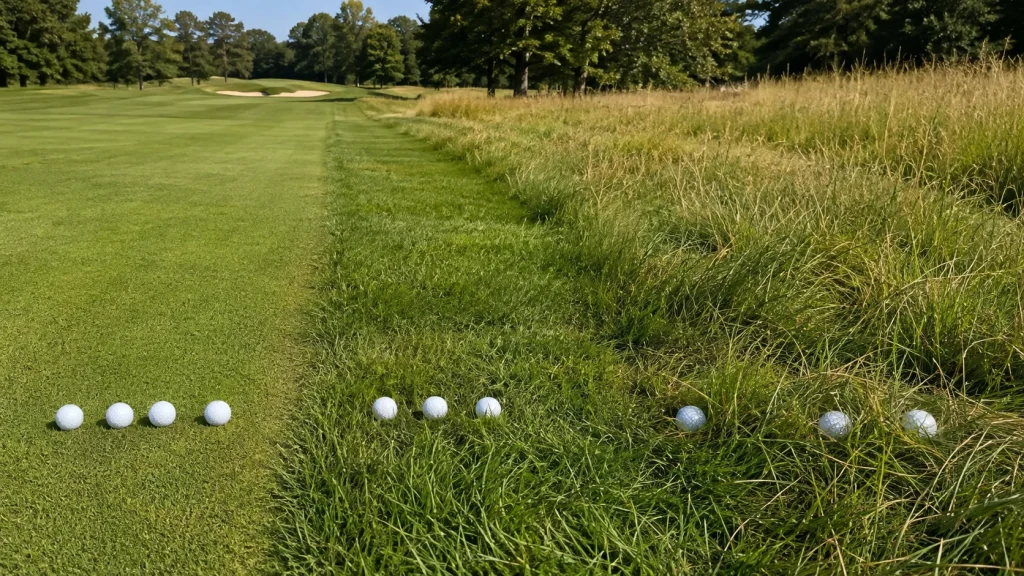
The rough is the longer grass found beside fairways, around greens, and in other areas where the course wants to increase difficulty. It creates a penalty for inaccurate shots without automatically adding a penalty stroke to the golfer’s score.
The exact appearance of rough varies. Some courses have thick, lush grass that wraps around the clubhead. Others use dry native grasses, sandy waste areas, pine straw, or less-maintained vegetation.
Under the USGA explanation of fairways and rough, both the fairway and rough are normally part of the course’s “general area.” This means the same basic Rules of Golf apply even though the playing conditions are very different. (USGA)
Rough has several purposes:
- It defines the shape of a hole.
- It rewards accurate drives and approach shots.
- It creates strategic decisions.
- It separates one hole from another.
- It provides environmental and wildlife areas.
- It reduces the amount of closely maintained turf a course needs.
Rough is not automatically a penalty area or out-of-bounds area. A golfer will normally play the ball as it lies unless another rule allows or requires relief.
Common Types of Golf Rough
Courses do not all use the same terms or mowing heights. However, most rough can be placed into several practical categories.
| Type of rough | Typical condition | Expected difficulty | Sensible club choice |
|---|---|---|---|
| First cut | Slightly longer than fairway grass | Low | Normal iron, hybrid, or fairway wood |
| Primary rough | Ball partially surrounded by grass | Moderate | Iron or hybrid, depending on the lie |
| Deep rough | Ball sits low in thick grass | High | Wedge or short iron |
| Greenside rough | Longer grass close to the green | Moderate to high | Wedge with suitable bounce |
| Native rough | Tall, thin, or tangled vegetation | Very high | Lofted club or unplayable-ball relief |
| Wet rough | Heavy grass containing moisture | High | Shorter, more lofted club |
First Cut
The first cut is a narrow strip of grass between the fairway and primary rough. It is usually only slightly longer than the fairway.
A clean lie in the first cut may allow you to use your normal club. However, the ball can still launch with less spin, especially when grass or moisture becomes trapped between the clubface and ball.
Primary Rough
Primary rough is the regular longer grass found beside the fairway. The ball may remain visible, but the grass can grab the clubhead during the swing.
This is where club selection becomes important. A strong player may be able to use a mid-iron or hybrid from a favorable lie. A beginner will often score better by using a shorter iron and returning the ball to the fairway.
Deep or Secondary Rough
Deep rough contains longer, thicker grass. The ball may sit below the top of the grass, making clean contact difficult.
Trying to hit a low-lofted club from this lie often causes the clubhead to slow down or twist closed. The result may be a low pull, a weak shot, or a ball that remains in the rough.
Native Rough
Native rough usually receives less mowing and irrigation than primary rough. It may contain tall grasses or natural vegetation.
These areas can reduce course maintenance costs and water use while adding visual character. However, they can also make balls difficult to find and may contain uneven ground, insects, or wildlife.
Use caution before entering tall vegetation. Follow course signs, avoid protected areas, and do not search where snakes, unstable ground, or other hazards may be present.


Why Is Rough Harder to Play From?
Long grass changes the way the club reaches the ball. Instead of moving through a clean path, the clubhead must push through grass before and during impact.
This can cause several problems:
- The clubhead loses speed.
- The face may twist closed.
- Contact moves higher or lower on the face.
- Grass reduces friction between the face and ball.
- The ball launches with unpredictable spin.
- Distance control becomes less reliable.
A ball sitting down in thick grass usually comes out lower and shorter. A ball sitting cleanly on top of light rough may produce a flyer.
What Is a Flyer Lie?
A flyer lie occurs when grass or moisture gets between the ball and clubface, reducing backspin. The ball may launch faster, carry farther than expected, and roll more after landing.
Flyer lies are especially dangerous when hitting toward a firm green, a back pin, water, or trouble beyond the target.
Warning signs include:
- The ball is sitting up in light or medium rough.
- The grass is growing toward the target.
- Moisture is present on the ball or grass.
- You are using a mid-iron with a clean path to the ball.
When a flyer is possible, consider using less club, aiming for the front of the green, or choosing a safer landing area.
How to Read a Golf Ball Lie in the Rough
Do not choose a club until you have inspected the lie. A ball’s position in the grass matters more than the distance to the target.
1. Check How Much of the Ball Is Visible
A fully visible ball may allow a normal shot. A ball with only its top visible usually requires more loft and a shorter target.
When the ball is completely buried, your first goal should normally be escape rather than distance.
2. Look at the Direction of the Grass
Grass growing toward the target offers less resistance than grass growing against the swing.
Into-the-grain rough can slow the club dramatically. Down-grain rough may create a faster, lower-spinning shot.
3. Check the Space Behind the Ball
A clean path behind the ball makes solid contact more likely. Thick grass immediately behind it can catch the hosel and close the clubface.
Also check whether roots, stones, sprinkler components, or uneven ground could damage the club or injure your hands.
4. Consider the Ball’s Height
A ball sitting high can sometimes be struck with a normal iron. However, it may also be easy to hit too high on the face or swing underneath.
A ball sitting low requires a steeper strike and more loft.
5. Choose the Safest Useful Target
Do not automatically aim for the green. Ask:
- Can I make solid contact?
- Can this club clear the grass?
- Is there trouble short or long?
- Would a pitch back to the fairway protect my score?
- Where should my next shot come from?
A 100-yard recovery into the fairway is often better than a failed 170-yard attempt that remains in the rough.
How to Hit a Golf Ball Out of the Rough
There is no single swing for every rough lie. These adjustments provide a reliable starting point for beginner and intermediate golfers.
1. Use More Loft
Higher-lofted clubs are easier to move through thick grass and launch the ball upward. A wedge, 9-iron, or 8-iron is usually safer than a long iron or fairway wood.
The PGA of America’s guidance on escaping heavy rough also recommends prioritizing loft and a realistic recovery rather than forcing a low-lofted club through a buried lie. (PGA of America)
2. Grip the Club Firmly
Grass can twist the clubface during impact. Hold the club slightly more firmly than you would for a normal fairway shot.
Do not squeeze so tightly that your arms become rigid. You need control without creating excessive tension.
3. Move the Ball Slightly Back
For a buried lie, move the ball slightly back from your normal position. This encourages a steeper angle of attack and helps the club reach the ball before too much grass becomes trapped.
Avoid moving it extremely far back, which can deloft the club and produce a low shot that cannot escape.
4. Open the Clubface Slightly When Needed
Thick grass often closes the face. Opening it slightly at address can help preserve loft through impact.
This adjustment is most useful with wedges and short irons. It is less reliable with long clubs.
5. Make a Committed Swing
Deceleration is one of the most common reasons golfers fail to escape rough. Choose a club and target that allow you to swing positively through the grass.
A shorter backswing with firm acceleration is often more effective than a long, hesitant swing.
6. Expect Less Control After Landing
Shots from rough commonly produce less backspin. Plan for more bounce and roll, especially when the green is firm.
Landing the ball short of your ideal fairway-shot target may provide a better result.
Expert Tip: Take one practice swing beside the ball in grass of similar thickness. Notice how strongly the grass grabs the clubhead, but do not disturb the area that affects your actual lie or swing.
Club Selection From Different Rough Lies
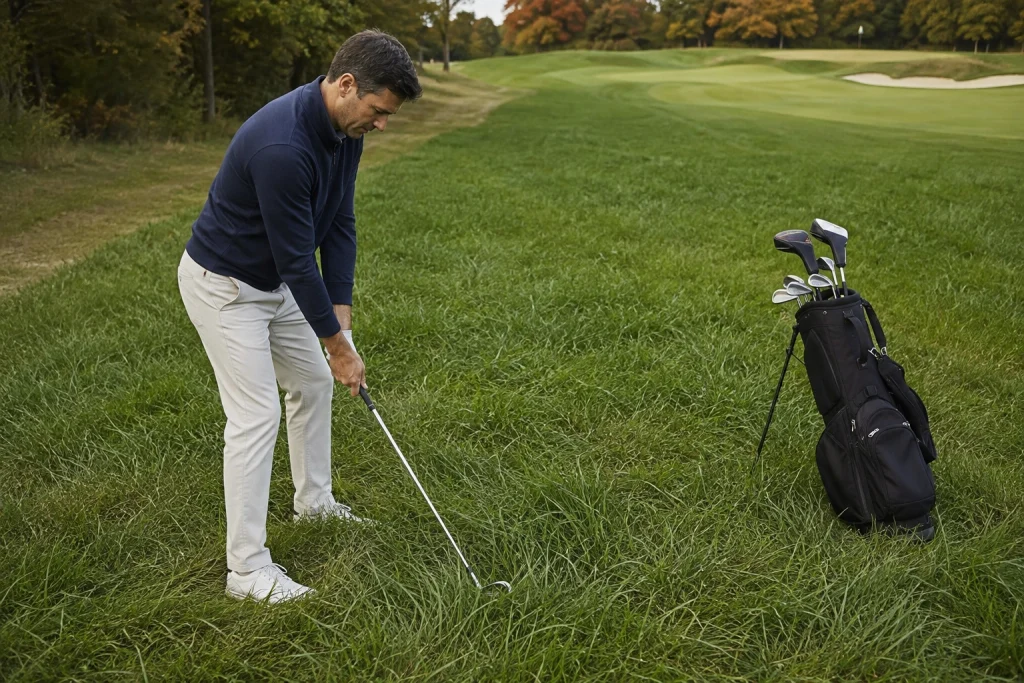
When a Fairway Wood May Work
A fairway wood can work when the ball is sitting high in thin rough and the clubhead has a clear path. Its wide sole may slide through light grass effectively.
Do not use one when the ball is buried or surrounded by thick stems. The low loft and long shaft make consistent contact difficult.
When a Hybrid May Work
A hybrid is often more reliable than a long iron from light or medium rough. Its compact head can move through grass while providing useful loft.
It is still not a rescue tool for every lie. From deep rough, a short iron may be the smarter choice.
When to Choose a Wedge
Use a wedge when:
- The ball is buried.
- Thick grass sits behind the ball.
- You need to clear nearby rough or a bunker.
- Distance is less important than escape.
- You are playing a short greenside shot.
The wedge’s loft and shorter shaft help create a steeper, more controlled strike.
Playing Short Shots From Greenside Rough
Greenside rough requires both lie evaluation and landing-point control.
For a ball sitting cleanly, you may be able to play a normal chip or pitch. For a buried ball, expect the grass to reduce speed and spin.
A basic greenside approach is:
- Select a wedge with enough loft.
- Set most of your pressure on the lead foot.
- Keep the handle slightly ahead.
- Make a compact backswing.
- Accelerate through the grass.
- Allow for extra rollout.
Do not automatically use your highest-lofted wedge. A less-lofted wedge may be easier when there is plenty of green available, while more loft may be necessary when the ball must rise quickly.
Rules and Etiquette in the Rough
Play the Ball as It Lies
In most cases, you must play a ball in the rough from its existing position. You cannot press down grass, bend growing vegetation, or create a cleaner path if doing so improves the conditions affecting your stroke.
You may usually move loose natural objects such as leaves or detached twigs, provided you do not cause the ball to move. Different consequences can apply if the ball moves, so check the Rules when uncertain.
Search Time for a Lost Ball
A ball is considered lost when it is not found within three minutes after the player or caddie begins searching. The official R&A lost-ball rule explains the search period and the stroke-and-distance procedure that applies when a ball is lost. (R&A)
To protect pace of play:
- Watch the ball until it stops or disappears.
- Choose a fixed reference point near the landing area.
- Play a provisional ball when the original may be lost outside a penalty area or out of bounds.
- Help other players search without delaying the group behind.
Declaring a Ball Unplayable
You may decide that a ball in the rough is unplayable, even when it is technically possible to make a swing.
The USGA unplayable-ball guidance provides three standard relief options for one penalty stroke: stroke-and-distance relief, back-on-the-line relief, or lateral relief within two club-lengths, subject to the required limits. (USGA)
Taking one penalty stroke can be the smartest decision when:
- The ball is buried in extremely thick grass.
- A tree, root, or bush blocks the swing.
- A dangerous stance would be required.
- The likely recovery could create a much larger score.
Never strike near exposed roots, rocks, maintenance equipment, or another person. Protecting yourself and your playing partners is more important than saving one stroke.
Why Rough Conditions Vary Between Courses
Rough difficulty depends on more than mowing height. Grass species, moisture, soil, weather, shade, and maintenance practices all affect playability.
A course with a large maintenance budget may produce dense, consistent rough. Another course may use natural or low-input areas to control water, fuel, labor, and equipment costs.
Course quality should not be judged only by whether every rough area is green and uniform. Natural rough can improve drainage, support wildlife, reduce resource use, and create strategic character. The limitation is that very long grass may increase search times and slow play.
Tournament rough may also be grown longer than normal. Do not assume everyday course conditions will match what you see during a professional championship.
Common Mistakes Golfers Should Avoid
- Choosing a club based only on distance: The lie determines which club can reach the ball cleanly.
- Trying to hit a long iron from deep grass: Low loft and a narrow clubhead often make escape harder.
- Ignoring grass direction: Into-the-grain rough creates far more resistance.
- Swinging too gently: Hesitation allows the grass to stop or twist the club.
- Trying to lift the ball: Scooping usually produces poor contact. Let the club’s loft launch the ball.
- Aiming directly at a difficult flag: Reduced spin can send the ball through the green.
- Assuming every rough shot will fly short: A clean flyer lie may travel unexpectedly far.
- Improving the lie: Pressing down grass or moving growing vegetation can result in a penalty.
- Risking injury near roots or rocks: Take relief when the swing could damage your club or hands.
- Searching without a reference point: Watch the ball carefully and identify a landmark immediately.
When to Get Help From a Golf Pro or Fitter
Book a lesson with a qualified golf professional when rough shots regularly cost multiple strokes, even after you make conservative club choices.
A professional can help you:
- Recognize different lies.
- Create a steeper strike without excessive tension.
- Control the clubface through thick grass.
- Select safer targets.
- Develop dependable greenside techniques.
A club fitting may help when your irons or wedges are poorly suited to your swing. A fitter can assess club length, lie angle, shaft characteristics, sole width, wedge bounce, and gapping.
However, equipment cannot overcome unrealistic decisions. Learn to read the lie and choose the correct shot before buying a specialized club.
FAQs
Is the rough considered a penalty area?
No. Regular rough is normally part of the general area. Penalty areas are separately defined and are usually marked with red or yellow stakes or lines.
Can I ground my club in the rough?
Yes, you may normally rest the club behind the ball. However, you must not press down the grass or take another action that improves the lie, swing path, stance, or intended line of play.
What is the best club for hitting out of thick rough?
A wedge or short iron is usually the safest choice. The extra loft and shorter shaft make it easier to move through the grass and return the ball to a playable area.
Why does my clubface close in the rough?
Long grass can wrap around the hosel and heel of the club. This slows that part of the clubhead and turns the face closed, often producing a shot that starts or curves left for a right-handed golfer.
Should I use a hybrid from the rough?
A hybrid can work from light or medium rough when most of the ball is visible. Avoid using it from deeply buried lies where a shorter, more lofted iron offers a better chance of escape.
Do shots from the rough go farther or shorter?
They can do either. Thick grass usually reduces clubhead speed and distance. A clean flyer lie may reduce spin and make the ball travel farther or roll more than expected.
Can I take free relief from thick rough?
Not simply because the grass is difficult. Free relief may be available when an abnormal course condition interferes, such as temporary water, ground under repair, an animal hole, or an immovable obstruction. Otherwise, play the ball as it lies or consider penalty relief.
Conclusion
The rough is designed to challenge inaccurate shots, but it does not need to ruin your score. The most important steps are to inspect the lie, choose enough loft, aim for a realistic target, and make a committed swing.
This Golf Rough Explained guide should help you recognize when an aggressive shot is possible and when a simple recovery is the smarter decision. During your next round, evaluate the grass before checking the yardage, choose the club that can escape cleanly, and focus on placing your next shot in a position you can manage.