
Distance From Ball in Golf: How Far Away Should You Stand?

Quick Answer
The correct distance from the ball in golf lets your arms hang naturally beneath your shoulders without reaching or feeling crowded. Hinge from your hips, add a small knee flex, let your arms fall, and then place the club behind the ball. There is no perfect inch measurement for every golfer because height, posture, arm length, and club length change the spacing. The PGA setup distance checkpoint uses natural arm hang as the main reference.
Quick Setup Check
- Build your posture: Hinge forward from your hips instead of rounding your upper back.
- Let arms hang: Your hands should fall naturally below your shoulders.
- Set the club: Bring the grip to your hanging hands instead of reaching toward it.
- Check your balance: Pressure should feel centered through your feet, not pushed onto your toes or heels.
- Make a rehearsal: You should be able to swing without feeling trapped or stretched.
Remember
- Longer clubs naturally place the ball farther from you. Short wedges bring it closer.
Distance from the ball looks like a small setup detail, but it affects almost everything that happens next. Stand too close and your arms can feel trapped; stand too far away and you may reach, lose balance, or change your posture.
I prefer treating distance as the result of good posture rather than something you measure first. Once your body is balanced and your arms hang naturally, the correct spacing becomes much easier to repeat.
In This Guide
- What Is the Correct Distance From the Ball in Golf?
- How Do You Know If You Are Too Close or Too Far Away?
- Should Your Distance From the Ball Change With Each Club?
- How Can You Find Your Ideal Distance at the Driving Range?
- What Setup Mistakes Change Your Distance From the Ball?
- Frequently Asked Questions
- What Should You Do Next?
What Is the Correct Distance From the Ball in Golf?
The correct distance is the spacing that allows you to maintain balanced posture while your arms hang naturally under your shoulders. You shouldn’t need to stretch your hands toward the grip or pull them inward toward your legs.
Definition: Distance from the ball is the horizontal space between your body and the golf ball at address after posture, stance, and club position have been established.
Start With Posture, Not the Ball
A common mistake is placing the club behind the ball first and then forcing your body into whatever position reaches the grip. Reverse that process.
Stand tall first. Soften your knees, hinge forward from your hips, and let your arms fall naturally toward the ground.
- Hip hinge: Your pelvis moves backward while your chest tilts forward.
- Knee flex: Keep it athletic and relaxed rather than sitting deeply.
- Arm hang: Let gravity position the arms instead of pushing them outward.
- Foot pressure: Stay balanced rather than leaning onto the toes.
Good posture creates room for your arms without manufacturing it. PGA instruction also emphasizes maintaining an athletic posture because changing that relationship during the swing can affect contact.
You can review a useful PGA posture drill if your setup feels inconsistent before you even think about ball spacing.
Let the Club Come to Your Hands
Once your arms hang naturally, place the club into your hands and sole the clubhead behind the ball. Your address position should feel connected rather than stretched.
For a right-handed golfer, one simple check is to let your trail arm hang freely. Swing that hand gently toward the grip without moving your torso.
- If your hand reaches the grip comfortably, your spacing is probably close.
- If you must stretch forward, you are likely too far away.
- If your hand naturally falls beyond or in front of the handle, you may be too close.
That test is useful because it responds to your body proportions. A fixed measurement cannot do that as reliably.
Should There Be a Specific Number of Inches?
You will sometimes hear golfers use a hand-width or several inches between the grip and thighs as a checkpoint. It can help visually, but it should never become a rigid rule.
A tall golfer with long arms may look different from a shorter golfer with the same club. Club length, lie angle, posture, grip height, and body proportions all affect the visible gap.
The better goal is repeatability. Build the same posture, arm hang, balance, and club position every time.
Section Takeaway: The correct distance from the ball is created by posture and natural arm hang, not by forcing yourself to match one universal measurement.
Pro tip: If finding a balanced posture causes back, hip, knee, or shoulder discomfort, work with a certified golf instructor and an appropriate health professional rather than forcing a textbook-looking position.
How Do You Know If You Are Too Close or Too Far Away?

Standing too close often makes the arms feel crowded, while standing too far away creates reaching and balance problems. Both mistakes can force compensations before the club even starts moving.
| Checkpoint | Too Close | Neutral Setup | Too Far |
|---|---|---|---|
| Arm hang | Hands feel pulled inward | Arms hang below shoulders | Arms reach outward |
| Balance | May shift toward heels | Centered and athletic | Often moves toward toes |
| Hand room | Crowded near thighs | Comfortable clearance | Excessive reach |
| Typical feeling | Trapped | Relaxed | Stretched |
Signs You May Be Standing Too Close
Your hands need space to move through impact. Crowding the ball can reduce that room and encourage you to stand up, pull your arms inward, or reroute the club.
- Your hands sit unusually close to your thighs.
- Your arms feel tucked against your body.
- You struggle to swing without raising your torso.
- Your setup feels cramped before the takeaway.
- You repeatedly strike shots from the heel area of the face.
Heel strikes can have several causes, so don’t diagnose your entire swing from contact location alone. Use impact location as evidence alongside posture and balance.
Signs You May Be Standing Too Far Away
Reaching is the clearest warning. If your shoulders move toward the ball just to reach the grip, the club is probably too far from your natural arm position.
- Your arms point noticeably outward instead of hanging down.
- Your weight feels pushed toward the balls of your feet or toes.
- Your upper back or shoulders feel stretched.
- Your trail shoulder moves forward when you reach for the grip.
- You frequently make contact toward the toe of the clubface.
The best correction is usually small. Moving the ball and club only slightly can change the entire feel of your setup.
Should Your Distance From the Ball Change With Each Club?
Yes. Longer clubs naturally place the golf ball farther from your body, while shorter clubs place it closer.
You should not try to stand the same physical distance from a driver and a pitching wedge. The club itself changes the geometry.
| Club Type | Relative Distance | Posture Tendency | Main Check |
|---|---|---|---|
| Wedge | Closest | More forward bend | Don’t crowd the hands |
| Short iron | Close | Athletic iron posture | Natural arm hang |
| Mid-iron | Moderate | Balanced hip hinge | No reaching |
| Hybrid / fairway wood | Farther | Slightly taller | Stay centered |
| Driver | Farthest | Tallest full-swing posture | Avoid stretching arms |
Distance From the Ball With Irons
For irons, build posture first and let the sole of the club sit naturally on the turf. Your arms should still hang without being pushed away from your chest.
As you move from a wedge toward a 5-iron, the longer club gradually moves the ball farther away. You shouldn’t need a completely different setup routine.
Distance From the Ball With Driver
The driver is longer, so the ball naturally sits farther from your body. The mistake is turning that extra distance into an exaggerated reach.
Your arms can still feel relaxed below your shoulders. You may stand slightly taller than with a wedge because the longer club changes your address geometry.
Why Club Length Matters
Golf clubs are built in different lengths because they serve different jobs. Your setup therefore needs enough flexibility to accommodate the club while preserving the same basic athletic structure.
The R&A publishes the official Equipment Rules governing golf clubs and other equipment. Those standards matter for conformity, while your personal address position remains an individual setup issue.
Section Takeaway: Let club length change the ball’s distance naturally. Don’t force every club into one identical body-to-ball measurement.


How Can You Find Your Ideal Distance at the Driving Range?
The easiest method is to build your setup from the body outward and then test whether you can return the club consistently. Use a mid-iron first because it gives you a neutral starting point.
Try This Five-Step Distance Drill
- Stand tall. Begin without reaching the club toward the ball.
- Hinge from your hips. Let your hips move backward as your chest tilts forward.
- Relax your arms. Allow both hands to hang beneath your shoulders.
- Place the club. Grip it without moving your shoulders toward the ball.
- Move your feet. Adjust your entire stance until the clubhead sits properly behind the ball.
Now make several slow rehearsals. Pay attention to balance and whether your arms can move without feeling trapped.
The PGA has also demonstrated a setup exercise using posture and arm hang to establish where the club should naturally meet the ground. That same concept is useful when your normal address starts drifting.
You can see another version in this PGA setup fundamentals guide.
Use Face Contact as Feedback
Apply removable impact tape or foot-powder spray to the clubface during practice if your facility allows it. Hit a small group of shots without changing your swing thought.
- Centered pattern: Keep testing the setup.
- Repeated heel pattern: Check whether you are crowding the ball or moving toward it.
- Repeated toe pattern: Check whether you are reaching or moving away.
- Scattered pattern: Contact may involve more than address distance.
Do not move farther away after every heel strike or closer after every toe strike. A single mishit is not enough evidence.
Use an Alignment Stick for Repeatability
Place one alignment stick on the ground along your target line. Use a second stick for your toe line if you need help rebuilding the same stance.
After several shots, step away completely. Then rebuild your setup from scratch instead of keeping your feet planted.
That’s the range habit I prefer because it tests whether the position is repeatable. A setup only helps on the course if you can recreate it without a ruler.
Pro tip: If changing your spacing creates a new swing pattern or makes contact worse, a certified PGA professional can separate a setup problem from a swing-path or club-fitting problem.
What Setup Mistakes Change Your Distance From the Ball?
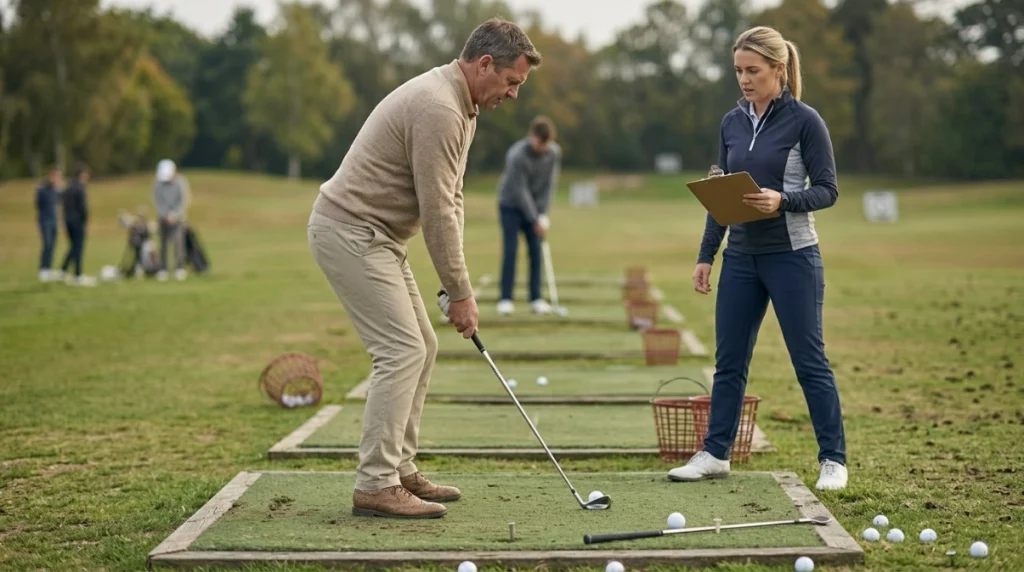
Ball distance rarely goes wrong by itself. It usually changes because another setup piece moved first.
1. Bending From the Upper Back
Rounding your shoulders instead of hinging from the hips changes where your arms hang. That can make an otherwise reasonable ball position feel too far away.
Reset by standing tall and pushing your hips gently backward. Let your chest tilt from the hip joints.
2. Sitting Too Deeply Into the Knees
Excessive knee bend lowers your body and can pull your hands closer to your thighs. Your setup may then feel crowded.
Use enough flex to feel athletic. You should not look or feel like you’re sitting in a chair.
3. Reaching With the Shoulders
Moving your shoulders toward the golf ball simply to reach the handle is a strong sign that your spacing has broken down. Your arms should reach the grip without that extra movement.
PGA Coach Jackie Riegle’s distance check uses this same principle: reaching and changing the shoulder position indicate that the ball may be too far away.
4. Letting Weight Drift Onto the Toes
A stretched setup often pulls your pressure forward. That makes maintaining posture more difficult once the club begins moving.
Check your balance before every swing. You should feel stable enough that a gentle push would not easily knock you forward.
5. Copying Another Golfer’s Exact Look
Professional golfers can look different at address because their height, arm length, club specifications, mobility, and swing patterns differ. Copy principles instead of copying an exact visual gap.
The useful principles are simple: balanced posture, natural arm hang, enough hand clearance, and no unnecessary reaching.
6. Changing Ball Distance to Fix Ball Flight
Moving closer or farther away can change contact, but it is not a reliable cure for every slice, hook, thin shot, or fat shot. Ball flight also depends on clubface direction, swing path, strike location, and impact conditions.
Use setup changes only when your setup checkpoints show a genuine problem. Otherwise, you may replace one issue with another.
Frequently Asked Questions
How far should I stand from the golf ball?
Stand far enough away that your arms hang naturally beneath your shoulders while you maintain balanced posture. You should not need to reach for the grip or pull your hands inward. Exact spacing changes with your body proportions and the club you’re using.
Should my arms hang straight down in the golf swing?
At address, your arms should generally hang naturally from your shoulders instead of being deliberately pushed outward. The exact appearance varies by posture and club, but natural arm hang is a useful checkpoint for finding repeatable spacing.
What happens if I stand too close to the golf ball?
Standing too close can crowd your hands and reduce room for the arms to move. Some golfers compensate by standing up, pulling the club inward, or changing their swing path. Repeated heel contact can also appear, although heel strikes have several possible causes.
What happens if I stand too far from the golf ball?
Standing too far away often makes you reach with your arms or shoulders. Your balance may move toward your toes, and maintaining posture becomes harder. Repeated toe contact can be one clue, but it should be checked alongside posture and balance.
Should I stand farther from the ball with a driver?
Yes. A driver is longer than an iron or wedge, so the ball naturally sits farther from your body. However, your arms should still feel relaxed rather than stretched toward the grip.
Should distance from the ball change with every iron?
It changes gradually as club length changes. A long iron naturally places the ball farther from you than a wedge. Keep your posture and arm-hang principles consistent instead of trying to use one fixed measurement for every iron.
Can standing the wrong distance cause a slice?
It can contribute to compensations, but distance from the ball is not a single cause of a slice. Clubface angle, swing path, strike location, grip, alignment, and movement patterns can all influence curvature. Confirm your setup before changing your swing.
What Should You Do Next?
The best distance from the ball is the one that supports balanced posture, natural arm hang, and repeatable contact. You do not need to memorize a universal number.
As of 2026, the simplest setup advice remains useful: build your posture first, let your arms fall naturally, and then place the club and ball where that structure allows.
- Start with a mid-iron.
- Build posture before positioning the club.
- Check that your arms hang naturally.
- Avoid reaching or crowding your hands.
- Test contact over several shots.
- Repeat the same routine with longer and shorter clubs.
If you keep changing your distance but still cannot find a balanced position, stop guessing. A qualified golf professional can quickly determine whether the problem comes from posture, setup, swing mechanics, or equipment fit.
Take this checkpoint to the range during your next practice session. Five minutes spent rebuilding your setup can be more useful than hitting another bucket of balls from an address position you cannot repeat.