
Indoor Golf Practice: A Complete Guide to Improving at Home

Quick Answer
Indoor golf practice lets you improve putting, ball striking, swing mechanics, and distance control without visiting a course. Start with a safe space, one measurable goal, and simple feedback from alignment aids, impact tape, video, or a launch monitor. The PGA of America can help you find qualified instruction when a swing problem needs hands-on guidance.
A Simple Indoor Practice Plan
- Choose one skill: Work on putting, contact, tempo, or distance control during each session.
- Set up safely: Check your ceiling, walls, floor, lighting, net, and clearance before swinging.
- Add feedback: Use a mirror, phone camera, alignment stick, impact spray, or launch monitor.
- Practice with purpose: Complete drills with targets and scores instead of hitting endless balls.
- Record results: Track strike quality, start line, dispersion, and successful repetitions.
- Transfer outdoors: Test the skill at a range or course before making another swing change.
Indoor golf practice is one of my favorite ways to keep a swing active when weather or daylight limits course time. It works best when every shot has a purpose.
This guide covers putting, chipping, full swings, simulator data, equipment, safety, and weekly routines. You can use it in a small apartment, garage, basement, or commercial simulator bay.
In This Guide
What Is Indoor Golf Practice?
Indoor golf practice means training golf skills inside a home, garage, studio, or simulator facility. It can include putting, slow-motion swings, short chips, net sessions, video review, and simulated course play.
The goal is not merely to stay busy. Good indoor training gives you clear feedback and develops a skill that can transfer to real golf.
What can you improve indoors?
You can improve more than swing appearance. Even a small practice area supports several valuable skills:
- Putting start line: Learn whether the ball begins on your chosen target line.
- Putting pace: Train the ball to finish inside a defined distance window.
- Centered contact: Identify heel, toe, high, or low strikes on the clubface.
- Setup consistency: Check posture, alignment, ball position, and distance from the ball.
- Swing tempo: Develop a repeatable backswing and transition speed.
- Low-point control: Train where the club reaches the bottom of its arc.
- Distance control: Build predictable carry numbers when reliable launch data is available.
Definition: A golf launch monitor is a device that measures ball or club data after impact. Depending on the model, it may report ball speed, launch angle, spin, club path, face angle, and estimated carry distance.
What indoor practice cannot fully reproduce
Indoor training has limits. A flat mat cannot reproduce deep rough, uneven lies, wet sand, wind, changing turf, or the pressure of one attempt on the course.
Putting mats also provide a consistent roll. Real greens change with slope, grain, moisture, firmness, and maintenance.
A simulator can show a complete ball flight, but the displayed result depends on measured data and software calculations. Poor setup or an unread shot can produce misleading feedback.
I learned this lesson after producing tidy seven-iron numbers from a mat. My strike pattern looked controlled, but the first outdoor session exposed a low point that sat slightly behind the ball.
The mat had disguised those heavy strikes. A grass range gave me the missing feedback within five swings.
Section Takeaway: Indoor golf practice builds repeatable skills, but outdoor testing confirms whether those skills transfer to real playing conditions.
How Much Space Do You Need for Indoor Golf Practice?
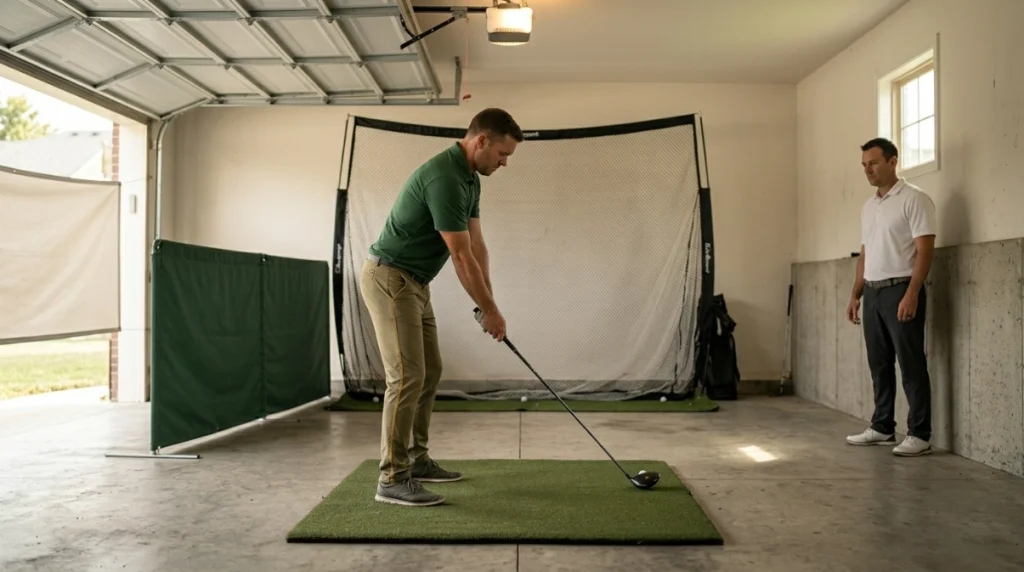
The space you need depends on the drill. Putting needs little vertical clearance, while full swings require safe room around the golfer, club, ball, and enclosure.
Never assume a room is large enough because another golfer uses a similar space. Your height, swing shape, club length, and position inside the room all matter.
Start with a slow clearance test
Hold the longest club you expect to use. Make several slow swings without a ball while another adult watches from a safe position.
Check these areas before increasing speed:
- Ceiling clearance above the backswing and follow-through
- Distance from walls, lights, fans, windows, and furniture
- Space behind the golfer and around the clubhead
- Room between the hitting position and impact screen or net
- Space behind the net to prevent a ball from reaching the wall
- Floor grip and whether the hitting mat can slide
Repeat the check with every golfer who uses the area. A tall player or upright swing may need more clearance.
Indoor practice method comparison
| Practice Method | Best Use | Ball Type | Main Feedback | Space Demand |
|---|---|---|---|---|
| Putting mat | Start line and pace | Real golf ball | Roll and finish position | Low |
| Mirror or video drill | Setup and movement | None required | Visual positions | Low to medium |
| Foam-ball chipping | Contact and landing spot | Foam practice ball | Strike and direction | Medium |
| Net without monitor | Contact and tempo | Real golf ball | Impact location and video | High |
| Launch monitor setup | Flight and distance analysis | Compatible real ball | Measured ball or club data | High |
Safety matters more than convenience
A full-speed golf ball can damage property and cause serious injury. Inspect the net, seams, frame, screen, and side protection before every session.
Keep children, pets, and other people outside the hitting area. Lock doors when someone could enter through a blind spot.
Stop using a net if you find torn fabric, loose fasteners, damaged cords, or a frame that moves. Side barriers may also be needed for shanks and ricochets.
Pro tip: Ask a certified PGA professional to check your setup and swing clearance if you are unsure about practicing full shots indoors.
Section Takeaway: Test the actual swing slowly, protect every possible ball path, and follow the clearance requirements for your specific equipment.
Which Indoor Golf Practice Drills Work Best?
The best indoor drills produce an observable result. A drill should tell you whether the repetition succeeded without requiring a guess.
Choose one drill per skill. Twenty focused repetitions usually teach you more than a long session of random swings.
Gate drill for putting start line
Place two coins slightly wider than your putter head. Set the ball about three feet from a target and make strokes without touching either coin.
Next, build a second gate for the ball several inches ahead of impact. The putter gate tests your stroke path, while the ball gate tests start direction.
- Make five practice strokes through the putter gate.
- Hit ten putts through both gates.
- Count clean strokes and balls that pass through the second gate.
- Narrow the gates only after scoring at least eight successful attempts.
A straight mat can help with alignment, but avoid watching the putter head during the stroke. Keep your attention on setup, rhythm, and the intended start line.
Speed-window putting drill
Place two markers on the floor to create a finish zone. The ball must stop between them rather than simply touch a cup.
Start with a wide zone and reduce it as control improves. Practice from several distances so you do not memorize one stroke length.
- Hit five putts from four feet.
- Hit five putts from six feet.
- Hit five putts from eight feet.
- Score one point whenever the ball finishes inside the window.
- Record the total out of 15.
This drill develops pace awareness. However, carpet speed will not match every course green.
Centered-contact drill for irons
Apply removable impact tape or an appropriate foot-powder spray to the clubface. Confirm that the product is safe for your club’s finish before use.
Hit groups of five shots into a secure net. Mark whether each strike lands near the center, heel, toe, high, or low on the face.
Do not make a mechanical change after every miss. Look for a repeated pattern across several shots.
Low-point control without a ball
Place a strip of painter’s tape on a durable practice mat. Set up so the imaginary ball would sit just ahead of the tape.
Make controlled half-swings and note where the club brushes the surface. For a normal iron shot, the low point should occur after the ball position.
Never perform this drill on flooring that could be damaged. Avoid striking down hard into a thin mat over concrete.
Tempo drill with a metronome
Use a metronome or steady audio beat to create a repeatable rhythm. Match one beat to the start and another to a consistent point in the downswing.
The exact beat rate matters less than repetition. Choose a pace that lets you finish balanced without rushing the transition.
Film three swings at the start and three at the end. Compare the timing without obsessing over isolated body positions.
Pro tip: A qualified instructor can help you choose a swing cue that matches your motion instead of copying a drill designed for another golfer.
Section Takeaway: Effective drills use gates, strike marks, finish zones, or scores to make success visible and repeatable.


How Should You Practice on a Golf Simulator?
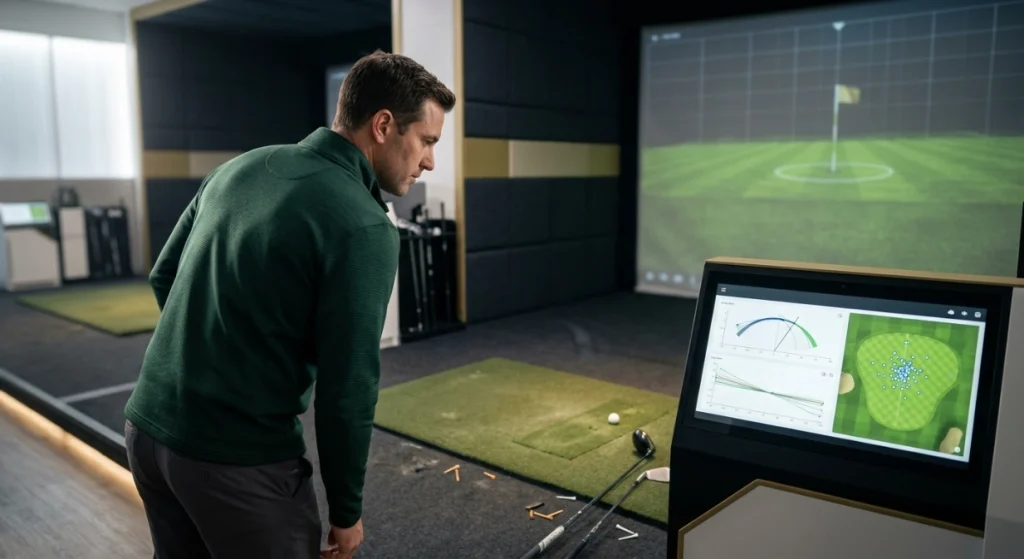
Use a golf simulator as a measurement and decision-making tool, not only as entertainment. Begin in range mode, collect a small sample, and focus on one metric or shot pattern.
Indoor simulators have become a recognized part of modern golf. As of 2026, the USGA supports indoor golf through an official simulator partnership connected with its championships.
Warm up before collecting data
Start with short wedges and controlled swings. Increase club length and speed gradually.
A useful warm-up might include:
- Five slow rehearsal swings without a ball
- Five short wedge shots
- Five half-swings with a mid-iron
- Five comfortable full swings
Do not treat early shots as a performance test. Your body and timing still need time to settle.
Understand the most useful measurements
Launch monitors vary in what they measure directly and what they calculate. Read the manufacturer’s documentation before comparing numbers across different devices.
- Ball speed: The speed of the ball immediately after impact.
- Launch angle: The vertical angle at which the ball begins its flight.
- Spin rate: The number of ball rotations per minute.
- Carry distance: The estimated distance traveled before the first landing.
- Club path: The clubhead’s horizontal direction through impact.
- Face angle: The direction the clubface points at impact.
- Dispersion: The overall spread of a group of shots around a target.
A single shot proves little. Review a group after removing obvious mishits or confirmed misreads.
Use random practice after block practice
Block practice means repeating the same shot with the same club. It helps you explore a movement, but it can become too predictable.
Random practice changes the target, club, or shot between attempts. It better reflects the decisions you face on a course.
Try this nine-shot simulator test:
- Hit a wedge to a short target.
- Hit a seven-iron to a medium target.
- Hit a driver toward a defined fairway.
- Repeat the sequence three times.
- Record playable results instead of total distance alone.
Play simulated holes with one-ball rules
Do not replay every poor shot. Use one ball, accept the result, and make the next decision.
This approach exposes club-selection errors and target problems. It also adds consequences that disappear during unlimited range practice.
Track fairways, greens, penalties, and three-putts. Those measures reveal where practice time may produce the greatest scoring benefit.
Section Takeaway: Use simulator data in groups, combine repeated drills with changing targets, and include one-ball sessions that recreate on-course decisions.
What Equipment Do You Need for Indoor Golf Practice?
You need only enough equipment to make practice safe and measurable. A putter, ball, floor target, and phone camera can support a productive session.
Buy additional technology when it solves a known feedback problem. Expensive equipment cannot replace a clear practice goal.
Basic equipment for a small space
- Putting surface: Use a mat or smooth carpet with consistent roll.
- Golf balls: Reserve clean balls for mats and screens.
- Flat markers: Coins or tape can create gates and distance zones.
- Mirror: Check setup without making full-speed swings nearby.
- Phone tripod: Record face-on and down-the-line views safely.
- Foam balls: Use them for limited-flight practice where appropriate.
Equipment for full shots
- Hitting mat: Choose stable padding that protects joints and flooring.
- Net or impact screen: Use a product designed for golf-ball impact.
- Side protection: Cover reasonable miss directions, including shanks.
- Frame and anchors: Follow the manufacturer’s assembly instructions.
- Lighting: Provide clear visibility without creating screen glare.
- Launch monitor: Confirm required ball flight, placement, and room dimensions.
Some radar-based and camera-based monitors have different placement needs. Never assume that one manufacturer’s spacing works for another device.
Should you buy a golf simulator?
A simulator makes sense when you will practice consistently and have a safe permanent area. It also helps golfers who need measurable ball-flight feedback throughout a long off-season.
Start with these questions:
- Can the room safely accommodate every intended golfer?
- Will the monitor work within the available dimensions?
- Do you need ball data, club data, or both?
- Are software subscriptions or course packages required?
- Can you control noise, lighting, heat, and ventilation?
- Will the setup remain convenient enough for regular use?
A commercial bay may be the better choice for occasional practice. Facilities can provide calibrated technology without requiring permanent home space.
The PGA TOUR Superstore Practice Center is one example of a broad indoor practice option with simulator technology, lessons, and fitting services.
Keep equipment from creating bad practice
Training aids should make a specific error easier to detect. Remove the aid periodically and test whether the skill remains.
Avoid forcing your body around rigid obstacles at speed. Stop if a drill causes pain in your hands, wrists, elbows, shoulders, or back.
Pro tip: Consult a certified instructor or club fitter before using launch data to change equipment, shaft characteristics, or swing mechanics.
Section Takeaway: Begin with simple feedback tools, then add a net, monitor, or simulator only when your space and practice goals justify it.
What Is a Good Weekly Indoor Golf Practice Routine?
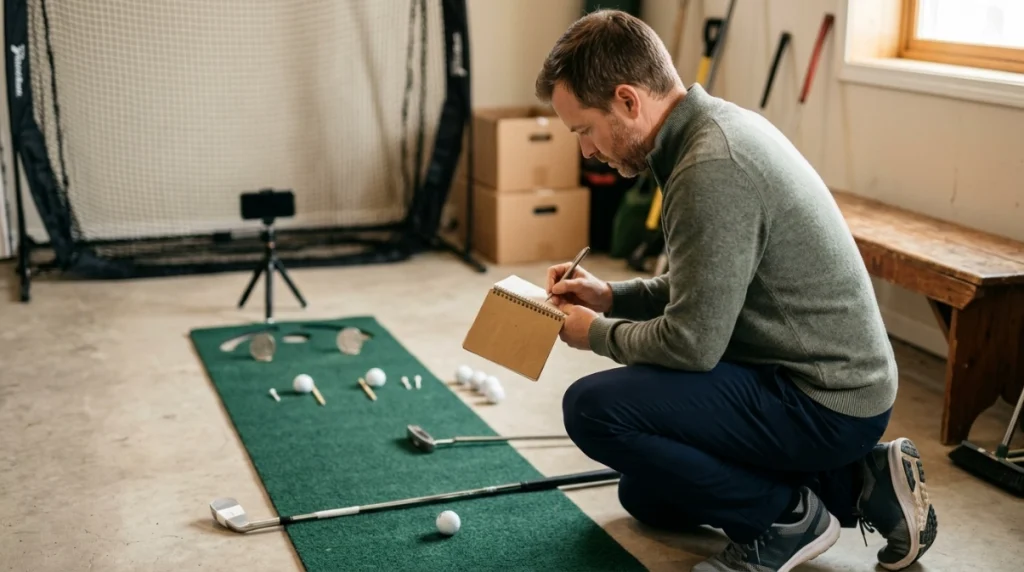
A good weekly routine uses short sessions with different goals. Three focused sessions of 20 to 30 minutes can be easier to maintain than one unfocused marathon.
The PGA recommends setting a regular schedule, covering different areas of the game, and keeping a practice journal. Its guide to better golf practice supports a structured approach.
Three-session weekly plan
| Session | Primary Goal | Practice Blocks | Score to Record |
|---|---|---|---|
| Session 1 | Putting | 5-minute warm-up, 10-minute gate drill, 10-minute speed drill | Gate successes and pace-zone total |
| Session 2 | Contact and tempo | 5-minute warm-up, 10 half-swings, 20 scored strikes | Centered strikes out of 20 |
| Session 3 | Shot variation | Warm-up, three-club target test, nine simulated holes | Playable shots, penalties, greens, and three-putts |
Use a baseline and retest
Begin each four-week practice cycle with a simple test. Repeat the same test at the end under matching conditions.
Your baseline might include:
- Successful start-line putts out of ten
- Putts finishing inside a pace window out of ten
- Centered iron strikes out of twenty
- Playable simulator drives out of ten
- Average dispersion for a selected club
Do not change the test halfway through the cycle. Consistent testing makes progress easier to see.
Separate practice from testing
Practice allows rehearsals, feedback, and adjustments. Testing gives you one attempt and records the outcome.
Mixing the two can hide improvement. A golfer may hit 50 balls and remember only the five best shots.
Finish each session with a short test. Record every attempt, including misses.
Keep a simple practice journal
Your journal does not need technical language. Record the date, drill, score, common miss, and next session’s goal.
- Date: August 13, 2026
- Goal: Start ten putts through the ball gate
- Result: Seven successful attempts
- Pattern: Three misses started left
- Next step: Check alignment before changing the stroke
This format reduces random swing changes. It also gives a coach useful information if you later book a lesson.
Section Takeaway: Schedule short sessions, measure one skill, and retest under the same conditions before deciding whether a change worked.
Indoor Golf Practice FAQ
Can indoor golf practice improve your game?
Yes. Indoor practice can improve putting start line, contact, tempo, setup, and distance control. The greatest gains come from measurable drills and regular outdoor testing. Mats and simulators cannot perfectly reproduce turf, wind, slopes, rough, or on-course pressure.
Can you practice golf indoors without a simulator?
Yes. You can practice putting with a mat, check setup in a mirror, make slow-motion rehearsals, record swings, and use foam balls for controlled chipping. A secure net also supports contact practice when the room provides safe clearance.
How often should you practice golf indoors?
Two or three focused sessions per week can produce useful repetition without encouraging fatigue. A 20-to-30-minute session is enough when it has one clear goal. Stop when tiredness changes your setup, balance, or contact pattern.
Is hitting golf balls into a net good practice?
It can be effective when you track contact, tempo, video, or launch data. A net alone hides the final ball flight, so poor shots may look acceptable. Add impact feedback and confirm the pattern outdoors before making a lasting swing change.
Can you practice chipping inside a house?
You can practice controlled chips with foam balls and a safe target. Remove fragile objects and keep people away from the area. Real golf balls should only be used with suitable protection because even a short chip can damage property or cause injury.
Are golf simulator distances accurate?
Accuracy depends on the device, setup, environment, ball, strike, calibration, and data measured. Compare shot groups rather than trusting one result. Follow the manufacturer’s placement instructions and verify important club distances outdoors under known conditions.
What is the best indoor golf drill for beginners?
A putting gate drill is an excellent starting point because it is safe, measurable, and easy to repeat. For full-swing practice, beginners should begin with slow rehearsals and short swings while focusing on balance and centered contact.
Build a Practice Routine That Transfers to the Course
Indoor golf practice works when it connects a clear goal to visible feedback. Pick one skill, choose a measurable drill, record the result, and test it outdoors.
Start small. A putter, two coin gates, and 20 focused minutes can be more valuable than an hour of unplanned simulator swings.
Once your routine becomes consistent, add contact work, random targets, and one-ball challenges. Seek qualified instruction when pain, confusion, or a persistent swing problem makes self-diagnosis unreliable.