
Stroke Play Rules: Complete Golf Guide for 2026

Quick Answer
In regular stroke play, every stroke and penalty stroke counts toward your total score, and the player with the lowest total wins. You normally must hole out on every hole, keep accurate hole-by-hole scores, correct certain Rules mistakes before starting the next hole, and return a properly certified scorecard. The official Rule 3 stroke play requirements explain the competition and scoring responsibilities in detail.
Stroke Play Rules to Remember
- Count everything: Your score includes strokes made plus any penalty strokes.
- Hole out: Regular stroke play normally requires your ball to finish in the hole on every hole.
- Check the card: Your marker records your gross hole scores, and both marker and player have certification responsibilities.
- Correct mistakes: Wrong-ball, wrong-tee and serious wrong-place errors may need correction before starting the next hole.
- Know relief: Lost balls, out-of-bounds shots, penalty areas and unplayable balls follow different procedures.
- Ask when unsure: In stroke play, Rule 20 can allow you to finish a hole with two balls when no referee is readily available.
Before a Competition
- Read the Terms of the Competition and Local Rules because they can affect procedures, pace requirements and relief options.
Stroke play looks simple because the lowest total score wins. The details become more important once penalties, scorecards, relief procedures and tournament mistakes enter the picture.
I use a simple approach: know the rules that can change a score before the round begins. This guide covers the regular stroke play rules golfers are most likely to need in competition.
As of September 2026, the governing framework remains the 2023 Rules of Golf, together with subsequent official clarifications.
In This Guide
What Is Stroke Play in Golf?
Stroke play is a form of golf in which players compete by comparing their total scores over one or more rounds. Every counted stroke and applicable penalty contributes to that total.
Definition: Regular stroke play adds the number of strokes made and penalty strokes on every completed hole. The competitor with the fewest total strokes over the competition wins.
You may also hear regular stroke play called medal play. That term is common at clubs, although the Rules use “stroke play.”
Gross Stroke Play vs. Net Stroke Play
A gross competition uses your actual score without applying handicap strokes. Shoot 82, and your competition score is 82.
A net competition adjusts the gross score using the handicap procedure set by the competition. This allows golfers of different abilities to compete on a more level basis.
- Gross score: All strokes made plus penalty strokes.
- Net score: Gross score adjusted for applicable handicap strokes.
- Scratch competition: Handicap strokes are not applied.
- Handicap competition: The competition calculates results using applicable handicap strokes.
The current Rules no longer generally require the player to put a handicap on the scorecard. The Committee is normally responsible for calculating handicap strokes, subject to any applicable Model Local Rule.
How Is Stroke Play Different From Match Play?
Stroke play compares your total score with the entire field. Match play compares holes won and lost against a specific opponent or opposing side.
| Rule Area | Regular Stroke Play | Match Play |
|---|---|---|
| How winner is decided | Fewest total strokes | Most holes won |
| General penalty | Two penalty strokes | Loss of hole |
| Conceded putts | Not permitted in regular stroke play | Permitted |
| Playing out of turn | Normally no penalty; responsible ready golf is allowed | Opponent may sometimes cancel the stroke |
| Scorecard procedure | Formal hole-score certification applies | Regular Rule 3.3 scorecard procedure does not apply |
This difference explains why one bad hole hurts more in stroke play. An eight stays on your card instead of merely costing one hole.
Section Takeaway: Stroke play rewards the lowest total score across the competition. Every counted stroke matters, so accurate scoring and correct procedures are central to the format.
How Does Scoring Work in Stroke Play?
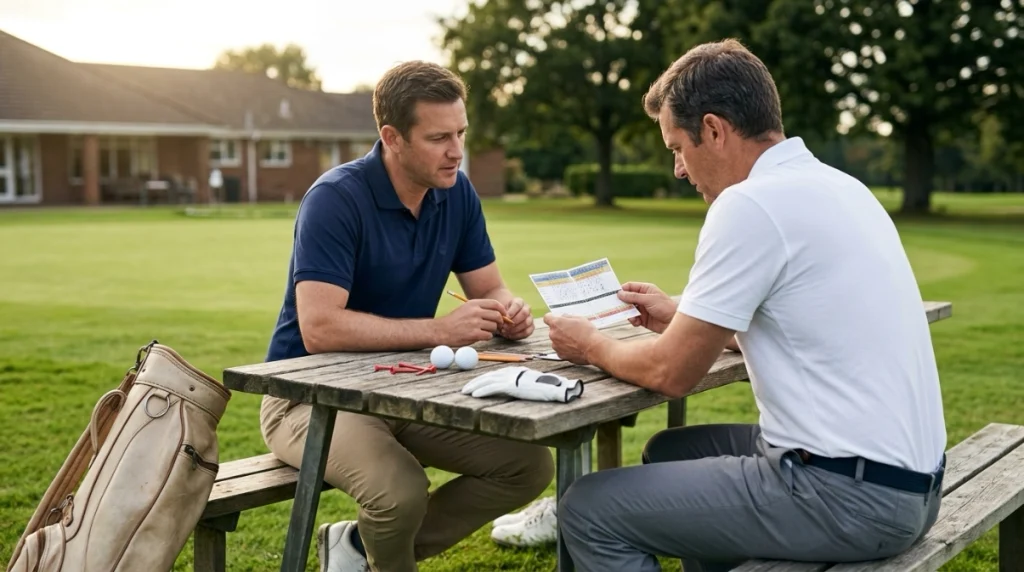
Your score for a hole includes strokes you make plus penalty strokes that apply. Those hole scores combine to create your total round score.
The USGA stroke play guidance also emphasizes that regular individual stroke play normally requires you to hole out on every hole.
Who Keeps Your Score?
A marker is the person responsible for recording your hole scores. The Committee identifies or approves how that marker is selected.
After each hole, your marker should confirm your number of strokes and record the gross score. Penalty strokes belong in that calculation.
- Marker: Records and later certifies your hole scores.
- Player: Checks the scores and ensures required certification is completed.
- Committee: Handles disputes, applies Rules decisions and processes the returned card.
What Must You Do Before Returning the Scorecard?
Check each hole score carefully before returning the card. Fix a disputed hole score with the marker’s agreement or the Committee’s approval.
Your marker must certify the required hole scores. You must also certify them and promptly return the scorecard according to the competition’s procedure.
- Review all 18 hole scores.
- Confirm any penalties that may have applied.
- Resolve doubtful scores with the Committee.
- Make sure the marker certification is complete.
- Certify the scorecard yourself.
- Return it promptly under the Committee’s procedure.
Do this before leaving the scoring process behind. Once the scorecard is considered returned, you normally cannot change it.
What Happens If a Hole Score Is Wrong?
A returned score higher than your actual score normally stands. That mistake costs strokes, but it does not give you a lower score than you earned.
A returned score lower than your actual score normally results in disqualification. There is an important exception for certain penalty strokes you did not know about before returning the card.
| Scorecard Situation | Normal Result |
|---|---|
| Returned hole score is too high | Higher score stands |
| Returned hole score is too low | Disqualification, subject to specific exceptions |
| No score returned for a required hole | Disqualification |
| Player fails to hole out and does not correct in time | Disqualification in regular stroke play |
I prefer to reconstruct each hole while walking toward the next tee. That makes a forgotten penalty easier to catch before the card reaches scoring.
Section Takeaway: The scorecard is part of the competition, not paperwork to rush through. Check individual hole scores and resolve uncertainty before returning it.
What Rules Must You Follow During Each Hole?
Most stroke play mistakes happen during ordinary situations rather than unusual rulings. Starting from the correct tee, playing the correct ball and finishing the hole correctly prevent many costly penalties.
Start From Inside the Teeing Area
Your ball must start the hole from inside the defined teeing area. The teeing area extends two club-lengths behind the front edge established by the tee markers.
If you start a hole from outside the teeing area in stroke play, the general penalty applies. You must then correct the mistake by playing from inside the proper teeing area.
The stroke made from outside the teeing area does not become your ball in play for the hole. Failing to correct in time can lead to disqualification.
Play the Correct Ball
Mark your golf ball before the round. A line, initials or another distinctive mark can prevent an expensive wrong-ball mistake.
Playing a wrong ball in stroke play brings the general penalty of two strokes. You must then correct the mistake by continuing with the correct ball or properly taking relief.
- Wrong-ball stroke: Does not count toward your score.
- General penalty: Add two penalty strokes.
- Correction: Resume play with the correct ball under the Rules.
- Deadline: Correct before starting the next hole, or before returning the card on the final hole.
If you do not correct within that time, disqualification can follow. Checking your identification mark before hitting is much easier.
Play the Ball as It Lies Unless a Rule Allows Relief
Golf starts with a basic principle: play the course as you find it and the ball as it lies. You cannot improve the lie simply because the shot is difficult.
The Rules do provide relief for defined situations. Examples include abnormal course conditions, penalty areas, an unplayable ball and stroke-and-distance relief.
Before lifting or dropping, identify which Rule you are using. That prevents a correct-looking drop from becoming a wrong-place penalty.
You Must Hole Out in Regular Stroke Play
A short putt is not automatically good. There are no concessions in regular stroke play.
If you pick up before holing out, you must correct the mistake in time. Replace or otherwise proceed correctly and finish the hole before starting the next one.
Maximum Score, Stableford and Par/Bogey are different forms of stroke play. They have special scoring Rules that can change what happens when you do not hole out.
Section Takeaway: Start from the proper tee, identify your ball and finish every required hole. Those three habits prevent several of stroke play’s most serious avoidable mistakes.


What Are the Most Common Stroke Play Penalties?
The most useful penalty rules are the ones golfers face repeatedly. Lost balls, out of bounds, penalty areas, unplayable lies and wrong places deserve special attention.
Lost Ball or Out of Bounds
A ball becomes lost when it is not found within three minutes after you or your caddie begins searching. A ball is out of bounds only when all of it lies outside the course boundary.
For a lost ball outside a penalty area or a ball out of bounds, standard Rule 18 relief is stroke and distance. Add one penalty stroke and play again from where the previous stroke was made.
The official Rule 18 lost-ball and out-of-bounds procedures also explain how a provisional ball can save time when the original might be lost outside a penalty area or out of bounds.
Here is the common tee-shot example:
- Your first tee shot goes out of bounds.
- The original swing counts as stroke one.
- Add one penalty stroke.
- Play again from the teeing area.
- The next swing is stroke three.
That is why golfers often describe stroke and distance as especially costly. You add a penalty and also lose the distance gained by the original shot.
Penalty Areas
Penalty areas are marked or defined as red or yellow. You may often play the ball as it lies without adding a penalty.
If you take relief outside the penalty area, the standard relief choices cost one penalty stroke. Red penalty areas provide an extra lateral option.
- Stroke and distance: One penalty stroke and play again from the previous location.
- Back on the line: One penalty stroke using the required reference line.
- Red-area lateral relief: One penalty stroke and a two-club-length relief area from the relevant crossing point.
The key reference is where the ball last crossed the edge of the penalty area. It is not necessarily where the ball eventually stopped.
Unplayable Ball
You may declare your ball unplayable anywhere except in a penalty area. You alone make that decision.
Outside a penalty area, the standard Rule 19 choices normally cost one penalty stroke.
- Stroke and distance: Return to the previous stroke location.
- Back on the line: Keep the original ball’s position between the hole and the point used for relief.
- Lateral relief: Use a two-club-length relief area from the original ball’s position, no nearer the hole.
Bunkers have additional restrictions. Back-on-the-line and lateral relief for one penalty stroke normally keep the ball in the bunker.
A special back-on-the-line option outside the bunker is available for a total of two penalty strokes.
Playing From a Wrong Place
Playing from the wrong place normally brings the general penalty. In stroke play, that means two penalty strokes.
The next question is whether the mistake was a serious breach. A serious breach exists when playing from the wrong place could give the player a significant advantage.
- Not serious: Continue with the ball played from the wrong place and include the general penalty.
- Serious breach: Correct by playing from the right place under the Rules.
- Failure to correct: Can result in disqualification if the correction deadline passes.
This is one reason I identify the Rule and reference point before dropping. A few seconds of checking can prevent a much larger scoring problem.
Section Takeaway: Do not treat every difficult situation as the same drop. Lost balls, penalty areas and unplayable balls use different reference points and relief options.
What Should You Do If You Are Unsure of a Rule?
In stroke play, you do not need to guess blindly when a referee or Committee member is unavailable. Rule 20 provides a procedure that can protect you while keeping the round moving.
Can You Play Two Balls in Stroke Play?
Yes, when you are genuinely uncertain about the correct procedure while playing a hole. You may complete the hole with two balls under the Rule 20 procedure.
This is not permission to experiment with two strategies. The procedure exists to resolve a Rules uncertainty.
- Recognize the Rules uncertainty before making the next stroke.
- Decide to play two balls before making a stroke.
- When possible, announce which ball you want to count if the Rules allow it.
- Complete the hole as required with the two balls.
- Report the facts to the Committee before returning your scorecard.
If you do not choose a ball in time, the first ball played is treated as the chosen ball by default. The Committee ultimately decides which score counts.
You must report the situation even when you make the same score with both balls. Failing to report as required results in disqualification.
The complete Rule 20 procedure for Rules questions is worth reviewing before playing formal competitions.
What If You Think a Penalty Might Apply?
Do not quietly assume it will disappear. Raise the issue with the Committee before returning the scorecard.
This matters because the scorecard Rules distinguish between a penalty you genuinely did not know about and one you knew or suspected might apply.
When uncertain, record the facts while they are fresh:
- Where the ball originally lay.
- What action you took.
- Where you dropped or placed the ball.
- Which strokes were made afterward.
- What you told your marker before continuing.
Those details help the Committee apply the correct Rule. Trying to reconstruct the situation after the round is much harder.
Section Takeaway: Stroke play gives you a formal way to handle uncertainty. Use the two-ball procedure correctly, document the facts and report the issue before returning your card.
What Other Competition Rules Should You Remember?

Scoring and relief receive most of the attention, but several other rules can affect a competitive stroke-play round. Order of play, pace and equipment are easy to overlook.
Is Ready Golf Allowed in Stroke Play?
Yes. Stroke play allows and encourages players to use ready golf safely and responsibly.
The traditional order still gives the first tee to the Committee’s draw or another approved method. On later tees, the lowest gross score on the previous hole normally has the honor.
After teeing off, the ball farthest from the hole traditionally plays first. In stroke play, however, there is normally no penalty simply for playing out of turn.
- Play when you are ready and it is safe.
- Do not distract another golfer preparing to play.
- Do not hit if anyone could be endangered.
- Do not agree to manipulate playing order to give someone an advantage.
The Rules recommend making a stroke within 40 seconds once you can play without interference or distraction. Golfers are normally encouraged to play sooner when practical.
How Many Clubs Can You Carry?
You may carry no more than 14 clubs during the round. Starting with fewer than 14 is allowed.
If you breach the 14-club limit in stroke play, the penalty is two strokes for each hole where the breach occurred. The maximum is four penalty strokes for the round.
Once you discover the breach, clearly take the excess club or clubs out of play before your next stroke. Do not use a club that has been declared out of play.
Check the Local Rules Before You Start
The Rules of Golf provide the worldwide framework, but the Committee can adopt authorized Local Rules. These may affect specific conditions at the course.
Common competition information can include:
- How out of bounds is defined.
- Which areas are penalty areas.
- Whether dropping zones are available.
- Ground under repair and no-play zones.
- Preferred-lie procedures when authorized.
- Pace-of-play requirements.
- How and when a scorecard is considered returned.
I check the notice board, starter sheet or digital competition notice before warming up. Local Rules can change how a familiar hole must be played.
Regular Stroke Play vs. Other Stroke Play Formats
Not every competition labeled stroke play uses the standard total-strokes format. Rule 21 includes several alternative forms.
| Format | Basic Scoring Idea | Effect of a Bad Hole |
|---|---|---|
| Regular Stroke Play | Total strokes for all required holes | Every counted stroke remains in the total |
| Maximum Score | Committee sets a maximum score for each hole | Score can be capped at the defined maximum |
| Stableford | Points awarded from the score on each hole | A hole may reach a point where further strokes cannot improve its result |
| Par/Bogey | Hole result is compared with a fixed target score | Scoring differs from regular cumulative stroke play |
Always confirm the competition format before applying a rule you remember from another event. “Stroke play” can describe a family of formats with important scoring modifications.
Section Takeaway: Good tournament preparation goes beyond counting strokes. Check Local Rules, confirm the format, stay within the 14-club limit and use ready golf responsibly.
Stroke Play Rules FAQs
Do you have to hole every putt in stroke play?
Yes, in regular stroke play you normally must hole out on every hole. Conceded putts are not part of regular stroke play. If you pick up accidentally, correct the mistake before starting the next hole or, on the final hole, before returning the scorecard.
What is the general penalty in stroke play?
The general penalty is normally two penalty strokes in stroke play. It applies to many Rules breaches, including playing a wrong ball or playing from a wrong place. Some Rules instead have a one-stroke penalty or disqualification.
How long can you search for a lost golf ball?
You have three minutes from the time you or your caddie begins searching. If the ball is not found within that period, it is lost. A ball lost outside a penalty area normally requires stroke-and-distance relief.
Can you play out of turn in stroke play?
Yes. There is normally no penalty merely for playing out of turn in stroke play. Responsible ready golf is encouraged when it improves pace, provided players do not agree to change order specifically to give someone an advantage.
What happens if you sign for a lower score?
If a returned hole score is lower than your actual score, the normal result is disqualification. A specific exception can apply when the difference resulted from penalty strokes you genuinely did not know about before returning the card.
Can you use two balls when you do not know a rule?
Yes, in stroke play Rule 20 can allow you to complete the hole with two balls when you are uncertain about the correct procedure. You must follow the required steps and report the facts to the Committee before returning your scorecard.
What happens if you carry 15 clubs in stroke play?
Breaching the 14-club limit brings two penalty strokes for each hole affected, with a maximum of four penalty strokes in the round. Once you discover the breach, you must clearly take the excess club out of play before making another stroke.
Final Takeaway: Stroke play becomes much easier when you focus on a few high-impact rules: count every stroke, hole out, identify your ball, know your relief procedure and check your scorecard before returning it.
Keep the official Rules available on your phone or in your bag during competition. When something unusual happens, protect your score by checking the Rule or asking the Committee instead of guessing.e outbound Rules links used in the article were verified against current official USGA and R&A pages.