
Compact Backswing: How to Build a Shorter, More Repeatable Golf Swing

Quick Answer
A compact backswing is a shorter, controlled backswing that removes unnecessary arm and club movement while keeping a useful body turn. The goal is not to stop turning. It is to reach a repeatable top position that lets you start down without extra timing or manipulation. For more swing instruction, the PGA of America is a useful coaching resource.
Build a Compact Backswing in Five Steps
- Start connected: Move your chest, shoulders, arms, and club away together instead of snatching the club back with your hands.
- Keep turning: Let your trail hip and shoulders rotate rather than simply lifting your arms.
- Let wrists hinge: Allow a natural wrist set without deliberately adding extra club travel at the top.
- Stop with your turn: When your useful shoulder turn finishes, avoid letting the arms continue drifting behind you.
- Swing through freely: A shorter backswing still needs rhythm, rotation, and a committed finish.
One Important Reminder
- Do not confuse compact with tense. Your backswing can be short while your arms, grip, and shoulders remain athletic and relaxed.
When golfers hear “compact backswing,” many picture a stiff half-swing with no power. That is not what I am trying to create when I shorten my own motion.
I want enough turn to load the swing, but I do not want the club wandering after my body has finished turning. In this guide, I will show you how to find that balance and practice it without destroying your natural rhythm.
In This Guide
- What Is a Compact Backswing?
- Who Benefits Most From a Compact Backswing?
- How Do You Make Your Backswing More Compact?
- Compact Backswing vs. Long Backswing: Which Is Better?
- What Drills Help Shorten a Golf Backswing?
- Will a Compact Backswing Cost You Distance?
- Compact Backswing FAQ
- Build a Backswing You Can Repeat
What Is a Compact Backswing?
A compact backswing is a golf backswing that creates enough turn, width, and wrist hinge without adding unnecessary motion near the top. The club often finishes short of the exaggerated long position many golfers associate with maximum power.
Definition: A compact backswing is a controlled, connected backswing in which the club stops when the golfer has completed a useful body turn, rather than continuing through excess arm lift, elbow collapse, or overswinging.
The word compact describes efficiency, not one exact top position. A golfer with limited shoulder mobility will naturally look different from a flexible competitive player.
I judge compactness by how well the arms stay coordinated with the torso. If my chest stops but my hands keep traveling, I usually feel that I have gone too far.
Short does not mean incomplete
You still need a functional shoulder turn. You also need enough hip movement to let the torso rotate without forcing the lower back.
- Shoulders: Turn around your posture instead of lifting your lead shoulder straight upward.
- Trail hip: Allow it to rotate behind you rather than locking your lower body.
- Arms: Stay supported by the body turn instead of running independently behind the chest.
- Wrists: Hinge naturally as the club travels upward.
- Balance: Keep pressure under your feet rather than swaying outside your trail foot.
The Golf Digest instruction section is one place I use when comparing different coaching ideas. You will see successful swings with many backswing lengths, which is a useful reminder not to chase one cosmetic position.
Section Takeaway: A compact backswing removes wasted motion while preserving the turn and structure needed for a full golf shot.
Who Benefits Most From a Compact Backswing?
A compact backswing often helps golfers whose longer swing creates inconsistent contact, poor timing, or a club that crosses into difficult positions. It can also suit players who simply feel more athletic with a shorter motion.
I especially consider shortening the swing when the ball striking gets worse as I try to hit harder. That is often a clue that extra backswing length is adding complexity instead of useful speed.
Golfers who often benefit
- Golfers who overswing: The club keeps traveling after the shoulders have stopped turning.
- Players with inconsistent contact: Fat, thin, heel, and toe strikes appear without one reliable pattern.
- Golfers fighting a flying elbow: The trail elbow loses structure and separates excessively near the top.
- Players with limited mobility: A shorter motion may feel more natural than forcing a tour-style turn.
- Golfers under pressure: A simpler motion can feel easier to reproduce on tight tee shots.
A compact backswing is not automatically best for everyone. Some golfers have excellent sequencing with a longer, flowing motion.
That is why I would never shorten a backswing only because it looks long on video. I want to see whether its length creates an actual ball-flight or contact problem first.
Pro tip: If shortening your backswing causes shoulder, neck, or back discomfort, stop forcing the position and work with a qualified PGA professional or appropriate medical professional.
How Do You Make Your Backswing More Compact?
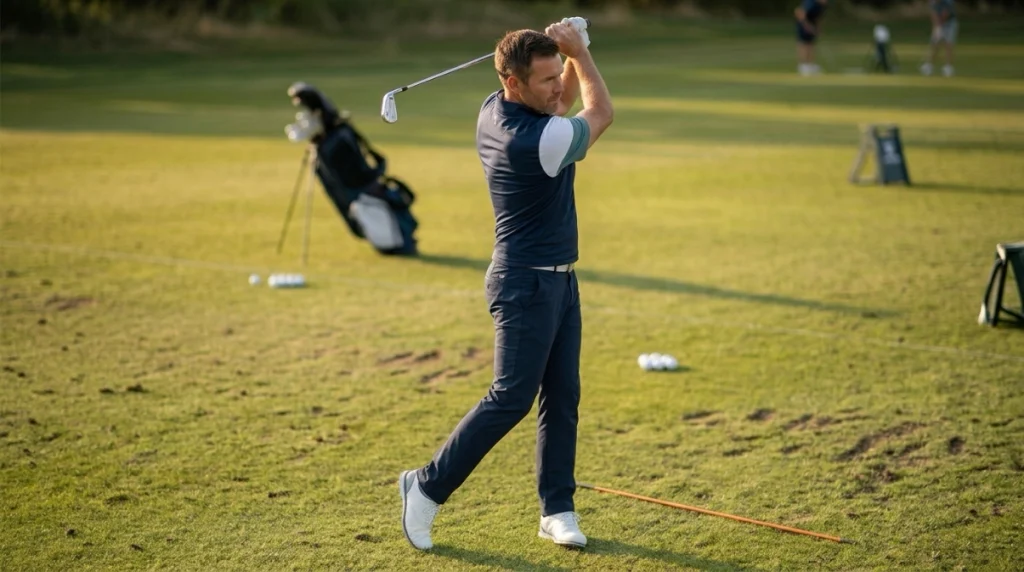
Make your backswing more compact by improving the sequence of the takeaway, turn, arm motion, and wrist hinge. Do not simply tell yourself to “stop halfway back.”
Whenever I try to shorten the swing by force alone, my tempo usually becomes quick. A better result comes from creating a cleaner stopping point.
1. Start the club back with your chest
For the first part of the takeaway, I like the feeling that my chest, arms, hands, and club are moving as a unit. The wrists stay responsive, but they do not snatch the club behind me.
2. Keep your hands in front of your body
Your hands do not need to stay directly in front of your sternum throughout the entire swing. They should, however, remain coordinated with your turn rather than getting trapped far behind you.
- Turn your chest away from the target.
- Let the hands travel with that rotation.
- Allow the wrists to hinge as the club rises.
- Avoid dragging the club excessively inside.
3. Let your trail hip turn
A common mistake is trying to keep the hips completely still. That restriction can make the shoulders stop early while the arms keep traveling.
I prefer a controlled trail-hip turn. It gives the upper body room to rotate while helping me stay centered.
4. Stop when useful rotation ends
This is the checkpoint that changed how I think about backswing length. I do not judge the top solely by whether the shaft reaches parallel.
I watch for the moment when continuing farther would require extra arm lift, elbow collapse, or loss of posture. That is usually where I want the backswing to finish.
5. Keep the transition unhurried
A shorter backswing can tempt you to rush the downswing. Resist that urge.
Let the transition happen with the same rhythm you would use from a longer position. Shorter travel does not require a violent change of direction.
Section Takeaway: Do not manufacture a short swing with tension. Create a better takeaway and turn, then let the club stop naturally when useful rotation ends.

Compact Backswing vs. Long Backswing: Which Is Better?
Neither backswing length is automatically better. The best choice is the one that gives you reliable center contact, manageable curvature, useful speed, and repeatable timing.
| Factor | Compact Backswing | Longer Backswing |
|---|---|---|
| Typical feel | Three-quarter, connected, controlled | Full, flowing, extended |
| Top position | Shaft may finish short of parallel | Shaft may reach parallel or travel beyond it |
| Main priority | Repeatability and coordination | Rhythm, range of motion, and speed potential |
| Timing demand | Often fewer moving parts to organize | May require more precise sequencing |
| Common mistake | Becoming tight or rushing down | Overswinging after the body stops |
| Best fit | Players seeking control or simpler timing | Players who naturally sequence a full motion well |
Club choice matters too. My driver backswing can naturally appear a little longer than my wedge backswing because the shaft is longer and the swing has a wider arc.
Do not force every club into an identical-looking position. Focus on the same principles of balance, connection, and control.
The USGA is also useful for understanding the broader equipment and rules framework of the game. Technique can change, but your equipment still has to fit within golf’s governing standards.
What Drills Help Shorten a Golf Backswing?
The best compact-backswing drills give you a physical checkpoint instead of asking you to guess where the club is. I prefer simple drills that I can repeat on the range without rebuilding my entire swing.
Three-quarter swing drill
Start with a mid-iron and hit shots using what feels like a three-quarter backswing. Do not reduce your follow-through by the same amount.
- Make your normal setup.
- Take the club back at about 70 percent of your usual length.
- Pause briefly enough to notice your balance.
- Turn through the ball normally.
- Finish in balance facing the target.
I often find that my “three-quarter” feel looks much closer to a full swing on video. Feel and reality can be surprisingly different.
Lead-arm checkpoint drill
Make slow practice swings and stop when your lead arm reaches roughly chest to shoulder height. Check whether your arms still feel supported by your chest turn.
Then continue slightly farther until you reach your natural top. The goal is to feel where rotation ends and unnecessary arm travel begins.
Wall or chair awareness drill
Stand several inches from a wall or chair with your trail side nearest it. Make slow backswings without a ball.
- Let the trail hip turn behind you.
- Keep your posture instead of standing up.
- Notice when your hands begin traveling independently.
- Stop before you feel forced to collapse your arms.
Use plenty of clearance and perform this drill slowly. You should never risk striking the wall, chair, ceiling, or another person.
Phone-video drill
Film five swings from down the target line and five from face-on. Use normal speed first, then review the top position.
Look for repeatability rather than a perfect screenshot. A slightly unusual backswing that repeats is often more useful than a textbook position you cannot reproduce.
The coaching resources at The R&A can also help golfers understand the game’s wider development and instruction environment.
Section Takeaway: Train a compact backswing with clear checkpoints, then judge the change by contact and ball flight rather than appearance alone.
Will a Compact Backswing Cost You Distance?

A compact backswing can reduce distance if you shorten it so much that you lose useful turn, speed, or rhythm. It can also preserve distance when the shorter motion improves strike quality and sequencing.
This is why I never assume a longer backswing automatically creates longer shots. Clubhead speed matters, but so does where the ball meets the clubface.
Do not make these common mistakes
- Locking the hips: Restricting your lower body can make rotation harder and create tension.
- Stopping the shoulders: A compact arm swing still needs a useful torso turn.
- Squeezing the grip: Extra grip pressure can reduce rhythm and natural wrist action.
- Rushing from the top: A short backswing does not require a faster transition.
- Chasing shaft position: “Short of parallel” is a description, not a universal requirement.
- Shortening the follow-through: You can make a compact backswing and still rotate fully through the shot.
Test the change with ball flight
I like to compare normal and compact swings in alternating groups rather than hitting 30 shortened swings in a row. That makes the differences easier to feel.
- Watch starting direction.
- Watch curvature.
- Compare strike location on the clubface.
- Notice whether your finish stays balanced.
- Judge whether the motion survives when you increase speed.
If the compact version produces better contact without making you feel restricted, it deserves more practice. If it creates weak shots and poor rhythm, you may have shortened the wrong part of the swing.
Section Takeaway: Compact is useful only when it improves efficiency. Do not sacrifice a functional turn or natural rhythm just to make the swing look shorter.
Compact Backswing FAQ
Is a compact backswing better for accuracy?
It can help accuracy when a golfer’s longer backswing creates extra movement and inconsistent timing. A shorter motion is not automatically straighter, though. Face angle, swing path, strike location, setup, and sequencing still influence where the ball goes.
How short should my golf backswing be?
There is no universal length. Your ideal stopping point is usually where you have completed a useful turn without needing extra arm lift, elbow collapse, or loss of posture to move the club farther.
Should the golf club reach parallel at the top?
No. Reaching shaft-parallel is not a requirement for an effective golf swing. Many strong ball strikers finish short of parallel, while others naturally reach or pass it and still control the club well.
Can I use a compact backswing with my driver?
Yes. You can use a compact driver backswing while still creating width and a full athletic turn. Because the driver is longer, its swing may look longer than your iron swing even when both motions feel equally controlled.
Does a shorter backswing stop an overswing?
It can, but you need to address the reason you overswing. If your arms continue after your torso stops, improving connection and turn is usually more useful than simply trying to freeze the club at a predetermined position.
Can senior golfers use a compact backswing?
Yes, if it feels comfortable and supports good contact. Golfers with reduced mobility should avoid forcing a restricted turn. A certified instructor can help match backswing length to flexibility, balance, speed, and individual physical limits.
How long does it take to learn a shorter backswing?
The feel can change quickly, but making it automatic on the course takes repetition. Start with slow practice swings and three-quarter shots, then gradually add speed before testing the motion under normal playing pressure.
Build a Backswing You Can Repeat
The best compact backswing is not the shortest swing you can make. It is the shortest motion that still gives you enough turn, structure, width, speed, and freedom to hit the shot you want.
As of 2026, that is still the way I prefer to judge swing changes. I care more about repeatable contact and predictable ball flight than whether the club reaches a fashionable position at the top.
- Build the takeaway with your chest and arms working together.
- Let the hips and shoulders turn naturally.
- Allow the wrists to hinge without forcing them.
- Stop before extra arm travel begins.
- Keep the transition smooth.
- Test the result with real ball flight.
Start with a mid-iron and a three-quarter feel during your next practice session. Once that motion becomes comfortable, bring the same compact structure into your longer clubs and see whether your swing becomes easier to repeat.