
Grip Pressure in Golf: How Tight Should You Hold the Club?

Quick Answer
Good golf grip pressure is firm enough to keep the club secure but relaxed enough to let your wrists, arms, and shoulders move freely. For most golfers, starting around 4 to 6 on a 1-to-10 pressure scale is a useful test, but your ideal feel depends on your hand strength, grip size, shot, and swing. A recent PGA grip-pressure drill uses a similar scale to help golfers find a relaxed starting point.
Quick grip-pressure checks
- Too tight: Your forearms feel hard, your waggle feels stiff, or you struggle to release the club.
- Too light: The handle moves in your hands or you feel you must grab it during the downswing.
- Good pressure: The club feels secure while your wrists and forearms remain responsive.
- Best test: Hit balls at several pressure levels instead of trusting a number alone.
- Key goal: Avoid a sudden squeeze when you start the swing or change direction.
One useful feel
- Make a small waggle before swinging. If the clubhead moves freely without the handle slipping, your pressure is usually close to workable.
Grip pressure sounds like a tiny golf fundamental. In my experience, it can influence the whole swing because your hands are the only connection between your body and the club.
As of 2026, I don’t teach myself to chase one magic pressure number. I want the club secure without adding needless tension, then I test that feel with real swings.
In This Guide
What Is Grip Pressure in Golf?
Grip pressure is the amount of force your hands apply to the golf club’s handle. It is different from whether your hand position is described as strong, neutral, or weak.
Simple definition: Grip pressure describes how firmly you hold the club, while grip position describes how your hands sit and rotate around the handle.
That distinction matters. You can have a technically strong hand position while holding the club softly, or a neutral grip while squeezing far too hard.
The basic job of the grip is simple. It must help you control the club without letting the handle slip or twist.
The USGA Equipment Rules describe a golf grip as material added to the shaft so a player can obtain a firm hold.
That doesn’t mean you should squeeze with maximum effort. A firm hold and excessive muscular tension are two different things.
Where should the pressure feel strongest?
I prefer feeling the club supported mainly through the fingers instead of crushing it deep into the palms. That usually makes it easier for me to keep my arms responsive.
- Lead hand: Feel secure contact through the fingers, especially the lower fingers.
- Trail hand: Keep enough contact to control the club without dominating it.
- Thumbs and index fingers: Avoid pinching the handle as if you were trying to squeeze something flat.
- Forearms: They should feel ready to move, not locked before the takeaway.
The exact distribution varies from golfer to golfer. Hand size, grip style, strength, and swing pattern all matter.
Section Takeaway: Grip pressure means how firmly you hold the club, not where your hands are positioned. The goal is secure contact without unnecessary tension.
How Tight Should You Hold a Golf Club?
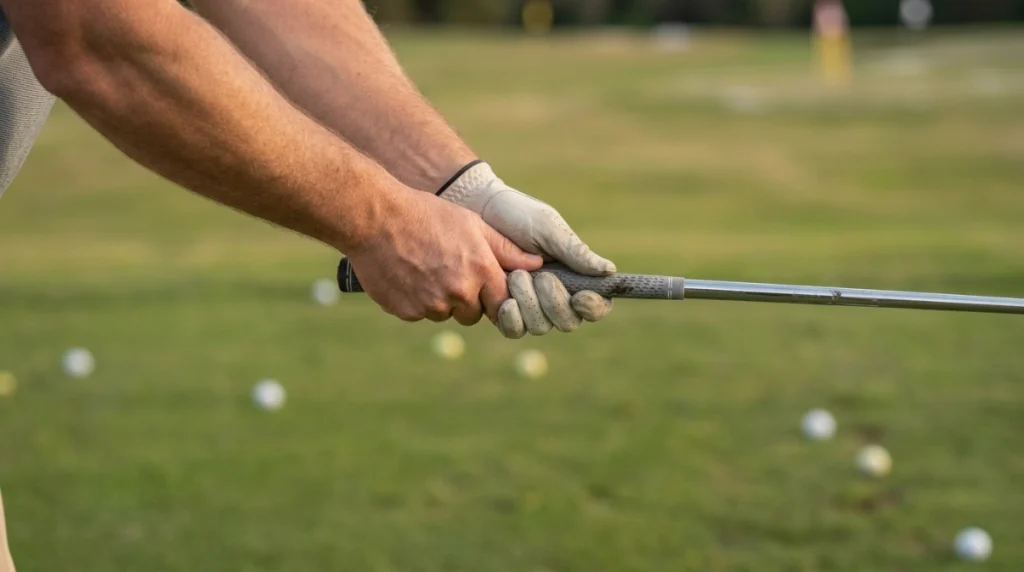
A useful starting point is about 4 to 6 on a 1-to-10 scale, where 1 barely holds the club and 10 is your hardest squeeze. Treat that range as a calibration tool, not an exact measurement.
Golfers have different hand strength. A powerful player’s 5 can create far more actual force than another golfer’s 5.
| Pressure feel | Approximate scale | What you may notice | What to test |
|---|---|---|---|
| Very light | 1-3 | Handle may shift or feel insecure | Add pressure until the club stays stable |
| Moderate | 4-6 | Secure club with responsive wrists | Use as a starting range |
| Firm | 7-8 | More control, but tension may appear | Check forearms and waggle |
| Maximum | 9-10 | Hands and forearms feel rigid | Reduce pressure before hitting balls |
I use the middle of that scale as a starting point. Then I let ball contact and freedom of motion tell me whether I need to adjust.
Recent sensor-based reporting also shows why a single traditional number can mislead golfers. Better players may apply substantial force while still managing how that pressure changes during the swing.
A Golf Digest report on measured grip pressure described better players beginning around 45 percent of their maximum capability in one dataset.
The practical lesson isn’t to copy 45 percent. It is to stop confusing relaxed movement with barely holding the club.
Pro tip: If changing your pressure produces major changes in contact or clubface control, ask a certified PGA or LPGA instructor to check your full grip and swing.
Section Takeaway: Start in a moderate range, then judge the result by control, tension, and strike quality. Your ideal pressure is personal rather than a universal number.
What Happens If Your Grip Pressure Is Too Tight or Too Light?
Too much grip pressure can add tension to your hands and forearms. Too little can make the club unstable and cause you to grab it later in the swing.
Signs you may be gripping too tightly
- Your forearms feel hard before the club moves.
- Your waggle becomes short or stiff.
- Your wrists feel restricted.
- Your shoulders feel tense at address.
- You squeeze even harder when trying to hit the ball farther.
- Your rhythm becomes quick when you’re nervous.
I notice the last one most often when a golfer wants extra distance. The instinct is to hold tighter because the swing feels more powerful.
That extra effort can make the motion less fluid. More hand tension doesn’t automatically mean more clubhead speed.
Signs you may be holding the club too lightly
- The handle changes position during the backswing.
- The club feels unstable near the top.
- You suddenly squeeze harder during transition.
- You struggle to control the face through impact.
- Your grip feels insecure in rough or wet conditions.
A light grip isn’t automatically a good grip. The club still needs enough support to stay stable throughout the motion.
The sweet spot is a secure connection with as little excess tension as you can manage. That balance usually feels athletic rather than limp.
Section Takeaway: Too tight can restrict movement, while too light can reduce security. Look for stable contact without hard forearms or a late grab at the handle.


Should Grip Pressure Change for Different Golf Shots?
Your grip pressure can change slightly with the shot, but I avoid dramatic changes. The club still needs to feel secure whether I’m using a driver, wedge, or putter.
Driver and full swings
With the driver, I want enough pressure to control the club through a fast motion. I don’t try to hold it as softly as possible.
A useful check is your waggle. If your hands feel secure but your wrists and shoulders can still move freely, you’re in a workable area.
Iron shots
My iron pressure feels similar to my driver pressure. Consistency matters more to me than creating a different number for every club.
If the ball is sitting in thick grass, I may naturally hold the club a little more securely. That helps resist the grass trying to twist the face.
Chipping and pitching
Short shots need control and touch. I still avoid letting the club become loose in my hands.
- Keep the handle secure.
- Avoid squeezing harder during the downswing.
- Notice whether your wrists feel free enough for the shot you chose.
- Rebuild your grip if tension appears before starting.
Putting
Putting often feels lighter because the stroke is slower. However, pressure still needs to keep the putter face stable.
On short pressure putts, some coaches even prefer slightly firmer pressure for face stability. The important part is avoiding a sudden one-handed squeeze during the stroke.
Pro tip: Specialty shots can respond differently to grip changes, so make larger technique changes with a certified instructor rather than rebuilding your hands during a round.
Section Takeaway: Grip pressure may change slightly by shot, lie, and speed, but the basic goal stays the same: a secure club with controlled tension.
How Do You Find Your Ideal Grip Pressure?
The best way is to test several pressure levels on the range. Don’t choose a number because somebody famous used it.
Try my simple pressure ladder
- Take a 7-iron and hold it at your maximum pressure. Call that 10.
- Relax until the club is almost too loose to control. Call that 1.
- Build the grip again around a 4.
- Make two or three small waggles.
- Hit three balls without trying to create extra speed.
- Repeat at 5, 6, and 7.
- Compare strike, rhythm, security, and forearm tension.
I care more about the pattern than one perfect shot. A pressure level that produces several comfortable swings tells me more than one flushed ball.
Use the throw test
Another useful drill comes from biomechanist Dr. Sasho MacKenzie. His grip-pressure test compares your golf hold with the natural hand and wrist freedom you use when throwing a ball.
- Throw a golf ball safely toward a net or open target.
- Notice how much tension you feel in your hand and wrist.
- Repeat while squeezing the ball harder.
- Notice whether the harder squeeze makes the throwing motion feel restricted.
- Use that contrast to identify excess tension in your golf grip.
Do this in a safe open space. Never throw toward people, windows, vehicles, or anything that could be damaged.
Check your pressure before every swing
I like a small waggle because it gives instant feedback. A stiff waggle often tells me I’m carrying tension before I even start the backswing.
One short check is enough. I don’t want grip pressure to become another complicated swing thought.
Section Takeaway: Test pressure on the range instead of guessing. Your best setting should combine secure control, free movement, and repeatable contact.
Can Grips, Gloves, and Weather Affect Grip Pressure?
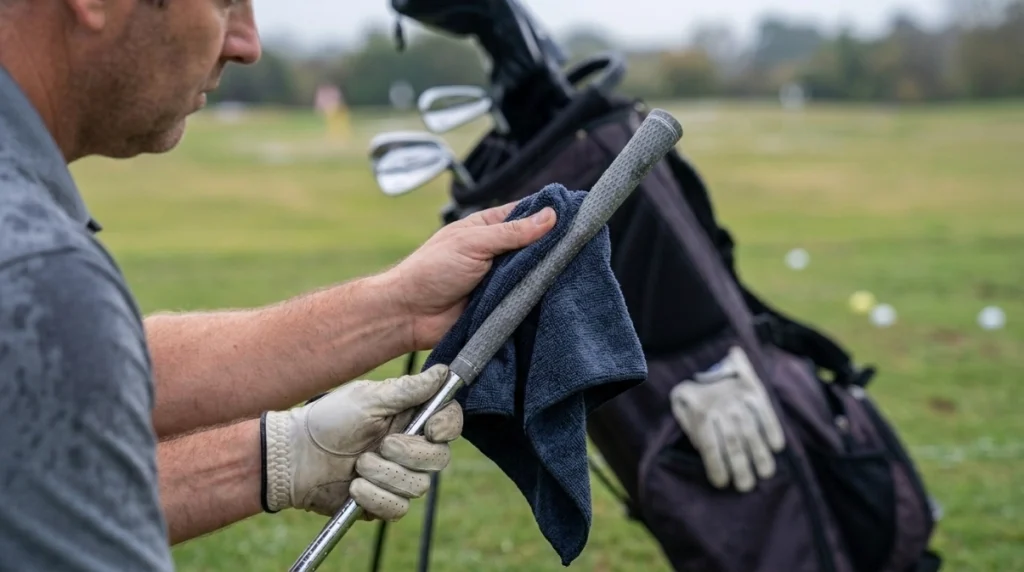
Yes. Grip size, grip condition, gloves, moisture, and hand strength can change how much pressure you feel you need.
Worn golf grips
Smooth or worn grips can encourage you to squeeze harder because the handle feels less secure. Cleaning may restore some tack, but badly worn grips eventually need replacement.
Grip size
A grip that feels poorly matched to your hands can change how naturally your fingers wrap around the handle. The PGA also notes that proper grip size is an important part of establishing a sound golf grip.
If you’re unsure about sizing, a club fitter can check it quickly. Don’t assume every standard grip automatically suits every golfer.
Hand strength
Two golfers can report the same 5-out-of-10 feel while applying different actual force. That’s one reason pressure scales are useful for personal calibration but weak as universal measurements.
PGA guidance on hand strength also explains how stronger hands can help golfers maintain a secure hold without excessive tension.
Rain, sweat, and humidity
Moisture can make the club feel less secure. Many golfers respond by squeezing much harder, which can spread tension into the arms.
- Keep grips clean and dry.
- Carry a dry towel.
- Rotate gloves in humid or rainy conditions.
- Replace badly worn grips.
- Dry your hands before rebuilding your grip.
These simple steps can reduce the urge to compensate with extra pressure. Equipment condition often matters more than golfers expect.
Section Takeaway: If you constantly need to squeeze harder, inspect the grip, glove, moisture, and sizing before assuming your swing is the problem.
Grip Pressure FAQ
What is the ideal grip pressure in golf?
There is no universal ideal number. A 4-to-6 feel on a 1-to-10 scale is a useful starting test for many golfers, but your hand strength, grip size, swing, and shot can change what feels right.
Should golf grip pressure be light?
It should be relaxed enough to avoid needless tension, but not so light that the handle slips or twists. Think secure rather than soft.
Can gripping the golf club too tightly cause a slice?
Excess tension can affect wrist motion, rhythm, and clubface delivery, which may contribute to poor shots. A slice can also come from grip position, swing path, face angle, setup, and other causes.
Does grip pressure increase during the golf swing?
Actual pressure can change as the club accelerates. Your goal shouldn’t be to force an identical pressure reading throughout the swing, but you should avoid a sudden conscious squeeze that disrupts rhythm or movement.
Should driver grip pressure be lighter than iron grip pressure?
Not necessarily. I prefer a similar secure baseline for both, then let the lie, shot, and swing speed create small natural differences rather than deliberately using completely different pressure levels.
How do I know if I’m gripping the club too hard?
Check your forearms, wrists, shoulders, and waggle. If they feel rigid before the takeaway, or your grip leaves you feeling locked over the ball, test a slightly softer hold on the range.
Should I grip tighter when hitting from the rough?
A slightly firmer hold can help when thick grass may twist the clubhead. Keep enough freedom in your arms and wrists to swing normally rather than turning the entire motion rigid.
My main takeaway is simple: don’t chase the lightest grip or the firmest grip. Find the pressure that keeps the club secure while your hands, wrists, arms, and shoulders can still move naturally.
Test it with a 7-iron on the range, rebuild your grip before each ball, and pay attention to strike and tension. If you’re still fighting the club, a PGA or LPGA professional can help you separate a pressure problem from a grip-position or swing problem.