
Distance Control Practice: Drills for Better Golf Shots
Quick Answer
Distance control practice teaches you to match swing length, speed, and contact with a specific target. Start with short wedge shots, build three repeatable swing lengths, and finish with randomized targets. This approach supports the basic practice habits covered in our beginner guide to starting golf.
A Simple Distance-Control Session
- Warm up: Hit 10 smooth half-swings without aiming at a precise number.
- Build baselines: Measure three comfortable swing lengths with one wedge.
- Change targets: Alternate between short, medium, and long distances.
- Test yourself: Hit one ball per target without repeating a shot.
- Record results: Track carry distance and total finishing distance separately.
Best Practice Rule
- Judge practice by the size of your shot pattern, not your single best result.
Distance control separates useful golf shots from swings that merely look solid. A shot can fly straight and still leave a difficult recovery if it finishes 15 yards long or short.
I learned this most clearly while practicing wedges to an elevated green. My contact sounded good, but the landing points covered nearly 25 yards.
This guide explains how to build predictable wedge, iron, and putting distances. You will also learn how to transfer those skills to the course.
In This Guide
What Is Distance Control in Golf?
Distance control is the ability to make a golf ball finish predictably near a chosen distance. It depends on carry, bounce, roll, strike quality, and environmental conditions.
Carry distance measures how far the ball travels through the air. Total distance includes every bounce and the remaining roll.
That difference matters. A 70-yard wedge carrying onto a soft green behaves differently from one landing on a dry, firm surface.
Distance control is not the same as maximum distance
Maximum distance asks how far you can hit a club. Distance control asks how often you can produce a useful number.
Most golfers benefit more from a repeatable 80-yard wedge than an occasional 95-yard wedge. Predictability makes club selection easier.
- Wedge control: Match swing length and tempo to a carry number.
- Iron control: Produce centered contact with controlled trajectory.
- Putting control: Match stroke energy to green speed and slope.
- Course control: Adjust the planned shot for wind, lie, temperature, and landing conditions.
What should you measure?
Track your average result rather than trusting one perfect shot. A launch monitor helps, but marked targets and careful pacing also work.
| Measurement | What It Shows | Practice Use |
|---|---|---|
| Carry distance | Airborne yardage | Clearing hazards and reaching landing zones |
| Total distance | Carry plus bounce and roll | Planning firm-ground shots and putts |
| Dispersion | Overall shot pattern | Choosing realistic targets |
| Strike location | Where the ball meets the face | Explaining unexpected distance changes |
Section Takeaway: Good distance control means producing a small, predictable pattern around the intended yardage.
Why Does Your Golf Distance Keep Changing?

Your distance changes when impact, swing speed, launch, or playing conditions change. Inconsistent contact usually creates the largest variation for developing golfers.
Strike quality changes ball speed
A centered strike transfers energy more efficiently. Contact low, high, toward the toe, or toward the heel can reduce carry.
Heavy contact creates an even larger loss. The club hits the ground before reaching the ball, slowing the clubhead.
- Thin strike: Launches lower and may roll farther than expected.
- Heavy strike: Usually loses carry because the ground slows the club.
- Toe or heel strike: Can reduce speed and alter direction.
- Centered strike: Produces the most dependable distance pattern.
Tempo and swing length stop matching
Many golfers shorten the backswing but accelerate violently through impact. Others make a long swing and decelerate because the target feels close.
Neither pattern offers reliable control. A smooth motion with a committed finish works better.
Conditions alter the result
Wind, temperature, altitude, lie, moisture, and ground firmness all influence distance. These factors can change during the same round.
The USGA explains why green conditions can change throughout the day, including traffic, moisture, grass growth, and weather.
Practice on different surfaces when possible. Mat-only practice cannot teach how rough, fairway grass, and tight lies affect contact.
Section Takeaway: Before changing your swing, identify whether contact, tempo, or conditions caused the distance error.
Which Drills Improve Wedge Distance Control?
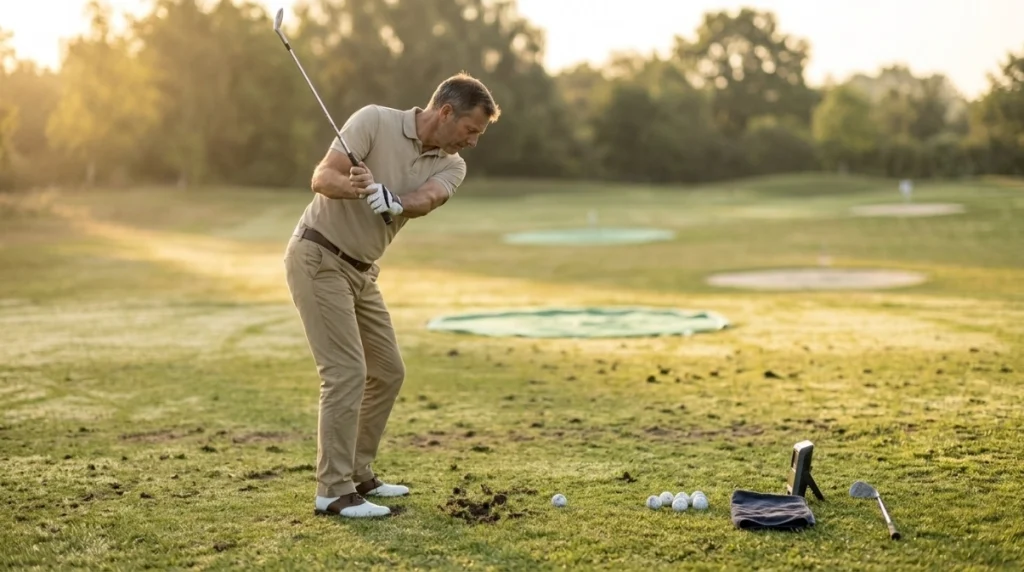
The best wedge drills connect a repeatable swing length with a measured carry distance. Begin with one wedge before building a complete system.
Use the three-swing ladder
Choose three comfortable backswing lengths. Common reference points are hands near the hip, chest, and shoulder.
These positions are guides rather than exact clock-face measurements. Your body structure and mobility affect how they feel.
- Hit five balls with the shortest swing.
- Record each carry distance.
- Remove obvious mishits from the baseline.
- Calculate the average of the remaining shots.
- Repeat with the medium and longer swings.
Suppose your averages are 45, 62, and 78 yards. Those numbers become starting references rather than permanent guarantees.
Repeat the test on another day. A usable wedge chart should survive more than one practice session.
Practice the landing-zone challenge
Place towels, hoops, or imaginary circles at several distances. Award points based on where each ball first lands.
- Inside 3 yards: Three points
- Inside 6 yards: Two points
- Inside 10 yards: One point
- Outside 10 yards: Zero points
This drill emphasizes carry instead of final position. That makes your results easier to compare across different practice surfaces.
Try random-distance practice
Blocked practice repeats the same shot. Random practice changes the target before every ball.
Hit one ball to 40 yards, another to 65, and another to 50. Continue changing clubs, trajectories, and targets.
Random practice feels harder because you cannot copy the previous motion. It better resembles the decisions required during a round.
Short shots are also an efficient starting point for new players. Our guide to how long learning golf takes shows where distance practice fits into a realistic beginner timeline.
Pro tip: A certified PGA instructor can check your setup and contact pattern if every partial wedge flies unpredictably.
Section Takeaway: Build a baseline with repeated swings, then test that baseline by changing the target after every shot.

How Do You Practice Distance Control With Irons?
Iron distance control begins with centered contact and balanced speed. Trying to force maximum yardage usually expands your dispersion.
Build a carry-distance chart
Warm up before collecting numbers. Then hit five to ten shots with each club you commonly use.
Record carry distance, strike quality, and directional pattern. Remove severe mishits, but do not keep only your best shots.
| Practice Type | Main Goal | Best Time to Use It |
|---|---|---|
| Blocked practice | Build a repeatable movement | Early in a technical session |
| Random practice | Improve target and club changes | After establishing a baseline |
| Pressure practice | Test commitment and routine | At the end of the session |
Use the nine-shot distance test
Select one iron and three targets within its practical range. Hit three balls to each target.
For example, use a 7-iron for controlled, stock, and firm swings. Avoid changing your balance or making an all-out effort.
- Controlled shot: Smooth tempo with a slightly shorter finish.
- Stock shot: Your normal on-course swing.
- Firm shot: Committed motion without losing balance.
Not every golfer needs three versions of every iron. Two dependable distances are more valuable than several uncertain ones.
Change clubs after every shot
Create a pretend hole on the range. Hit a tee shot, approach, pitch, and recovery shot in sequence.
Use a complete pre-shot routine for each ball. The USGA’s pace-of-play guidance also encourages efficient club selection and a short, trusted routine.
Pro tip: Ask a qualified instructor or club fitter to review unusual distance gaps between neighboring irons.
Section Takeaway: Build honest carry averages, then practice selecting and producing those numbers in changing situations.
How Can You Improve Putting Distance Control?
Putting distance control improves when you focus on finishing speed rather than making every long putt. A practical goal is leaving the ball within a comfortable second-putt range.
Start with the ladder drill
Place markers at 10, 20, 30, and 40 feet. Putt one ball toward each marker without repeating a distance.
The ball should stop near each target without racing far beyond it. Repeat the ladder in reverse order.
Use a three-foot safety zone
Create a three-foot semicircle behind the hole. Putt from several long distances and score each result.
- Holed putt: Three points
- Inside the safety zone: Two points
- Short but within three feet: One point
- Outside the zone: Zero points
This game rewards useful pace. It also exposes whether your common error is short or long.
Calibrate before every round
Begin with flat putts across the practice green. Avoid aiming at a hole during your first few rolls.
Watch how far the ball travels with a comfortable stroke. Then test uphill, downhill, and side-slope putts.
Green speed varies with moisture, mowing, rolling, weather, and traffic. The USGA’s explanation of green-speed measurement shows why consistent conditions and technique matter.
The same practice method supports several scoring skills. Our overview of the physical and mental benefits of golf explains why focused short-game work can add value without requiring constant full-speed swings.
Section Takeaway: Judge long-putting practice by predictable finishing speed and the length of the next putt.
What Is an Effective 30-Minute Practice Plan?

A useful 30-minute session combines calibration, repetition, random targets, and a short performance test. Each block needs a clear purpose.
Minutes 0–5: Warm up and find contact
Make short, balanced swings with a wedge. Ignore exact yardages until your body feels ready.
- Begin with waist-high swings.
- Use a relaxed grip.
- Hold a balanced finish.
- Notice where the club contacts the ground.
Minutes 5–15: Build one distance skill
Choose one club and three targets. Hit three to five balls at each distance.
Record carry or finishing distance. Do not make a major swing change after every poor shot.
Minutes 15–25: Randomize every target
Change the target after each ball. Switch clubs whenever the new distance requires it.
Follow the same routine you use on the course:
- Confirm the target and required carry.
- Check wind, lie, slope, and landing conditions.
- Select the club and shot shape.
- Make one rehearsal swing.
- Set up and play without delaying.
Minutes 25–30: Finish with a pressure test
Choose five different targets and use one ball for each. Set a scoring zone before starting.
You must restart the test if fewer than three shots finish inside the chosen zone. Adjust the standard to your current skill level.
Beginners should favor controlled half-swings and solid contact. The guide explaining who can play golf reinforces why control should develop before maximum speed.
What should you record?
- Date and conditions: Include wind, temperature, and surface firmness.
- Club and target: Record what you intended to produce.
- Average result: Use the whole pattern, not the best ball.
- Common miss: Note whether shots finish short, long, left, or right.
- Next-session goal: Choose one measurable priority.
Review your notes every few sessions. Look for a repeated pattern before changing technique or equipment.
Section Takeaway: A short session becomes productive when every block has a target, measurement, and performance test.
Distance Control Practice FAQ
How often should I practice golf distance control?
Two focused sessions per week can produce useful progress for many recreational golfers. Even 20–30 minutes helps when you measure results and change targets. Quality matters more than hitting a large bucket without a specific goal.
Should I practice carry distance or total distance?
Practice both, but build your club chart around carry distance first. Carry determines whether the ball clears hazards and reaches its landing area. Total distance becomes more important on firm turf, running chip shots, and putts.
Do I need a launch monitor?
No. A launch monitor makes carry measurement easier, but it is not required. Use range markers, a rangefinder where permitted, towels, hoops, or paced distances. Repeat the test on different days before trusting the averages.
Why do my range distances differ from course distances?
Range balls, mats, wind, elevation, temperature, and target measurement can change the result. Course lies also vary more than range lies. Treat range numbers as a baseline and refine them through on-course observation.
Is it better to change swing length or swing speed?
Most golfers find swing-length references easier to repeat with wedges. Keep the motion smooth and accelerate naturally through impact. Avoid trying to guide the club or stopping the follow-through.
How many wedge distances should I learn?
Start with three comfortable swing lengths using one wedge. Once those distances become predictable, test another wedge. A small number of reliable shots is more useful than a large matrix you cannot reproduce.
What is the fastest way to improve distance control?
Improve contact first, measure honest averages, and change targets frequently. Finish each session with one-ball tests that imitate course pressure. Guidance from a certified PGA professional can shorten the process when contact remains inconsistent.
Build Predictable Golf Distances One Target at a Time
Effective distance control practice is simple to describe: choose a number, produce a shot, measure the result, and adjust intelligently. The challenge is repeating that process without chasing every poor swing.
Begin with one wedge and three distances. Add random targets when your baseline becomes stable.
Track the entire shot pattern and bring the same routine onto the course. Predictable contact and useful misses will lower scores more reliably than occasional perfect shots.