
Golf Swing Guide 97: How to Build a Repeatable Golf Swing

Quick Answer
A reliable golf swing starts with a repeatable grip, athletic posture, correct ball position, smooth takeaway, balanced turn, organized downswing, centered contact, and a controlled finish. Build those pieces at reduced speed before chasing distance, and consider working with a PGA Coach if you need personalized swing feedback.
Seven Swing Keys to Check
- Grip: Hold the club securely without creating unnecessary hand and forearm tension.
- Setup: Build balanced posture, sensible stance width, and consistent ball position.
- Takeaway: Start the club without snatching it sharply inside or outside.
- Backswing: Turn comfortably while maintaining balance instead of chasing extra length.
- Transition: Change direction smoothly rather than throwing the club from the top.
- Impact: Judge the swing by contact and ball flight rather than a frozen pose.
- Finish: Rotate through and finish balanced enough to hold the position.
Best Way to Start
- Practice with a wedge or 7-iron at comfortable speed before moving to longer clubs.
- Track contact, starting direction, and balance before judging improvement by distance.
Golf Swing Guide 97 is built around one goal: helping you create a golf swing you can repeat when the shot matters. I’ve learned that consistency improves faster when I simplify the motion instead of collecting ten new swing thoughts.
This complete golf swing guide covers setup, sequence, impact, common misses, practice, video feedback, and tempo. Use it as a framework, then adjust the details to your body, clubs, and normal ball flight.
In This Guide
What Are the Most Important Golf Swing Fundamentals?
The most important golf swing fundamentals are grip, clubface aim, posture, alignment, ball position, balance, and rhythm. Get those pieces reasonably stable before making complicated changes during the swing.
That order matters. A setup error can create a swing compensation that looks like a backswing or downswing problem.
Start with a repeatable golf grip
Your grip is your physical connection to the club. The USGA also regulates golf equipment, including club and grip requirements, but your instructional goal is simpler: hold the club securely without making your arms rigid.
I want enough pressure that the handle stays controlled. I don’t want so much pressure that my wrists and forearms feel locked.
- Lead hand: Let the grip run more through the fingers than deep across the palm.
- Trail hand: Place it so both hands can work together instead of fighting each other.
- Pressure: Keep the hold secure while allowing the wrists to move naturally.
- Consistency: Rebuild the grip the same way before every practice shot.
Build athletic posture
Good golf posture gives your arms room to swing while keeping your body balanced. You shouldn’t feel as if you are sitting deeply or standing rigidly upright.
Begin tall, soften the knees, and hinge forward from the hips. Let your arms hang naturally beneath the shoulders.
- Keep pressure near the middle of your feet.
- Avoid pushing your weight entirely into your heels.
- Do not reach excessively toward the golf ball.
- Keep enough space for your hands to move through impact.
What is ball position?
Ball position is the location of the golf ball relative to your feet and body at address. It changes where the club is likely to meet the ball within the swing arc.
For a standard iron shot, I normally begin near the middle and move progressively forward with longer clubs. The driver usually sits much closer to the lead heel.
| Club | Starting Ball Position | Stance | Main Contact Goal |
|---|---|---|---|
| Wedge | Near center | Relatively narrow | Ball first, then turf |
| 7-Iron | Slightly forward of center | About shoulder width | Centered strike with low point after ball |
| Fairway Wood | Forward of center | Moderately wide | Shallow, sweeping contact |
| Driver | Near lead heel | Wider | Centered tee contact without striking turf first |
These positions are starting points, not laws. Your build, stance width, swing direction, intended shot, and lie can justify small adjustments.
Alignment starts with the clubface
I prefer aiming the clubface before arranging my feet. This gives me a clear reference instead of letting my stance accidentally aim the entire shot.
- Aim the clubface at your intended starting line.
- Place your feet around the ball position.
- Set your knees, hips, and shoulders comfortably.
- Check that your body feels balanced rather than twisted.
Practice alignment with a club or alignment stick on the ground. Remove training aids before hitting if their location creates a safety risk.
Section Takeaway: A good swing becomes easier when grip, posture, alignment, and ball position are predictable. Fix setup variables before rebuilding moving parts.
What Is the Correct Golf Swing Sequence?

A useful golf swing sequence is setup, takeaway, backswing, transition, downswing, impact, and finish. Think of those as checkpoints inside one continuous motion rather than seven separate poses.
The goal is coordination. Your swing should flow instead of feeling like a checklist performed at full speed.
1. Setup
Everything begins before the club moves. Set the face, feet, posture, grip, and ball position with enough consistency that you trust the address position.
I like a final balance check before starting back. If I feel pressure heavily in my toes or heels, I reset.
2. Takeaway
The takeaway is the first movement away from the ball. A smooth start helps the chest, arms, hands, and club begin working together.
Avoid yanking the club sharply inside. Also avoid pushing it dramatically outside to manufacture a position.
- Keep the opening movement unhurried.
- Let your torso begin turning.
- Allow the arms to stay connected to that turn.
- Keep your balance centered.
3. Backswing
The backswing creates space and organizes the club for the change of direction. It doesn’t need to reach a textbook parallel position.
My better swings usually feel complete but not forced. When I chase extra backswing length, my balance and timing often become less predictable.
4. Transition
The transition is the change from backswing to downswing. This is where many golfers turn a smooth motion into a violent hit.
Let pressure begin moving toward the lead side as the body starts unwinding. Avoid throwing the hands directly at the ball from the top.
5. Downswing
A good downswing delivers speed while preserving enough structure to control the strike. The lower body, torso, arms, hands, and club must coordinate rather than fire independently.
You don’t need to consciously micromanage every segment. A balanced transition and clear target can produce a more athletic motion than five technical thoughts.
6. Impact
Impact is the brief moment when the clubface meets the golf ball. It matters more than whether your backswing looks identical to a professional golfer’s swing.
With irons, I want the ball struck before the lowest part of the swing reaches the turf. With a teed driver, the strike happens farther forward within the swing arc.
- Contact: Where the ball meets the clubface.
- Face direction: A major influence on the ball’s starting direction.
- Swing direction: Influences curvature together with face orientation.
- Low point: Determines where the club bottoms out relative to the ball.
7. Finish
Your finish gives useful evidence about the motion that came before it. A balanced finish often suggests you controlled your effort well enough to complete the swing.
After practice shots, I sometimes hold the finish for two or three seconds. If I repeatedly stumble, I reduce effort before changing technique.
Pro tip: If changing your rotation, pressure shift, or swing sequence causes discomfort, stop forcing the movement and work with a certified instructor or qualified fitter.
Section Takeaway: Treat swing positions as checkpoints, not poses. The sequence should produce balanced movement, predictable contact, and a finish you can control.
Should Your Golf Swing Change With Different Clubs?
Your basic motion can stay recognizable across the bag, but setup and strike conditions change with club length and loft. The driver should not be treated exactly like a pitching wedge.
Loft is the angle of the clubface that helps influence launch. Longer clubs generally have less loft and require different setup conditions than short irons and wedges.
Wedges and short irons
Use these clubs to learn contact before chasing speed. Their shorter shafts make them practical choices for half-swing and three-quarter-swing practice.
- Begin with a relatively narrow stance.
- Keep the ball around the middle for a standard wedge.
- Focus on centered contact.
- Finish balanced instead of trying to overpower the shot.
Mid-irons
A 7-iron is one of my favorite practice clubs because it sits between short-game motion and long-club speed. It lets you work on full-swing fundamentals without immediately reaching for the driver.
Move the ball slightly forward of center and give your arms room to swing. Maintain the same general rhythm you used with shorter clubs.
Long irons, hybrids, and fairway woods
Longer clubs usually need more space and a slightly wider setup. The ball also moves farther forward compared with a wedge.
Do not assume the answer is a harder swing. Longer clubs already create speed through their length.
Driver
The driver uses a tee and normally places the ball near the lead heel. Your stance is wider, and the ball sits farther forward within the swing arc.
This creates a different visual picture at address. It does not mean you need a completely different tempo.
- Set the ball near the lead heel as a starting point.
- Create enough stance width for balance.
- Keep your upper body relaxed.
- Make a complete turn without chasing extra backswing length.
- Swing through the ball rather than lunging toward it.
The governing organizations, including The R&A, maintain rules and equipment standards for the game. From an instruction standpoint, however, your priority is matching setup and movement to the club you are using.
Section Takeaway: Keep one recognizable swing concept throughout the bag while adjusting stance width, ball position, and strike intention for each club.


Why Do Golf Swings Break Down?
Golf swings usually break down because setup, balance, face control, low-point control, or timing changes. Diagnose the ball flight first instead of randomly changing your backswing.
I use the miss as evidence. A fat shot and a push are different clues, even if both shots feel terrible.
Why do you hit fat golf shots?
A fat shot occurs when the club contacts the ground too early before reaching the ball. The useful question is why the low point moved behind the intended strike.
- Ball position may have drifted too far forward.
- Your pressure may remain too much on the trail side.
- Your posture may change during the downswing.
- You may throw the club downward from the top.
Start by checking setup. Then hit shorter shots while trying to brush the ground after the ball.
Why do you hit thin or topped shots?
A thin shot catches the ball low on the clubface. A topped shot contacts the upper portion of the ball and often rolls forward with little useful flight.
Do not automatically blame your head movement. Contact can change because of posture, low-point location, balance, ball position, or arm structure.
Why does the golf ball slice?
A slice curves significantly away from the golfer’s lead side. For a right-handed golfer, that usually means the ball curves to the right.
The relationship between clubface orientation and swing direction drives that curvature. Your grip, setup, takeaway, transition, and release can all influence that relationship.
- Check whether the clubface starts excessively open.
- Check your grip before making a major swing change.
- Note where the ball starts before it curves.
- Use face spray or impact tape to check strike location.
Why do you hook the golf ball?
A hook curves strongly toward the golfer’s lead side. For a right-handed player, that means a strong curve to the left.
An overly closed clubface relative to the swing direction is a common ball-flight condition behind hooks. Grip, body rotation, hand action, and strike location may all contribute.
Why do you push or pull shots?
A push starts right of the target for a right-handed golfer. A pull starts left.
Starting direction gives you valuable face information. Compare the start line with the later curve instead of labeling every rightward shot a slice.
| Miss | First Check | Simple Practice Response |
|---|---|---|
| Fat | Ball position and low point | Short iron shots with reduced speed |
| Thin | Posture and strike location | Half-swings focused on brushing turf |
| Slice | Grip, face, start line | Shorter swings while monitoring face control |
| Hook | Grip and face orientation | Controlled swings with a neutral setup |
| Push/Pull | Starting direction and alignment | Use an intermediate target and alignment reference |
Pro tip: Persistent swing faults can have several causes. A certified golf instructor can identify whether the visible miss comes from setup, movement, equipment, or a compensation elsewhere in the swing.
Section Takeaway: Let contact and ball flight guide your diagnosis. Fix the earliest repeatable cause you can identify instead of changing several swing positions at once.
How Should You Practice Your Golf Swing?
Good golf practice should have a clear target, one priority, and measurable feedback. Hitting ball after ball without a purpose can make a poor pattern more familiar.
I divide practice into technique, contact, variability, and on-course simulation. That keeps me from spending an entire session repeating the same comfortable 7-iron.
Start with slow rehearsals
Make several practice swings before hitting balls. Use enough speed to feel the movement while keeping the motion under control.
This is where a new grip, takeaway, or transition concept should begin. Full speed makes unfamiliar movements harder to organize.
Use a simple 40-ball practice session
- 5 balls: Easy wedge shots focused on balance.
- 10 balls: Half and three-quarter 7-iron swings focused on contact.
- 10 balls: Full iron shots toward a defined target.
- 5 balls: Fairway wood or hybrid shots.
- 5 balls: Driver swings at normal on-course effort.
- 5 balls: Random clubs and targets with a full pre-shot routine.
The numbers are a practice framework, not a scientific prescription. Adjust the session around your priority and physical comfort.
Measure three things
Distance is tempting because it is easy to celebrate. I prefer measuring contact, starting direction, and balance first.
- Contact: Did the ball strike near the center of the face?
- Direction: Did the shot begin near the intended starting line?
- Balance: Could you finish without stepping or falling away?
If those three improve, then adding speed becomes more useful. If they disappear, extra effort is probably costing you control.
How do you improve golf swing tempo?
Golf swing tempo describes the pace and timing of the overall motion. Your ideal tempo does not need to look slow.
Use a simple spoken count if you tend to rush. Give the backswing time to finish, then move through the ball without a sudden hit from the top.
- Make three continuous practice swings.
- Keep the grip pressure comfortable.
- Move from backswing to downswing without a pause or lunge.
- Hit one ball while preserving the same general rhythm.
- Repeat only if contact and balance stay predictable.
Practice random shots before you leave
The golf course rarely gives you ten identical 7-irons from a perfect lie. Your range session should eventually become less predictable too.
Finish by changing clubs and targets after every shot. Go through your normal pre-shot routine each time.
Section Takeaway: Practice the movement slowly, test it with a ball, and finish with random on-course-style shots. Measure quality before speed.
How Do You Analyze and Improve Your Swing?
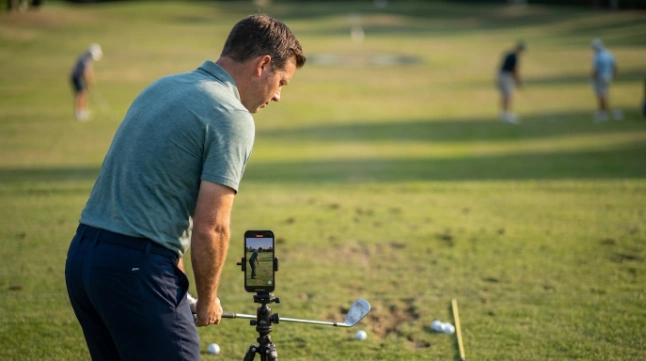
Analyze your swing by combining ball flight, strike pattern, balance, and consistent video angles. Video is most useful when it helps you identify the first meaningful problem instead of ten cosmetic differences.
I rarely learn much by comparing one random swing with a tour player. I learn more by comparing several of my own swings under the same conditions.
Record from consistent camera angles
Use a phone or camera from a safe location where it cannot be struck by your club or another golf ball. Keep the angle consistent when comparing sessions.
- Down-the-line: Position the camera behind you along the target-line area.
- Face-on: Position the camera in front of your body at a safe distance.
- Height: Keep the camera around hand or torso height for repeatable comparisons.
- Framing: Include your full body, club, and enough space to see the swing.
Review the swing in order
Do not jump straight to impact. Find the earliest checkpoint where the pattern begins to change.
- Grip and setup
- Takeaway
- Backswing
- Transition
- Downswing
- Impact evidence
- Finish
Choose one priority after reviewing the swing. Trying to fix grip, takeaway, hip rotation, wrist angles, and finish in one bucket rarely creates clear feedback.
Use ball-flight evidence with video
A strange-looking position may not be the cause of your miss. Connect any video observation with what the golf ball is doing.
For example, a repeated rightward start, heel strike, and loss of balance provides more useful evidence than an unusual screenshot alone. Patterns matter.
When should you get golf lessons?
Get professional help when you cannot connect the miss with a reliable cause, when changes keep making the problem worse, or when a movement creates pain. Coaching can shorten the trial-and-error process.
Instruction libraries such as Golf Digest Instruction can help you understand concepts, but personalized diagnosis still matters when the problem is specific to your swing.
As of 2026, phones and launch monitors can provide golfers with more feedback than ever. More data only helps when you know which piece matters.
Pro tip: If you are making a substantial technique change or experience back, wrist, elbow, shoulder, hip, or knee discomfort, get qualified hands-on guidance rather than forcing the movement.
Section Takeaway: Use video to locate patterns, not to chase perfect positions. Match what you see with contact and ball flight, then work on one priority at a time.
Golf Swing Guide FAQ
What is the easiest way to learn a golf swing?
Start with grip, posture, ball position, and balance using a wedge or mid-iron. Make half-swings until contact becomes predictable, then gradually increase swing length and speed instead of beginning with maximum-effort driver swings.
What are the seven stages of the golf swing?
A practical seven-stage model is setup, takeaway, backswing, transition, downswing, impact, and finish. These stages are useful checkpoints, but the golf swing should remain one continuous athletic movement rather than seven separate poses.
What should a beginner focus on in the golf swing?
A beginner should prioritize centered contact, balance, predictable starting direction, and a repeatable setup. Distance matters less at first because extra speed is difficult to use when contact and face control change from swing to swing.
Should you keep your head down during the golf swing?
Avoid forcing your head into one frozen position. Your head can respond naturally as your body rotates, while excessive lifting or posture changes may still hurt contact. Focus more on balance, posture, and completing the swing.
How hard should you swing a golf club?
Swing hard enough to create useful speed without losing balance, contact, or rhythm. If maximum effort makes your strike pattern unpredictable, reduce effort until you can hold your finish and control the clubface more consistently.
How often should you practice your golf swing?
Focused practice is more important than mindless volume. Several short sessions with one clear priority can be more productive than one long session where fatigue causes your mechanics and attention to deteriorate.
How long does it take to build a consistent golf swing?
There is no universal timeline because golfers differ in experience, mobility, practice quality, coaching, and goals. Judge progress by trends in contact, direction, balance, and scoring rather than expecting one swing change to become permanent after a single range session.
The best golf swing is not the one with the most perfect-looking positions. It is the motion you can repeat with enough balance, contact, face control, and confidence to play the next shot.
Start with setup, improve one priority at a time, and use the ball as your feedback. When your contact and balance become predictable, add speed instead of rebuilding everything.
If your swing feels lost, return to the basics. Grip the club comfortably, choose a clear target, make a balanced turn, and finish the motion.