
What Golf Towel Material Is Best for Grooves?

Quick Answer
Waffle-weave microfiber is the best golf towel material for grooves for most players. Its fine synthetic fibers handle moisture well, while the raised waffle texture helps lift grass, mud, and loose debris from iron and wedge faces. Cotton terry is a strong alternative when absorbency matters most, but it is usually heavier when wet. The USGA groove guidance explains why properly maintained clubface grooves matter within golf equipment standards.
Best Choices for Cleaning Grooves
- Best overall: Waffle-weave microfiber combines cleaning texture, low bulk, and practical moisture control.
- Best for mud: Textured microfiber gives you more surface edges for loosening fresh soil and grass.
- Best for water: Cotton terry provides plenty of absorbent fabric for rainy or dew-heavy conditions.
- Best lightweight option: Thin microfiber works well for walking golfers and compact stand bags.
- Best setup: Keep one section damp for cleaning and another section dry for the final wipe.
One Important Limitation
- A towel handles routine debris well, but packed or dried material may need a suitable club-cleaning brush.
If you’re wondering what golf towel material is best for grooves, I’d start with texture rather than thickness. A towel needs enough grip to remove debris without becoming bulky or awkward on your bag.
For most golfers, waffle microfiber gives the best balance. This guide explains why, how cotton compares, and when a brush becomes the better cleaning tool.
In This Guide
- What Golf Towel Material Is Best for Grooves?
- Why Does Towel Texture Matter for Golf Club Grooves?
- How Do Microfiber, Waffle Weave, and Cotton Compare?
- How Should You Clean Golf Club Grooves With a Towel?
- What Should You Look for in a Groove-Cleaning Golf Towel?
- Golf Towel Material for Grooves FAQ
- Final Takeaway: Choose Texture First
What Golf Towel Material Is Best for Grooves?
Waffle-weave microfiber is my first choice for cleaning golf club grooves. It combines fine synthetic fibers with a textured surface that works well against dirt, grass, sand, and moisture.
The key is that “microfiber” and “waffle weave” describe different things. Microfiber describes the fine synthetic fibers, while waffle weave describes the raised grid pattern of the fabric.
Definition: A groove-cleaning golf towel is a reusable cloth with enough absorbency and surface texture to remove loose debris and moisture from the recessed grooves and surrounding face of an iron or wedge.
Combining microfiber with a waffle structure gives you a practical balance. The towel remains relatively light while the textured pattern helps work across an uneven clubface.
Why microfiber works well on irons and wedges
Iron and wedge faces collect material quickly because those clubs often contact turf, sand, or damp grass. A completely smooth cloth may wipe the surface while leaving debris packed along recessed areas.
Textured microfiber provides more small contact points. That makes it easier to loosen fresh debris before it dries onto the clubface.
- Grass: Fine fibers help catch loose grass strands and turf residue.
- Moist soil: A damp section can soften and lift fresh dirt.
- Sand: The texture helps collect loose particles from the face and sole.
- Water: Microfiber handles moisture without needing the bulk of thick terry cloth.
- Final drying: A clean, dry section can remove remaining moisture before the club returns to the bag.
Does the towel need to reach inside each groove?
No towel needs to physically fill every groove to be useful. The goal is to remove loose material from the entire clubface before it becomes compacted.
For stubborn material, use a suitable cleaning brush instead of grinding abrasive debris across the face. A towel is best viewed as your first-line cleaning tool.
Section Takeaway: Waffle microfiber is the strongest all-around choice because its fiber type and surface texture solve different parts of the cleaning job.
Why Does Towel Texture Matter for Golf Club Grooves?
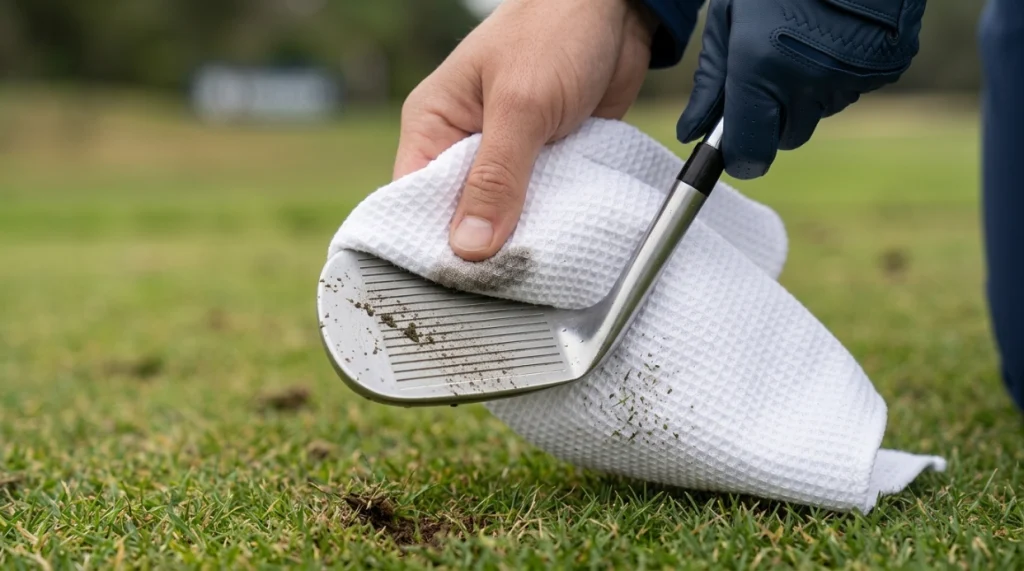
Texture matters because golf club grooves are recessed below the clubface. A textured towel creates more edges and contact points than a completely flat fabric.
Grooves are also tightly controlled equipment features. Under the R&A Equipment Rules, groove geometry, width, depth, spacing, and edge characteristics are regulated.
How small are golf club grooves?
USGA equipment specifications show why small amounts of packed dirt can matter during cleaning. The maximum groove dimensions are measured in fractions of an inch.
| Groove Specification | USGA Limit | Why It Matters for Cleaning |
|---|---|---|
| Maximum groove width | 0.035 in (0.9 mm) | Debris can sit inside a narrow recessed channel. |
| Maximum groove depth | 0.020 in (0.508 mm) | Packed dirt may remain below the main face surface. |
| Minimum edge-to-edge separation | At least 0.075 in (1.905 mm) and at least three times groove width | Cleaning involves both the recessed grooves and the flat areas between them. |
Those measurements should not make you obsess over microscopic cleaning. They simply show why wiping the visible face once may not remove everything.
Why waffle texture helps
A waffle weave has alternating raised and recessed areas. That three-dimensional pattern adds useful friction without requiring an extremely thick towel.
I prefer that structure for everyday cleaning because it gives the cloth somewhere to collect loosened dirt. A flat, saturated surface can simply smear mud across the clubface.
- Raised sections: Make first contact with grass and surface dirt.
- Recessed pockets: Give loosened moisture and debris somewhere to move.
- Flexible fabric: Conforms better around curved soles and uneven clubhead shapes.
- Low pile: Helps reduce the bulky feel associated with thick terry towels.
A specialized textured towel is not a replacement for deep cleaning. Golf Digest has also covered towel designs created specifically to remove dirt from grooves, showing that surface structure can play a meaningful role in club cleaning.
How Do Microfiber, Waffle Weave, and Cotton Compare?
Waffle microfiber offers the best overall groove-cleaning balance, while cotton terry excels when maximum moisture absorption is the priority. Standard smooth microfiber remains a useful lightweight option.
No single fabric wins every category. Weather, bag type, and how dirty your course plays should influence the choice.
| Material / Construction | Typical Fiber or Surface | Groove Cleaning | Moisture Handling | Best Use |
|---|---|---|---|---|
| Waffle microfiber | Fine synthetic fibers with raised grid texture | Excellent for routine grass, soil, and sand | Strong without excessive bulk | Best overall groove towel |
| Smooth microfiber | Fine synthetic fibers with flatter surface | Good for light debris and final wiping | Good for lightweight setups | Walking and stand bags |
| Cotton terry | Natural cotton fibers with looped pile | Good, especially when damp | Excellent absorbency but heavier when wet | Rain, dew, and traditional caddie setups |
| Cotton waffle | Natural cotton with grid texture | Good textured cleaning | Absorbent but generally bulkier than microfiber | Golfers who prefer cotton feel |
Is cotton bad for cleaning grooves?
No. Cotton terry works well because its loops provide both absorbency and texture.
The main tradeoff appears once the towel becomes saturated. A large cotton towel can become heavy, especially during rain or a muddy round.
That can still be a fair trade for cart golfers or caddies. A large towel gives you plenty of fabric for separate wet and dry areas.
- Choose cotton if: You value absorbency and a soft traditional feel.
- Choose microfiber if: You want lower weight and easier drying.
- Choose waffle microfiber if: Clubface and groove cleaning is your main priority.
What about blended towels?
Blended fabrics can work well, but the label alone tells you little. Pay attention to the actual surface texture, thickness, and intended cleaning use.
A well-designed blend with a textured face may outperform a poorly constructed towel made from a supposedly better fiber. Construction matters as much as the material name.
Section Takeaway: Waffle microfiber is the best general-purpose choice, but cotton remains competitive when water absorption matters more than weight or drying speed.


How Should You Clean Golf Club Grooves With a Towel?
Use a damp section first to loosen debris, then finish with a cleaner, drier section. That simple two-zone method works for most routine club cleaning during a round.
I like separating the towel into jobs before the first tee. It prevents the same muddy section from touching grips or hands later.
A simple groove-cleaning routine
- Dampen one section. Use enough water to loosen dirt without soaking the entire towel.
- Wipe the clubface promptly. Fresh grass and soil are easier to remove before they dry.
- Work across the grooves. Use light pressure and let the towel texture lift loose debris.
- Inspect the face. Look for mud or sand still trapped in recessed areas.
- Use a brush if needed. Do not keep rubbing packed debris with excessive force.
- Dry the clubhead. Finish with a clean section before returning the club to your bag.
Cleaning immediately after a shot is easier than waiting several holes. Moist dirt can harden while the club sits inside the bag.
When should you use a brush instead?
A towel is ideal for routine cleaning, but it has limits. Dried mud or compacted debris may remain inside the grooves after wiping.
- Use the towel: For grass, moisture, sand, and fresh soil.
- Use a brush: For compacted or dried debris that wiping does not remove.
- Use water: To soften stubborn dirt before gentle cleaning.
- Avoid excessive scraping: Do not use improvised sharp objects that could damage the clubface.
The USGA’s Equipment FAQ details the dimensional and surface requirements applied to clubface grooves. That is another reason to treat the clubface as precision equipment rather than aggressively scraping it clean.
Pro tip: If you are unsure about cleaning, restoring, or altering an expensive clubface, ask a qualified club fitter or PGA professional before using aggressive tools or abrasive methods.
What Should You Look for in a Groove-Cleaning Golf Towel?
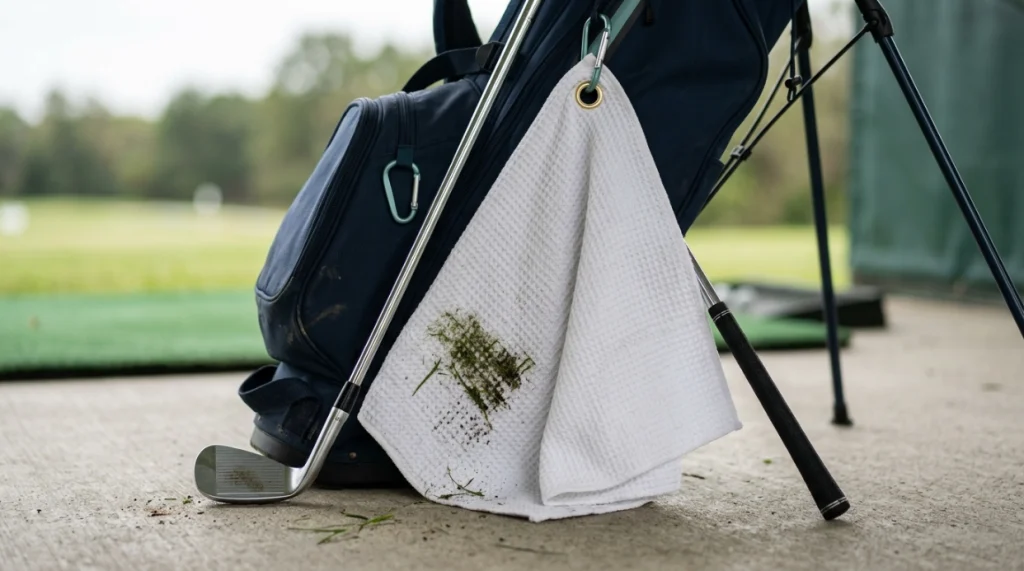
Prioritize texture, usable size, moisture control, and easy washing. A towel that looks premium but smears dirt around the face will not solve the problem.
As of 2026, there are plenty of golf-specific towel designs. You still do not need complicated technology to keep grooves clean.
1. Useful surface texture
Start by feeling the cleaning side. A waffle grid, textured microfiber, or quality terry loop gives you more working surface than an extremely smooth cloth.
2. Enough size for wet and dry zones
A tiny towel becomes dirty quickly. Choose enough surface area to keep one section damp and another relatively clean.
- Wet section: Mud, grass, sand, and dirty clubfaces.
- Dry section: Final drying, grips, and hands.
3. Low enough bulk for your bag
A walking golfer may value low weight more than a cart golfer. Large caddie-style towels provide more working area but take up more space.
4. Secure attachment
The towel should remain accessible without dragging on the ground. Common options include grommets, clips, loops, center slits, and magnetic attachments.
5. Easy washing
A groove towel gets dirty by design. Choose a washable fabric and follow its care label instead of letting mud accumulate for weeks.
6. A clean surface for each job
One towel can handle several jobs, but organization matters. Avoid using a gritty club-cleaning section on grips, your face, or other surfaces you want clean.
Simple buying rule: If groove cleaning is the priority, choose texture first, then size, drying speed, and attachment style.
Golf Towel Material for Grooves FAQ
Is microfiber or cotton better for cleaning golf club grooves?
Microfiber is the better all-around choice for most golfers, especially with a waffle texture. Cotton remains excellent for absorbing water and cleaning fresh dirt, but it can become heavier and slower to manage once saturated.
Is waffle weave better than regular microfiber?
For groove cleaning, I prefer waffle weave because the raised grid provides extra surface texture. Standard microfiber still works well for lighter dirt, moisture, and final wiping.
Can a towel completely clean wedge grooves?
A towel can remove most fresh grass, mud, sand, and moisture. Packed or dried debris may require a suitable brush after the towel has loosened as much material as possible.
Should a golf towel be wet or dry when cleaning grooves?
A slightly damp section usually works best for dirt because moisture helps soften soil and grass residue. Keep another section dry for the final wipe and for grips or hands.
Can I use a normal household microfiber cloth on golf clubs?
Yes. A clean household microfiber cloth can handle basic club cleaning, although golf-specific towels may offer better size, attachment options, and textured surfaces for convenient use during a round.
Does a thicker golf towel clean grooves better?
Not automatically. Surface texture, moisture, and cleaning technique matter more than thickness alone, so a thinner waffle microfiber towel can be more practical than a bulky smooth towel.
How often should I wash my golf towel?
Wash it whenever dirt, odor, or embedded debris starts building up. Heavy mud, rain, or frequent play may justify washing after each round, while lighter use may require less frequent cleaning.
Final Takeaway: Choose Texture First
For most golfers, waffle-weave microfiber is the best golf towel material for grooves. It combines useful cleaning texture with manageable weight, moisture control, and convenient on-course use.
Cotton terry remains a strong choice when absorbency matters most. Standard microfiber works well when you want something simple and lightweight.
- Best overall: Waffle-weave microfiber
- Best for wet conditions: Cotton terry
- Best lightweight choice: Standard microfiber
- Best routine: Damp clean, inspect, brush if necessary, then dry
Do not choose a towel based on thickness or branding alone. Pick a surface that removes debris easily, keep separate wet and dry areas, and clean your clubs before dirt has time to harden.
That simple routine keeps your equipment easier to maintain throughout the round. Your towel becomes more useful, and groove cleaning becomes one less thing to think about before the next shot.