
What Is a Hybrid Golf Rangefinder and How Does It Combine Technologies?

Quick Answer
A hybrid golf rangefinder combines laser rangefinding and GPS course mapping in one device. The laser measures the distance to a specific target, such as the flagstick, while GPS provides front, center, and back green distances and information about hazards. By combining both technologies, golfers can check precise target distances and understand the wider layout of each hole without carrying separate devices.
How the two technologies work together
- Laser measurement: Measures the distance to the flag, bunker edge, tree, or another visible target.
- GPS positioning: Uses satellite positioning and digital course data to show distances to mapped features.
- Green awareness: Provides front, center, and back distances to help you understand the putting surface.
- Hazard planning: Helps you assess bunkers, water, and layup areas, depending on the device’s mapping features.
- Faster decisions: Combines precise aiming with course-wide information in one compact unit.
- Practical limitation: Laser readings need a visible target, while GPS accuracy depends on positioning and the quality of the course data.
When is a hybrid rangefinder useful?
- Use GPS to plan a safe layup or understand a blind approach, then use the laser when you can see your intended target.
- Before competition, check the course’s device policy and confirm whether any slope-compensation feature must be disabled.
A hybrid golf rangefinder brings two useful distance-measuring technologies together for smarter decisions on the course. In this guide, I’ll explain how laser and GPS systems work, where their readings differ, and which features matter when choosing a device.
I’ll also cover practical examples, limitations, battery considerations, and competition rules so you can decide whether a hybrid model suits your game in 2026.
In This Guide
- What is a hybrid golf rangefinder?
- How do laser and GPS technologies work together?
- How does a hybrid compare with laser-only and GPS-only devices?
- What are the practical benefits on the golf course?
- Which features matter, and what are the limitations?
- How should you choose and use a hybrid rangefinder?
- Hybrid golf rangefinder FAQs
What Is a Hybrid Golf Rangefinder?
A hybrid golf rangefinder is a distance-measuring device that combines a laser rangefinder with GPS-based course information. It lets you measure a specific visible target while also viewing mapped distances to greens and hazards.
Understanding the two systems in one device
A conventional laser rangefinder measures the distance to the object you aim at, using reflected laser pulses. A GPS golf device calculates its position from satellite signals and uses digital course maps to estimate distances to mapped locations.
A hybrid unit brings these systems together, often displaying GPS yardages on a screen or within the laser viewfinder. The exact arrangement depends on the model, so not every hybrid offers identical displays or features.
For example, the Bushnell Tour Hybrid combines laser measurements to the flag with GPS-powered front, center, and back green distances in its viewfinder. Its manufacturer also lists integrated GPS and switchable slope-compensation features.
Why the combination matters
Golfers rarely need just one kind of distance information. A flagstick reading answers how far away the target is, but it doesn’t automatically explain the depth of the green or the position of every hazard.
GPS fills that information gap. The laser then helps refine the decision when a visible target gives you a more specific reference point.
**Section takeaway: A hybrid rangefinder combines precise target measurement with broader course awareness, reducing the need to carry separate distance devices.**
How Do Laser and GPS Technologies Work Together?
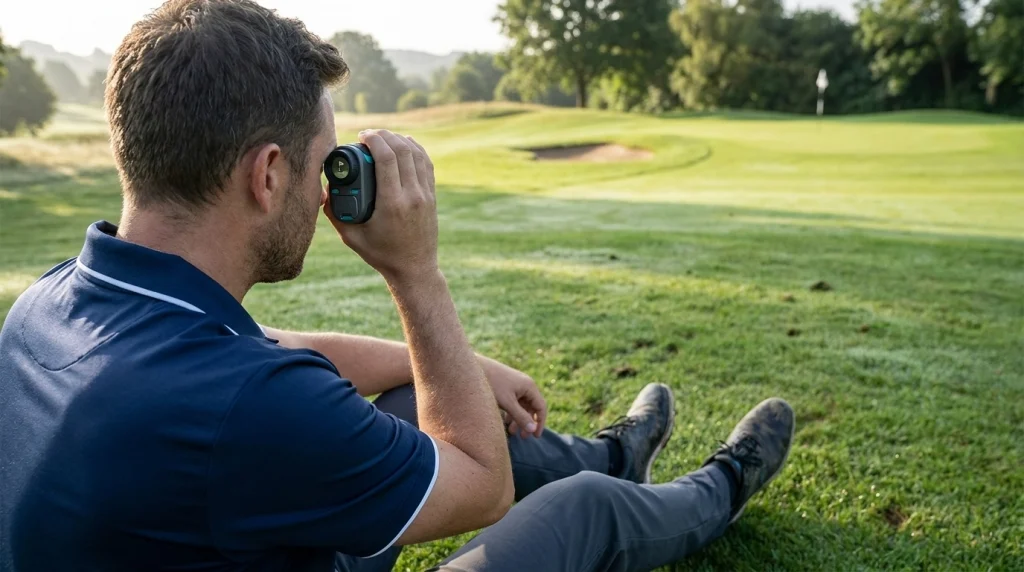
Laser and GPS systems work together by answering different questions about the same shot. GPS provides mapped course distances, while the laser measures the actual distance to the target you select.
How the laser measures distance
The laser sends a brief pulse of infrared light toward a target and measures how long the reflected signal takes to return. Internal electronics calculate the distance from that travel time.
When you aim at a flagstick, the device attempts to distinguish the flag from the trees or other objects behind it. Features such as target-lock indicators, vibration, or visual confirmation can help you recognize a successful reading.
Laser performance depends on the target and conditions. A small flag in bright sunlight may be harder to acquire than a large, reflective object nearby.
How GPS calculates golf distances
GPS uses satellite signals to estimate the device’s position, then compares that position with mapped course features. The resulting information can include distances to the front, center, and back of the green, plus selected hazards and layup points.
The quality of these readings depends partly on the accuracy and freshness of the course mapping. GPS doesn’t need a direct line of sight to the flag, but it cannot independently confirm the flag’s exact current position from a standard preloaded course map.
How the technologies complement each other
Imagine you’re 165 yards from the green on a par-four approach, with a bunker guarding the front and a flag positioned toward the back. GPS might show the distances to all three green reference points, while the laser gives you a direct measurement to the flag.
That combination gives you more context than either reading alone. You can consider the target distance alongside the green’s depth and the risks of coming up short.
Here is the practical sequence I recommend when using a hybrid device:
- Check GPS: Review the green’s front, center, and back distances.
- Identify the target: Decide whether you need the flag, a bunker edge, or another visible landmark.
- Take the laser reading: Aim carefully and wait for a stable measurement or target-lock confirmation.
- Choose your shot: Factor in your normal carry distance, lie, wind, and the hazards ahead.
Neither technology chooses the right club for you. Your carry distances and course judgment still matter.
For a broader understanding of distance-measuring equipment, the USGA’s distance-measuring device guidance explains how electronic distance information fits within the Rules of Golf.
**Section takeaway: GPS establishes the wider picture, and the laser refines your target measurement. Used together, they give you more useful information before committing to a shot.**
How Does a Hybrid Compare With Laser-Only and GPS-Only Devices?
A hybrid rangefinder offers the widest combination of target-specific and mapped distance information. A laser-only device emphasizes direct measurements, while a GPS-only device prioritizes convenient course mapping.
The best choice depends on how you play, how much information you want, and how much you’re willing to spend on golf equipment.
Hybrid vs. laser vs. GPS: What’s the difference?
| Feature | Laser-only | GPS-only | Hybrid |
|---|---|---|---|
| Measures the flag directly | Yes, if visible and acquired | Usually uses mapped green data | Yes, if visible and acquired |
| Front, center, and back distances | Not usually built in | Common feature | Common feature |
| Mapped hazard distances | Requires aiming at a visible hazard | Available when supported by course maps | Available when supported by course maps |
| Direct line of sight required | For the laser target | No | For laser measurements only |
| Course-map dependence | Low for direct distance readings | High | High for GPS features |
| Typical trade-off | Limited mapped context | No direct laser measurement | Higher cost and more features to manage |
This comparison describes common device categories, not universal specifications. Features, display layouts, battery arrangements, and course coverage vary by manufacturer and model.
When is a laser-only rangefinder enough?
A laser-only model is a sensible option if you prefer a simple routine and mainly want exact distances to visible targets. It can also suit golfers who already know the course or carry a separate GPS watch.
For example, a golfer who regularly plays the same course may already understand its landing areas and hazards. In that situation, paying for integrated mapping may add less value.
When does GPS-only make more sense?
GPS-only devices suit golfers who want quick distance checks without aiming at a flag. A GPS watch or handheld unit can be especially convenient when the green is hidden behind a hill or trees.
GPS can also be useful for planning around doglegs and choosing layup points, provided the course map includes the relevant features. However, a mapped yardage may not match the exact distance to the flag’s current position.
Who benefits most from a hybrid?
A hybrid is particularly useful for golfers who frequently play unfamiliar courses, encounter blind approaches, or want both detailed aiming and mapped context. It can also reduce the need to carry separate laser and GPS devices.
The trade-off is complexity. If you rarely use GPS information, a simpler rangefinder may deliver better value.
**Section takeaway: Choose hybrid for versatility, laser-only for straightforward target measurements, and GPS-only for convenient mapped distances.**


What Are the Practical Benefits of a Hybrid Rangefinder on the Golf Course?
The main benefit of a hybrid rangefinder is better-informed course management. It helps you connect the distance to your intended target with the hazards and green dimensions surrounding that target.
How does it help with approach shots?
Approach shots demand more than knowing the distance to the flag. You also need to consider where the green starts, where it ends, and how much room you have around your intended landing area.
Suppose GPS reports 145 yards to the center and 160 yards to the back, while the laser measures 154 yards to the flag. You now know the pin sits toward the back portion of the green, although you still need to account for your normal carry and the day’s conditions.
This information helps you avoid treating every flag distance as an instruction to aim directly at the pin. Sometimes, the middle of the green is the smarter target.
Can a hybrid help with hazards and layups?
Yes, when the GPS map includes the relevant hazard or landing-area data. You can estimate whether a bunker or water feature affects your planned landing zone before choosing a club.
Consider a par-five with water across the approach to the green. GPS can help you identify a safer layup distance, while the laser can measure a visible tree or other landmark that helps you judge the landing area.
That combination supports more deliberate decisions. It doesn’t remove the need to estimate carry distance or account for a poor lie.
Does it help on unfamiliar courses?
Hybrid devices can be especially useful when you travel for golf. A new course may have unfamiliar bunkers, unusual green shapes, and blind landing areas that aren’t obvious from the fairway.
GPS offers an initial overview, and the laser helps you check visible targets as you move through the hole. Before playing, confirm that your model supports the course and has current map data.
How can it improve pace of play?
Having both technologies in one unit can reduce the need to switch between a rangefinder and a separate GPS watch or phone. The actual time saved depends on the device’s interface and how quickly you can read the display.
I recommend establishing a simple pre-shot routine rather than checking every available number. Start with the green and hazards, confirm the key distance, and make your decision.
**Section takeaway: Hybrid technology is most valuable when course layout and target distance both influence your shot. Use the information that changes your decision, not every number the device displays.**
Which Features Matter, and What Are the Limitations?
A hybrid rangefinder can offer excellent convenience, but combining technologies doesn’t guarantee better readings or a better golfing experience. You should assess its display, targeting system, course coverage, battery design, and additional functions before buying.
Which features should you prioritize?
- Clear optics: Look for an image and aiming reticle you can see comfortably in different lighting conditions.
- Reliable target acquisition: Vibration or visual lock confirmation can help you recognize when the laser has picked up the flag.
- Useful GPS mapping: Check for front, center, and back distances, plus hazard information relevant to the courses you play.
- Readable display: Confirm that yardages and indicators remain easy to read without excessive button presses.
- Battery practicality: Check whether the laser and GPS share a battery or use separate power sources, and review charging or replacement requirements.
- Durability: Consider water resistance, grip, carrying case quality, and ease of cleaning.
- Course updates: Check whether maps update automatically, through an app, or through a manual process.
What are the main limitations?
Hybrid models have several practical limitations that are easy to overlook when comparing feature lists.
- Higher purchase cost: Combining laser optics, GPS hardware, mapping, and software can cost more than buying a basic single-purpose device.
- Laser visibility: The laser cannot reliably measure a target it cannot acquire, such as a flag hidden behind trees or a hill.
- GPS map quality: Incomplete, outdated, or incorrectly aligned course data can affect mapped distances.
- Battery management: Some models need separate charging and battery replacement routines for their different systems.
- Learning curve: Extra screens and controls can complicate a task that a basic laser performs with one or two button presses.
- Weather and handling: Rain, glare, shaky hands, and poor visibility can make readings or displays harder to use.
Does slope compensation make a hybrid more accurate?
Slope compensation estimates how elevation changes affect the distance a shot plays, but it doesn’t make the underlying measurement automatically more accurate. It provides a different type of information: an adjusted playing-distance estimate rather than simply the physical distance to the target.
For example, a target 150 yards away uphill may play longer than a level 150-yard shot. The size of that difference depends on the elevation change and other factors, including the shot you intend to hit.
Not every hybrid has slope compensation, and implementations differ. Check the model’s documentation rather than assuming that GPS and laser readings both receive the same adjustments.
**Section takeaway: Prioritize dependable target acquisition, useful mapping, and simple operation before paying extra for advanced features.**
How Should You Choose and Use a Hybrid Rangefinder?

The right hybrid rangefinder should fit your playing habits, preferred display, and budget. Compare the functions you will use regularly rather than choosing the device with the longest feature list.
What should you check before buying?
- Match the device to your game: Decide whether you regularly need direct flag measurements, mapped hazards, or both.
- Check supported courses: Verify coverage for the courses you play most often, especially when traveling.
- Test the display: If possible, look through the optics and read the GPS information in person.
- Review the power system: Understand charging time, battery life claims, replacement costs, and whether the technologies use separate batteries.
- Confirm the rules features: Find out whether slope can be disabled and whether the device meets the requirements for your intended competition.
- Compare total value: Weigh the price against the functions you will genuinely use and the cost of any required app or subscription.
How do you use one effectively during a round?
Start by checking GPS distances and identifying the hazards that could affect your shot. Then use the laser to measure the flag or another visible target when that extra precision helps.
Next, compare the numbers with your own carry distances and current playing conditions. Your final choice should account for the lie, wind, elevation, and the amount of trouble around the green.
A rangefinder supplies information, not a guaranteed club choice. You remain responsible for interpreting that information and selecting a shot that fits your ability.
Are hybrid rangefinders allowed in tournament golf?
Distance-measuring devices are generally permitted under Rule 4.3a of the Rules of Golf, subject to the Committee’s ability to prohibit them by Local Rule and restrictions on the information a player accesses. Slope-adjusted playing distances and other prohibited advice or measurements cannot be used when they breach the applicable rules.
A slope switch alone doesn’t guarantee that every device is permitted in every competition. Check the event’s conditions and the device’s operating modes before your round.
The R&A’s Rule 4 guidance provides the governing framework for equipment use during a round. You can also review the USGA explanation of distance-measuring devices for further context.
**Section takeaway: Choose a model that suits your routine, learn its controls before playing, and verify competition restrictions rather than relying on a feature label.**
Hybrid Golf Rangefinder FAQs
Is a hybrid golf rangefinder more accurate than a regular laser rangefinder?
Not necessarily. The laser component still depends on target acquisition and the device’s measurement specifications, while GPS provides mapped distances to course features. A hybrid offers more kinds of information, but that doesn’t automatically make its laser measurements more accurate than those of a quality laser-only model.
Does a hybrid rangefinder need a phone or internet connection?
Many hybrid models use onboard GPS and preloaded course maps, so their core distance functions can work without a live phone or internet connection. However, app pairing, map updates, and certain connected features may require a phone or network access, depending on the model.
Can a hybrid rangefinder measure distances to bunkers and trees?
Yes, its laser can measure a visible bunker edge, tree, or other target that the device successfully acquires. GPS may also provide mapped distances to selected hazards, but that depends on the course data and the features supported by the model.
Is slope compensation worth paying extra for?
Slope compensation can help recreational golfers understand how uphill and downhill shots may play differently from their measured distances. It may be less important if you prefer simple yardages or play competitions where slope-adjusted information is prohibited, so check that the feature can be disabled when required.
Can beginners benefit from a hybrid golf rangefinder?
Yes. Beginners can use GPS to understand green distances and hazards, then use the laser to check specific targets. The key is to keep the routine simple and learn how distance relates to personal carry distances rather than expecting the device to choose every club.
Do hybrid rangefinders work on every golf course?
The laser can measure suitable visible targets on many courses without relying on a course map. GPS features depend on satellite positioning and supported mapping data, so you should confirm that the courses you plan to play appear in the manufacturer’s coverage information.
Should you buy a hybrid rangefinder or a GPS watch?
Choose a hybrid if you want direct laser measurements alongside mapped green and hazard distances. A GPS watch may be better if you prefer hands-free access and quick yardages without aiming at a target, especially if you rarely need a laser measurement.
Final Takeaway: Is a Hybrid Golf Rangefinder Worth It?
A hybrid golf rangefinder is worth considering if you want the precision of laser targeting and the convenience of GPS course mapping in one device. It is particularly useful for golfers who play unfamiliar courses, manage hazards carefully, and want more context before choosing a shot.
Before buying, compare the display, supported courses, battery system, slope controls, and price. A well-chosen device should make your pre-shot routine clearer, not turn every shot into a search through menus.
Start with the features that solve real problems in your game. When you combine reliable distance information with sound course management, you can make more confident decisions without expecting technology to replace practice or judgment.