
What Is Golf? A Beginner-Friendly Guide to How the Game Works
Golf can look complicated when you first encounter it. There are different clubs, unusual scoring terms, written and unwritten rules, and courses that appear difficult to navigate.
So, what is golf, and what does a new golfer actually need to know?
Golf is a target-based sport in which players use clubs to move a ball from a starting area into a hole using as few strokes as possible. This guide explains how golf works, how scoring is calculated, what equipment you need, basic rules and etiquette, and the simplest way to start playing confidently.
Quick Answer
Golf is a sport where players use different clubs to hit a ball around a course and into a series of holes. The goal is to complete each hole—and the entire round—in as few strokes as possible. Golf rewards accuracy, distance control, strategy, patience, and consistent decision-making.
What Is Golf?
Golf is played on a course containing a sequence of holes. Most full-size courses have 18 holes, although many facilities offer nine-hole layouts, short courses, or beginner-friendly practice areas.
Every hole begins at a designated teeing area and ends when the ball is hit into the cup on the putting green.
Unlike many sports, golf does not use a standardized playing field. Each course has its own combination of:
- Hole lengths
- Fairway shapes
- Slopes and elevation changes
- Trees and rough
- Sand bunkers
- Water hazards
- Putting green designs
The golfer must adjust to these changing conditions while choosing where to aim, which club to use, and how aggressively to play.
The official Rules of Golf published by The R&A cover how the game should be played in recreational rounds and organized competitions. The Rules describe golf as a game of skill and personal challenge, with the player responsible for making each stroke and applying the Rules honestly. (Randa)
What Is the Main Objective of Golf?
The objective is simple:
Complete the course using the fewest possible strokes.
A stroke generally counts whenever a player intentionally swings a club to strike the ball. If a golfer takes four strokes to complete a hole, the score for that hole is four.
Penalties may add extra strokes. For example, a lost ball, an out-of-bounds shot, or certain improper drops can increase the score.
Golf is not only about hitting the ball as far as possible. A successful player must combine:
- Distance
- Accuracy
- Course management
- Short-game control
- Putting
- Emotional discipline
- Rules knowledge
A shorter but accurate shot is often more useful than a long shot that finishes in trouble.


How a Hole of Golf Is Played
A typical golf hole follows a simple sequence.
1. Start From the Teeing Area
The golfer places the ball on or near a small peg called a tee and plays the first shot.
Longer holes are usually started with a driver or fairway wood. On shorter holes, the player may use an iron or hybrid.
2. Play the Ball Toward the Green
After the opening shot, the golfer normally plays the ball from wherever it comes to rest.
The next shot may be played from:
- The fairway
- The rough
- A bunker
- A recovery area near trees
- Another permitted part of the course
The golfer continues until the ball reaches or approaches the putting green.
3. Play the Short Game
Shots played close to the green are part of the short game.
Common short-game shots include:
- Pitch: A higher shot that travels through the air and stops relatively quickly.
- Chip: A lower shot that lands near the green and rolls toward the hole.
- Bunker shot: A shot played from sand.
- Putt: A rolling stroke usually played on the green.
4. Hole the Putt
The hole is complete when the entire ball is resting below the surface of the putting green inside the cup.
The player records the total number of strokes and penalties before moving to the next hole.
Understanding the Main Parts of a Golf Course
Knowing basic course terminology makes golf much easier to follow.
Teeing Area
The designated starting area for a hole. Courses usually provide several sets of tees so golfers can choose a distance that matches their ability.
Fairway
The shorter-cut grass leading toward the green. The fairway usually provides the cleanest surface for an approach shot.
Rough
Longer grass located beside the fairway. Shots from the rough may be more difficult because the grass can interfere with the clubhead and reduce ball control.
Bunker
A prepared area containing sand. Bunkers are designed to create strategic difficulty around fairways and greens.
Penalty Area
An area—often containing water—from which special relief options may be available under the Rules.
Putting Green
The closely cut surface surrounding the hole. Players normally use a putter when the ball is on the green.
Out of Bounds
Ground outside the permitted boundaries of the course. Under the standard Rule, a ball that is lost or out of bounds normally requires stroke-and-distance relief: one penalty stroke is added, and another ball is played from the location of the previous stroke. (Randa)
How Golf Scoring Works

Every golf hole has a number called par. Par represents the score an accomplished golfer would generally be expected to make on that hole under normal conditions.
Most holes are classified as:
- Par 3: Usually intended to reach the green with the first shot.
- Par 4: Usually intended to reach the green in two shots.
- Par 5: Usually intended to reach the green in three shots.
A course’s total par is the combined par of all its holes.
Common Golf Scoring Terms
| Term | Meaning |
|---|---|
| Ace or hole-in-one | The ball is holed with the first stroke |
| Eagle | Two strokes under par |
| Birdie | One stroke under par |
| Par | The expected score for the hole |
| Bogey | One stroke over par |
| Double bogey | Two strokes over par |
| Triple bogey | Three strokes over par |
Suppose a golfer completes a par-4 hole in five strokes. The player has made a bogey.
If the same golfer completes the next par-5 hole in four strokes, the player has made a birdie.
Gross Score and Net Score
A gross score is the golfer’s actual number of strokes.
A net score is the gross score after handicap strokes have been applied. Handicaps allow golfers of different abilities to compete more fairly.
According to the USGA’s World Handicap System guidance, a Handicap Index represents a player’s demonstrated ability based on scores relative to the courses and tees played. (USGA)
A new golfer does not need an official handicap immediately. It becomes more useful when the player begins recording rounds regularly or entering competitions.
What Equipment Do You Need to Play Golf?
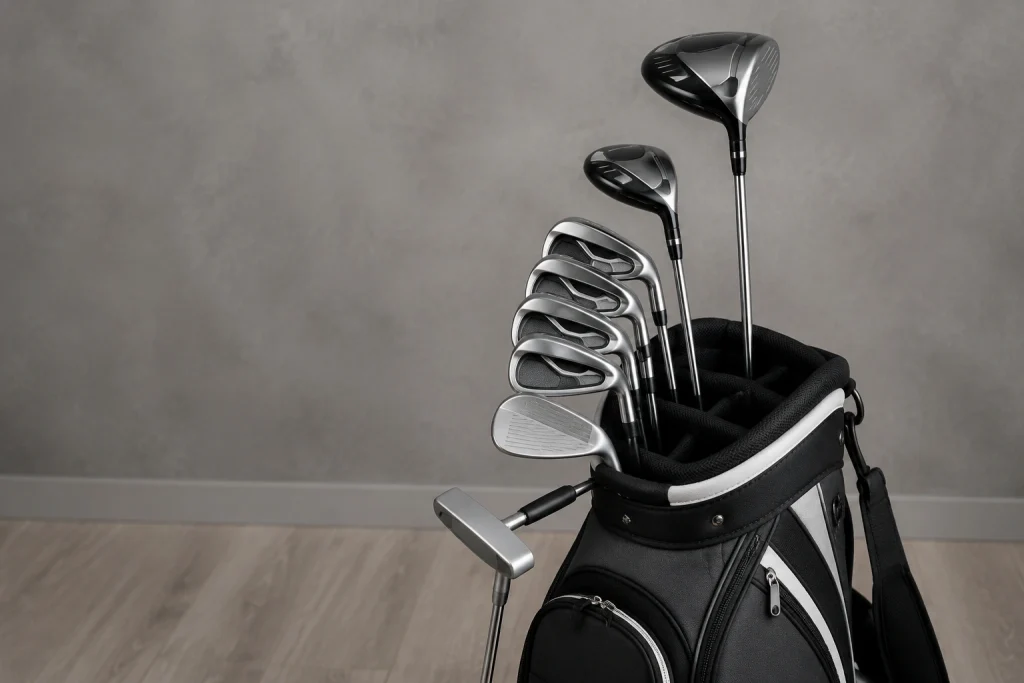
You do not need a full professional setup to begin. A basic collection of dependable clubs is usually enough.
Common Golf Clubs and Their Uses
| Club category | Typical purpose | Beginner guidance |
|---|---|---|
| Driver | Long tee shots | Offers distance but can be difficult to control |
| Fairway wood | Long fairway or tee shots | Often easier to launch than a low-lofted iron |
| Hybrid | Replaces difficult long irons | A practical choice for many beginners |
| Irons | Approach shots at different distances | Mid- and short irons are useful for learning |
| Wedges | Chips, pitches, bunkers and short approaches | Focus on distance control rather than maximum power |
| Putter | Rolling the ball on the green | Choose one that feels comfortable and easy to aim |
Beginners can often start with:
- A driver or fairway wood
- One hybrid
- A small group of irons
- One or two wedges
- A putter
- A golf bag
Golf Balls
Golf balls differ in compression, construction, spin and feel.
Beginning golfers generally benefit from a durable ball that offers reasonable distance and does not cost so much that losing one becomes stressful.
Premium tour balls can provide excellent control for skilled players, but they do not automatically improve a beginner’s score. Consistent contact matters more than using the most expensive ball.
Shoes, Glove and Accessories
Useful accessories include:
- Golf glove
- Tees
- Ball marker
- Pitch-mark repair tool
- Towel
- Water bottle
- Sunscreen
- Weather-appropriate clothing
Golf shoes can improve traction, but many beginners can start in comfortable athletic shoes if the facility permits them.
Cost, Quality and Durability Considerations
A lower-cost boxed set can be suitable for a new golfer who is still learning basic technique. Used clubs can also offer strong value, provided they are not damaged or badly worn.
Before buying used equipment, inspect:
- Clubheads for cracks or major dents
- Shafts for bending, rust or splitting
- Grips for hard, slick or crumbling rubber
- Club lengths for major inconsistencies
- Set composition for large distance gaps
More expensive equipment may offer better materials, adjustability and fitting options. However, premium clubs cannot correct poor alignment, an unstable grip or inconsistent contact.
Buy equipment that fits your current ability, not the player you hope to become several years from now.
Expert Tip: Start with a simple half-set or beginner set and spend part of your budget on practice or a lesson. Better contact with basic clubs will usually produce more improvement than poorly fitted premium equipment.
The Most Common Ways to Play Golf
Stroke Play
Stroke play records every stroke taken during the round. The player with the lowest total score wins.
This is the format most people recognize from professional tournaments.
Match Play
In match play, golfers compete hole by hole.
The player with the lower score wins that hole. The match is decided by the number of holes won rather than the total stroke count.
Scramble
In a scramble, each team member hits a shot. The team selects its preferred result, and everyone plays the next shot from that area.
Scrambles are popular at charity events and social outings because they reduce pressure on less experienced players.
Stableford
Stableford awards points according to the score made on each hole. A very poor hole does not necessarily ruin the entire round because the player can pick up the ball after reaching a certain point.
The Rules also recognize formats such as Maximum Score and Par/Bogey play. (Randa)
Basic Golf Rules and Etiquette
Beginners do not need to memorize every Rule before playing. They should, however, understand several basic responsibilities.
Play the Ball Honestly
Do not intentionally move, improve or replace the ball unless a Rule allows it.
Count all strokes and penalties accurately when keeping an official score.
Protect Other Players
Never hit when another person could be within range.
Before swinging:
- Check the area in front of and beside you.
- Make sure no one is close to the clubhead.
- Wait until the group ahead is safely out of range.
- Shout “Fore!” immediately if a shot may travel toward someone.
Maintain a Reasonable Pace
Prepare while other golfers are playing, provided it is safe and does not distract them.
The USGA’s pace-of-play guidance suggests that a stroke should generally be made within 40 seconds when it is the player’s turn, and most shots should be played sooner. (USGA)
Care for the Course
Good etiquette includes:
- Repairing pitch marks on greens
- Replacing or filling divots when required
- Raking bunkers
- Keeping carts away from restricted areas
- Avoiding unnecessary damage during practice swings
- Following posted course instructions
Respect Other Golfers
Remain quiet and still while another player is preparing to swing.
Avoid standing directly behind a player or close to the intended putting line. Do not walk across another golfer’s putting line when it can reasonably be avoided.
Golf relies heavily on honesty, awareness and consideration. Good etiquette makes the course safer and more enjoyable for everyone.
How to Start Playing Golf
The easiest way to begin is to learn in stages.
1. Visit a Driving Range
A driving range allows you to practise without the pressure of playing an entire course.
Begin with short swings using a wedge or mid-iron. Focus on balance and solid contact rather than distance.
2. Practise Putting and Chipping
A large percentage of golf shots occur near the green.
Spend time learning:
- Short putts
- Long-distance putting
- Basic chip shots
- Small pitch shots
- Distance control
3. Play a Short Course
Try a par-3 course, executive course or nine-hole layout before committing to a difficult full-length course.
Shorter courses are usually less intimidating and allow beginners to practise real golf decisions.
4. Choose the Correct Tees
Playing from tees that are too long can make every hole unnecessarily difficult.
Choose a tee that allows you to reach greens with realistic shots. Moving forward is not a sign of weak ability. It improves pace, enjoyment and learning.
5. Track Simple Statistics
Instead of focusing only on the total score, record:
- Tee shots kept in play
- Penalty strokes
- Greens reached
- Number of putts
- Successful chips
- Avoidable mistakes
These statistics reveal where improvement is most likely.
Golf Technique: What Beginners Should Focus On
A golf swing contains many moving parts, but beginners should avoid trying to control everything at once.
Start with four priorities.
Grip
Hold the club securely without excessive tension. A grip that is too tight can restrict movement and reduce control.
Alignment
Aim the clubface toward the target first. Then position the feet, hips and shoulders parallel to the intended starting line.
Balance
Maintain a stable posture and finish the swing under control.
Contact
Try to strike the ball and ground in the correct sequence rather than attempting to swing as hard as possible.
Speed should be developed after contact becomes reasonably consistent.
A player who stays balanced and hits the center of the clubface will often outperform someone who swings harder but misses the center.
When to Get Help From a Golf Pro or Fitter
Professional help becomes valuable when repeated trial and error is no longer producing improvement.
Consider working with a golf professional when:
- You regularly miss the ball or hit the ground first.
- Your shots curve severely in the same direction.
- You experience pain during or after swinging.
- You cannot identify why contact changes from shot to shot.
- Online tips have created too many conflicting swing thoughts.
- You want a structured practice plan.
The PGA of America coach directory can help golfers find lessons, beginner programs and PGA professionals in their area. (PGA of America)
A professional club fitting may be appropriate when:
- You are unusually tall or short.
- Standard clubs feel difficult to address comfortably.
- Your swing speed has changed significantly.
- You strike the ball consistently but launch or direction remains unsuitable.
- You are purchasing an expensive long-term set.
A fitting is most useful when the golfer can produce a reasonably repeatable swing. A complete beginner may benefit more from an introductory lesson before paying for a detailed fitting.
Common Mistakes Golfers Should Avoid
- Trying to hit every shot at maximum power: Extra effort often reduces balance and center contact.
- Buying advanced clubs too early: Small, less-forgiving clubheads can make learning more difficult.
- Ignoring the short game: Better putting and chipping can reduce scores faster than adding a few yards to a drive.
- Playing tees that are too long: This creates difficult approach shots and slows down the group.
- Changing technique after every bad shot: Golf improvement requires enough repetition to judge whether a change works.
- Using damaged or worn grips: Slippery grips can increase tension and reduce control.
- Failing to warm up: Begin with gentle movement and short swings before attempting full-speed drives.
- Ignoring safety: Never swing near another person or hit toward a group that may still be within range.
- Keeping an inaccurate score: Honest scoring helps golfers measure real progress.
- Expecting immediate consistency: Even experienced golfers hit poor shots. Recovery and decision-making are part of the game.
FAQs
Is golf difficult to learn?
Golf is easy to begin but challenging to master. A beginner can learn the basic rules and make contact fairly quickly, but developing reliable direction and distance control takes practice. Starting with short swings and beginner-friendly facilities makes the process easier.
How many clubs does a beginner need?
A beginner does not need a complete set. A driver or fairway wood, hybrid, several irons, wedge and putter can cover most situations. A smaller set also makes club selection less confusing.
Do I need lessons before playing a golf course?
Lessons are not mandatory, but one introductory lesson can help with grip, posture, safety and basic contact. Beginners can also start at a range and then play a short course with an experienced golfer.
What is par in golf?
Par is the expected number of strokes assigned to a hole. A score below par is generally good, while a score above par means the golfer used more strokes than the hole’s assigned number.
How long does a round of golf take?
The time depends on the number of holes, course difficulty, group size and pace. Nine holes usually require much less time than a full 18-hole round. Beginners should choose quieter times or shorter courses while learning.
Is golf good exercise?
Golf can involve substantial walking, especially when a player carries or pushes a bag. Swinging and walking across varied terrain also require balance and coordination. The physical demand depends on course length, weather and whether a cart is used.
Can I play golf without expensive equipment?
Yes. Beginners can use rental clubs, a used set or an affordable starter set. Proper length, comfortable grips and suitable club design matter more than brand prestige or premium pricing.
Conclusion
Golf is a target sport built around a straightforward challenge: move the ball from the teeing area into the hole using as few strokes as possible.
Understanding what golf is requires more than learning how to swing a club. Golf also involves strategy, scoring, equipment selection, course management, etiquette and personal responsibility.
New golfers should begin with simple equipment, practise short controlled swings, learn basic safety rules and choose courses that match their ability. Avoid rushing into expensive clubs or complicated swing changes before developing dependable contact.
Start at a driving range or short course, track a few basic performance statistics, and seek help from a golf professional when a recurring problem becomes difficult to diagnose. Build the game one skill at a time, and make your next round focused on safe play, smart decisions and steady improvement.