
What Golf Towel Does Bryson DeChambeau Use?

Quick Answer
As of October 2026, I couldn’t verify the exact golf towel brand or model Bryson DeChambeau uses during competition. Although his equipment choices receive close attention, the available equipment reports don’t establish a specific towel. If you want a similar practical setup, look for an absorbent microfiber golf towel with a secure attachment and enough surface area to clean clubfaces and grips.
What to look for in a golf towel
- Reliable cleaning: A waffle-weave microfiber surface helps lift dirt and grass from club grooves.
- Useful size: A compact towel suits walking golfers, while a larger tour towel offers more cleaning area.
- Secure attachment: A clip, carabiner, or suitable magnetic attachment keeps the towel within reach.
- Wet and dry zones: A larger towel makes it easier to reserve one area for cleaning and another for hands and grips.
- Easy maintenance: Choose a towel that you can wash regularly without complicated care.
For context, Golf Digest’s coverage of DeChambeau’s unusual towel setup describes a towel being held behind him during putting practice to help him see a laser training line. That incident doesn’t confirm his regular on-course towel brand.
Bryson DeChambeau is known for questioning conventional golf equipment choices, so it’s natural to wonder what he carries alongside his clubs. In this guide, I’ll separate what published reporting confirms from what remains unknown and explain how to choose a golf towel that works for your own game.
In This Guide
- What golf towel does Bryson DeChambeau use?
- Why was a towel held behind Bryson while putting?
- What type of golf towel should you choose?
- How do microfiber, cotton, and magnetic towels compare?
- How do you choose a golf towel for your bag?
- How should you use and maintain a golf towel?
- Frequently asked questions
What golf towel does Bryson DeChambeau use?

The exact brand and model of Bryson DeChambeau’s regular golf towel remain unconfirmed by the reliable equipment reporting I could verify. I wouldn’t name a particular manufacturer simply because its towel resembles one shown in a tournament photograph.
DeChambeau’s equipment history offers useful context, though. His clubs have changed substantially over the years, and recent equipment coverage illustrates how willing he is to experiment with different manufacturers and prototypes.
What published equipment reports actually tell us
The official LIV Golf website provides player and equipment coverage, while specialist golf publications regularly document the clubs and balls DeChambeau puts into play. These sources are useful for tracking his equipment, but they don’t establish a confirmed towel model in the reporting reviewed for this article.
For example, GolfMagic’s equipment report on DeChambeau discusses his evolving club setup. It illustrates the level of detail available for his clubs, but it doesn’t provide reliable confirmation of his everyday golf towel.
- Confirmed: DeChambeau has a documented history of experimenting with golf equipment.
- Not confirmed: The exact manufacturer, model, dimensions, fabric, and attachment of his regular playing towel.
- Worth remembering: A sponsor logo or brand visible in a photograph doesn’t necessarily identify the towel’s manufacturer.
Does he use a Cobra, Titleist, or another branded towel?
There isn’t enough reliable evidence to confirm that he currently uses a Cobra, Titleist, or another specific branded towel. Past club sponsorships also shouldn’t be treated as proof of a current towel preference.
Golfers who want to replicate a professional’s setup should distinguish between a documented equipment choice and a reasonable guess. That’s especially important with accessories, which often receive less detailed coverage than drivers, irons, putters, and golf balls.
Section takeaway: The most accurate answer is that DeChambeau’s regular golf towel brand hasn’t been verified. Choose a towel for its cleaning performance and attachment rather than buying one based on an unconfirmed association.
Why was a towel held behind Bryson while putting?
A widely discussed incident in February 2020 explains one reason a towel appeared in DeChambeau’s putting routine. His assistant held a towel behind him while he practised with a laser-based putting aid, helping him see the projected line in bright conditions.
This was a training-related use of a towel, not evidence of his preferred cleaning towel. The distinction matters because photographs of unusual practice routines can easily be mistaken for product endorsements.
What happened at the 2020 WGC-Mexico Championship?
According to Golf Digest’s report from February 21, 2020, DeChambeau used a laser attached to his putter while working on his stroke path over a chalk line.
The towel helped make the laser line easier to see in sunlight. It wasn’t being used to wipe mud from an iron, dry a grip, or clean a golf ball.
That unusual scene fits his reputation for analysing small details in his practice. However, it doesn’t tell us whether his everyday towel is microfiber, cotton, oversized, magnetic, or attached with a clip.
What can recreational golfers learn from this?
The useful lesson isn’t that every golfer needs a towel assistant. It’s that equipment should serve a clear purpose, whether that’s keeping club grooves clean or making practice feedback easier to see.
- During practice: Keep training aids organised and use them for a specific purpose.
- During a round: Use your towel to remove grass, sand, and moisture from clubfaces and grips.
- Between shots: Return the towel to a consistent spot so you can reach it without disrupting your routine.
A simple cleaning routine can be more useful than copying a professional’s unusual practice setup. Clean grooves and dry grips are practical benefits for golfers at every skill level.
Section takeaway: The famous towel incident concerned visibility during putting practice. It doesn’t identify the brand of towel DeChambeau normally carries on the course.
What type of golf towel should you choose?
A golf towel is a cloth designed to remove dirt, grass, sand, and moisture from golf equipment while helping players keep their hands and grips dry. The best option depends on how you carry your bag, how often you play in wet conditions, and how much cleaning surface you need.
Rather than copying an unverified professional choice, start with three common options: waffle-weave microfiber, traditional cotton, and towels with specialised attachment systems.
Waffle-weave microfiber towels
Microfiber towels with a waffle texture are a practical choice for golfers who want to clean club grooves efficiently. Their textured surface can help lift dirt from iron faces, while the fabric absorbs moisture for general cleaning.
- Useful for cleaning iron grooves after shots from grass or soft ground.
- Available in compact sizes and larger tour-style formats.
- Often lightweight and easy to attach to a golf bag.
For most recreational players, this is a sensible starting point. It offers a useful balance between portability, cleaning area, and everyday maintenance.
Traditional cotton towels
Cotton golf towels offer a familiar, soft texture and can absorb moisture well. They’re worth considering if you prefer a traditional towel feel or want a larger cloth for drying your hands and equipment.
However, a thick cotton towel may take longer to dry after a wet round. Its suitability depends on how much moisture it absorbs and how you store it between games.
Magnetic and clip-on towels
A magnetic golf towel attaches to compatible metal surfaces, such as certain clubheads or golf-cart components. A clip-on towel uses a carabiner or similar fitting to connect to a bag, making it easy to carry during a walking round.
Neither attachment style makes a towel inherently better at cleaning. The main difference is convenience and where you prefer to keep it between shots.
Section takeaway: Waffle-weave microfiber is a strong general-purpose starting point. Choose cotton for its traditional feel, or select a magnetic or clip-on design when quick access matters most.


How do microfiber, cotton, and magnetic golf towels compare?
These options aren’t all mutually exclusive: microfiber and cotton describe materials, while magnetic describes an attachment method. A magnetic towel, for example, can also use microfiber fabric.
The comparison below focuses on typical characteristics rather than claiming that DeChambeau uses any of these specific designs.
| Towel option | Main strength | Main trade-off | Best suited to |
|---|---|---|---|
| Waffle microfiber | Textured cleaning surface | Needs regular washing to remove trapped dirt | Golfers cleaning irons and wedges frequently |
| Cotton terry | Soft feel and moisture absorption | Can become bulky or remain damp | Players who prefer a traditional towel |
| Magnetic towel | Convenient attachment to compatible metal surfaces | Attachment depends on magnet strength and surface | Cart users and golfers who want quick access |
| Clip-on tour towel | Secure bag attachment and potentially larger cleaning area | A large towel takes up more space | Walking golfers and players who clean clubs often |
What size is best for a golf towel?
There’s no universal ideal size, but a compact towel is easier to carry, while a larger towel gives you more room to separate dirty and clean areas.
- Compact: Consider a roughly 16-by-16-inch towel if you want something lightweight and easy to manage.
- Medium: A towel around 16 by 24 inches offers additional cleaning surface without the bulk of a full-size tour towel.
- Oversized: A tour-style towel around 22 by 40 inches provides more room for repeated cleaning and drying.
These are example formats, not confirmed specifications for DeChambeau’s towel. Actual dimensions vary by manufacturer and model.
For a golfer who carries a bag over the shoulder, I’d start with a compact or medium option. Players using a push cart or riding cart may appreciate the extra surface area of a larger towel.
Section takeaway: Match the fabric to your cleaning needs and the attachment to your bag setup. Don’t pay extra for a tour-style design unless its additional size or convenience will help you.
How do you choose a golf towel for your bag?
The right towel should be easy to reach, useful in your normal playing conditions, and simple to clean after a round. A few practical checks will narrow the options more effectively than a professional’s unconfirmed brand preference.
1. Consider the conditions you play in
Wet grass, soft ground, sand, and early-morning dew can leave clubfaces dirty or grips damp. If you regularly play in these conditions, prioritise absorbency, useful texture, and enough fabric to keep a relatively clean section available.
In dry conditions, a compact towel may be sufficient for wiping away dust and occasional grass. You may not need the larger format that suits someone playing in wet weather several times a week.
2. Check how it attaches to your bag
A towel that drags on the ground or swings into the wheels of a push cart quickly becomes inconvenient. Before buying, check the attachment point and how securely it holds the towel when you walk or move your bag.
- Choose a carabiner or clip if you want a straightforward bag attachment.
- Consider a magnetic design if you have a convenient compatible metal surface.
- Look for a suitable grommet or hanging loop if you prefer a traditional towel.
3. Decide whether you need separate wet and dry areas
A larger towel makes it easier to dedicate one section to cleaning clubheads and another to drying your hands. That separation can be useful when rain or morning moisture makes grip control more challenging.
With a smaller towel, you can achieve a similar result by folding it and keeping track of which surface is clean. The important part is avoiding unnecessary transfer of mud and grit to the grips.
4. Look beyond branding
A logo can make a towel attractive, but it doesn’t tell you how well the fabric absorbs moisture or how securely the attachment works. Check the dimensions, fabric description, washing instructions, and attachment design before making your choice.
Also consider replacement cost. A towel that can be washed regularly and used throughout many rounds may be better value than a premium-branded option with features you won’t use.
Section takeaway: Prioritise the conditions you play in, attachment security, and cleaning area. Those practical details will affect your experience more than an unverified professional endorsement.
How should you use and maintain a golf towel?
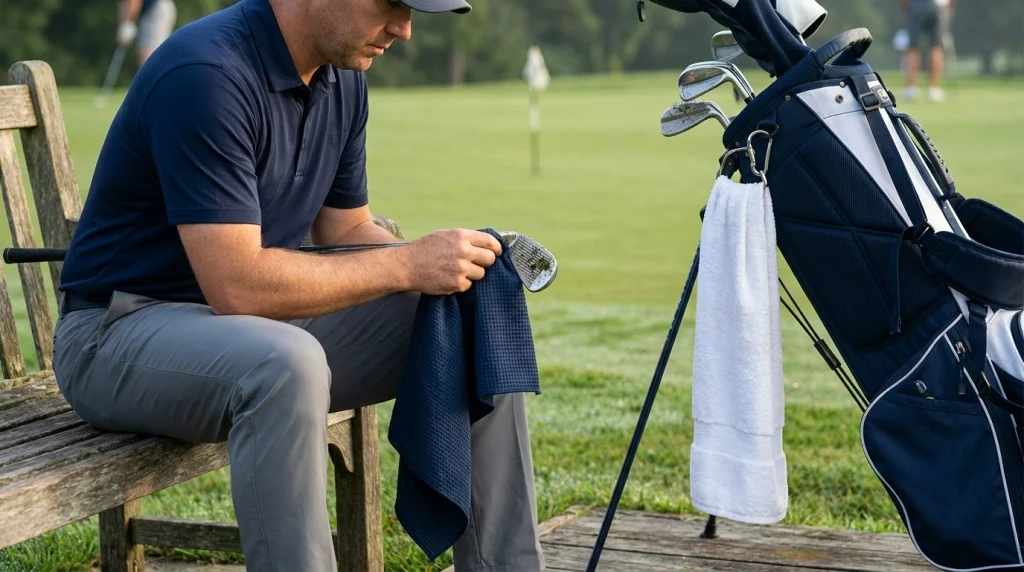
A golf towel works best when you use it consistently and wash it before dirt builds up. Good maintenance also helps prevent mud, grass, and grit from transferring back onto your clubs and grips.
Use the towel in a consistent routine
After a shot, inspect the clubface and remove visible dirt before putting the club back in your bag. Clean grooves can help you maintain your equipment, particularly when grass or soil has collected around the face.
- Remove loose debris: Brush away visible grass or dirt without grinding grit into the clubface.
- Clean the face and grooves: Use a suitable damp section of the towel to remove remaining residue.
- Dry the club: Wipe away excess moisture before storing the club.
- Keep grips dry: Use a cleaner, drier section of fabric for your hands and grips.
- Hang the towel: Allow it to air-dry when practical instead of leaving it damp inside a closed bag.
Wash it without damaging the fabric
Follow the manufacturer’s care instructions, especially for microfiber towels and models with magnets or metal fittings. Regular washing removes accumulated dirt and helps the towel remain useful over time.
- Shake off loose sand and grass before washing.
- Wash according to the stated fabric-care instructions.
- Avoid fabric softener on microfiber if the manufacturer advises against it.
- Let the towel dry fully before storing it for an extended period.
- Check clips, stitching, grommets, and magnets for wear.
If you play in wet weather, carrying a second towel can make the round more comfortable. Keep one available for cleaning equipment and reserve the other for drying hands and grips.
Section takeaway: Consistent cleaning and proper drying make a towel more useful. A simple two-towel setup can be especially helpful during rainy rounds or in damp conditions.
Frequently asked questions
Does Bryson DeChambeau use a Cobra golf towel?
I couldn’t verify that DeChambeau currently uses a Cobra golf towel. His past association with Cobra golf equipment doesn’t establish his present towel choice, so treating a Cobra-branded towel as his confirmed model would be speculation.
What size golf towel does Bryson DeChambeau use?
His regular towel’s dimensions haven’t been reliably established in the sources reviewed. If you’re choosing a similar setup for practical use, consider a compact 16-by-16-inch towel or a larger tour-style option based on how much cleaning surface you need.
Why did Bryson DeChambeau have someone hold a towel while putting?
In February 2020, his assistant held a towel behind him while he practised with a laser-based putting aid. Golf Digest reported that the towel helped him see the laser line in bright sunlight; it wasn’t evidence of his preferred cleaning towel.
What kind of golf towel do professional golfers use?
Professional golfers and their caddies use a range of towels, including cotton, microfiber, and oversized tour-style designs. Their choices can vary by player, equipment arrangements, and conditions, so there’s no single model that represents every professional golfer.
Is a waffle-weave microfiber golf towel worth buying?
It can be a good choice if you clean clubfaces and grooves frequently. The textured fabric provides a practical cleaning surface, and many models come in compact sizes that attach easily to a golf bag. Check the material and care instructions before buying.
Is a magnetic golf towel better than a clip-on towel?
Neither is automatically better. A magnetic towel offers convenient attachment to compatible metal surfaces, while a clip-on towel attaches directly to your bag. Choose based on where you want the towel within reach and how you move around the course.
Does the golf towel brand affect your performance?
The brand itself doesn’t guarantee better play. A towel that removes dirt effectively, helps keep grips dry, and stays accessible can support consistent equipment care. Fabric, size, and attachment are more useful buying criteria than a famous player’s unconfirmed preference.
Final takeaway: Choose a towel that works for your game
So, what golf towel does Bryson DeChambeau use? The exact brand and model remain unverified, and the towel incident that attracted attention in 2020 concerned his putting practice rather than a confirmed product choice.
If you’re upgrading your own golf bag, start with a waffle-weave microfiber towel, a secure clip or compatible magnetic attachment, and enough surface area for your typical playing conditions. A larger tour towel may suit frequent practice or wet-weather golf, while a compact towel keeps a walking bag lighter.
My advice is simple: choose for cleaning performance and convenience first. You can build a professional-style equipment routine without guessing which towel a tour player carries.
Research note: This article distinguishes published reporting from unverified equipment details. DeChambeau’s regular golf towel brand and model could not be confirmed from the available sources.