
Mirror Drills for Golf: 7 Ways to Check Your Swing and Setup

Quick Answer
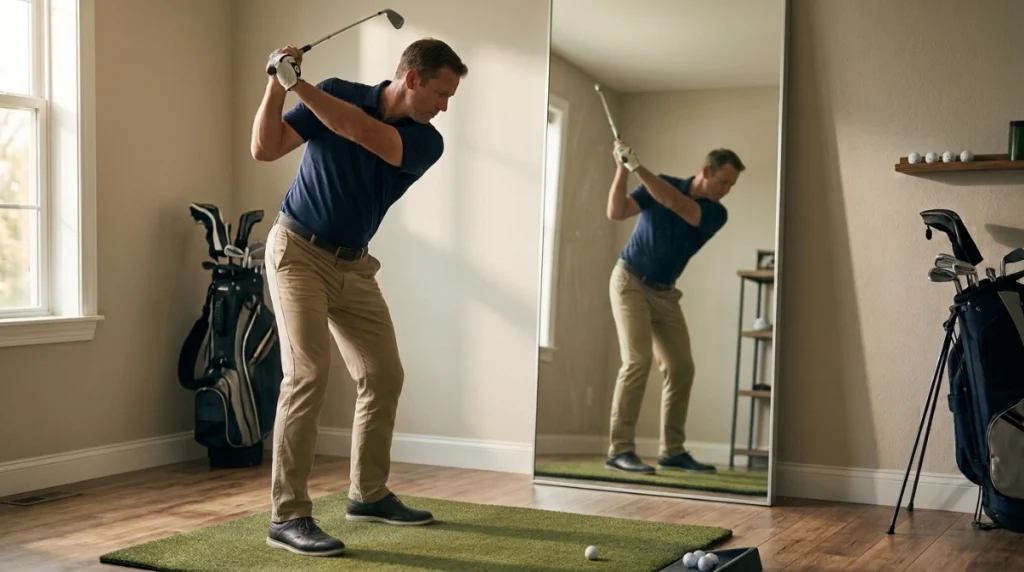
Golf mirror drills use a full-length mirror to give instant visual feedback on your setup, posture, backswing, rotation, impact rehearsal, and putting position. Start slowly without a ball, check one position at a time, and compare what you feel with what you actually see. For hands-on swing help, a qualified instructor through the PGA of America can help identify which movement deserves your attention.
How to Use a Mirror Effectively
- Start at address: Check posture, knee flex, arm hang, ball-position reference, and balance.
- Move slowly: Rehearse at 25% to 50% speed so you can actually observe each position.
- Check one thing: Avoid correcting your shoulders, hips, wrists, head, and knees during the same repetition.
- Use two views: Face-on and down-the-line positions reveal different swing tendencies.
- Rebuild every rep: Step away between repetitions instead of holding a corrected pose.
Best Verification Tip
- After several mirror rehearsals, record a normal swing on your phone. Your goal is to transfer the movement without staring at the mirror.
Mirror drills are among the simplest golf practice tools I use because they expose the difference between feel and reality. A position that feels centered, square, or fully turned can look surprisingly different once you see it.
The key is not copying a frozen tour-player pose. I use the mirror to make my own setup and movement more repeatable, then test those changes with normal swings.
In This Guide
- What Are Mirror Drills in Golf?
- How Should You Set Up for Golf Mirror Drills?
- What Are the Best Mirror Drills for Your Golf Swing?
- Face-On vs Down-the-Line Mirror Drills: What Should You Check?
- What Mistakes Should You Avoid With Mirror Practice?
- How Should You Build Mirror Drills Into Practice?
- Mirror Drills FAQ
What Are Mirror Drills in Golf?
Golf mirror drills are slow practice movements performed in front of a mirror so you can compare your body and club positions with what you intended to do. They are especially useful for setup, posture, rotation, balance, and putting alignment.
The mirror provides immediate visual feedback. You do not have to guess whether your spine angle changed or whether your shoulders turned.
Definition: A mirror drill is a golf training exercise in which a mirror acts as an external reference for checking positions or movement patterns without relying only on feel.
What can a mirror help you see?
- Posture: Whether you hinge from your hips or simply squat toward the ball.
- Balance: Whether your pressure appears centered instead of sitting heavily on your toes or heels.
- Arm hang: Whether your arms hang naturally or reach away from your torso.
- Shoulder position: Whether your upper body looks excessively open or closed.
- Hip turn: Whether your backswing includes rotation rather than a large sideways sway.
- Head movement: Whether your head shifts dramatically during a slow rehearsal.
- Finish position: Whether you can complete the motion in balance.
I find mirrors most useful when something feels unfamiliar. Seeing the movement prevents me from abandoning a useful adjustment simply because it feels different.
That does not mean every unfamiliar feeling is correct. The mirror is feedback, not a diagnosis.
Pro tip: If you are changing your golf swing rather than simply checking setup, ask a certified instructor to confirm that the movement fits your swing and mobility.
How Should You Set Up for Golf Mirror Drills?
A safe mirror-practice area needs enough room to rehearse without striking the mirror, ceiling, furniture, or another person. Full-speed swings are unnecessary for most mirror work.
I usually begin without a ball. That keeps my attention on the movement instead of the imagined shot result.
Basic mirror drill setup
- Use a large mirror that lets you see most of your body.
- Leave enough clearance for the club in every direction.
- Start with a short or mid-iron.
- Take your normal address position.
- Check only one or two reference points.
- Step away and reset.
- Repeat five to ten deliberate repetitions.
You can stand face-on, with the mirror facing your chest, or down the line, with the mirror positioned beside you. Both views reveal different information.
Use a club, not just your body
Body-only rehearsals have value, but I usually hold a club when space allows. The club changes your posture, hand position, balance, and overall feel.
Keep the movement slow. A mirror is much better for observation than for hitting golf balls.
The USGA provides the current Rules of Golf and equipment guidance if you are unsure when training aids may be used during competition.
What Are the Best Mirror Drills for Your Golf Swing?
The best mirror drills have a clear purpose and an easy visual checkpoint. I prefer exercises where I can tell within seconds whether the rehearsal matched my intention.
1. Address posture mirror drill
This is the first mirror drill I recommend because every swing starts from address. A poor starting position can make later movements harder to judge.
- Take your normal stance with a mid-iron.
- Hinge forward from your hips.
- Add comfortable knee flex.
- Let your arms hang naturally.
- Check whether your weight feels balanced.
From down the line, look for a comfortable hip hinge rather than excessive rounding or squatting. Your arms should not look as though they are reaching desperately for the ball.
From face-on, inspect your stance width and general balance. Avoid trying to make every body line perfectly symmetrical.
2. Backswing turn mirror drill
This drill helps separate rotation from excessive lateral movement. I use it when my backswing starts feeling loose or disconnected.
- Set up in front of the mirror without a ball.
- Move the club back slowly.
- Allow your chest to turn away from the target.
- Keep your lower body stable enough to maintain balance.
- Pause before reaching the top.
The goal is not to eliminate hip movement. Golf requires rotation.
You are checking whether the motion looks like a turn rather than your entire body sliding away from the target.
3. Takeaway checkpoint drill
The first part of the backswing often sets up everything that follows. A mirror makes this small movement easier to inspect.
- Move the club back until your hands reach roughly hip height.
- Pause.
- Check the relationship between your hands, clubhead, chest, and arms.
- Return to address.
- Repeat instead of continuing into a full swing every time.
I like five slow rehearsals followed by one uninterrupted practice swing. That shows whether the checkpoint can survive without a pause.
4. Top-of-backswing balance drill
A mirror cannot tell you whether one exact top position is universally correct. It can show whether you remain controlled while reaching it.
Make your backswing at about 25% speed. Pause near the top and notice your balance, body turn, arm structure, and any obvious lateral sway.
Avoid forcing your club into a picture-perfect angle. Club length, flexibility, grip, swing style, and body proportions all influence how the top can look.
5. Impact rehearsal drill
Impact is too fast to inspect in a mirror during a normal swing. Instead, rehearse the general movement slowly.
- Start at address.
- Move into a simulated impact position.
- Allow pressure to move toward your lead side.
- Let your hips and chest begin opening.
- Move through into a short balanced finish.
Do not freeze an exaggerated impact pose and assume it represents a real golf swing. Impact is a moving event.
For instruction on ball striking and swing fundamentals, Golf Digest maintains a broad library of golf instruction from coaches and players.
6. Finish-and-balance mirror drill
A balanced finish gives me a simple test of whether the rehearsal stayed under control. You do not need a tour-style finish to benefit.
- Make a slow practice swing.
- Finish with most pressure supported by the lead side.
- Allow your chest to turn toward the imaginary target.
- Hold the position for three seconds.
- Check whether you can remain still without stepping or falling backward.
If you cannot hold the finish at half speed, reduce the speed again. Balance comes before speed during this exercise.
7. Putting mirror drill
A mirror can also help with putting posture and eye position. This works best with a small putting mirror or a safe full-length mirror setup.
Check whether your eyes sit comfortably around the ball’s target-line area. Do not force your head into an uncomfortable position simply to match a diagram.
- Check your shoulder orientation.
- Check your eye position.
- Let your arms hang comfortably.
- Keep unnecessary tension out of your hands.
- Rebuild the setup before each repetition.
Section Takeaway: Mirror drills work best when each exercise has one clear visual checkpoint. Use the mirror to verify movement, then remove it and test whether the feel transfers.


Face-On vs Down-the-Line Mirror Drills: What Should You Check?
Face-on and down-the-line views answer different questions. Using only one view can hide a problem that appears obvious from another angle.
| Mirror View | Best for Checking | Common Issue You May Notice |
|---|---|---|
| Face-on | Stance width, ball-position reference, sway, pressure movement | Excessive lateral movement |
| Down the line | Posture, arm hang, hip depth, body rotation | Standing up or crowding the ball |
| Putting view | Eyes, shoulders, arm hang, putter relationship | Inconsistent address position |
For face-on work, I pay close attention to whether my torso turns while my balance stays controlled. Large sideways motion becomes easy to spot.
Down the line is more useful for posture. It also shows whether my arms have enough room to move.
Phone video can complement mirror feedback because video lets you watch the swing without changing your head position. The mirror is better for immediate rehearsals.
The R&A is another useful authority for the Rules of Golf and equipment-related guidance when practice tools intersect with competition rules.
What Mistakes Should You Avoid With Mirror Practice?
The biggest mistake is turning mirror work into a search for perfect-looking positions. Golf is dynamic, and individual swings do not need to look identical.
Trying to fix too many things
A golfer can quickly notice ten details in a mirror. Changing all ten at once rarely helps.
Pick one priority. Make five to ten repetitions and then reassess.
Watching the mirror during a normal-speed swing
Turning your eyes or head toward a mirror during a fast swing can distort your normal movement. It may also create unnecessary physical strain.
Use slow rehearsals when actively looking. Use video for normal swings.
Holding poses for too long
A good swing flows through positions rather than stopping at them. A checkpoint should help you understand the motion, not become the motion itself.
Copying another golfer exactly
Tour players differ in height, flexibility, swing plane, grip, stance, backswing length, and impact dynamics. There is no single mirror image every golfer must reproduce.
I focus first on balance and repeatability. Those qualities usually matter more than whether my shaft matches someone else’s screenshot.
Practicing too close to the mirror
Safety is non-negotiable. A golf club can break a mirror long before you realize your practice area is too small.
- Rehearse the entire motion without a club first.
- Check the ceiling.
- Check the clubhead’s path behind you.
- Keep people and pets outside the area.
- Use slow swings rather than full-speed swings.
Pro tip: Stop any movement that creates pain or unusual strain. A PGA professional, physical therapist, or other qualified specialist can help determine whether the drill suits your body.
Section Takeaway: Use a mirror to simplify your feedback, not multiply swing thoughts. One clear checkpoint is more useful than ten simultaneous corrections.
How Should You Build Mirror Drills Into Practice?
Mirror practice does not need to dominate a training session. Ten focused minutes can provide enough feedback before you move to normal swings.
A simple 15-minute mirror routine
| Time | Drill | Focus |
|---|---|---|
| 3 minutes | Address resets | Posture and balance |
| 3 minutes | Takeaway rehearsals | Controlled start |
| 3 minutes | Backswing turns | Rotation and balance |
| 3 minutes | Impact-to-finish rehearsals | Lead-side movement and rotation |
| 3 minutes | No-mirror swings | Transfer the new feel |
The final three minutes are important. Stop looking in the mirror and make uninterrupted practice swings.
That transition tells you whether the drill has created a usable movement or only a position you can reproduce while watching yourself.
How often should you practice?
Short sessions work well because mirror drills demand concentration. Three focused sessions per week may be more useful than one long session filled with unfocused repetitions.
As of 2026, the basic practice principle remains unchanged: feedback should make practice more deliberate, not more complicated.
Once a movement looks consistent, add a ball at the range and observe the result. Ball flight, contact, balance, and starting direction matter more than the mirror itself.
Section Takeaway: Start with visual feedback, remove the mirror, and then test the movement with real shots. Transfer is the goal.
Mirror Drills FAQ
Are mirror drills good for golf?
Yes. Mirror drills can help golfers check setup, posture, balance, rotation, takeaway positions, putting posture, and slow swing rehearsals. They are most useful when you focus on one specific checkpoint instead of trying to make your entire swing look perfect.
Can mirror drills fix a golf swing?
A mirror can reveal movement patterns, but it cannot determine every cause of a bad shot. Clubface angle, swing path, strike location, speed, and impact conditions also affect ball flight. Use mirror feedback alongside ball flight, video, and professional instruction when needed.
Should I look at the mirror while swinging?
Look at the mirror during slow rehearsals and paused checkpoints. Avoid turning your head toward a mirror during normal-speed swings. Record those swings with a phone instead so you can review the motion afterward.
What size mirror is best for golf practice?
A full-length mirror works well because it lets you see posture and most of your body. Small putting mirrors are better for eye position and putter setup. Whatever you use, leave generous clearance between the club and the mirror.
Is a mirror better than golf swing video?
Neither tool is always better. A mirror gives instant feedback while you move, while video shows a normal swing without requiring you to look away from the ball. Using both can provide a clearer comparison between feel and actual movement.
Can beginners use mirror drills?
Yes. Beginners can benefit from simple address, posture, balance, and putting checks. Avoid copying complicated tour-player positions. Building a comfortable, repeatable setup usually offers more value than chasing advanced swing mechanics.
Can I practice mirror drills indoors?
Yes, provided you have enough clearance and use slow movements. Check ceilings, walls, furniture, windows, people, and pets before holding a club. For small spaces, rehearse without a club or use a shortened training aid designed for indoor use.
Final Takeaway: Use the Mirror for Feedback, Not Perfection
Mirror drills work because they expose the gap between what a golf movement feels like and what it actually looks like. That feedback can make setup and slow-motion practice far more productive.
Start with posture and balance. Then add takeaway, rotation, impact rehearsals, or putting work based on the specific part of your game you want to improve.
Keep each session simple. Check one movement, make several deliberate repetitions, remove the mirror, and see whether the change survives in a normal swing.
That transfer matters most. A prettier reflection means little unless it eventually helps you create a more repeatable golf shot.