
Golf Takeaway Guide: How to Start Your Swing Correctly

Quick Answer
A good golf takeaway starts the backswing without a sudden hand or arm snatch. The club, hands, arms, and torso should move in a coordinated way, while the clubface stays controlled. Your exact feel can vary by swing style, so use checkpoints rather than forcing one rigid “perfect” motion.
Key Takeaway Checkpoints
- Start smoothly: Avoid jerking the club away from the ball.
- Keep width: Let your arms and hands stay organized in front of your torso.
- Control the face: Don’t aggressively roll the forearms open or shut.
- Turn naturally: Your torso rotation should support the club’s movement.
- Check halfway back: When the shaft is roughly parallel to the ground, use the clubface and hand path as useful checkpoints.
I’ve spent plenty of time watching golfers work on their swings, and the takeaway is one of the first places I look when a swing feels inconsistent.
The tricky part is that golfers often hear conflicting advice about whether the hands, arms, shoulders, or clubhead should move first.
In This Guide
What Is the Golf Takeaway?
The golf takeaway is the opening phase of the backswing, when you move the club away from the ball before completing the rest of the backswing.
For many golfers, this means the first several inches of club movement through the point where the shaft approaches parallel with the ground.
Why does the takeaway matter?
The takeaway doesn’t determine the entire swing, but it strongly influences the positions you have to work with later.
If your hands immediately pull the club far inside, you may need to make a compensation later to get the club back to the ball.
- Club path: Early movement influences the direction the club travels during the backswing.
- Clubface control: Excessive forearm rotation can change the face angle early.
- Width: A cramped takeaway can make the backswing feel narrow.
- Balance: Excessive body movement can make it harder to repeat the motion.
- Tempo: A rushed start often creates tension before the main backswing is underway.
That’s why I prefer treating the takeaway as a setup for the rest of the backswing rather than obsessing over one exact position.
Section Takeaway: The takeaway is the first phase of the backswing. Its job is to start the club on a repeatable path while keeping the body and club organized.
How Do You Make a Proper Golf Takeaway?
A proper golf takeaway starts with a balanced address position and a smooth movement away from the ball. The club should move without an abrupt wrist roll or violent body shift.
1. Start with a repeatable setup
Your takeaway can’t be consistent if your address position changes dramatically from shot to shot.
- Posture: Maintain your normal athletic golf posture.
- Grip: Hold the club securely without excessive tension.
- Ball position: Use a position appropriate for the club you’re hitting.
- Alignment: Give yourself a clear target line before starting.
At address, avoid squeezing the grip so hard that your forearms already feel rigid.
2. Begin without snatching the club
The first movement should feel controlled rather than explosive.
One useful thought is to let the club, hands, arms, and torso work together instead of consciously throwing the clubhead backward with your wrists.
3. Create useful width
Width simply means maintaining useful space between your hands and body as the club moves away from the ball.
You don’t need to force your arms straight or push the club as far away from you as possible.
Instead, let the hands remain comfortably in front of your torso as your body turns.
4. Let the wrists set naturally
One common mistake is trying to eliminate all wrist movement during the entire backswing.
The takeaway and the rest of the backswing aren’t the same thing, so your wrists can begin setting as the club continues upward.
Good instruction often emphasizes coordination rather than completely removing wrist action.
Section Takeaway: Start smoothly, keep the club organized in front of you, and allow the wrists to blend into the backswing rather than forcing a rigid one-piece motion.
What Should the Club Look Like Halfway Back?
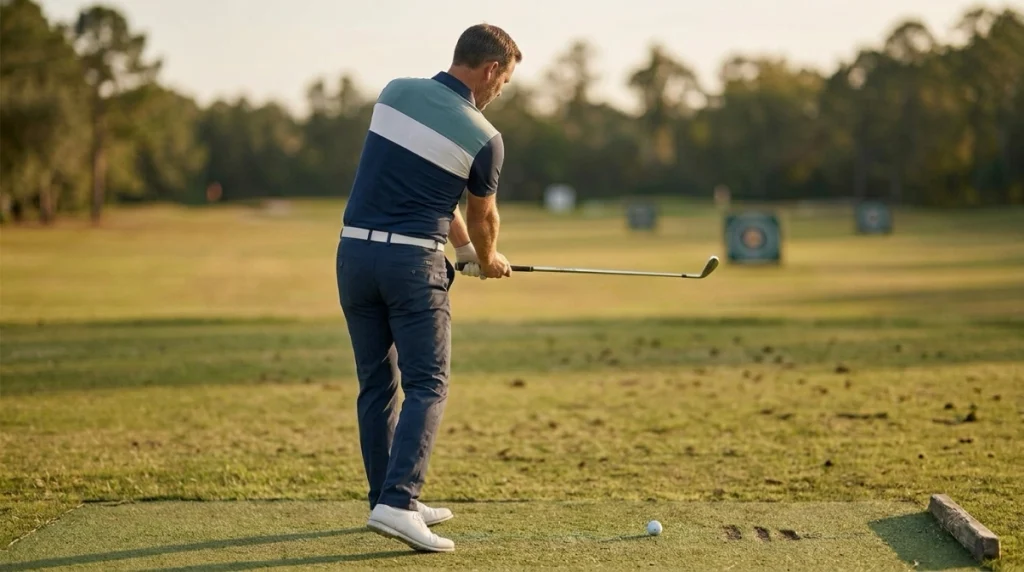
One of the most useful golf takeaway checks happens when the shaft is approximately parallel to the ground.
At this point, you’re far enough into the backswing to see whether the club has immediately gone too far inside, outside, open, or closed.
Check the hand path
From a down-the-line camera view, your hands shouldn’t disappear dramatically behind your body during the early takeaway.
A takeaway that gets excessively inside can leave the club behind you and make the later backswing harder to organize.
Check the clubface
Clubface position is another useful checkpoint.
Rather than forcing the face into one universal angle, look for excessive opening or closing during the first part of the backswing.
A clubface that dramatically points toward the sky can indicate excessive opening, while an aggressively closed face can indicate excessive rotation in the opposite direction.
Check your body turn
Your torso should participate in the movement without creating a large lateral sway.
Think rotation rather than sliding.
| Checkpoint | Useful Look | Warning Sign |
|---|---|---|
| Hands | Remain organized in front of the torso | Immediately disappear far behind the body |
| Clubface | Controlled and consistent with your swing | Rapidly fans open or shuts down |
| Torso | Turns without excessive sway | Large lateral movement |
| Tempo | Smooth and controlled | Sudden, rushed start |
These are checkpoints, not laws. Your grip, posture, body proportions, mobility, and swing pattern can change what looks natural.
Section Takeaway: Use halfway-back checkpoints to identify obvious problems. Don’t force your swing into an artificial position just because a still image looks different.

What Are the Most Common Golf Takeaway Mistakes?
Most takeaway problems come from trying to make the club do too much too early.
Pulling the club inside
This is one of the most common problems I see in recreational golfers.
The hands and forearms pull inward while the torso stays relatively quiet, causing the club to travel behind the golfer’s body.
Rolling the forearms
Excessive forearm rotation can change the clubface rapidly during the first part of the backswing.
This can make the golfer feel as if they need to manipulate the face again later.
Picking the club straight up
The opposite mistake is lifting the club abruptly with the hands and arms.
This can create a steep, disconnected feeling and remove the smooth relationship between your body turn and club movement.
Starting with excessive hip movement
Your lower body will participate in the complete backswing, but aggressively sliding the hips away from the target isn’t a reliable way to begin the takeaway.
A controlled turn gives you more room to organize the club without introducing unnecessary movement.
Trying to make the takeaway too slow
Slow doesn’t automatically mean good.
If you deliberately move the club at an unnaturally slow speed, you may create tension and lose the natural rhythm of your swing.
Overthinking “one-piece” mechanics
The phrase “one-piece takeaway” can be useful as a simple feel, but it shouldn’t become a rigid rule.
Modern instruction includes different ways of describing how the clubhead, arms, wrists, and body sequence through the opening part of the backswing.
Section Takeaway: The biggest takeaway faults are usually excessive hand action, an overly inside path, abrupt lifting, or unnecessary body movement.
Which Drills Improve the Golf Takeaway?
The best takeaway drills give you immediate feedback without requiring you to hit a full shot.
Wall or alignment-stick drill
Set up beside a wall or use an alignment stick as a reference behind you.
- Set up normally: Take your normal golf posture without a ball.
- Make a small takeaway: Move the club back slowly.
- Watch the reference: Notice whether your hands or club immediately move too far inside.
- Repeat slowly: Make several rehearsals before adding a ball.
The goal isn’t to force the club along one perfectly straight line.
You’re simply learning how your current takeaway moves in three-dimensional space.
Clubhead awareness drill
Place a second ball a short distance behind your ball on the target line.
Make a small takeaway and notice where the clubhead travels relative to that second ball.
If the club immediately cuts far inside, you’ll see it without needing a launch monitor.
Pause-and-check drill
Make your takeaway and stop when the shaft reaches approximately parallel to the ground.
- Check your hands: Are they still organized in front of your torso?
- Check your face: Has it rapidly opened or closed?
- Check your balance: Did you sway or stand up?
- Check tension: Are your forearms and shoulders relaxed enough to continue?
Then complete the backswing and make a controlled practice swing.
Slow-motion rehearsal
Slow-motion swings are useful because they remove the pressure to hit a ball.
Make five to ten rehearsals while focusing on one checkpoint at a time rather than trying to fix everything simultaneously.
Pro tip: If you have persistent swing faults or physical discomfort, work with a qualified PGA professional or certified instructor rather than forcing a movement that doesn’t fit your body.
Section Takeaway: Practice without a ball first. A simple wall, alignment reference, or pause drill can expose takeaway problems before they become full-swing problems.
Does the Takeaway Change With Different Golf Clubs?
The basic principles of a controlled takeaway apply across the bag, but the swing itself changes with club length, lie, ball position, and shot intention.
You shouldn’t expect a driver takeaway to look identical to a pitching-wedge takeaway.
Driver
The longer shaft can make an exaggerated inside takeaway more noticeable.
Focus on maintaining width and rhythm without trying to manually steer the club along a straight line.
Irons
With irons, your setup and ball position change the geometry of the swing.
The takeaway still needs to be coordinated, but don’t copy the exact visual position of your driver swing.
Wedges
Shorter clubs often produce a more compact motion.
A controlled takeaway becomes especially useful when you’re trying to manage distance and trajectory rather than maximize speed.
| Club Type | Takeaway Priority | Common Focus |
|---|---|---|
| Driver | Width and rhythm | Avoiding a rushed or excessively inside start |
| Mid Irons | Connection and clubface control | Balanced body turn |
| Wedges | Control and consistency | Compact, repeatable movement |
The goal isn’t identical geometry with every club. The goal is a repeatable motion that matches the club and shot you’re trying to play.
Section Takeaway: Your takeaway should remain coordinated across the bag, but club length and setup naturally change how the motion looks.
Golf Takeaway FAQ
What is the first move in a golf takeaway?
There isn’t one universal first-move sensation that fits every golfer. A useful starting point is a coordinated movement of the club, arms, hands, and torso, without an abrupt hand snatch or excessive hip slide.
Should the golf takeaway be one piece?
A one-piece takeaway can be a useful feel for many golfers, especially when it prevents excessive hand action. However, it shouldn’t be treated as an absolute rule because different players use different sequencing and wrist patterns.
How far should the club go inside on the takeaway?
The club should not be deliberately dragged far behind your body during the early takeaway. Use a down-the-line video to check whether your hands and club are moving excessively inward before the backswing has developed.
Should I use my hands during the takeaway?
Your hands are part of the takeaway, but excessive conscious manipulation can create inconsistency. Think about moving the club in coordination with your body rather than trying to steer the clubhead with your wrists.
Why does my golf takeaway get too far inside?
An overly inside takeaway can come from excessive forearm rotation, pulling the hands inward, or turning the arms without enough coordinated torso movement. Video from down the line can help identify which pattern you actually have.
Should the clubface be open during the takeaway?
The clubface naturally changes orientation as the club moves around your body. The important point is avoiding an excessive opening or closing motion that forces you to compensate later in the backswing.
How can I practice my takeaway at home?
Practice slow-motion rehearsals without a ball. A wall, alignment stick, or simple halfway-back pause can give you feedback on hand path, clubface control, balance, and tempo without requiring a full swing.
Final Takeaway: Build a Start You Can Repeat
A good golf takeaway isn’t about creating a picture-perfect position in the first few inches of the swing.
It’s about starting the club in a way that gives the rest of your backswing room to work.
For most golfers, I’d start with four priorities:
- Balanced setup
- Smooth initial movement
- Controlled clubface
- Coordinated body and arm motion
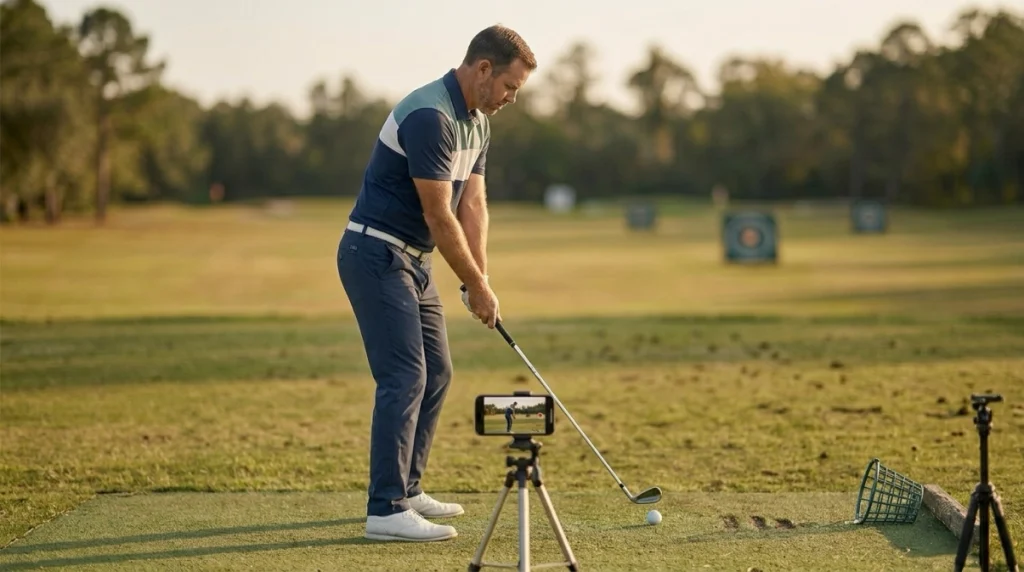
Record a few swings from face-on and down the line, then look at the takeaway before changing anything at the top.
As of 2026, golf instruction still offers different opinions about the exact sequence, but one principle remains useful: your opening move should make the rest of the swing easier, not harder.
Once you find a takeaway that produces repeatable contact, keep practicing that motion until it becomes something you can perform without thinking about every moving part.