
Can You Learn Golf at Any Age?
Quick Answer
Yes, you can learn golf at any age. Children, adults, and seniors can all develop a reliable golf swing with suitable instruction, manageable equipment, and regular practice. Begin with this practical guide to starting golf for the first time.
Five Steps for New Golfers
- Start small: Learn putting and short shots before trying to master the driver.
- Get guidance: Take a beginner lesson or clinic to avoid building painful habits.
- Use easy clubs: Choose light, forgiving equipment that suits your height and strength.
- Practice briefly: Two focused 30-minute sessions often beat one tiring weekly session.
- Play forward: Use shorter tees and nine-hole rounds while learning the course.
A Realistic First Goal
- Aim to make safe contact, understand basic etiquette, and enjoy nine holes—not shoot a certain score.
I’ve played with beginners in their teens, forties, and seventies. Age changed how they practiced, but it never decided whether they could learn.
This guide explains what to expect, how to begin, and how to make golf comfortable for your body and budget.
In This Guide
Is There an Age When It Is Too Late to Learn Golf?
No fixed age is too late for golf. The game can be adapted to different levels of strength, mobility, speed, and experience.
The R&A describes golf as a game that people of different ages, backgrounds, and abilities can enjoy. That broad access is one reason golf suits later-life beginners.
Learning golf means developing enough skill and knowledge to practice, play safely, keep pace, and enjoy a round. It does not mean building a professional-looking swing.
Your starting point matters more than your birth year
A mobile 65-year-old may learn more comfortably than an inactive 35-year-old. Previous experience in tennis, baseball, hockey, or cricket can also help with balance and coordination.
Beginners usually need to develop five basic abilities:
- Holding the club with comfortable grip pressure
- Setting up with stable posture and alignment
- Making predictable contact with the ball
- Controlling short shots around the green
- Following safety, pace, and etiquette rules
None of these skills requires exceptional speed. Reliable contact and sensible decisions matter more during an ordinary recreational round.
Golf also offers flexible ways to participate
You do not need to walk 18 holes from the longest tees. Driving ranges, putting courses, simulators, par-three courses, and nine-hole rounds all provide easier starting points.
I often recommend nine holes to new adults. Their swings stay fresher, and they have more energy to learn from each shot.
The question is therefore not whether age permits golf. It is which version of golf best fits your body, schedule, and goals.
You can explore more examples of who can start playing golf before choosing your first program.
Section Takeaway: No birthday makes golf unavailable. Choose a starting format that matches your current ability and energy.
How Does Learning Golf Change With Age?

The fundamentals remain the same at every age. The useful differences involve coaching style, practice length, recovery, and expectations.
| Starting Stage | Common Advantage | Common Challenge | Helpful Approach |
|---|---|---|---|
| Children and teens | Fast motor learning | Limited attention or strength | Games, short sessions, junior clubs |
| Adults in their 20s–40s | Strength and coordination | Work and family schedules | Planned weekly practice |
| Adults in their 50s–60s | Patience and clear goals | Reduced flexibility or recovery | Warm-ups and efficient motion |
| Adults over 70 | Good course management | Balance, stamina, or joint limits | Short sessions, forward tees, carts |
Adults often understand instructions faster
Adults can connect a coach’s explanation to a clear goal. They may understand alignment and strategy sooner than a young player.
The drawback is overthinking. I’ve watched new adults freeze over the ball while trying to remember six swing positions.
One simple cue works better. A coach might ask you to finish balanced instead of giving several technical commands.
Older players may need more recovery
Golf practice includes repeated rotation and bending. A long bucket of range balls can tire the back, hips, hands, and shoulders.
Older beginners often improve faster with fewer full swings. They can spend the remaining time putting, chipping, or learning course strategy.
That approach is not a compromise. Short-game skill can lower scores without demanding high swing speed.
Distance expectations should remain personal
Clubhead speed often affects distance, but distance alone does not define good golf. Playing from a suitable tee keeps approach shots reasonable.
Modern courses may offer several teeing options. Choose one based on comfortable playing distance, not age or gender labels.
If the learning curve concerns you, read this explanation of why golf feels difficult at first. Knowing which challenges are normal prevents early frustration.
Section Takeaway: Age changes the training plan, not the core possibility of learning. Match practice volume and expectations to your present abilities.
What Is the Best Way to Learn Golf as an Adult?
The best method combines basic instruction, short practice sessions, and early on-course experience. Waiting for a perfect swing usually slows progress.
1. Begin with one lesson or beginner clinic
A trained coach can check your grip, posture, alignment, and ball position. Those four setup details influence almost every shot.
The PGA of America coaching directory includes private lessons and beginner programs. Group clinics can also reduce the cost and make the first session less intimidating.
Tell the instructor about old injuries, limited movement, or balance concerns. A good coach can adjust the motion instead of forcing a textbook position.
Pro tip: Work with a certified golf instructor when changing your swing, especially if a movement causes pain.
2. Learn from the hole backward
Start with putting, then chipping, pitching, irons, and tee shots. Each stage adds speed and motion.
- Roll short putts toward a clear target.
- Practice longer putts for distance control.
- Learn a small chipping motion near the green.
- Add half-swings with a short iron.
- Build toward comfortable full swings.
- Use a driver only after learning basic contact and safety.
This order gives beginners early success. It also reflects how many shots occur near the green.
3. Practice with a specific target
Do not hit ball after ball without a goal. Choose one target, one club, and one skill for each practice block.
A useful 30-minute session could include:
- Five minutes: Warm up without trying to create speed.
- Ten minutes: Hit short shots toward one target.
- Ten minutes: Practice one setup or contact skill.
- Five minutes: Play an imaginary hole with different clubs.
Stop when fatigue changes your posture or balance. Tired repetition can train the mistake you hoped to fix.
4. Visit the course before you feel ready
Your first round teaches lessons the range cannot. You will encounter uneven lies, bunkers, slopes, clubs to carry, and other groups.
Begin with a quiet nine-hole or par-three course. Review a first-time golfer checklist before leaving home.
Learn the basic Rules of Golf gradually. The R&A Rules Hub offers official rules and beginner education.
Section Takeaway: Take instruction, practice one skill at a time, and experience the course early. Golf becomes clearer when practice connects to real play.


What Golf Equipment Does a Beginner Need?
A beginner does not need 14 clubs or premium equipment. A smaller, comfortable set makes club selection easier and costs less.
A practical starter set
Most new golfers can begin with six to nine clubs:
- A driver or higher-lofted fairway wood
- A hybrid
- A mid-iron, such as a 7-iron
- A short iron, such as a 9-iron
- A pitching wedge
- A sand wedge
- A putter
A hybrid blends qualities of an iron and fairway wood. Many beginners find its wider sole easier to use from grass.
Loft is the angle of the clubface that helps launch the ball. More loft often makes it easier for a slower swing to produce height.
Forgiving clubs usually have larger heads and perimeter weighting. These features can reduce the penalty from contact outside the center.
Club length and shaft feel matter
Clubs that are too long can make balance and center contact harder. Heavy or stiff shafts may also feel difficult to control.
A full custom fitting is optional for a first trial. However, unusually tall or short players may benefit from a basic length and lie check.
Pro tip: Ask a qualified fitter to check club length, shaft weight, grip size, and lie angle before making permanent adjustments.
Used and borrowed clubs are fine
Borrowed equipment lets you test your interest before spending much. Inspect the grips, shafts, clubheads, and bag before use.
A worn grip can feel slippery and encourage excessive hand pressure. Replacing grips may improve an older set without replacing every club.
Beyond clubs, bring:
- Golf balls and tees
- A glove if it improves comfort
- Stable shoes with good grip
- Water and sun protection
- A pitch-mark repair tool and ball marker
For a deeper equipment breakdown, see which golf clubs beginners genuinely need.
Section Takeaway: Start with a small, forgiving set that fits comfortably. Skill development matters more than buying expensive clubs.
How Long Does It Take to Learn Golf?
Most beginners can learn basic safety, setup, putting, and short shots within several sessions. Building dependable contact usually takes months of regular practice.
There is no single finish line. “Ready to play nine holes” requires less skill than “consistently break 100.”
A realistic beginner timeline
| Practice Period | Reasonable Focus | Possible Progress |
|---|---|---|
| First 1–2 sessions | Safety, grip, posture, putting | Understand basic movements |
| First month | Short shots and center contact | Play a short beginner course |
| Two to six months | Club selection and repeatable contact | Complete nine or 18 holes more comfortably |
| Six to twelve months | Short game, strategy, and scoring | Develop personal patterns and goals |
These ranges are examples, not promises. Coaching quality, practice frequency, health, previous sports, and course difficulty all affect progress.
Measure useful progress instead of perfect shots
Score alone can hide improvement. A beginner may score the same while losing fewer balls or taking fewer putts.
Track simple signs:
- How often you make playable contact
- How many penalty shots you take
- How many putts you need per hole
- Whether you finish balanced
- Whether you keep pace comfortably
- How your body feels afterward
I once spent weeks chasing longer drives while ignoring my putting. My scores improved only after I divided practice time more evenly.
For a fuller timeline, review how long learning golf can take at different practice levels.
Section Takeaway: You can learn enough to participate within weeks, but consistency takes months. Measure contact, decisions, comfort, and enjoyment alongside score.
How Can Older Beginners Learn Golf Safely?
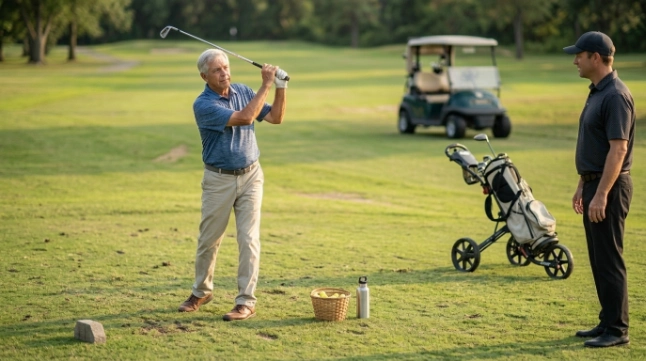
Older beginners should build practice volume gradually and avoid swinging through pain. Comfortable movement matters more than maximum speed.
Warm up before hitting full shots
Begin with a short walk and gentle movements within your normal range. Then make slow practice swings before hitting balls.
A simple golf warm-up may include:
- Easy shoulder and arm movements
- Gentle hip turns
- Small knee bends while holding support
- Short chip shots
- Half-swings with a lofted iron
Do not force a stretch or copy another golfer’s range of motion. Stop if you feel sharp pain, dizziness, unusual weakness, or chest discomfort.
People with heart, joint, balance, or recent surgical concerns should consult a qualified healthcare professional before beginning.
Reduce strain during practice
Use a small basket instead of the largest range bucket. Rest between groups of shots and switch to putting when full swings become tiring.
Lightweight bags, push carts, riding carts, and shorter rounds can reduce fatigue. Supportive shoes also help on wet or uneven ground.
Stay hydrated and use sun protection. Heat can become a greater problem during slow rounds than beginners expect.
Adapt the swing to your body
A golfer does not need a huge shoulder turn or high finish. A compact, balanced swing can produce playable shots.
Some players benefit from a wider stance, shorter backswing, or slightly open foot position. These changes should support comfort and contact.
Pro tip: Ask a certified instructor to adapt the swing around your mobility instead of forcing painful positions.
Choose a welcoming first course
Look for a flat par-three or shorter public course with forward tees. Avoid crowded peak hours during your first few rounds.
Call the course and ask about walking distance, cart rules, dress requirements, and beginner-friendly times. Reviewing what happens on a first day at a golf course can also reduce uncertainty.
The USGA provides official information about the game, handicapping, competitions, and rules. You do not need to memorize everything before playing recreational golf.
As of 2026, beginners can also learn through outdoor ranges, indoor simulators, group clinics, and short-course programs. Choose the setting that makes regular participation easiest.
Section Takeaway: Build slowly, protect your body, and adjust the game to your needs. Safe, comfortable practice supports longer-lasting improvement.
Frequently Asked Questions
Can I learn golf at 40?
Yes. Many people begin in their forties and have enough strength, coordination, and patience to progress well. Start with a lesson, practice one or two times weekly, and play shorter courses while learning.
Can I start playing golf at 60?
Yes. Golf can be adapted with forward tees, lightweight clubs, carts, shorter rounds, and a compact swing. Build practice gradually and discuss medical or mobility concerns with an appropriate professional.
Is 70 too old to take golf lessons?
No. A qualified instructor can tailor a lesson to your balance, mobility, goals, and energy. Tell the coach about physical limits before swinging, and choose short sessions with enough recovery.
Do I need to be physically fit to learn golf?
You do not need elite fitness, but golf involves walking, balance, rotation, and repeated swings. Beginners can use carts, play nine holes, rest often, and improve their general activity gradually.
How many lessons does a golf beginner need?
One lesson can establish safer fundamentals, while three to six lessons provide more time for setup, short game, full swing, and on-course skills. The best number depends on your goals and independent practice.
Can I teach myself golf?
You can learn rules, etiquette, putting, and basic drills alone. However, an early lesson can identify grip or posture problems that are difficult to see without feedback.
Should older beginners use senior-flex golf clubs?
Not automatically. Shaft choice depends on speed, tempo, strength, feel, and ball flight—not age alone. Test different shaft weights and flexes with help from a qualified fitter before buying.
Golf has room for beginners at every stage of life. Start with a small goal, suitable instruction, and a version of the game you can enjoy now.
Book a beginner lesson, borrow a few clubs, or spend 30 minutes on a putting green this week. Your first step does not need to be perfect—it only needs to be comfortable.