
How Do You Wash a Waffle Weave Golf Towel

Quick Answer
Wash a waffle weave golf towel by shaking out loose sand and grass, rinsing heavy mud, and washing it with a small amount of normal detergent according to its care label. Skip fabric softener on microfiber, avoid unnecessarily high heat, and dry the towel completely before putting it back in your golf bag. For broader equipment information, the USGA is a useful golf reference, but the towel manufacturer’s care label should control the washing method.
Quick Washing Steps
- Shake it out: Remove loose sand, dried grass, and surface dirt before the towel enters the washer.
- Check the label: Waffle describes the weave, so microfiber, cotton, and blended towels can need different care.
- Pre-rinse mud: Rinse heavily soiled areas before washing instead of letting thick mud circulate through the load.
- Use detergent: Add the normal amount recommended for the load rather than pouring extra detergent onto the towel.
- Skip softener: Avoid fabric softener on microfiber unless the manufacturer specifically allows it.
- Dry completely: Air-dry or use the care-label-approved dryer setting before storing the towel.
One Important Rule
- Treat the fiber and care label as more important than the waffle pattern itself.
If you use a waffle towel for muddy irons and wedges, it can look rough after only one wet round. I prefer cleaning mine before soil, grass, sunscreen, and moisture get a chance to settle into the textured pockets.
The process is simple, but a few common laundry habits can shorten a golf towel’s useful life. Here’s how I wash, dry, and store waffle weave towels without making the routine complicated.
In This Guide
- How do you wash a waffle weave golf towel step by step?
- Can you machine-wash a waffle weave golf towel?
- What detergent and water temperature should you use?
- How do you remove mud, grass, sand, and odors?
- How should you dry and store the towel?
- Frequently asked questions
- What is the easiest towel-care routine?
How Do You Wash a Waffle Weave Golf Towel Step by Step?
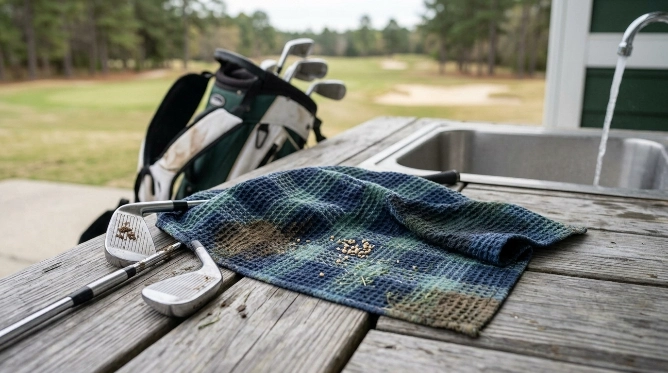
The safest routine is to remove loose debris first, treat obvious soil, wash gently, and dry the towel completely. You do not need an aggressive cleaning process after every round.
Definition: A waffle weave is a fabric construction with raised sections and recessed pockets arranged in a grid. It describes the towel’s texture, while terms such as microfiber, cotton, or polyester describe the fibers used to make it.
That distinction matters. Two waffle golf towels can look similar while having different washing instructions.
1. Shake off loose material
Take the towel outside and shake it firmly before washing. Pay special attention after bunker play or a dry, sandy round.
- Remove loose sand.
- Brush away dried grass.
- Knock off chunks of dried soil.
- Check folds, corners, and attachment areas.
This prevents unnecessary grit from moving around the washing machine. It also lets you see which areas need extra attention.
2. Rinse the dirtiest areas
If one end is covered with mud, rinse that area under cool or lukewarm water. I usually do this before the mud dries completely.
Work water through the weave instead of scrubbing aggressively. The goal is to release dirt from the recessed texture.
3. Check attachments
Remove detachable carabiners, clips, or magnets when the towel design allows it. Fixed hardware should be handled according to the manufacturer’s instructions.
- Detachable magnet: Remove it before laundering when the design permits.
- Carabiner: Unclip it if possible.
- Embroidered logo: Use gentler washing and drying.
- Fixed hardware: Follow the original care directions.
4. Wash with normal detergent
Use the amount recommended by your detergent manufacturer for the load size. Extra detergent does not automatically make a dirty golf towel cleaner.
For microfiber waffle towels, I keep the laundry routine simple. I also avoid washing them with lint-heavy items when possible.
5. Dry it fully
Do not return a damp towel straight to the golf bag. Let it dry completely before clipping it back on or packing it away.
Section Takeaway: The best routine is shake, rinse, wash, and dry. Checking the fiber and care label first prevents most avoidable laundry mistakes.
Can You Machine-Wash a Waffle Weave Golf Towel?
Most washable golf towels can go through a washing machine when their care label permits it. Hand washing is useful for towels with delicate embroidery, special attachments, or light everyday soil.
I use machine washing for the towels that collect mud throughout a full round. A quick hand wash is often enough for a lightly used spare towel.
| Method | Best For | Basic Process | Main Caution |
|---|---|---|---|
| Machine wash | Regularly used, heavily soiled towels | Use the care-label-approved cycle and detergent amount | Avoid incompatible heat, bleach, or softener |
| Hand wash | Embroidery, delicate construction, small loads | Soak about 5–10 minutes, gently work dirty areas, then rinse | Do not aggressively twist delicate fabric |
| Quick rinse | Fresh mud or light dirt after a round | Rinse dirty section and air-dry completely | Not a substitute for washing when odor or residue builds up |
Do not assume every magnetic or clipped towel belongs in a washing machine unchanged. Some components are removable specifically so the fabric can be washed separately.
A mesh laundry bag can also reduce snagging when you are washing a towel with embroidery or a non-removable loop. It is an optional precaution rather than a requirement for every towel.
What Detergent and Water Temperature Should You Use?
Use ordinary laundry detergent and follow the temperature listed on the towel’s care label. The weave pattern alone does not determine whether cold, warm, or another setting is appropriate.
For microfiber towels, simpler usually works better. Excess products can leave residue in the textured surface.
What should you avoid?
- Too much detergent: Excess detergent can be harder to rinse completely from the fabric.
- Fabric softener on microfiber: Many microfiber-care instructions discourage it because coatings can affect the fibers.
- Unapproved bleach: Bleach may damage colors, stitching, or fibers when the care label does not permit it.
- Unnecessarily high heat: High temperatures may be unsuitable for some synthetic fibers, prints, or attachments.
- Lint-heavy loads: Microfiber can collect lint from some cotton garments and towels.
I normally separate a dirty club-cleaning towel from clothing when it contains a noticeable amount of grass or sand. That keeps golf-course debris out of the rest of the load.
The same idea applies on the course. Keep dirty fabric away from grips and your hands whenever possible, a habit that fits naturally with the equipment-care information available through the PGA of America.

How Do You Remove Mud, Grass, Sand, and Odors?
Deal with golf-course dirt based on what is trapped in the towel. Mud, sand, grass, and musty odor do not all need the same first step.
Mud and soil
Let thick clumps loosen under running water before washing. Avoid grinding dry soil deeper into the waffle pockets.
- Shake off dry material.
- Rinse the affected section.
- Apply laundry detergent as permitted by its directions.
- Wash according to the towel label.
Sand
Sand is the dirt I most want out before the towel reaches the washer. Give the towel several firm shakes outdoors and rinse stubborn grains away.
The habit also matters for your clubs. A grit-free towel is safer for polished or painted club surfaces than one carrying bunker sand.
Grass marks
Fresh grass residue is easier to deal with than material left in the towel for days. Rinse visible debris and wash the towel instead of storing it dirty.
When I clean clubs during a round, I keep a dirty damp zone and a cleaner dry zone. That simple division also makes post-round washing easier.
Musty odor
A towel that smells stale was often stored damp or left in a closed bag. Wash it according to its care instructions, rinse it well, and let it dry completely in open air.
- Remove the towel from the bag after wet rounds.
- Open it fully instead of leaving it bunched up.
- Do not store it until the fabric is dry.
- Wash it again if odor remains after drying.
For official equipment rules and broader golf standards, the R&A is another useful authority. Laundry care itself should still follow the towel manufacturer’s instructions.
Section Takeaway: Remove loose grit first, rinse visible contamination, and never let a muddy wet towel live permanently inside your golf bag.
How Should You Dry and Store a Waffle Weave Golf Towel?
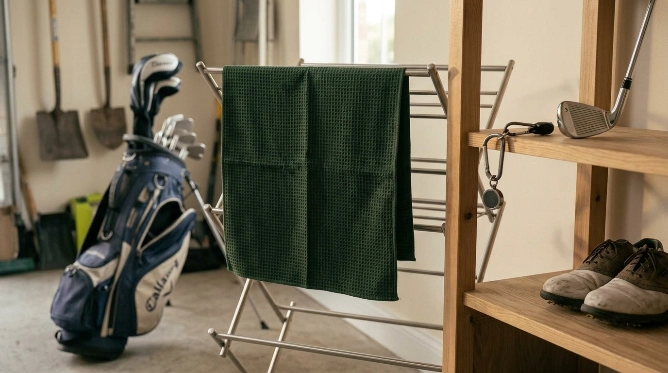
Drying matters almost as much as washing. A clean towel stored damp can become unpleasant before your next tee time.
Air-drying is a simple option when you are unsure about dryer heat. If the care label permits machine drying, use the approved setting rather than automatically choosing high heat.
My post-round routine
- Take the towel off the bag.
- Shake out grass and sand.
- Rinse obvious mud.
- Wash it when needed.
- Open the towel fully while drying.
- Return it to the bag only when dry.
Avoid leaving a wet towel folded in the trunk alongside shoes and rain gear. Warm, enclosed storage does nothing useful for a damp piece of fabric.
Also check the clip, loop, magnet pocket, and stitching while the towel is off the bag. Small attachment problems are easier to notice at home than beside the first tee.
When is a towel ready to go back on the bag?
It should feel dry throughout, not just on the exposed outer surface. Check the thickest seam and any folded attachment area.
A clean towel should also be free of obvious sand and dried debris. That gives you a fresh cleaning surface for your next round.
Frequently Asked Questions About Washing Waffle Weave Golf Towels
Can you put a waffle weave golf towel in the washing machine?
Yes, if the manufacturer’s care label allows machine washing. Remove detachable clips or magnets when appropriate, shake out loose sand first, and select the detergent, cycle, and temperature recommended for that specific towel.
Can you put a microfiber golf towel in the dryer?
Many microfiber towels can be tumble-dried at an approved low setting, but care instructions differ. Check the label before using heat, and air-dry the towel when you are uncertain about the fabric, printing, embroidery, or attachments.
Should you use fabric softener on a waffle golf towel?
Skip fabric softener when the towel is microfiber unless its manufacturer says otherwise. Waffle weave describes the construction rather than the fiber, so a cotton waffle towel may have different instructions from a microfiber version.
How often should you wash a golf towel?
Wash it whenever dirt, mud, grass, sunscreen, odor, or other residue builds up. A lightly used dry towel may not need laundering after every round, while a towel used during wet or muddy golf may need immediate cleaning.
Can you wash a golf towel with regular clothes?
You can when its care instructions are compatible with the load, but separation is useful when the towel contains sand, mud, or heavy grass residue. Microfiber towels may also pick up lint from some cotton items.
Why does my golf towel still smell after washing?
Persistent odor can come from residue, incomplete rinsing, or storing the towel before it dries. Rewash it according to the care label, avoid excessive detergent, and allow the fabric to dry completely in an open area.
Do I need a special detergent for a waffle weave towel?
Usually not. A normal laundry detergent is suitable when it matches the manufacturer’s instructions, and using the recommended amount is more important than buying a special golf-specific cleaning product.
What Is the Easiest Waffle Golf Towel Care Routine?
The easiest system is consistent: shake out grit, rinse heavy dirt, wash according to the care label, and dry the towel fully. Pay special attention to microfiber instructions because waffle weave tells you the fabric structure, not its fiber content.
I also make removing the towel part of unloading my golf bag. That small habit keeps yesterday’s wet mud from becoming next weekend’s cleaning problem.
- After dry rounds: Shake the towel out and inspect it.
- After muddy rounds: Rinse and wash it promptly.
- For microfiber: Avoid fabric softener unless specifically permitted.
- Before storage: Make sure every part of the towel is dry.
- Before the next round: Check that the towel is clean, grit-free, and securely attached.
Keep that routine simple and your waffle weave golf towel will stay ready for dirty wedges, wet irons, and the everyday mess that comes with playing golf in 2026.