
How Do You Use a Golf Towel to Clean Irons?

Quick Answer
To use a golf towel to clean irons, dampen one section of the towel, wipe grass and soil from the clubface, clean across the grooves, then finish with a dry section. Remove loose sand before rubbing the face, because trapped grit can act like an abrasive; the USGA club-face equipment rules also show how precisely iron grooves are regulated.
Quick Cleaning Steps
- Check for grit: Brush or shake away loose sand before wiping.
- Use a damp section: Moisture softens grass, mud, and soil without soaking the club.
- Wipe the face: Work across the hitting surface using light pressure.
- Check the grooves: Use a suitable club brush when packed debris remains.
- Dry the iron: Finish with a clean, dry section before returning it to your bag.
Best Habit
- Clean the iron immediately after the shot, before turf and mud have time to dry inside the grooves.
Learning how to use a golf towel to clean irons takes about one hole, but the habit can help for every round afterward. I treat my towel as part of the normal shot routine, not as something I remember only when the clubs look filthy.
The basic method is simple. Keep one part damp for cleaning and another part clean and dry for the final wipe.
In This Guide
- What Is the Best Way to Clean Irons With a Golf Towel?
- How Do You Clean an Iron With a Golf Towel Step by Step?
- Should a Golf Towel Be Wet or Dry for Cleaning Irons?
- How Do You Clean Iron Grooves Without Damaging Them?
- Is Microfiber or Cotton Better for Cleaning Irons?
- What Mistakes Should You Avoid When Cleaning Irons?
- Frequently Asked Questions
What Is the Best Way to Clean Irons With a Golf Towel?
The best method is to wipe your iron immediately after each shot using a slightly damp section of towel. Then use a dry section before putting the club back into your bag.
Definition: On-course iron cleaning means removing grass, soil, sand, and moisture from the clubface and grooves between shots rather than waiting for a deep cleaning at home.
Why cleaning the clubface matters
Irons regularly strike turf after contacting the ball. That contact can leave grass, damp soil, or mud across the clubface.
Grooves also have an important job. They help manage moisture and debris around the contact area between the ball and clubface.
- Fairway shots: Expect grass and a thin layer of soil after taking a divot.
- Wet turf: Damp dirt can spread across several grooves in one swing.
- Rough: Grass and moisture can remain on the face after impact.
- Bunker shots: Sand needs extra care because loose grit can scratch finishes when rubbed aggressively.
A 2024 Golf Digest clean-versus-dirty clubface test illustrates why golfers pay attention to this habit. In that limited five-shot wedge test, the clean face averaged 10,552 rpm of spin while the dirty face averaged 5,759 rpm.
That does not mean every golfer or iron will produce the same numbers. It does show that face contamination can materially change club-ball interaction.
My rule is simple: if dirt is easy to remove now, I don’t give it time to become difficult later.
How Do You Clean an Iron With a Golf Towel Step by Step?
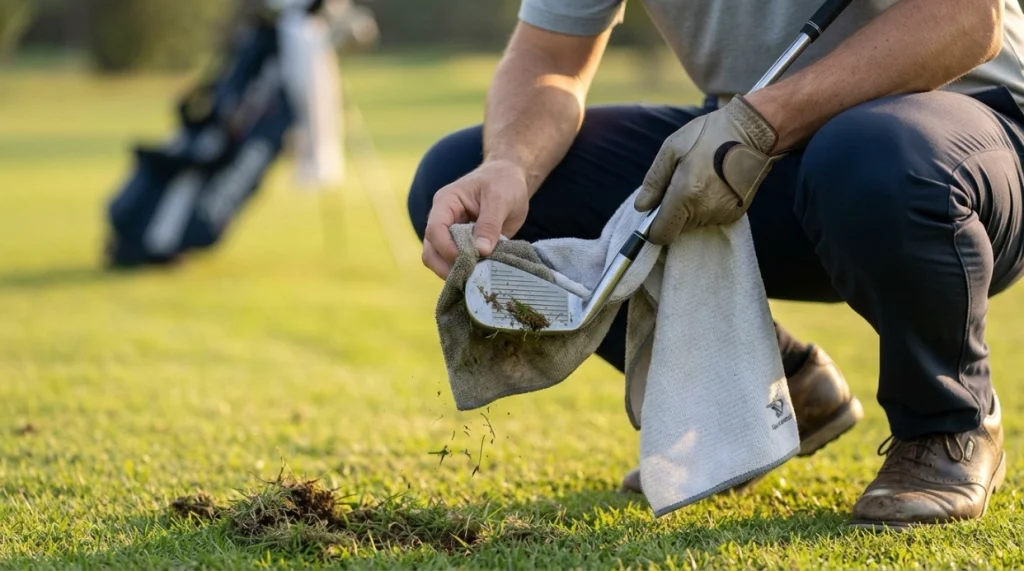
Start by checking the clubface before wiping it. The process should remove debris rather than grind it into the metal.
- Inspect the face and sole. Look for loose sand, grass, wet soil, or dried mud.
- Remove loose grit. Shake, tap, or brush away visible sand before using pressure with the towel.
- Dampen one section. The towel should feel moist rather than dripping wet.
- Wipe the clubface. Use several light passes across the face and grooves.
- Check the grooves. If dirt remains packed inside them, use a suitable golf club brush.
- Wipe the sole. Remove grass and soil before they dry.
- Finish with a dry area. Remove remaining moisture before the club goes back into the bag.
Clean the iron before putting it away
This is the part beginners often skip. They hit the shot, put the iron straight into the bag, and plan to clean it later.
Fresh mud usually wipes away more easily than dried mud. Cleaning immediately also prevents dirty clubs from rubbing against other equipment inside the bag.
- Approach shot from clean fairway: quick dry or damp wipe.
- Shot from wet turf: damp wipe followed by drying.
- Heavy mud: loosen with moisture before applying pressure.
- Bunker contamination: remove loose sand before wiping.
During soft-course rounds, I prefer cleaning the club before I start walking toward the next shot. It becomes automatic once it is attached to the end of the swing routine.
Should a Golf Towel Be Wet or Dry for Cleaning Irons?
Use both if possible. A damp section loosens dirt, while a dry section removes remaining moisture and leaves the iron ready for the bag.
When a damp towel works best
Moisture is useful when grass or soil is sticking to the clubface. It reduces the need for aggressive rubbing.
- Fresh mud
- Wet grass
- Dirt across the sole
- Light residue around the grooves
You do not need to soak the towel. A wet towel can become heavy, messy, and useless for drying grips or hands.
When a dry towel works best
A dry area is ideal for finishing the club after cleaning. It is also useful when the iron only has dew or light surface moisture.
Try keeping the dirty damp end away from your grips. Mud and moisture that help clean a clubface do not belong on the part of the club you hold.
| Iron Condition | Best Towel Setup | Extra Tool Needed? |
|---|---|---|
| Light moisture or dew | Dry section | Usually no |
| Fresh grass and soil | Damp, then dry | Usually no |
| Packed groove debris | Damp towel | Club brush may help |
| Loose bunker sand | Remove grit first, then damp wipe | Brush can help |
Section Takeaway: Use moisture to loosen dirt and a clean dry area to finish. Keeping those two zones separate makes one towel far more useful.


How Do You Clean Iron Grooves Without Damaging Them?
Start gently and use the towel for loose debris. If material remains packed inside the grooves, switch to a suitable club-cleaning brush instead of scrubbing harder with a gritty towel.
Iron grooves are precisely regulated equipment features. The USGA states that groove width must not exceed 0.035 inches, or 0.9 mm, and groove depth must not exceed 0.020 inches, or 0.508 mm, under its current equipment specifications.
The R&A Equipment Rules provide the corresponding equipment framework. Those standards are another reason I treat the clubface as functional equipment rather than a surface to attack with any sharp object nearby.
Use a towel first, brush second
- Loose grass: Wipe it away with the towel.
- Fresh soil: Loosen it using a damp section.
- Packed dirt: Use an appropriate golf brush.
- Loose sand: Brush or shake it away before rubbing.
- Final moisture: Dry the face with a clean towel section.
Avoid using knives, screwdrivers, or other sharp metal objects to scrape the grooves. They are unnecessary for normal cleaning and can damage the face.
Also avoid grinding a sandy towel across the clubhead. The fabric may be soft while the particles trapped inside it are not.
Pro tip: If you are unsure about clubface wear, groove condition, or equipment conformity, ask a qualified club fitter or PGA professional to inspect the club rather than modifying it yourself.
Section Takeaway: A towel handles everyday cleaning, while a proper club brush handles stubborn groove debris. More pressure is not the answer when grit is present.
Is Microfiber or Cotton Better for Cleaning Irons?
Both can clean irons well when they are clean and used correctly. Microfiber usually offers lower bulk and useful texture, while cotton terry provides a soft feel and strong moisture absorption.
| Feature | Microfiber | Cotton Terry |
|---|---|---|
| Clubface cleaning | Excellent, especially textured weaves | Very good |
| Absorbency | Good | Excellent |
| Wet-bag bulk | Usually lower | Usually higher |
| Traditional soft feel | Good | Excellent |
| Main caution | Can hold grit if dirty | Loops can also trap grit |
A waffle-weave microfiber towel is my practical all-around choice for irons. Its textured surface works well on grass and fresh soil without adding much bulk to the bag.
Cotton still makes sense when absorbency matters most. Whichever material you choose, cleanliness matters more than the label.
A dirty premium towel is still dirty.
What Mistakes Should You Avoid When Cleaning Irons?
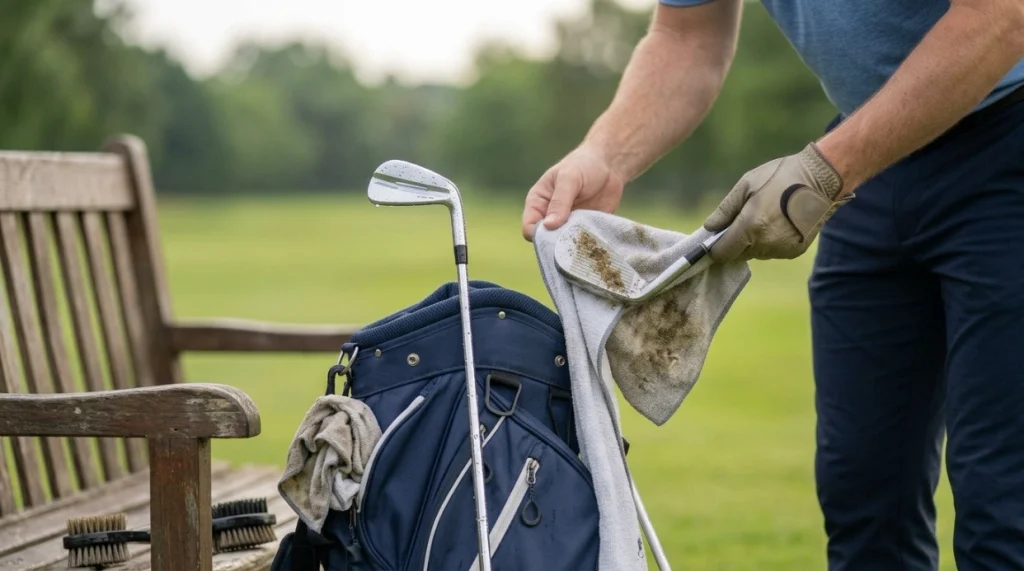
The biggest mistake is rubbing abrasive debris across the clubface. Golfers often focus on towel material while ignoring the sand or grit already trapped inside it.
- Do not scrub loose sand: Remove it before applying pressure.
- Do not use one dirty corner all round: Rotate to cleaner sections as the towel becomes contaminated.
- Do not soak the whole towel: Preserve a dry area for finishing and for your grips.
- Do not ignore the grooves: Use a suitable brush when a towel cannot remove packed debris.
- Do not store clubs wet: Dry them before returning them to the bag when practical.
- Do not leave a wet towel sealed in the bag: Remove it after the round and let it dry.
A simple 18-hole towel routine
Before teeing off, I dampen one corner and leave most of the towel dry. That gives me a cleaning zone and a finishing zone from the first hole.
After each iron shot, I check the face before replacing the club. A five-second wipe is easier than dealing with eighteen holes of dried soil later.
- Start with a clean towel.
- Dampen only one section.
- Keep the towel within easy reach on the bag.
- Remove sand before wiping.
- Use a brush only when the towel cannot clear the grooves.
- Wash the towel after muddy or sandy rounds.
For broader instruction and equipment guidance, the PGA of America is also a useful resource for golfers building better on-course habits.
Section Takeaway: Good iron cleaning depends more on routine than force. Keep the towel accessible, separate wet and dry areas, and clean the club before debris hardens.
Frequently Asked Questions
Can I clean my irons with a dry golf towel?
Yes. A dry towel works well for loose grass, dust, and surface moisture, but a slightly damp section usually removes mud and sticky soil more easily.
Should I wet my golf towel before a round?
Yes, but only wet part of it. Keep one corner damp for clubfaces and preserve a clean, dry area for final wiping, grips, and hands.
Can a golf towel clean the grooves of an iron?
A textured towel can remove loose grass, dirt, and moisture around the grooves. If debris is tightly packed, use a suitable club-cleaning brush rather than increasing pressure with the towel.
Can a dirty golf towel scratch irons?
Potentially, yes. The towel material may be soft, but sand or hard grit trapped in the fabric can become abrasive when dragged across a polished or finished surface.
Should I clean my irons after every shot?
It is a useful habit, especially after shots from wet turf, rough, or sand. Cleaning immediately prevents fresh debris from drying on the face and reduces the amount of work needed after the round.
Is microfiber safe for golf irons?
Clean microfiber is generally well suited to routine club cleaning. Inspect the towel for sand or other hard debris and use light pressure instead of aggressive scrubbing.
Do clean iron grooves improve performance?
Keeping the face and grooves free from dirt helps them work as designed. Golf Digest testing has also shown a substantial spin difference between clean and dirty wedge faces, although exact results vary by player, club, lie, and conditions.
The easiest routine is still the best one: damp section, light wipe, groove check, then dry. Do that after iron shots and your clubs will be much easier to maintain through the season.
As of 2026, nothing complicated is required. A clean golf towel, a proper club brush for stubborn debris, and a few seconds after each shot cover most on-course iron cleaning.