
Weight Distribution in Golf: How to Shift Your Weight for Better Contact
Quick Answer
Good weight distribution in golf starts from a balanced setup, moves pressure toward the trail side during the backswing, then shifts toward the lead side before and through impact. The goal is controlled weight transfer through the golf swing, not a large sideways sway.
Simple Weight Distribution Checkpoints
- At setup: Start close to balanced between both feet for a normal full swing.
- During takeaway: Let pressure move into the inside of your trail foot as your body turns.
- Near the top: Begin moving pressure back toward the lead side instead of staying loaded behind the ball.
- Through impact: Most pressure should be moving into the lead foot while your body continues rotating.
- At the finish: Finish balanced with most of your weight supported by the lead leg.
Best Check
- If you can hold your finish comfortably for several seconds, your balance and weight transfer are probably moving in a useful direction.
Weight distribution sounds like a small swing detail, but it affects contact, power, low-point control, and balance. Golfers also call it weight transfer, although pressure under your feet can change without your entire body sliding sideways.
I like to think of the golf swing as a controlled transfer of pressure around a stable turning motion. Once that feeling clicks, many fat, thin, and weak shots become easier to diagnose.
In This Guide
- What Does Weight Distribution Mean in Golf?
- Where Should Your Weight Be at Setup?
- How Should Weight Move During the Golf Swing?
- Does Weight Distribution Change for Different Golf Shots?
- What Weight Distribution Mistakes Cause Poor Shots?
- Which Drills Improve Golf Weight Transfer?
- Golf Weight Distribution FAQs
What Does Weight Distribution Mean in Golf?
Golf weight distribution describes how your body is supported between your lead and trail sides at different stages of a shot. For a right-handed golfer, the lead side is the left side and the trail side is the right.
Definition: Weight distribution is the proportion of support carried by each side of your body during setup and the swing. Pressure describes how strongly each foot pushes against the ground at a particular moment.
Those ideas are closely related, but they are not identical. Your foot pressure can change quickly while your head and torso remain relatively centered.
This distinction matters because golfers often hear “shift your weight” and respond by sliding their hips several inches away from the target. That movement can make returning to the ball much harder.
Weight shift is not the same as a sway
A useful backswing combines rotation with pressure moving toward the trail side. Your chest turns, your trail hip moves behind you, and your pressure loads mainly inside the trail foot.
You should still feel athletic and supported. If pressure rolls onto the outside edge of your trail shoe, you may have shifted farther than you can recover.
Why weight distribution affects contact
Your swing has a lowest point where the club reaches the bottom of its arc. Good pressure movement helps control where that low point occurs.
With an iron, the ideal low point is generally on the target side of the ball. Moving correctly into the lead side makes that easier to produce.
- Too much trail-side pressure at impact: Can contribute to fat shots, thin shots, and scooping.
- Too much lateral movement: Makes centered contact harder to repeat.
- Good lead-side pressure: Supports rotation and forward low-point control.
- Balanced finish: Shows that your motion stayed controlled through the strike.
Section Takeaway: Think about pressure moving between your feet while your body turns. Do not interpret weight transfer as a large side-to-side slide.
Where Should Your Weight Be at Setup?
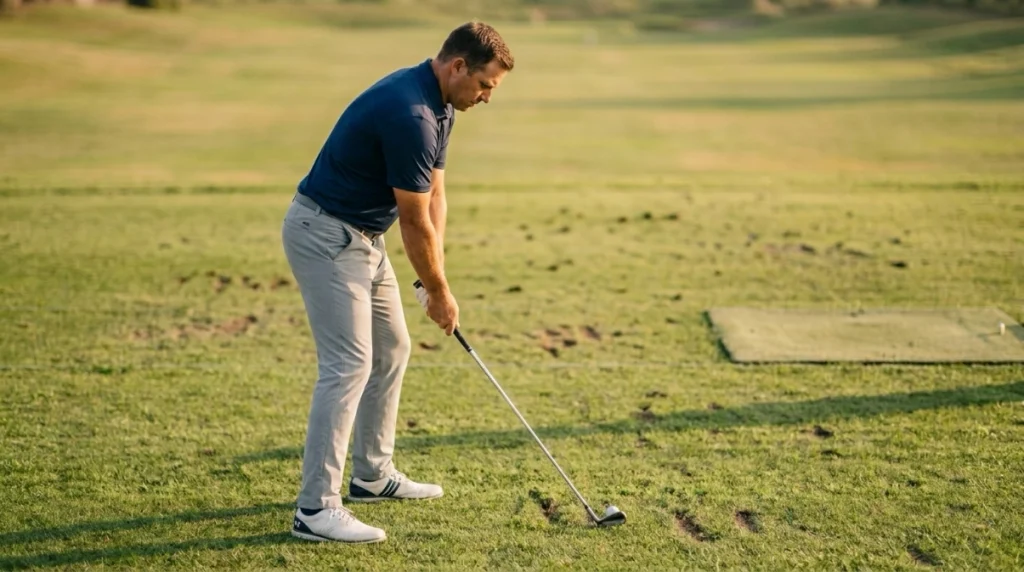
For a normal full swing, a near-balanced setup is a reliable starting point. Small changes are appropriate depending on the club, ball flight, lie, and shot you are trying to play.
The PGA of America has described roughly 50/50 distribution at address as a useful full-swing reference. Other instruction uses a slight lead-side bias with irons, so treat exact percentages as checkpoints rather than universal laws.
Start balanced from heel to toe
Side-to-side balance is only half the setup. You also need to avoid sitting heavily on your heels or leaning onto your toes.
I look for pressure through the middle of each foot with enough knee flex to feel athletic. You should feel ready to move in either direction without first correcting your posture.
- Too much heel pressure: Can make you stand up or lose posture during rotation.
- Too much toe pressure: Can pull your balance toward the ball.
- Centered foot pressure: Gives your hips room to rotate while maintaining stability.
Should irons start with more weight forward?
A slight lead-side bias can work well for many iron players. PGA instruction aimed at reducing topped iron shots has suggested roughly 55% to 60% favoring the lead side at setup.
That does not mean pinning your body over the front foot. You still need enough freedom to turn and load during the backswing.
What about the driver?
With a driver, I prefer a balanced feeling rather than forcing weight aggressively forward. The wider stance and forward ball position already create a different delivery than an iron.
The important point is that a driver setup should not trap you on the trail side. You still need pressure moving forward during transition and through the finish.
Pro tip: If changing setup pressure creates pain, instability, or a major swing compensation, work with a certified PGA coach or qualified club fitter instead of forcing a position.
Section Takeaway: Begin close to balanced for a normal full swing. Make only small setup adjustments that match the club and shot.
How Should Weight Move During the Golf Swing?
The basic sequence is trail side during the early backswing, back toward center near transition, then strongly toward the lead side through impact. Timing matters as much as the amount of movement.
One mistake I see in practice is treating the top of the backswing as the moment to finally load the trail foot. For many effective swings, pressure has already started moving forward by then.
1. Address: establish balance
Begin with stable pressure under both feet. A normal full swing commonly starts close to a 50/50 distribution.
Your body should feel ready rather than rigid. Excess tension makes natural pressure movement harder.
2. Takeaway: pressure moves toward the trail foot
As your torso turns away from the target, pressure should increase under the trail foot. Feel that load mostly inside the foot rather than rolling toward its outside edge.
Golf Digest describes the movement as something that should feel natural, similar to stepping. That is a better image than trying to force your entire upper body sideways.
3. Backswing: turn without drifting
Your trail hip should rotate behind you while your upper body completes its turn. This creates depth without requiring a large sway.
The exact amount of trail-side loading varies by golfer. PGA guidance has used an 80/20 trail-side checkpoint at the top, while other instruction uses smaller shifts.
That variation is important. The number matters less than whether you can transition efficiently from the position.
4. Transition: begin moving toward the lead side early
This is where many golfers improve fastest. Pressure should begin returning toward the lead foot before the club is halfway down.
Modern swing analysis often calls this recentering. Golf Digest has shown that elite players can start moving pressure toward the lead side before the backswing has completely finished.
You can read a practical explanation of this sequence in Golf Digest’s weight-transfer drill.
5. Impact: lead-side pressure dominates
By impact, most golfers should feel clearly supported by the lead leg. That support gives the hips and torso something stable to rotate around.
You should not need to throw your chest toward the target. Pressure moves forward while the body continues turning.
6. Finish: stand fully on the lead side
A good finish is one of my favorite self-checks. You should be able to hold the pose without falling backward or stepping sideways.
PGA guidance has used roughly 90/10 favoring the lead side at the finish as a useful reference. The trail foot should feel light with its heel naturally raised.
Section Takeaway: Load the trail side early, start recentering before you feel stuck at the top, then finish fully supported by the lead leg.


Does Weight Distribution Change for Different Golf Shots?
Yes. Full swings, chips, pitches, knockdowns, and putting require different amounts of pressure movement. Using one weight-distribution rule for every shot makes the short game unnecessarily difficult.
| Shot Type | Setup Feel | During Swing | Main Goal |
|---|---|---|---|
| Driver | Near balanced or slight trail-side feel | Load trail side, then transfer forward | Speed with balance |
| Mid-Iron | 50/50 to slight lead bias | Dynamic trail-to-lead transfer | Ball-first contact |
| Chip | About 60/40 lead side | Minimal weight shift | Predictable low point |
| Pitch | Closer to balanced | Small natural transfer with rotation | Controlled carry |
| Knockdown | Lead-side bias | Remain forward through impact | Lower flight and solid strike |
| Putt | Stable and balanced | Almost no lateral shift | Centered strike |
Chipping needs more stability
PGA short-game instruction has recommended roughly 60% of the pressure on the lead leg for a standard chip. That forward bias can remain fairly constant during the motion.
The movement is small, so there is little reason to load heavily onto the trail foot. Excess shifting often moves the bottom of the swing behind the ball.
Pitching allows more movement
A pitch uses more body rotation and a longer swing. PGA guidance has described a more balanced 50/50 setup for this type of shot.
You still move naturally through the ball, but the transfer is smaller than a full iron swing.
Knockdown shots favor the lead side
When I want to lower an iron flight, I like feeling pressure forward before the swing begins. That makes it easier to control the strike and avoid adding unnecessary loft.
PGA guidance for windy knockdown shots similarly recommends leaning most of the weight toward the front side. The finish is usually shorter than a stock full swing.
Section Takeaway: Longer swings need dynamic pressure transfer. Shorter shots usually work better with less movement and more lead-side stability.
What Weight Distribution Mistakes Cause Poor Shots?
The most common problems are swaying too far back, hanging on the trail foot, reverse pivoting, and forcing the weight shift too late. Each mistake changes where the club reaches the ground.
Swaying outside the trail foot
A sway happens when your pelvis and upper body drift away from the target instead of turning around a stable base. Pressure often moves toward the outside edge of the trail shoe.
From there, you need a large recovery move toward the ball. Timing becomes difficult, especially with irons.
Hanging back through impact
This fault leaves too much pressure on the trail foot during the downswing. The club may bottom out too early or the golfer may try to lift the ball with the hands.
Common results include fat shots, thin shots, weak contact, and high shots that lack compression.
Reverse pivoting
A reverse pivot moves pressure toward the lead side during the backswing, then falls backward during the downswing. That is almost the opposite of an efficient full-swing sequence.
The golfer may feel like the body is working hard but struggle to create useful speed. Balance at the finish is often poor.
Shifting too late
Some golfers load the trail foot correctly but remain there until the downswing begins. They then rush toward the target to catch up.
A better pattern begins recentering earlier. The lower body can start moving lead-side while the backswing is still completing.
Spinning without transferring pressure
Rotation alone is not enough. Golfers sometimes spin their hips open while their pressure remains behind the ball.
The result can be an open clubface, heel contact, or weak shots to the right for a right-handed golfer. Pressure and rotation need to work together.
- Fat contact: Check whether pressure stays on the trail foot too long.
- Thin or topped contact: Check for hanging back or trying to lift the ball.
- Poor balance: Check for excessive lateral movement.
- Weak finish: Check whether the trail foot still carries most of your weight.
- Inconsistent strike: Check whether your shift changes dramatically from swing to swing.
Pro tip: Repeated pain or difficulty loading one leg can have physical causes. A certified instructor or qualified movement professional can help you find a safer pattern.
Section Takeaway: Most weight-distribution faults come from moving too far, moving too late, or failing to reach the lead side through impact.
Which Drills Improve Golf Weight Transfer?
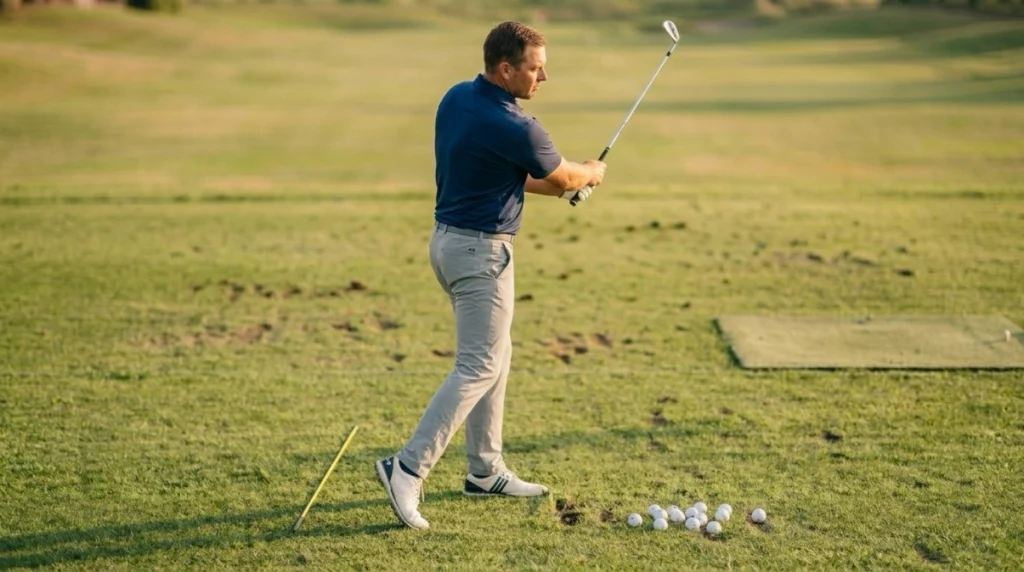
The best drills exaggerate the feeling of moving from trail side to lead side while keeping you balanced. Start slowly before adding normal swing speed.
1. Step-through drill
This is my first choice for golfers who finish on the back foot. It turns pressure transfer into a motion that feels closer to walking.
- Address the ball with a comfortable stance.
- Make a smooth backswing while loading the trail side.
- Start down and allow the trail foot to step toward the target after impact.
- Finish standing tall and balanced.
- Repeat slowly before hitting shots at normal speed.
The PGA of America includes a similar step-through exercise among its practical swing drills. You can review the PGA step-through drill for another reference.
2. Feet-together drill
Hit short shots with your feet close together. The narrow stance immediately exposes excessive swaying.
Start with a wedge or short iron and half swings. Your goal is centered contact and a balanced finish, not distance.
3. Trail-foot pressure drill
Make slow backswings without a ball and notice where you feel pressure in the trail foot. Keep it around the inside portion instead of rolling onto the outside edge.
Then begin moving pressure toward the lead foot before your hands start aggressively toward the ball. This helps separate recentering from a rushed upper-body downswing.
4. Hold-the-finish drill
Hit a controlled 7-iron and freeze your finish for three seconds. Your chest should face the target area while the majority of your support comes from the lead leg.
I use this checkpoint whenever my contact becomes inconsistent. If I cannot hold the finish, I first fix balance before changing the clubface or swing path.
5. Powder-line low-point drill
Draw a line on the practice ground using foot powder spray or another safe marker. Place the ball just ahead of the line toward the target.
Try to strike the ball and brush the turf on the target side of the line. This gives immediate feedback about whether your pressure and low point are moving forward.
How many repetitions should you do?
Quality matters more than volume. Five to ten slow rehearsals followed by a few normal shots is usually enough to test whether the feel transfers.
If the motion disappears at full speed, return to half swings. Building the sequence gradually works better than forcing harder swings.
For individualized instruction, the PGA Coach directory can help you find a qualified instructor.
Section Takeaway: Use drills that provide clear balance and contact feedback. A successful drill should improve the real swing rather than become a separate motion you can only perform during practice.
Golf Weight Distribution FAQs
What should my weight distribution be at address?
For a normal full golf swing, start close to 50/50 between the lead and trail feet. A slight lead-side bias can work well with irons, while chips often begin more clearly forward.
How much weight should be on the back foot during the backswing?
There is no single percentage that suits every golfer. Coaching references commonly describe a noticeable trail-side load, sometimes around 60% to 80%, but balance and timing matter more than reaching an exact number.
Should my weight be forward at impact?
Yes. For most full shots, pressure should favor the lead side by impact while your hips and torso continue rotating toward the target.
Why do I keep finishing on my back foot?
You may be loading the trail side too late, swaying too far away from the target, or failing to recenter during transition. The step-through drill can help exaggerate the correct forward movement.
Can poor weight distribution cause fat shots?
Yes. Staying on the trail side too long can move the swing’s low point behind the ball, causing the club to contact the ground first.
Can poor weight transfer cause topped shots?
It can. Hanging back may encourage the golfer to lift the club through impact, while excessive body movement makes the bottom of the swing harder to control.
Should I shift my weight when putting?
Very little lateral weight transfer is needed during a normal putting stroke. A stable setup helps the shoulders move the putter without unnecessary body motion.
The simplest way to improve golf weight distribution is to stop chasing exact percentages and learn the sequence. Start balanced, load the trail side without swaying, recenter early, and move firmly into the lead side through impact.
Practice that pattern with a mid-iron before worrying about maximum speed. When you can strike the ball cleanly and hold your finish, gradually build the motion into your driver and longer clubs.
As of 2026, modern instruction increasingly emphasizes pressure movement and recentering rather than an exaggerated side-to-side weight shift. That is a useful change because it encourages golfers to stay athletic, centered, and easier to balance.
If you keep fighting the same contact pattern after several focused practice sessions, book a lesson and have your movement checked in person. One good diagnosis can save weeks of guessing.