
Aim in Golf: How to Aim Correctly and Hit Your Targets More Often

Quick Answer
Aim in golf means choosing a specific target and aligning the clubface and body correctly for the shot. The simplest method is to stand behind the ball, choose a precise target, pick an intermediate spot a few feet ahead, square the clubface to that line, then build your stance parallel to it. A consistent routine makes proper aim easier to repeat.
What good golf aim looks like
- Pick a target: Choose a specific landing area rather than simply aiming at the hole or fairway.
- Choose a reference: Use a small intermediate target close to the ball to make alignment easier.
- Square the face: Aim the clubface first because it has a major influence on the ball’s starting direction.
- Set your body: Your feet, knees, hips, and shoulders should generally run parallel to the target line.
- Trust the setup: Correct alignment can feel strange at first, especially when your old setup was inconsistent.
Quick verification tip
- Place two alignment sticks on the practice ground to create parallel target and body lines, then check your setup from behind the ball.
When I think about aim in golf, I don’t think about simply pointing the club at the flag.
Good aim is a complete process that starts before the swing and continues through clubface alignment, body position, and target selection.
In This Guide
I’ve found that golfers often work on their swing when their real problem starts with where they’re aimed. That makes aim one of the most useful fundamentals to check before changing your mechanics.
This guide explains the target line, body alignment, intermediate targets, common mistakes, and simple drills you can use on the range or course.
What Does Aim Mean in Golf?
Aim in golf is the process of selecting where you want the ball to go and positioning the clubface and body to give the shot the best chance of reaching that target.
For a straight shot, the basic goal is simple: the clubface points along the intended starting line while your body is positioned parallel to that line.
What is the target line?
The target line is an imaginary line extending from the ball toward your intended target.
If you’re hitting a straight shot at a flag, the target line runs from the ball through the intended starting point and toward the flag.
The important detail is that your body does not normally point directly at the target. Instead, your body lines should run parallel to the target line.
What is the body line?
Your body line is the alignment created by your feet, knees, hips, and shoulders at address.
For a conventional right-handed setup, these body lines sit slightly left of the target line while remaining parallel to it.
Think of two railroad tracks. One track represents the ball-to-target line, while the other represents your body alignment.
That mental picture makes aim much easier to understand.
Section Takeaway: Aim isn’t simply pointing your body at the target. It means creating a target line and positioning your clubface and body correctly around that line.
How Do You Aim Correctly in Golf?
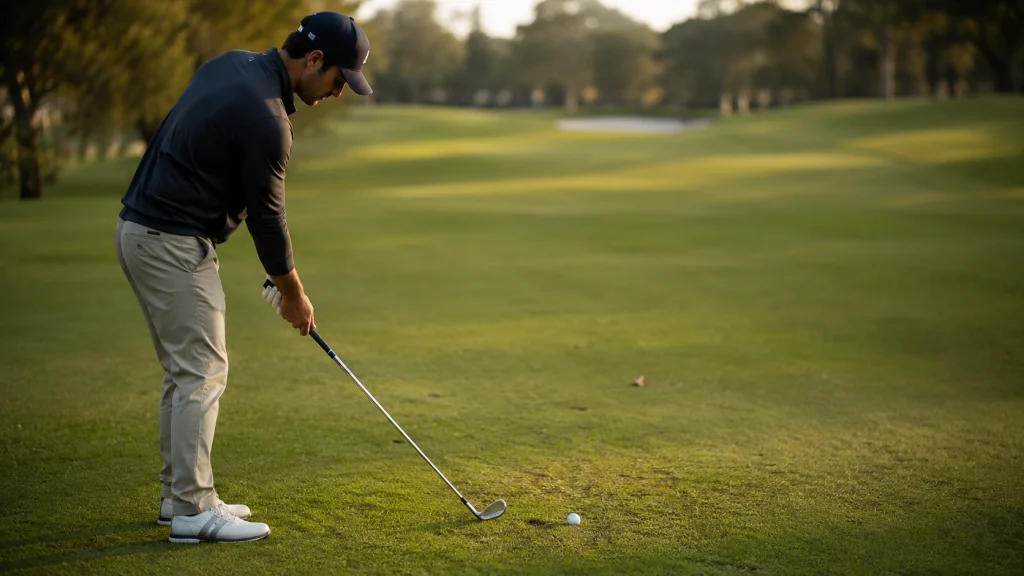
The easiest way to improve aim is to use the same setup sequence before every shot.
Instead of walking toward the ball and immediately placing your feet, start behind the ball and build the setup from the target outward.
1. Stand behind the ball
Move several yards behind the ball and look from the ball toward your intended target.
Don’t choose a vague target such as “the fairway.” Pick something specific, such as the left side of the fairway, a tree line, or a particular section of the green.
2. Choose the starting line
Decide where the ball needs to start, not just where you ultimately want it to finish.
This distinction becomes especially important when you intentionally play a fade, draw, or other shaped shot.
3. Pick an intermediate target
Find a small mark only a few feet in front of the ball that sits on your intended line.
A leaf, discolored patch of grass, old divot, or small natural mark can work.
A nearby reference is easier to use than staring at a target far down the fairway.
4. Square the clubface
Approach the ball from the side and position the clubface so its leading edge or face orientation matches the intended starting line.
Try not to move the clubface while you establish your stance.
5. Build your stance
Once the clubface is positioned, place your feet and settle into your normal stance.
Your feet, knees, hips, and shoulders should generally be parallel to the target line rather than pointing directly at the target.
6. Look once more and commit
Take one final look at the target, return your attention to the ball, and make your swing.
Don’t keep adjusting your alignment because the correct position feels unfamiliar.
- Stand behind the ball.
- Choose a specific target.
- Visualize the target line.
- Select an intermediate reference point.
- Square the clubface.
- Set your body parallel to the target line.
- Look at the target and commit to the shot.
Professional instruction commonly emphasizes this type of routine because alignment is easier to repeat when golfers follow a consistent sequence rather than relying on feel alone.
Section Takeaway: Build your aim from behind the ball. Choose the target first, use an intermediate reference, square the clubface, then position your body.
Should You Aim the Clubface or Your Body First?
For most standard golf shots, I recommend setting the clubface first and building your body position around it.
This gives you a clear reference point before your feet and shoulders can influence what you think is square.
Why clubface alignment matters
The clubface is the part of the club that directly contacts the ball, so its orientation has a major influence on the ball’s initial direction.
If the face is aimed significantly away from your intended starting line, changing your body position alone won’t solve the problem.
The railroad-track method
Imagine the ball-to-target line as one railroad track.
Your feet, hips, and shoulders form another track that runs parallel to it.
| Alignment Element | What It Should Do | Common Error |
|---|---|---|
| Clubface | Match the intended starting line | Aiming too far left or right |
| Feet | Run parallel to the target line | Pointing directly at the target |
| Hips | Follow the stance line | Open or closed setup |
| Shoulders | Remain broadly parallel to the stance line | Shoulders aimed at the target |
| Eyes | Help you judge the target line | Relying entirely on visual feel |
One of the biggest problems with golf alignment is that correct alignment can look wrong from the player’s perspective.
That’s why checking your setup from behind the ball or using alignment sticks can reveal mistakes that aren’t obvious while you’re standing over the shot.
Does this change for left-handed golfers?
The same principle applies to left-handed players, but the body-line relationship appears on the opposite side of the target line.
The goal remains the same: establish the clubface and target line, then create a parallel body line.
Section Takeaway: Start with the clubface for a standard shot, then build your stance around it. Think parallel railroad tracks instead of pointing your whole body at the target.


What Are the Most Common Golf Aim Mistakes?
Poor aim can look like a swing problem because golfers often compensate for where they are pointed.
Before rebuilding your swing, it’s worth checking whether your setup is sending you toward the wrong target.
Aiming the body directly at the target
This is one of the easiest mistakes to make.
A golfer looks at the flag, turns the feet toward it, and assumes everything is square.
For a standard straight shot, that usually puts the body line in the wrong relationship to the target line.
Setting the feet before the clubface
If you establish your feet first, your body position can become the reference for where you think the clubface should point.
That can reinforce an existing alignment error.
Aiming at a huge target
“Hit the fairway” isn’t a precise target.
Instead, pick a tree, bunker edge, fairway section, or specific landing area that gives your brain a clear visual objective.
Ignoring the intermediate target
Trying to align directly with a target hundreds of yards away is difficult.
A nearby spot gives you something much easier to square the clubface against.
Changing alignment to match ball flight
If you normally slice the ball, you might unconsciously aim farther left to compensate.
That can help one shot finish closer to the target, but it can also hide the underlying setup or swing issue.
Trusting feel instead of checking reality
Golfers often say a correct alignment feels uncomfortable after they change an old habit.
That doesn’t mean the new position is wrong.
Use an external reference such as alignment sticks, a mirror, video, or a coach to compare what you feel with what you’re actually doing.
- Body points at target: Rebuild the stance around the target line.
- Feet set first: Place the clubface before establishing your stance.
- Target is vague: Choose a precise landing area.
- No intermediate target: Select a small reference near the ball.
- Alignment compensates for a slice: Separate aim from swing correction.
- Correct setup feels wrong: Verify it with an external reference.
Section Takeaway: Many aim problems survive because golfers trust what alignment feels like. External feedback is often the fastest way to discover the truth.
What Drills Improve Aim and Alignment?
You don’t need a complicated training system to improve aim.
A few minutes of deliberate alignment practice can make your pre-shot routine more reliable.
The two-stick railroad drill
Place one alignment stick on the ground along the target line and another parallel to it where your feet would sit.
Address the ball while using both sticks as visual references.
- Place the first stick toward the target.
- Place the second stick parallel to the first.
- Set the clubface along the target line.
- Position your feet along the body line.
- Check your hips and shoulders.
- Hit several controlled shots without moving the sticks.
This drill gives your eyes a reference that you don’t have during a normal round.
The intermediate-target drill
Pick a target downrange and then find a small mark a few feet in front of the ball on the same line.
Set the clubface toward the nearby mark rather than trying to point it at the distant target.
Then build your stance and hit the shot.
Repeat the process until selecting an intermediate target becomes automatic.
The step-away check
After setting up, step away from the ball and look down your target line.
Check whether your clubface and body appear to match the intended shot.
Then step back in and make the swing.
The three-club test
Don’t practice alignment only with your driver.
Use a driver, mid-iron, and wedge to see whether your setup stays consistent as the club length changes.
| Practice Drill | Main Goal | Best Use |
|---|---|---|
| Railroad sticks | Body and clubface alignment | Range practice |
| Intermediate target | Target-line visualization | Range or course |
| Step-away check | Visual verification | Pre-shot routine practice |
| Three-club test | Consistency across clubs | Full practice session |
Alignment is a skill, so feedback matters. PGA of America instruction also emphasizes alignment routines, intermediate targets, and external checks as practical ways to improve consistency.
Pro tip: If your alignment problems remain persistent or you need hands-on swing changes, work with a certified golf instructor rather than guessing at the cause.
Section Takeaway: Practice aim as a separate skill. Use alignment sticks for diagnosis and an intermediate target for transferring the skill to the course.
How Should You Aim Different Golf Shots?
Your aim should match the shot you’re trying to produce.
A straight shot, fade, draw, chip, and putt can have different starting lines even when they finish near the same target.
How should you aim a straight shot?
For a straight shot, choose the intended target and align the clubface directly along the starting line.
Set your body parallel to that line and make your normal swing.
How should you aim a fade?
For a controlled fade, the intended starting line may sit left of the final target for a right-handed golfer.
Your exact alignment depends on how much the ball normally curves and where you want it to finish.
Don’t copy another golfer’s alignment simply because they play a fade.
How should you aim a draw?
A draw for a right-handed golfer may start right of the final target before curving back toward it.
The key is to choose the starting line first and then build your setup around the intended ball flight.
How should you aim on a dogleg?
On a dogleg, the flag is not always the best target from the tee.
Look at the entire hole and identify the safest landing area before choosing your line.
Aiming directly toward the flag can bring trees, bunkers, water, or other trouble into play unnecessarily.
How should you aim an approach shot?
On approach shots, aim for a landing area rather than automatically aiming at the flag.
Consider the green’s shape, surrounding hazards, pin position, and your normal shot pattern.
How should you aim a putt?
Putting adds another layer because the ball usually needs to follow a break rather than travel directly at the hole.
Choose the intended starting point, visualize the path, and align the putter face with that starting line.
A nearby visual reference can help here too.
Section Takeaway: Good aim isn’t always aimed directly at the final target. Pick the correct starting line for the shot shape and let your strategy determine the target.
How Can You Build a Reliable Pre-Shot Aim Routine?

The best alignment system is one you can repeat under pressure.
I prefer a short routine because long routines give you more opportunities to second-guess the setup.
My simple five-part routine
- See it: Stand behind the ball and visualize the complete shot.
- Pick it: Choose a precise target and starting line.
- Reference it: Find an intermediate spot near the ball.
- Set it: Square the clubface and build your stance.
- Hit it: Take one final look and commit.
The important part is consistency.
Use roughly the same sequence with your driver, irons, wedges, and short-game shots.
Why consistency matters
A repeatable routine reduces the number of decisions you need to make once you’re standing over the ball.
It also gives you a process to return to when your game becomes uncomfortable.
When a round starts going badly, I would rather return to a dependable routine than make five unrelated swing changes.
That approach keeps aim, alignment, and swing mechanics from becoming one confusing problem.
How often should you practice aim?
You don’t need an entire range session dedicated to alignment.
Spend the first 10 to 15 minutes of a practice session checking your setup, then continue using your routine during normal shot practice.
That combines technical feedback with realistic shot-making.
Section Takeaway: Make aim part of your normal pre-shot routine instead of treating it as a separate skill you remember only after a bad shot.
Aim in Golf FAQ
What does aim mean in golf?
Aim in golf means selecting a target and aligning the clubface and body to produce the intended shot. For a standard straight shot, the clubface follows the target line while the feet, hips, and shoulders remain parallel to it.
Should your feet point at the target in golf?
Usually, no. For a standard right-handed shot, your feet should generally be positioned parallel to the target line rather than pointing directly at the target. This creates the body alignment needed for a consistent setup.
What is the easiest way to improve golf aim?
The easiest starting point is to use an intermediate target. Choose a small spot a few feet ahead of the ball, square the clubface to it, and then build your stance parallel to the target line.
Why does correct golf alignment feel wrong?
Correct alignment can feel strange when your previous setup was inconsistent. Your eyes and brain become accustomed to familiar positions, so a technically better alignment may initially look or feel unusual.
Should I aim at the flag on every golf shot?
No. The flag is often only one part of the decision. A better target may be a safer section of the green, fairway, or landing area based on hazards, your normal shot shape, and the consequences of missing.
Can poor aim cause a golf slice?
Poor aim can contribute to compensations, but aim alone does not explain every slice. A slice can involve clubface orientation, swing path, impact conditions, and other factors, so persistent problems are best assessed by a qualified instructor.
How can I check my golf alignment at home?
You can use a mirror or indoor alignment aid to check your stance and shoulder position. For a more realistic test, use two alignment sticks on a safe practice surface and compare your body line with the intended target line.
Final Takeaway: Better Aim Starts Before the Swing
Learning how to aim in golf can improve your consistency without changing your entire swing.
The basic process is straightforward: choose a specific target, visualize the target line, pick an intermediate reference, square the clubface, and position your body parallel to that line.
Then trust the setup and make the swing.
As of 2026, alignment remains one of those fundamentals that is easy to overlook because it happens before the ball moves.
But that doesn’t make it less important.
If you’re struggling with inconsistent starts, pulled shots, pushed shots, or a recurring pattern of misses, check your aim before assuming your swing needs a major overhaul.
Start with the two-stick drill at your next practice session. Then take the intermediate-target routine onto the course and make it part of every shot.
Better golf doesn’t always begin with a bigger swing. Sometimes it begins with simply aiming where you actually intend to go.