
Can You Use Fabric Softener on Golf Towels?

Quick Answer
It is usually best not to use fabric softener on golf towels, especially microfiber towels. Softener can leave a coating on the fibers that reduces absorbency and cleaning performance. Microfiber-care guidance from The Rag Company specifically advises against fabric softener because it can clog microfiber and reduce its performance.
What I recommend instead
- Skip liquid softener: This is especially important for microfiber and waffle-weave golf towels.
- Avoid dryer sheets: They can leave similar softening residue on absorbent fibers.
- Use mild detergent: A small amount of fragrance-free or residue-conscious detergent is usually enough.
- Choose moderate temperatures: Follow the sewn-in care label and avoid unnecessary high heat on microfiber.
- Dry completely: Air drying or low dryer heat is the safer approach for many synthetic golf towels.
The simple rule
- If you want your golf towel to absorb water and lift dirt effectively, wash it without fabric softener unless its manufacturer specifically says otherwise.
A golf towel spends its life dealing with damp grass, bunker sand, mud, sweat, and wet clubheads. That makes absorbency and cleaning ability far more useful to me than a heavily perfumed, extra-soft feel.
As of 2026, my default advice is simple: keep fabric softener away from golf towels when performance matters. Below, I’ll explain why, how the answer changes by material, and what to do if you have already used softener.
In This Guide
- Can You Use Fabric Softener on a Golf Towel?
- Why Is Fabric Softener Bad for Microfiber Golf Towels?
- Does the Golf Towel Material Change the Answer?
- How Should You Wash a Golf Towel Without Fabric Softener?
- Can You Fix a Golf Towel After Using Fabric Softener?
- Frequently Asked Questions
- Final Takeaway
Can You Use Fabric Softener on a Golf Towel?
You technically can use fabric softener on some washable towels, but I would normally skip it for a golf towel. Its main job is cleaning and absorbing moisture, and softening residue can work against those jobs.
A golf towel is an absorbent equipment-care cloth used to remove moisture, soil, grass, sand, and debris from golf equipment during a round. That performance matters more than making the fabric feel unusually slick or scented.
Why absorbency matters on the course
I normally divide a golf towel into working zones. One part handles dirty clubheads, while another stays cleaner and drier for moisture control.
- Damp section: Loosens soil, grass, and bunker residue from clubfaces.
- Dry section: Removes moisture from clubheads, hands, and grips.
- Clean area: Can be reserved for a golf ball when the Rules allow cleaning.
If the fibers stop drawing in water properly, the towel becomes less useful for each of those jobs. It may push moisture around rather than picking it up efficiently.
Whirlpool’s general towel-care guidance also warns that fabric softener can affect towel absorbency because it can leave a coating behind. You can review its towel washing guidance for the same general principle.
What about an occasional use?
Using softener once does not automatically mean you have ruined a towel. The effect depends on the fabric, the softener, the amount used, and how thoroughly the towel rinses.
I still would not make it a regular habit. Golf towels benefit from staying as residue-free as practical.
Section Takeaway: For an equipment towel, absorbency and dirt pickup should come before fragrance or an artificially softened feel.
Why Is Fabric Softener Bad for Microfiber Golf Towels?
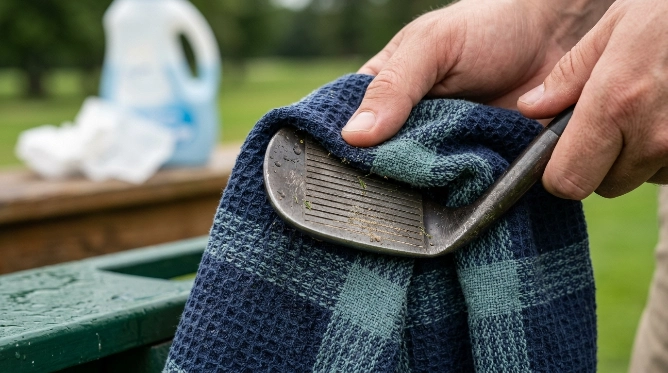
Fabric softener is particularly unsuitable for microfiber because it can coat the tiny fibers that give the material its water- and dirt-gripping behavior. That can make a once-effective towel feel less thirsty.
Microfiber is made from extremely fine synthetic fibers, commonly polyester and polyamide. The small fibers and textured weave create a large working surface for picking up moisture and debris.
Softener can interfere with the fiber surface
Liquid softener is designed to leave conditioning ingredients on fabric. That may create a softer hand feel, but residue is not useful when I want exposed microfiber working against a muddy wedge.
Maytag specifically recommends avoiding fabric softener when washing microfiber because it can coat the fibers and make them less effective at cleaning. Its microfiber washing guide also recommends separating microfiber from lint-producing fabrics.
Dryer sheets can cause the same basic problem
Skipping liquid softener but adding a dryer sheet is not much of a workaround. Dryer sheets also deposit conditioning agents during the drying cycle.
- Liquid softener: Added during washing or rinsing and may leave conditioning residue.
- Dryer sheets: Release softening ingredients during heated drying.
- Too much detergent: Can also leave residue if it does not rinse cleanly.
- Excess heat: May damage synthetic fibers independently of softener.
I would rather accept a towel that feels slightly less fluffy when dry. Once dampened, its ability to grab water and course dirt is much more important.
Waffle microfiber needs its texture working
Many golf towels use a waffle-style microfiber texture. The raised pattern creates useful pockets and edges that can help pick debris from a clubface.
When that fabric becomes loaded with detergent, softener, grease, or other residue, it may not work the way it did when clean. Proper rinsing matters as much as choosing the right detergent.
Does the Golf Towel Material Change the Answer?
Yes, material affects how cautious you need to be, but skipping fabric softener is still the simplest performance-first rule. Microfiber deserves the most care, while cotton can tolerate more traditional washing methods.
A useful real-world example is the OGIO Golf Towel sold by Callaway, which lists 380 gsm waffle microfiber made from an 85/15 fiber blend. That is a different construction from a traditional cotton terry towel.
| Golf Towel Type | Typical Construction | Fabric Softener? | Main Concern |
|---|---|---|---|
| Microfiber waffle | Polyester/polyamide microfiber; blends vary by product | Avoid | Residue can interfere with absorbency and dirt pickup |
| Cotton terry | Looped cotton fabric | Best skipped | Softener can reduce maximum towel absorbency |
| Synthetic blend | Polyester or mixed synthetic fibers | Usually avoid | Performance finishes and wicking can be affected by residue |
| Specialty wet/dry towel | Multiple layers or treated fabrics | Check label | Different layers may have different care requirements |
Microfiber golf towels
This is the category where I am strictest. I wash microfiber without liquid softener and keep dryer sheets out of the load.
Lint is another concern. Washing microfiber with fluffy cotton bath towels can leave lint trapped in the fine synthetic fibers.
Cotton golf towels
Cotton can handle a broader range of washing conditions, depending on the care label. However, a golf towel still needs to soak up moisture, so there is little reason to deliberately reduce that ability.
A small amount of softener may make cotton feel smoother. For my golf bag, I would trade that softness for maximum absorbency.
Specialty and printed towels
Embroidered logos, printed graphics, waterproof layers, magnets, and attached hardware can change the care routine. Always let the manufacturer’s care label override generic laundry advice.


How Should You Wash a Golf Towel Without Fabric Softener?
Remove loose debris first, wash with an appropriate amount of mild detergent, rinse thoroughly, and dry according to the care label. That simple routine is enough for most golf towels.
My basic golf towel washing routine
- Shake out grass and sand. Do this outdoors before putting the towel into your washer.
- Rinse heavy mud. Running water removes thick soil that does not need to circulate through a wash load.
- Check the care label. Temperature limits and drying instructions vary between products.
- Use a sensible amount of detergent. More detergent does not automatically mean cleaner fabric.
- Skip fabric softener. Leave both liquid softener and softening dryer sheets out.
- Choose cool or warm water when appropriate. Avoid extreme temperatures unless the manufacturer specifies otherwise.
- Dry completely. Air dry or use a low setting when the care label allows it.
Should microfiber be washed separately?
I prefer washing microfiber with other low-lint microfiber items rather than cotton bath towels. Fine microfiber can collect lint released by natural-fiber fabrics.
The Rag Company and other microfiber-care specialists recommend keeping microfiber away from lint-producing materials. This is especially useful for golf towels with deep waffle textures.
How much detergent should you use?
Follow the detergent label and account for your load size and washer type. Overdosing can make rinsing more difficult and may leave a towel feeling stiff or less absorbent.
I focus more on rinsing out soil and residue than adding extra fragrance. Golf towels will get dirty again quickly, so performance is the goal.
What about high heat?
High heat is unnecessary for many microfiber golf towels. Synthetic fibers can be more heat-sensitive than cotton, so low heat or air drying is a safer default when the label permits it.
- Microfiber: Favor cool or warm washing and low-heat or air drying unless the label says differently.
- Cotton: Follow the label because colors, embroidery, and shrinkage risk can vary.
- Specialty towels: Be cautious with magnets, waterproof layers, or decorative finishes.
Section Takeaway: A golf towel usually needs less laundry chemistry, not more. Remove the course dirt, rinse the fibers well, and protect the towel from residue and unnecessary heat.
Can You Fix a Golf Towel After Using Fabric Softener?
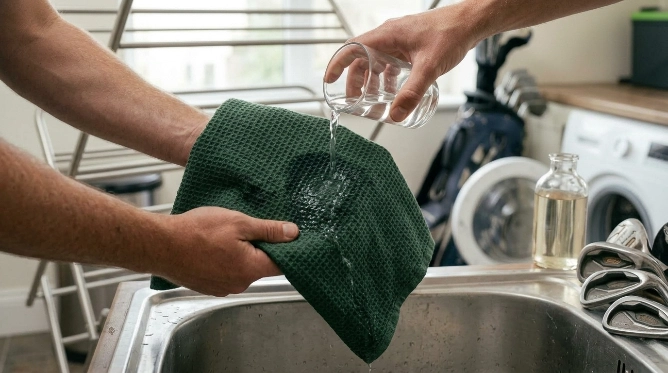
Sometimes a towel that has been washed with softener can improve after one or more detergent-only washes. The result depends on how much residue has accumulated and whether the fibers have also been damaged by heat or wear.
I would not throw a golf towel away after one accidental softener cycle. First, try washing the residue out.
Try this recovery routine
- Wash the towel again without fabric softener or dryer sheets.
- Use a suitable mild or microfiber-safe detergent.
- Choose the water temperature permitted by the care label.
- Use an extra rinse if your washer offers one and residue seems likely.
- Air dry or use an approved low-heat setting.
- Test the towel with clean water before putting it back on your bag.
How do you test absorbency?
Put a small amount of clean water on the towel and watch how quickly it moves into the fabric. An effective towel should take up the moisture rather than letting it sit on the surface for an extended time.
You do not need laboratory measurements. You are simply checking whether the towel still performs its basic job.
When should you replace the towel?
Residue is not the only reason golf towels lose performance. Repeated abrasion, embedded grit, damaged loops, stubborn odors, or heat-damaged microfiber can eventually justify replacement.
- The towel no longer absorbs water well after proper washing.
- Embedded debris will not rinse or wash out.
- The fabric has become hard, melted, or badly damaged.
- Persistent odor remains after complete washing and drying.
- The towel sheds heavily or leaves lint on equipment.
A worn towel can still be downgraded to garage or general cleaning duty. I simply would not keep relying on it for clean grips and clubheads.
Frequently Asked Questions
Can fabric softener make a golf towel less absorbent?
Yes. Fabric softener can leave conditioning residue on towel fibers, which may reduce their ability to soak up water. This matters most when you use the towel for wet clubheads, grips, hands, and damp course conditions.
Can you use dryer sheets with golf towels?
I recommend avoiding dryer sheets for microfiber and performance-focused golf towels. They contain softening ingredients that can coat fibers, creating a similar absorbency problem to liquid fabric softener.
Can you use fabric softener on a cotton golf towel?
You may be able to use it if the care label permits it, but I still prefer not to. Cotton golf towels need strong absorbency, and softener can reduce the water-holding performance you want on the course.
What detergent is best for microfiber golf towels?
Use a detergent compatible with microfiber and follow its dosage directions. Fragrance-free, additive-light, or dedicated microfiber detergents are sensible options when you want to minimize residue.
Should you wash a golf towel after every round?
Not necessarily after every clean, dry round, but wash it when it becomes dirty, muddy, oily, or smelly. A heavily soiled towel should not stay damp inside your golf bag for days.
Can you use a golf towel to clean your golf ball?
Yes, but only when the Rules permit the ball to be cleaned. Under USGA Rule 14, a ball lifted from the putting green may be cleaned, while restrictions apply in certain other situations.
Why does my microfiber golf towel repel water?
Residue from softener, dryer sheets, excessive detergent, oils, or other products may be interfering with the fibers. Rewash it without softener, rinse it thoroughly, and test the absorbency again after drying.
Final Takeaway
For most golfers, there is little upside to using fabric softener on a golf towel. Microfiber is especially sensitive to residue, while even cotton towels can lose some of the absorbency that makes them useful.
I keep my routine simple: shake out the course debris, wash with an appropriate amount of detergent, skip softener and dryer sheets, then dry the towel completely. It keeps the towel ready for the job that matters—cleaner equipment and better moisture control during the next round.
If your towel has already gone through a softener cycle, do not assume it is finished. Rewash it without softener, rinse it thoroughly, and check how well it absorbs clean water before replacing it.