
What Towels Do Caddies Use? A Golfer’s Guide to Tour-Style Golf Towels

Quick Answer
Golf caddies commonly use large, absorbent golf towels, often made from waffle-weave microfiber or cotton, to clean clubfaces, remove grass and sand, and manage moisture during a round. Waffle-weave microfiber is a particularly practical choice because its textured surface helps lift debris from club grooves while remaining relatively lightweight and quick-drying. If you want to understand the material in more detail, this guide to what a microfiber golf towel is explains the key differences.
What makes a caddie’s towel useful?
- Waffle texture: Helps remove loose dirt, grass, and sand from clubfaces and grooves.
- Large surface: Provides enough material for repeated cleaning throughout 18 holes.
- Absorbent fabric: Handles moisture from morning dew, wet grass, and ball cleaning.
- Wet and dry sides: Allow a caddie to scrub dirty equipment and finish with a drier section.
- Durable construction: Withstands frequent washing and regular use around the course.
- Easy access: A practical hanging arrangement keeps the towel close to the clubs.
The simplest way to choose one
- Choose waffle-weave microfiber for frequent club cleaning and faster drying.
- Consider cotton terry when you prefer a traditional, plush towel.
- Pick a larger tour-style towel if you need separate cleaning and drying areas.
Ever watched a caddie prepare a club before a crucial approach shot and noticed how clean the clubface looks? That small detail starts with having the right towel within reach.
In this guide, I’ll explain which golf towels caddies use, why their materials matter, and how you can choose a practical setup for your own bag in 2026.
In This Guide
What towels do golf caddies use?
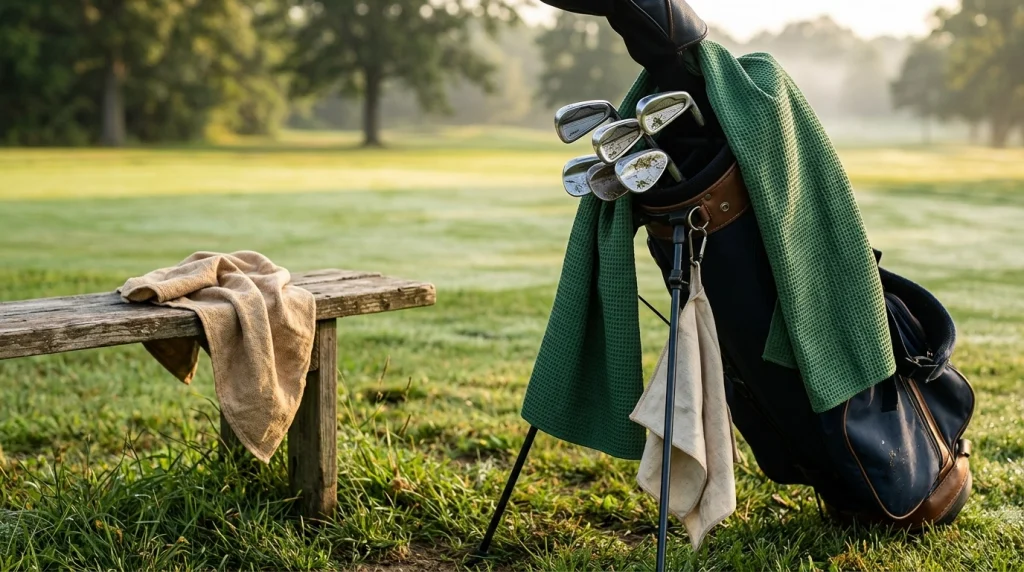
Golf caddies commonly carry large golf towels made from microfiber, cotton, or a textured blend suited to frequent cleaning. Waffle-weave microfiber is a popular option because it combines useful texture, manageable weight, and practical drying performance.
There isn’t one mandatory towel used by every professional caddie. Fabric, size, branding, and personal preference vary across players, tournaments, and equipment arrangements.
What is a caddie towel?
A caddie towel is a golf-specific towel designed to clean equipment and manage moisture during play. It typically hangs from a golf bag, sits over a suitable support, or remains within easy reach of the caddie.
Unlike an ordinary bathroom towel, a purpose-built golf towel must handle several different jobs without becoming awkward to carry. It needs to clean clubfaces, remove loose dirt, wipe balls when permitted, and dry hands or equipment when necessary.
You’ll generally encounter three practical formats:
- Tour-style towels: Larger towels that offer plenty of material for cleaning several clubs throughout a round.
- Compact bag towels: Smaller towels that suit walking golfers, stand bags, and lightweight setups.
- Specialty cleaning towels: Textured or dual-surface towels designed for equipment cleaning and moisture management.
Do professional caddies all use the same brand?
No. Some golfers and caddies use branded tour towels, while others choose towels supplied by equipment companies, golf clubs, sponsors, or independent manufacturers.
Club Glove, Titleist, and other established golf equipment brands offer recognizable towel options, but a logo alone doesn’t prove that a towel performs better. Material, construction, size, and ease of cleaning matter more for everyday use.
For a recreational golfer, copying a professional’s exact equipment isn’t necessary. Matching the towel to your own course conditions and cleaning habits is a better starting point.
Section takeaway: Caddies need dependable, easy-to-reach towels rather than one universal brand or model. A large waffle-weave microfiber towel is a strong starting point for golfers who prioritize club cleaning.
Why do caddies prefer waffle-weave microfiber towels?
Waffle-weave microfiber combines fine synthetic fibers with a raised, grid-like texture that helps collect moisture and loose debris. This combination makes it well suited to cleaning clubfaces and grooves during a round.
Two details matter here: microfiber describes the material, while waffle weave describes the fabric’s construction. They’re not competing materials; many golf towels use both.
How does the waffle texture help clean golf clubs?
Golf club grooves can collect grass, damp soil, and sand after shots from fairways, rough, and bunkers. A textured towel helps lift that loose debris rather than simply spreading it across the face.
That matters most with wedges and irons, where clean grooves help maintain the conditions needed for predictable contact. A towel won’t repair worn grooves or guarantee a particular spin rate, but it supports consistent equipment maintenance.
When cleaning a club, I would focus on a simple routine:
- Remove loose grass and soil with the textured part of the towel.
- Use a slightly damp section for stubborn dirt when needed.
- Wipe away remaining moisture and residue with a cleaner section.
- Check the grooves before returning the club to the bag.
Why does microfiber work well during a full round?
Microfiber is made from very fine synthetic fibers, commonly polyester or a polyester-polyamide blend. Its structure can help collect moisture and fine debris while keeping the towel relatively light.
Many microfiber towels also dry faster than thick cotton terry towels, although actual performance depends on fabric density, weave, towel size, humidity, and how wet the towel becomes.
On a humid morning or after a shower passes over the course, quick drying can be particularly helpful. A towel that stays wet for hours is less convenient when you need a reasonably dry section for grips or hands.
Is waffle weave better than smooth microfiber?
For cleaning dirty clubfaces, I would generally favor a textured waffle surface over completely smooth microfiber. The grid offers a useful cleaning texture, while smooth microfiber can still work well for wiping moisture and polishing relatively clean surfaces.
Neither construction wins every task. The best choice depends on whether you need to remove stubborn debris, dry equipment, clean a ball, or keep a lightweight towel attached to a walking bag.
Section takeaway: Waffle-weave microfiber is a practical all-around option because it combines texture with manageable weight. Look at the actual construction rather than assuming every towel labeled microfiber will clean equally well.
Which golf towel material is best?
The best golf towel material depends on how you use it, but waffle-weave microfiber is my first choice for regular club cleaning. Cotton terry remains a reasonable alternative when softness, traditional construction, and a substantial feel matter more.
Before comparing towels, remember that material and weave describe different features. Cotton and microfiber identify the fibers, while terry and waffle describe how the fabric is constructed.
Microfiber vs. cotton vs. waffle weave
Here’s how the main options compare for everyday golf and caddie use.
| Towel type | Main advantage | Main drawback | Best use |
|---|---|---|---|
| Waffle-weave microfiber | Textured cleaning surface and relatively quick drying | Requires careful washing to preserve performance | Clubfaces, grooves, and regular rounds |
| Smooth microfiber | Lightweight and useful for wiping moisture | Less pronounced texture for stubborn debris | General cleaning and compact bags |
| Cotton terry | Soft feel and familiar absorbent construction | Can become heavy when wet and dry slowly | Hands, general wiping, and traditional towels |
| Cotton waffle | Textured surface with a traditional cotton feel | Drying and weight depend on construction | Club towels and embroidered designs |
These are general construction differences, not laboratory rankings. Fiber quality, fabric thickness, and manufacturing methods can change how two towels of the same category perform.
Should you choose microfiber or cotton?
Choose microfiber if your priority is cleaning club grooves, handling damp conditions, and carrying less bulk. Choose cotton if you prefer a familiar towel feel or want a traditional embroidered club towel.
I wouldn’t judge either material by softness alone. A plush towel might feel excellent in your hands but offer less convenient cleaning performance than a textured towel designed for golf equipment.
There is also no need to assume that every microfiber towel is automatically superior to every cotton towel. A poorly constructed microfiber towel may perform worse than a well-made cotton alternative.
What about absorbency and fabric thickness?
Absorbency depends on more than the material label. Fabric weight, fiber structure, weave, and the amount of moisture already held by the towel all affect practical performance.
Manufacturers sometimes advertise GSM, or grams per square meter, as a measure of fabric weight. Higher GSM generally indicates a heavier fabric, but it doesn’t automatically mean better groove cleaning or faster drying.
For a golf towel, I would prioritize these features in order:
- Cleaning texture: The surface should help lift dirt without excessive rubbing.
- Useful absorbency: It should handle moisture without becoming cumbersome.
- Drying performance: It should recover between uses under your usual conditions.
- Construction: Reinforced edges and secure attachment points should withstand regular use.
Section takeaway: Waffle-weave microfiber is the most versatile starting point for golfers who clean their clubs frequently. Cotton remains a useful alternative, so compare the finished towel rather than relying on fabric labels alone.


What size and design do caddies use?
Caddies often benefit from larger towels because extra fabric provides more room for cleaning clubs and separating damp and dry sections. Recreational golfers can use smaller towels successfully, especially when walking with a lightweight stand bag.
There is no single official caddie-towel dimension that every professional must follow. The most suitable size depends on the towel’s construction, the golfer’s equipment, and the way the caddie carries it.
How large should a golf towel be?
Tour-style towels are commonly sold in oversized formats, while compact bag towels take up less space. As a practical shopping reference, compare the following approximate size categories rather than treating them as official tour standards.
| Size category | Example dimensions | Best suited to |
|---|---|---|
| Compact | 12 × 16 inches | Minimalist bags and occasional wiping |
| Medium | 16 × 24 inches | Everyday golfers and walking rounds |
| Large tour-style | 20 × 40 inches | Frequent cleaning and separate working areas |
These dimensions are illustrative examples, not standardized industry sizes. Always check the manufacturer’s stated measurements before purchasing.
Are center-slit towels better than clip-on towels?
A center-slit towel hangs over a suitable club, alignment stick, or support, while a clip-on towel attaches to a bag’s towel ring or another compatible attachment point. Both designs make the towel easy to reach.
The right choice depends on how your bag is arranged. A clip can be convenient for quick removal, while a center slit offers a simple hanging method without requiring a separate clip.
- Center slit: Useful when you prefer a towel that drapes over a suitable support.
- Carabiner or clip: Convenient for attaching and removing the towel from a bag.
- Reinforced grommet: Provides a dedicated attachment point on compatible designs.
- Hanging loop: Offers a simple attachment option when your bag has a suitable hook.
Whatever design you choose, make sure the towel stays clear of the ground. A towel dragging through wet grass can pick up extra mud and grit, defeating its purpose.
Do caddies use towels with separate wet and dry sides?
A wet-and-dry setup is a practical way to manage different cleaning tasks, although not every caddie uses the same arrangement. One section can handle dirt, while another remains available for final wiping or drying.
You don’t need a specially divided towel to use this method. Simply dampen one end and leave the remaining fabric dry, keeping both sections clean enough for their intended jobs.
Section takeaway: Choose a towel large enough for your cleaning routine without making it awkward to carry. A medium towel suits many recreational golfers, while a larger tour-style towel offers more working surface.
How do caddies use golf towels during a round?
Caddies use towels to keep clubs clean, manage moisture, and prepare equipment for the next shot. A consistent routine helps prevent dirt from accumulating on clubfaces and keeps the towel useful throughout the round.
The exact routine varies with weather, course conditions, and the player’s preferences. The underlying principle is simple: remove contamination when it appears instead of waiting until the end of the round.
How do caddies clean clubfaces and grooves?
After a shot from damp grass, soft ground, or a bunker, the clubface may carry dirt that needs attention. A caddie can use a damp, textured towel to remove loose debris and then wipe the surface clean.
For ordinary golfers, the same approach works well:
- Inspect the clubface after the shot.
- Remove loose grass and dirt with a textured towel.
- Use a little water for stubborn residue if necessary.
- Wipe the face and grooves clean before storing the club.
A towel is useful for routine cleaning, but a soft club brush can help with stubborn dirt lodged deep in grooves. Use an appropriate brush and avoid aggressive scrubbing that could damage the club’s finish.
How do caddies keep golf balls clean?
A towel can remove loose grass, mud, and other debris from a golf ball when the Rules of Golf permit cleaning. The important distinction is that players cannot clean their ball whenever they wish during play.
Under the Rules of Golf published by The R&A, whether you may lift and clean a ball depends on the situation and applicable rules.
For example, a ball lifted on the putting green can generally be cleaned before replacement. A ball lifted under certain other rules may also be cleaned, while other situations restrict cleaning.
Local rules and specific circumstances matter. A towel makes cleaning convenient, but it doesn’t override the rules governing when a ball may be lifted or cleaned.
How do caddies handle wet weather?
Rain and morning dew create different cleaning challenges from dry summer conditions. A useful towel routine separates the tasks of removing mud, drying hands, and keeping grips as dry as possible.
In wet weather, try these practical habits:
- Keep a dry towel section protected from unnecessary moisture.
- Use a damp section for dirt that won’t lift easily with dry fabric.
- Wipe grips before handling clubs when conditions allow.
- Reposition the towel if it begins dragging through wet grass.
Grip care matters because excess moisture can make the club harder to hold securely. A towel won’t eliminate every wet-weather problem, but it gives you a simple way to manage equipment between shots.
Does keeping grooves clean improve performance?
Clean grooves help maintain consistent contact conditions by removing dirt and grass that can interfere with the clubface’s interaction with the ball. This is especially relevant for wedges and short-iron shots, where contact conditions influence spin and control.
However, a clean clubface doesn’t guarantee a particular shot result. Swing delivery, lie conditions, ball contact, and equipment characteristics also affect what happens at impact.
For general equipment-care guidance, the United States Golf Association (USGA) provides information about the rules and equipment standards that govern the game. Cleaning your clubs is a maintenance habit, not a substitute for sound technique.
Section takeaway: Use your towel consistently after shots, keep a dry section available, and follow the rules when cleaning your ball. These habits help maintain your equipment without adding unnecessary complexity to your round.
How do you choose and care for a caddie-style towel?

The right caddie-style towel should match your course conditions, equipment, and cleaning habits. For most golfers seeking one versatile option, a medium or large waffle-weave microfiber towel offers a useful balance of cleaning texture, size, and convenience.
Before buying, consider how often you play, whether you walk or ride, and how much space your bag can spare. A more expensive towel isn’t automatically better for your needs.
What should you check before buying?
Start with the features that affect everyday use rather than decorative details. A towel that stays accessible, cleans effectively, and survives regular washing is more useful than one chosen purely for appearance.
- Material: Look for microfiber if club cleaning and quick drying are priorities.
- Texture: Choose a waffle surface for frequent removal of loose dirt and grass.
- Size: Match the dimensions to your bag and preferred wet-and-dry routine.
- Attachment: Check whether the clip, grommet, slit, or loop suits your setup.
- Construction: Inspect stitching, edges, and attachment points for durability.
- Care instructions: Make sure the fabric can tolerate your usual washing routine.
How should you wash a microfiber golf towel?
Wash microfiber towels according to the manufacturer’s instructions, and avoid fabric softener unless the manufacturer explicitly permits it. Softener can leave residues that interfere with the fine fibers’ ability to collect moisture and dirt.
Follow this basic care routine:
- Shake off loose sand, grass, and soil outdoors.
- Wash the towel with suitable laundry detergent.
- Avoid fabric softener and dryer sheets for microfiber.
- Use a suitable drying method and avoid excessive heat.
- Store the towel only after it has dried thoroughly.
If you regularly play muddy courses, wash the towel before dirt builds up in the fabric. Keeping a spare towel in your bag can also help when the main one becomes saturated.
When should you replace a golf towel?
A towel doesn’t need replacing simply because it has been used for a certain number of rounds. Its condition and cleaning performance are more useful indicators than an arbitrary replacement schedule.
Consider replacing it when the fabric develops persistent odors despite proper washing, the edges unravel, the attachment point fails, or the surface no longer cleans effectively.
Some performance problems are reversible. A microfiber towel that has accumulated detergent residue may improve after appropriate washing, so check its care instructions before discarding it.
Should you carry one towel or two?
One large towel is enough for many golfers, particularly when they can keep a clean, dry section available. Two towels become useful when conditions are muddy, rainy, or humid, or when you want to separate equipment cleaning from hand drying.
Here’s a simple way to decide:
- One towel: Best for casual rounds and golfers who prefer a lighter bag.
- Two towels: Useful when one towel may become soaked or heavily soiled.
- Large plus compact: A practical combination when you want a main cleaning towel and a separate towel for hands or grips.
There’s no need to carry extra equipment just because professional caddies sometimes use more elaborate setups. Start with one dependable towel and add another only if your playing conditions justify it.
Section takeaway: Prioritize texture, size, attachment, and easy maintenance when choosing a caddie-style towel. Wash microfiber without fabric softener and replace it when its condition or cleaning performance declines.
Frequently asked questions about caddie golf towels
1. What towels do PGA Tour caddies use?
PGA Tour caddies use a variety of golf towels, including large tour-style towels and textured microfiber options. Specific brands and materials vary by player, sponsor, and personal preference, so there isn’t one universal towel used by every caddie.
2. Why are golf towels often made from microfiber?
Microfiber uses fine synthetic fibers that can collect moisture and loose debris while remaining relatively lightweight. Textured waffle-weave microfiber is especially practical for removing grass and dirt from clubfaces and grooves during a round.
3. Are waffle-weave golf towels better than cotton towels?
Waffle-weave microfiber is often the more convenient choice for frequent equipment cleaning because it offers a textured surface and generally dries faster than thick cotton terry. Cotton remains useful for golfers who prefer a traditional towel feel and construction.
4. What size golf towel do professional caddies use?
Professional caddies may use large tour-style towels, but dimensions vary by manufacturer and personal preference. A towel around 20 × 40 inches is one example of an oversized format, while a 16 × 24-inch towel can suit everyday golfers.
5. Should a golf towel be wet or dry?
Both approaches are useful. A slightly damp section helps remove stubborn dirt, while a dry section is better for final wiping and managing moisture. Keeping the sections separate makes the towel more versatile throughout a round.
6. Can I use an ordinary bath towel for golf?
Yes, an ordinary towel can handle basic wiping and drying. However, a golf-specific towel may offer a more convenient size, a textured cleaning surface, and a suitable attachment system. Those features can make equipment cleaning easier on the course.
7. How often should I wash my golf towel?
Wash your golf towel whenever dirt, moisture, or odors accumulate, and more frequently after muddy or rainy rounds. Follow the manufacturer’s care instructions, avoid fabric softener on microfiber, and allow the towel to dry thoroughly before storing it.
The takeaway: choose the towel that keeps your clubs clean
So, what towels do caddies use? They commonly rely on golf-specific towels that provide enough surface area for repeated cleaning, with waffle-weave microfiber offering a practical combination of texture, absorbency, and manageable drying time.
You don’t need an expensive tour-branded towel to benefit from the same basic approach. Choose a suitable size, keep one section damp for cleaning, preserve another for drying, and wash the towel properly after your rounds.
Next time you prepare your golf bag, give your towel the same attention you give your clubs and golf balls. It’s a small accessory, but a dependable one can make equipment care easier from the first tee to the final green.