
What Towels Do PGA Tour Players Use?

Quick Answer
PGA Tour players and their caddies use a mix of oversized cotton terry towels, waffle-weave microfiber towels, and specialty moisture-control towels. Brands vary with sponsorships, personal preferences, and tournament setups, so there isn’t one towel used by every professional. If you want a practical tour-inspired setup, explore the golf towels available at PGA TOUR Superstore and choose a towel that matches your cleaning and drying needs.
What makes a tour-style golf towel different?
- Waffle microfiber: Its textured surface helps remove dirt and grass from club grooves.
- Oversized design: A larger towel provides more room for cleaning clubs and managing moisture.
- Cotton terry: Soft, absorbent loops work well for hands, faces, and general drying.
- Dry backup: Tour caddies carry spare towels to protect grips in wet conditions.
- Reliable attachment: A grommet, clip, or bag loop keeps the towel within easy reach.
The simplest way to copy the pros
- Carry one textured towel for clubfaces and grooves, plus a separate clean towel for hands and grips.
- Keep the drying towel protected from rain, mud, and the wet section of your cleaning towel.
Ever notice the big towel hanging from a PGA Tour player’s bag? I’ve always found that the more interesting question isn’t just which logo appears on it, but how professionals use their towels to keep their equipment ready for every shot.
In this guide, I’ll break down the towel styles associated with tour golf, the brands worth knowing, and the features that matter when choosing one for your own bag. I’ll also explain how to build a practical towel setup without paying extra just for a professional-looking logo.
In This Guide
- What towels do PGA Tour players actually use?
- Which golf towel brands are worth knowing?
- Is microfiber or cotton better for golf?
- Why do professional golfers use large towels?
- How should you choose a tour-style golf towel?
- How can you set up your golf bag like a pro?
- Golf towel frequently asked questions
What towels do PGA Tour players actually use?

PGA Tour players use several types of golf towels, with oversized caddie towels and textured microfiber models among the most recognizable. The exact brand depends on the player’s equipment arrangements, sponsorships, and personal preferences.
There is no universal PGA Tour towel requirement that makes every player use the same product. What matters most is having a towel that cleans clubfaces, absorbs moisture, and keeps the equipment ready for the next shot.
Oversized caddie towels
A traditional tour-style caddie towel offers plenty of material for repeated cleaning throughout a round. Its larger surface also makes it easier to separate a damp cleaning area from a dry area for hands and grips.
For example, the Players Towel brand has offered a 22-by-40-inch microfiber towel designed around professional golf needs. That size illustrates the roomy format associated with tour-style towels, rather than a mandatory size used by every professional.
Waffle-weave microfiber towels
Waffle-weave microfiber towels have a raised, textured surface that helps lift dirt from iron grooves and wedge faces. The fabric also absorbs moisture, making it useful for cleaning clubs after shots from wet grass or sandy lies.
Professional golfers need clean clubfaces because grass and debris can interfere with consistent contact. A good towel makes routine cleaning easier, although it cannot replace proper club maintenance.
Branded and custom towels
Players also carry towels displaying equipment manufacturers, sponsors, tournament logos, or personalized designs. Those markings can identify a brand or team, but they don’t automatically tell you how well the towel absorbs water or cleans grooves.
As of 2026, the most useful approach is to distinguish between a towel’s appearance and its actual construction. Look at the fabric, dimensions, attachment method, and drying needs before choosing a product.
- For cleaning: Look for textured microfiber or another durable club-cleaning fabric.
- For drying: Choose an absorbent cotton or microfiber towel with enough surface area.
- For convenience: Consider a secure clip, grommet, or magnetic attachment.
Section takeaway: Tour players don’t all use one towel. The best lesson to borrow is their focus on clean grooves, dry grips, and having the right towel available when conditions change.
Which golf towel brands are worth knowing?
Several established golf brands sell towels suitable for a tour-inspired setup, while specialist manufacturers focus on textured cleaning fabrics or custom player towels. The right choice depends more on your needs than on whether a professional carries the same logo.
Some useful names to compare include Titleist, TaylorMade, Callaway, PING, Club Glove, and Players Towel. Each offers a different combination of branding, design, fabric, or format across its product range.
Titleist, TaylorMade, Callaway, and PING
These familiar equipment brands offer golf towels that complement their wider golf equipment lines. Their products are worth considering if you prefer a coordinated bag or want a towel from a manufacturer already represented in your golf setup.
Don’t assume every towel from these brands uses the same fabric or dimensions. Check the individual product listing for its material, measurements, care instructions, and attachment hardware.
Club Glove and Players Towel
Club Glove is a useful name to investigate when shopping for practical golf accessories, including caddie-style towels. Players Towel is particularly associated with large microfiber towels and custom designs intended for golf bags.
Players Towel has also documented use of its products by professional golfers. That is evidence that the brand has a tour presence, but it doesn’t mean every PGA Tour player uses it or that it is automatically the best choice for every amateur.
What about the towels you see on television?
A televised tournament may show a player’s sponsor-branded towel, a custom design, or a towel supplied through a particular equipment relationship. A logo alone doesn’t establish the exact model, fabric, or current product specification.
If you want to identify a specific professional’s towel, use a recent, clear photograph and compare visible branding with the manufacturer’s current range. Treat older photographs cautiously because equipment and sponsorship arrangements can change.
| Brand or type | What to look for | Best reason to consider it |
|---|---|---|
| Titleist | Terry or performance towel options | A familiar golf equipment brand |
| TaylorMade | Tour-style and branded towel designs | Matching your existing equipment preference |
| Callaway | Fabric texture, size, and attachment | A practical branded bag accessory |
| PING | Player towel and cleaning options | Simple equipment coordination |
| Club Glove | Caddie towel format and absorbency | A straightforward working towel |
| Players Towel | Large microfiber designs and customization | A tour-inspired or personalized towel |
These are comparison categories, not a ranking of towel performance. Product specifications vary by model, so compare the actual item before purchasing.
Section takeaway: Start with the towel’s construction, not its logo. Choose an established brand if you like its design, but let absorbency, cleaning ability, and durability determine the final decision.
Is microfiber or cotton better for golf?
Waffle-weave microfiber is an excellent choice for cleaning clubfaces and grooves, while cotton terry is particularly useful for absorbing moisture and drying hands. Neither material wins every job, which is why many golfers benefit from carrying both.
A golf towel is a reusable cloth designed to remove dirt, grass, sand, and moisture from golf equipment during a round. Its material, weave, size, and attachment system determine how conveniently it performs those jobs.
How microfiber performs on the course
Microfiber uses extremely fine synthetic fibers, commonly polyester or a polyester-polyamide blend. These fibers can trap fine debris and absorb moisture without requiring the thickness of a traditional bath towel.
Waffle-weave microfiber adds a raised grid pattern that provides useful texture for cleaning iron faces and wedge grooves. It also folds compactly, making it a sensible option for golfers who carry their own bags.
- Club cleaning: Textured microfiber helps remove loose grass and soil.
- Portability: Lightweight construction suits walking and stand bags.
- Drying: Many microfiber towels dry relatively quickly when spread out between rounds.
For a closer look at the material itself, read this guide to what makes a microfiber golf towel useful.
When cotton makes more sense
Cotton terry uses raised loops that hold water and give the fabric a soft, familiar feel. It’s a good choice for wiping sweaty hands, drying equipment, and handling general cleaning tasks.
The main trade-off is weight when wet. A thick cotton towel can become heavy after a rainy round, and it may take longer to dry than a lightweight microfiber alternative.
- Moisture absorption: Cotton terry works well for hands and general drying.
- Comfort: The soft fabric feels pleasant against skin.
- Traditional design: Cotton suits golfers who prefer a classic caddie towel.
If you prefer natural fibers, see the practical guide to cotton golf towels and their everyday uses.
Microfiber vs. cotton: which should you buy?
| Feature | Waffle microfiber | Cotton terry |
|---|---|---|
| Club grooves | Textured surface is useful for lifting debris | Works well for wiping, especially when damp |
| Water absorption | Good, depending on construction | Often excellent in thick terry fabric |
| Weight when wet | Often relatively light | Can become heavier when saturated |
| Drying speed | Often quicker, depending on thickness and airflow | Often slower when thick and saturated |
| Best everyday role | Cleaning clubs and managing moisture | Drying hands and general-purpose wiping |
These are general material characteristics, not guarantees for every towel. Fabric density, finishing, weave, and care all affect performance.
Section takeaway: Choose microfiber for a versatile cleaning towel and cotton for a soft, absorbent drying towel. If you regularly play in changing weather, carrying one of each gives you more flexibility.


Why do professional golfers use large towels?
Professional golfers use towels to keep clubfaces clean, manage moisture, and protect grips from becoming slippery. A larger towel gives the player or caddie more working surface throughout a round.
These jobs matter because a clean clubface and a secure grip support consistent preparation before every shot. A towel won’t fix poor technique, but it helps remove avoidable distractions from equipment that should be ready to use.
Clean grooves help maintain consistent contact
Grass, dirt, and sand can collect on a clubface during normal play. Cleaning the face and grooves removes that debris before it builds up across multiple shots.
Grooves help manage grass and moisture between the clubface and ball, particularly on shots where spin matters. Keeping them clean is a simple equipment-care habit, not a promise of lower scores.
I would pay particular attention to wedges after bunker shots and approaches from damp rough. Those shots often leave visible residue that can be wiped away before the next swing.
Dry grips matter when conditions change
A golf grip needs to feel secure in your hands, especially when you swing hard or play in humid weather. Water, sweat, and rain can make grip management more difficult.
The PGA Tour has reported on caddies’ wet-weather routines, including keeping extra dry towels available and protecting them beneath an umbrella. That practical approach is worth copying if you regularly play in rain.
For official examples of professional wet-weather equipment management, see the PGA Tour’s equipment and playing coverage.
Why two towels can beat one
Using one towel for every task creates a predictable problem: the part you use to clean a muddy club may be too wet or dirty for your hands. Separating cleaning and drying duties makes the whole routine easier.
- Cleaning towel: Use a damp section for clubfaces, grooves, and loose dirt.
- Dry towel: Reserve a clean, dry section or separate towel for grips and hands.
- Backup towel: Store a spare in a protected pocket for rainy rounds.
That setup doesn’t require expensive equipment or a professional caddie. It simply keeps each towel doing a clear job.
Section takeaway: Professionals use towels as working equipment, not just decoration. Clean clubfaces, dry grips, and a protected backup towel are more valuable than an oversized logo.
How should you choose a tour-style golf towel?
The best tour-style golf towel balances cleaning performance, absorbency, usable surface area, and convenient attachment. Start with the conditions you play in and the way you carry your bag rather than copying a professional’s exact setup.
There’s no universal standard for golf towel dimensions. As of 2026, the market includes compact tri-fold towels, medium microfiber towels, and oversized caddie towels.
Choose a size that suits your bag
A larger towel gives you more space to separate dirty and clean areas, but it can become awkward on a lightweight walking bag. A compact towel is easier to carry but may need washing or replacement sooner if it gets heavily soiled.
| Approximate dimensions | Typical use | Main trade-off |
|---|---|---|
| 12 × 18 inches | Compact carry bags and light cleaning | Less working surface |
| 16 × 24 inches | Everyday recreational golf | Can become saturated in wet weather |
| 16 × 32 inches | Frequent cleaning with room for separate zones | Takes up more space |
| 20 × 40 inches or larger | Oversized caddie-style use and wet conditions | Can feel bulky on a walking bag |
These dimensions are examples of useful shopping categories, not official PGA Tour standards. Check the manufacturer’s measurements before ordering because similarly named towels can have different dimensions.
Look at texture and absorbency together
Texture helps a towel work against stubborn debris, while absorbency determines how well it handles moisture. For general club cleaning, I would start with waffle-weave microfiber and then consider whether a second, softer towel would improve your setup.
For more detail on the buying process, use this guide to choosing a golf towel by size, material, and features.
Pick an attachment that stays convenient
A towel only helps when you can reach it easily. The attachment should keep it secure without forcing you to dig through pockets or repeatedly untangle it from clubs.
- Carabiner or clip: A simple choice for most bag loops and grommets.
- Center slit: Useful on some oversized caddie towels designed to sit over a club or bag area.
- Magnetic attachment: Convenient when you want to place a compatible towel on an appropriate metal surface.
- Fabric loop: A straightforward option for bags with a suitable hook or handle.
Before buying a magnetic model, check the manufacturer’s attachment instructions and confirm that your intended mounting surface is compatible. A magnetic towel isn’t automatically suitable for every golf cart, club, or bag.
Section takeaway: Match the towel to your bag and playing conditions. A medium waffle microfiber towel is a practical starting point, while larger towels make sense when you need extra cleaning space.
How can you set up your golf bag like a pro?
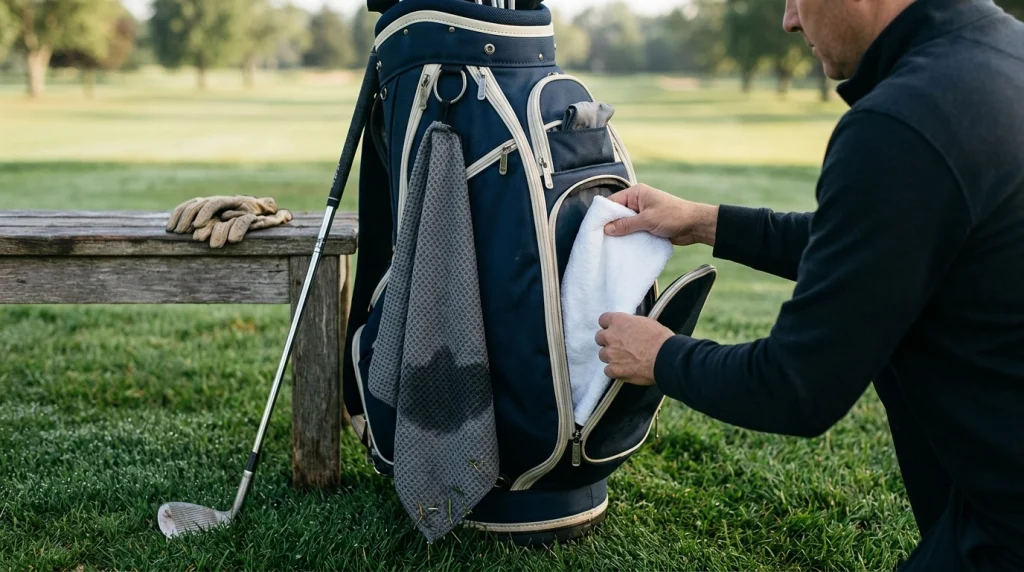
A professional-style towel setup focuses on having the right cleaning surface ready at the right time. You can copy that routine with two ordinary golf towels, a secure attachment, and a little attention to moisture control.
Use a simple two-towel system
Start with a textured towel for cleaning clubs and a separate dry towel for hands and grips. Keep them apart so mud and moisture from the cleaning towel don’t transfer to the surface you rely on for drying.
- Attach the cleaning towel: Place it where you can reach it between shots without obstructing your clubs.
- Dampen one section: Use enough water to loosen dirt without soaking the entire towel.
- Keep a clean area: Reserve a separate section for final wiping when the fabric allows it.
- Protect the dry towel: Store it in a clean, sheltered pocket or compartment.
- Check both towels: Reposition or replace them if they become saturated or heavily soiled.
This routine is particularly helpful when morning dew, soft ground, or wet rough leaves clubs dirty after every few shots. You don’t need to mimic a Tour player’s exact bag arrangement to get the same practical benefits.
Adjust your towel routine for rain
Rain changes the job because a towel can become wet before you need it. Keep a dry backup inside a protected bag compartment and use an umbrella or appropriate bag cover to limit exposure.
After cleaning a wet club, dry the grip before returning it to play. If the grip remains damp, reach for the protected towel rather than wiping it with the same dirty fabric.
Wash and store towels properly
Dirt and oils build up with repeated use, so wash golf towels according to their care labels. Separate heavily soiled towels from ordinary laundry when needed, and avoid fabric softener on microfiber if the manufacturer advises against it.
- Shake off loose grass and sand before washing.
- Use the recommended detergent and washing temperature.
- Allow towels to dry fully before storing them.
- Inspect clips, grommets, and loops for wear.
- Replace towels when they no longer clean effectively or their attachment fails.
Clean towels also help prevent old grime from transferring back onto clubfaces and grips. Regular washing is usually more useful than replacing a towel simply because a newer design looks more professional.
Remember the Rules of Golf
Using a towel to clean your clubs is ordinary equipment care, but cleaning a golf ball during play is subject to specific rules. Under Rule 14.1c, you generally may clean a lifted ball, with exceptions for certain situations where the ball must be replaced without cleaning.
When playing in a competition, check the USGA Rules of Golf resources or the applicable rules authority if you’re unsure whether cleaning is permitted. A useful towel routine should never lead to an avoidable rules penalty.
Section takeaway: Keep one towel for cleaning and another for drying. Protect the dry towel in wet weather, wash both regularly, and follow the Rules of Golf when cleaning a ball during play.
Golf towel frequently asked questions
Do all PGA Tour players use the same golf towel?
No. PGA Tour players use different towel brands, fabrics, and designs depending on sponsorships and personal preferences. Oversized caddie towels and microfiber cleaning towels are common styles, but there is no single universal model that every player must carry.
What size golf towel do professional golfers use?
Professional golfers and caddies use various sizes, including oversized towels around 22 × 40 inches. That measurement is an example of a tour-style format, not a mandatory Tour specification. Choose a size that provides enough cleaning area without dragging or getting tangled in your bag.
Are microfiber golf towels better than cotton?
Microfiber is a strong choice for cleaning clubfaces and grooves, particularly when it has a waffle texture. Cotton terry is useful for absorbing moisture and drying hands. The better option depends on your needs, and carrying both materials can provide a versatile setup.
Why do golfers keep a towel on their bags?
Golfers use towels to remove dirt, grass, and sand from clubfaces, manage moisture, and dry hands or grips. Keeping a towel attached to the bag makes it easier to clean equipment between shots. A separate dry towel is especially helpful during rainy or humid rounds.
Can I use a regular household towel for golf?
Yes. A clean, absorbent hand towel can perform the same basic cleaning and drying tasks as a dedicated golf towel. Purpose-built models mainly add convenient dimensions, textured fabric, and attachment features that make them easier to use on the course.
How many golf towels should I carry?
One towel can be enough for a short, dry round, but two provide more flexibility. Use one for club cleaning and reserve the other for dry hands and grips. Add a protected backup when rain or heavy morning dew is likely.
Does an expensive golf towel improve your scores?
Not by itself. A towel can help keep clubfaces clean and grips dry, but it cannot replace good technique, suitable equipment, or practice. Choose a durable towel that fits your routine rather than assuming a premium logo or price guarantees better performance.
Final takeaway: Which golf towel should you choose?
If you want to copy the practical side of PGA Tour equipment habits, start with a textured microfiber golf towel and a separate dry towel for your hands and grips. That combination covers most routine cleaning needs without requiring a professional’s exact brand or bag setup.
Choose an oversized caddie towel if you value a large working surface, or a compact model if you walk and prefer to travel light. The smartest purchase is the one that keeps your equipment clean, stays easy to reach, and holds up to repeated rounds.
Before buying, compare the fabric, dimensions, attachment, and care instructions instead of choosing by logo alone. A well-maintained towel is a small investment in a cleaner, more organized round of golf.