
Which Side of a Golf Towel Should You Use?

Quick Answer
There is no universal right or wrong side of a golf towel. Use the damp, textured, or dirtier section for cleaning clubfaces and grooves, then keep a clean, dry section for grips, hands, and final drying. If you clean a golf ball during play, make sure the Rules of Golf allow the ball to be cleaned at that time.
Best Way to Divide Your Towel
- Damp side: Use it for mud, grass, sand, and dirt on clubheads.
- Textured side: Use waffle or rougher fabric to work debris from grooves.
- Dry side: Use it to remove moisture after cleaning a club.
- Clean section: Reserve it for grips, hands, or your face.
- Different surfaces: Follow the towel manufacturer’s intended design when it has clearly different sides.
Simple Rule to Remember
- Dirty and damp for clubheads. Clean and dry for anything you need to keep dry.
Which side of a golf towel should you use? In most cases, the side matters less than how you divide the towel into clean, dirty, wet, and dry working areas.
My preferred setup is simple. I keep one section ready for dirty clubs and protect another section for grips and final drying.
In This Guide
Which Side of a Golf Towel Should You Use?
Use whichever side best matches the job. Standard golf towels do not have a universal front side for cleaning and back side for drying.
That changes when a towel has two deliberately different surfaces. A waffle-textured area may be better for dirt, while a softer area may work better for drying.
Golf towel definition: A golf towel is a reusable cloth carried during a round for cleaning equipment and managing dirt or moisture on clubs, balls, grips, and hands.
I find it more useful to think in terms of towel zones rather than sides. One zone gets dirty, while another remains protected.
- Dirty zone: Clubheads, soles, grooves, grass, and mud.
- Damp zone: Fresh soil or residue that needs moisture to loosen.
- Dry zone: Final clubhead drying and moisture removal.
- Clean zone: Grips, hands, and other surfaces you do not want contaminated with mud.
This approach also works when both sides of the towel feel identical. You simply create your own system and use it consistently.
As of 2026, golf towels come in many designs, including microfiber, cotton, waffle-weave, caddie, magnetic, and wet/dry models. Their construction varies too much for one universal side rule.
Does Golf Towel Material or Texture Change Which Side You Use?
Yes, when the two surfaces have noticeably different textures. The more textured surface usually makes sense for cleaning, while the softer or cleaner surface suits drying.
Do not assume every two-sided towel is designed that way. Check its construction before assigning special jobs to each surface.
| Towel Surface | Best Use | Main Advantage | Watch For |
|---|---|---|---|
| Waffle microfiber | Clubfaces and grooves | Textured cleaning surface | Sand trapped in fabric |
| Smooth microfiber | Drying and light wiping | Soft, lightweight feel | Less bite on packed mud |
| Cotton or terry | Moisture and general cleaning | Good absorbency | Can become heavy when soaked |
| Two-texture towel | Separate cleaning and drying | Clear job for each surface | Designs differ by manufacturer |
For dirty wedges and irons, I would start with the textured area. Dirt sitting in grooves is worth removing before the club goes back into your bag.
Golf Digest’s discussion of wedge-groove cleaning also highlights why golfers regularly clear debris from the clubface between shots.
If loose sand covers the face, remove that grit before rubbing aggressively. Grinding abrasive particles across a finish makes no sense when a gentle first pass can remove them.
How Should You Set Up Wet and Dry Towel Zones?
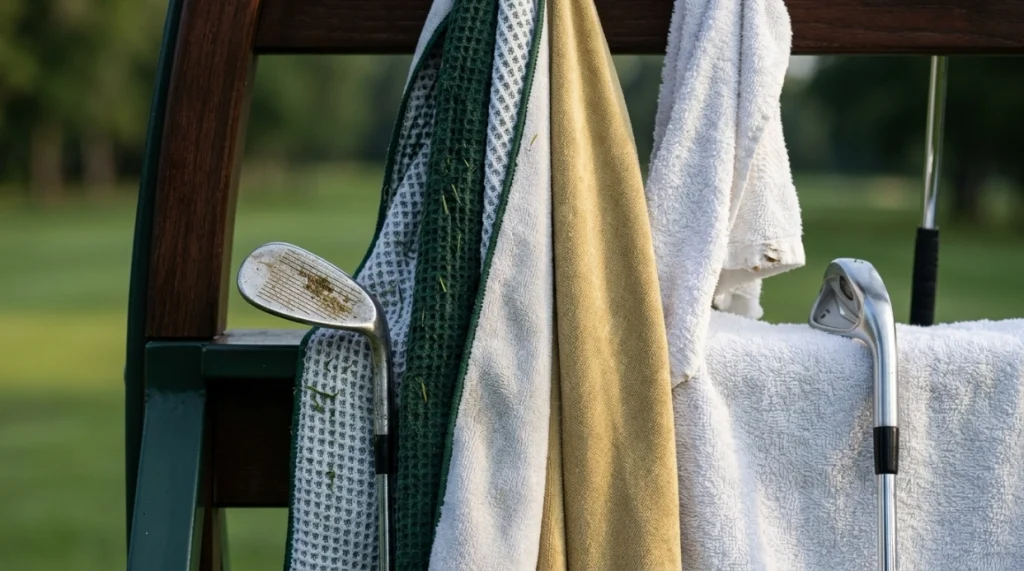
The most useful setup is often one damp area and one protected dry area. You can create this system even when the towel has identical sides.
- Dampen one end: Wet roughly one-third of the towel rather than soaking everything.
- Wring it out: The cleaning area should feel damp, not drip water down your bag.
- Choose a dirty area: Keep that section dedicated to clubfaces, soles, and grooves.
- Protect the opposite end: Keep it as dry and clean as possible.
- Dry after cleaning: Use the protected section when moisture remains on the club.
This is especially handy after a wedge shot from soft turf. The damp section loosens fresh soil before it dries inside the grooves.
Morning dew creates the opposite problem. You may need more dry fabric than wet fabric because your equipment already carries moisture.
Rain changes the setup again. The PGA’s wet-weather guidance recommends carrying towels and protecting them so grips and equipment can stay as dry as possible.
During steady rain, I would rather carry a second protected towel than sacrifice my only dry section. A towel sealed in a bag pocket can become valuable late in the round.
- Dry summer: Smaller damp zone, larger clean zone.
- Muddy course: Larger damp cleaning area.
- Morning dew: Protect plenty of dry fabric.
- Heavy rain: Carry an additional dry towel when possible.


Which Part of the Towel Should You Use for Each Job?
Match each job to the cleanest appropriate towel section. Do not wipe everything with the same muddy patch just because it is convenient.
Which side should you use on clubheads?
Use the damp or textured section for irons and wedges carrying grass, soil, or mud. Follow with dry fabric when moisture remains.
- Remove loose grass or sand first.
- Wipe with the damp cleaning area.
- Check the grooves for packed debris.
- Use a suitable brush when the towel cannot reach stubborn material.
- Finish with the dry area.
Which side should you use on golf grips?
Use a clean section and finish with a dry one. A muddy or soaked towel section should never be your first choice immediately before a swing.
During a humid or rainy round, I protect my grip section carefully. A dry grip is one reason separating towel zones works so well.
Which side should you use on a golf ball?
When cleaning is permitted, use a clean damp area for mud and a dry area for the final wipe. Do not automatically lift and clean the ball whenever it is dirty.
Under Rule 14.1c, a ball lifted from the putting green may be cleaned. Elsewhere, certain situations restrict cleaning, as explained by the USGA’s golf-ball cleaning guidance.
Which side should you use for your hands or face?
Reserve the cleanest section. Club-cleaning areas can carry mud, fertilizer residue, bunker sand, and general course grime.
If you frequently wipe sweat from your face, a separate personal towel is the cleaner setup. It also leaves more usable golf-towel surface for your equipment.
What Golf Towel Mistakes Should You Avoid?
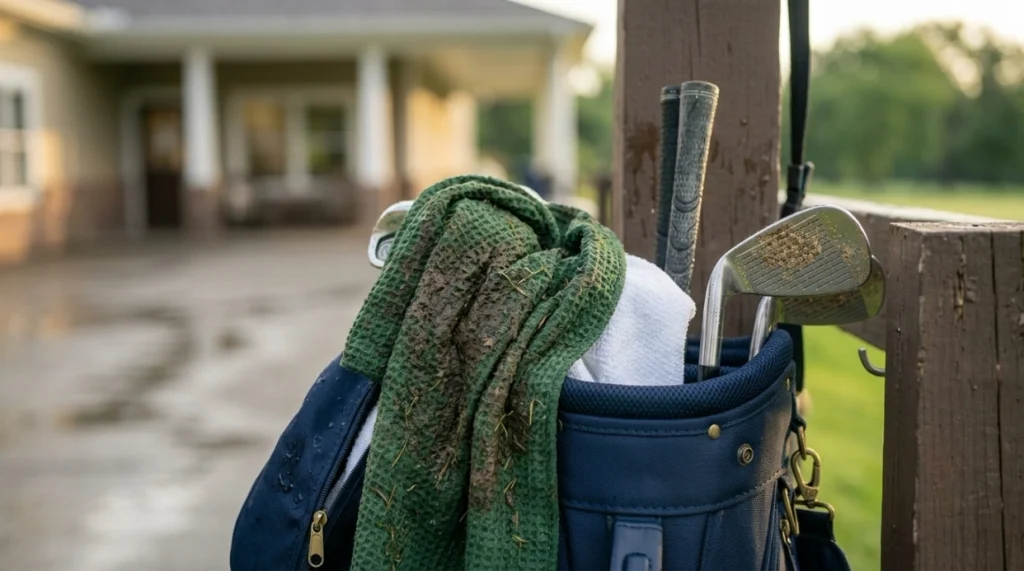
The biggest mistake is allowing the whole towel to become equally wet and dirty. Once that happens, you lose the section needed for grips and drying.
- Soaking the entire towel: You remove your useful dry zone before the round begins.
- Using muddy fabric on grips: This transfers dirt and moisture to your hands.
- Rubbing loose sand aggressively: Shake or brush away grit before wiping firmly.
- Ignoring packed grooves: A towel may not remove everything without help from a suitable brush.
- Cleaning a ball automatically: Golf’s rules do not allow unrestricted cleaning in every situation.
- Leaving a wet towel in the bag: Remove it after the round and let it dry.
- Never washing the towel: Dirt builds up and contaminates sections you intended to keep clean.
Another mistake is obsessing over which physical side faces outward. A consistent wet-side/dry-side system matters more than whether you use the towel’s front or back.
A magnetic towel, tri-fold towel, caddie towel, or basic microfiber towel can all use the same principle. Assign specific sections to specific jobs.
Golf Towel Side FAQs
Does a golf towel have a correct front and back?
Usually, no. Many golf towels use the same material on both sides, so there is no official front for cleaning or back for drying.
If the manufacturer uses two different textures, use each according to its intended purpose.
Should I use the rough side or soft side of a golf towel?
The rougher or waffle-textured side generally makes sense for clubface cleaning. Keep the softer or cleaner side for moisture removal, grips, or gentler wiping.
Should the golf towel be wet or dry?
Both can be useful. Keep one section slightly damp for mud and grass, while protecting another section for drying clubheads, grips, and hands.
Can I use the same towel section for my clubs and face?
You can, but I would not use a section already covered with club dirt. Reserve clean fabric for your skin or carry a separate personal towel.
Which side should I use for cleaning golf-club grooves?
Start with a damp textured section because it can help loosen fresh debris. Use a suitable groove brush when material remains packed beyond what the towel can remove.
Can I clean my golf ball with my towel anytime?
No. A ball on the putting green may be cleaned after it is properly lifted, but Rule 14.1c contains situations elsewhere where cleaning is restricted.
Check the applicable rule whenever you are unsure during competition.
Do microfiber golf towels have a special cleaning side?
Some do and some do not. A towel with noticeably different weaves may provide separate cleaning and drying surfaces, while a uniform microfiber towel can be divided into your own working zones.
Final Takeaway: Use the Dirty Side to Clean and the Dry Side to Finish
Which side of a golf towel should you use? There is no universal front-versus-back rule, so organize the towel by function instead.
- Use a damp or textured section for dirty clubheads.
- Use a dry section after cleaning.
- Keep a clean area for grips and hands.
- Remove loose sand before rubbing a clubface.
- Protect extra dry fabric during wet rounds.
- Follow the Rules of Golf before cleaning a lifted ball.
The easiest system is also the one you are most likely to remember. Wet and dirty at one end, clean and dry at the other.
Set your towel up that way before your next round. After a few holes, choosing the correct section becomes automatic.