
Do Microfiber Golf Towels Scratch Clubs? What Golfers Need to Know

Quick Answer
Clean microfiber golf towels generally do not scratch clubs when used correctly. Quality microfiber is made for gentle equipment cleaning, and Club Glove describes its microfiber golf towel as non-abrasive for club care. The bigger risk comes from sand, dried mud, metal particles, or other hard grit trapped inside the towel.
What can cause scratches?
- Trapped sand: Hard grains can drag across polished or painted surfaces while you wipe.
- Dried mud: Mud can contain gritty mineral particles that should be rinsed away first.
- Dirty towel sections: Reusing one heavily contaminated area increases the chance of rubbing debris back onto the club.
- Heavy pressure: Aggressive scrubbing makes any trapped particle more likely to leave a visible mark.
- Damaged fabric: Inspect rough stitching, exposed hardware, clips, or foreign objects before wiping delicate finishes.
Safest habit
- Shake or rinse away visible grit before wiping, then use a clean microfiber section with light pressure.
Do microfiber golf towels scratch clubs? Under normal use, a clean microfiber towel is one of the safer choices for wiping golf equipment.
The catch is simple. A soft towel stops being gentle when sand, soil, or hard debris becomes trapped between the fabric and your club.
In This Guide
- Can Microfiber Towels Scratch Golf Clubs?
- What Actually Causes Scratches When Cleaning Clubs?
- Which Golf Club Surfaces Need the Most Care?
- Is Microfiber Safer Than Cotton or Other Golf Towels?
- How Should You Clean Golf Clubs With Microfiber?
- How Should You Wash and Inspect a Microfiber Golf Towel?
- Frequently Asked Questions
Can Microfiber Towels Scratch Golf Clubs?
A clean, good-quality microfiber golf towel should not normally scratch a golf club during routine wiping. Microfiber towels are widely sold specifically for cleaning clubfaces, grooves, balls, and other golf equipment.
Definition: A microfiber golf towel is a cleaning towel made from extremely fine synthetic fibers, commonly polyester or a polyester blend, designed to lift moisture and loose debris from surfaces.
Microfiber itself is not the problem most golfers need to worry about. Contamination is.
- Clean microfiber: Suitable for ordinary wiping and drying.
- Microfiber containing sand: Potentially abrasive because particles sit between the cloth and club.
- Microfiber containing dried soil: Better rinsed before you apply pressure.
- Microfiber with exposed hard objects: Stop using that section until the object is removed.
Golf Digest’s golf-accessory guidance recommends towels with a soft texture that will not scratch clubs and specifically discusses microfiber waffle towels for cleaning irons.
I treat a towel the same way I treat any club-cleaning tool. I check what is trapped in it before I worry about what the fabric label says.
Section Takeaway: Microfiber is normally a club-friendly cleaning material. Embedded grit, not the microfiber fibers themselves, is the main reason a towel can become abrasive.
What Actually Causes Scratches When Cleaning Clubs?
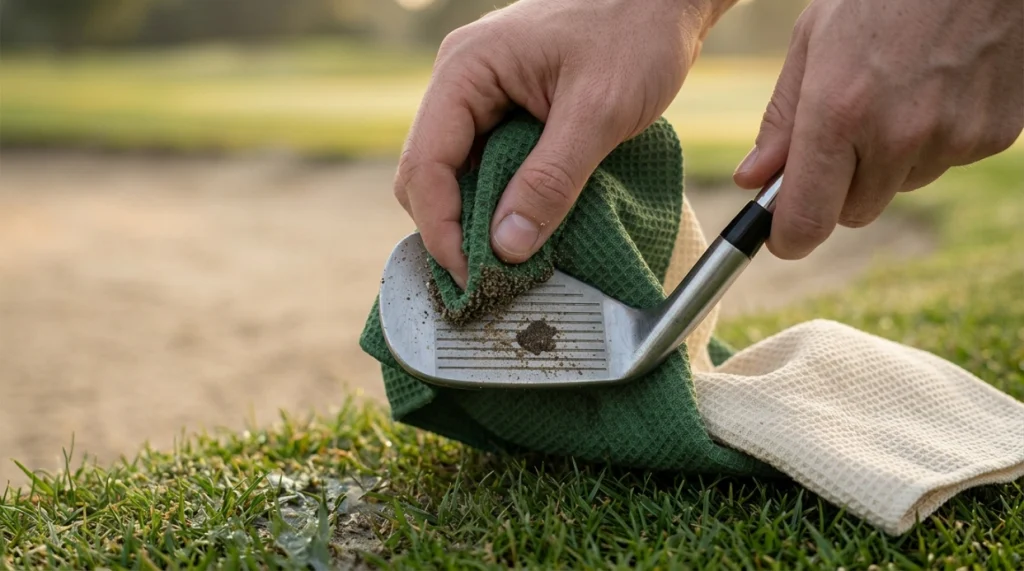
Scratch risk rises when a hard particle becomes trapped between your towel and the club surface. Pressure then drags that particle across the finish.
Sand and bunker grit
Sand deserves the most attention because it sticks easily to damp clubheads and towels. After a bunker shot, I prefer knocking or rinsing loose sand away before wiping the face.
- Shake the towel before folding it onto another surface.
- Brush heavy sand from iron and wedge grooves first.
- Use water to loosen stubborn contamination when practical.
- Switch to a cleaner towel area for the final wipe.
Mud and dried soil
Fresh mud often comes away easily with a damp towel. Dried mud is different because rubbing harder can drag gritty particles across the club.
Moisten the dirt first instead. Let water and the towel loosen it before applying more pressure.
Too much cleaning pressure
Microfiber does not need aggressive scrubbing for ordinary grass, moisture, or soft mud. Light passes usually work better than grinding the cloth against the finish.
- Light dirt: Wipe once or twice with a damp section.
- Groove debris: Use a suitable groove brush when the towel cannot remove it easily.
- Heavy contamination: Rinse first rather than increasing pressure.
I also avoid cleaning every surface with the same corner. The part that just cleaned a sandy wedge should not immediately move to a glossy driver crown.
Section Takeaway: The safest cleaning routine removes hard particles before wiping. More pressure is rarely the right solution when grit is present.
Which Golf Club Surfaces Need the Most Care?
Any club can develop cosmetic marks, but smooth, glossy, painted, or dark surfaces tend to make those marks easier to notice. Treat those areas more carefully than a heavily used sole.
Driver, fairway wood, and hybrid crowns
Painted crowns deserve a clean towel section. I would never take the sandy corner used on a wedge and rub it across the top of a driver.
A slightly damp, clean microfiber section is enough for fingerprints, water spots, and light dirt. Avoid scraping dried debris with your fingernail or another hard object.
Iron and wedge faces
Iron and wedge faces encounter grass, soil, and sand throughout a normal round. Their grooves can also hold material that a towel cannot always reach.
- Remove loose grass immediately.
- Shake away visible sand.
- Dampen stubborn mud.
- Use a club brush for debris packed inside grooves.
- Finish with a clean towel section.
Shafts and grips
Shafts generally need little more than a clean wipe after a wet or dirty round. Keep the towel free of sand before running it along a polished shaft.
Reserve a dry section for grips. That prevents the mud and moisture from your club-cleaning area moving directly onto your hands.
Section Takeaway: Match the cleanest towel section to the most cosmetic surface. Painted crowns, polished areas, shafts, and grips should never get the dirtiest part of your towel.

Is Microfiber Safer Than Cotton or Other Golf Towels?
Microfiber and quality cotton can both be safe when they are clean. For clubface cleaning, textured microfiber has the practical advantage of combining a flexible surface with a purpose-built cleaning texture.
The construction matters as much as the material name. A waffle weave creates recessed areas that help collect moisture and loose debris while the cloth moves across a clubface.
| Verified Golf Towel | Construction or Club-Care Feature | Size | Practical Role |
|---|---|---|---|
| Club Glove Microfiber Caddie Towel | Waffle-textured microfiber; manufacturer describes it as non-abrasive for club care | 17 × 40 inches | Large towel with room for separate wet and dry zones |
| Club Glove Microfiber Cart Towel | Waffle-textured microfiber; manufacturer describes it as non-abrasive for club care | 16 × 24 inches | Compact cleaning towel with carabiner attachment |
| Titleist StaDry Performance Towel | Microfiber interior with integrated club-groove cleaner | 20 × 20 inches | Weather-focused design with protected microfiber interior |
Titleist’s StaDry Performance Towel specifications are another useful example of microfiber being deliberately incorporated into a club-cleaning product.
Cotton terry still works well for moisture and general drying. Its deeper loops, however, can also collect grass or grit, so cleanliness remains more important than choosing one fiber over another.
For my bag, I favor textured microfiber for clubheads and preserve a cleaner dry area for grips. That simple separation matters more than chasing a supposedly perfect fabric.
Section Takeaway: Both microfiber and cotton can be safe, but no towel stays safe when abrasive debris remains trapped in it. Cleanliness and technique decide the outcome.
How Should You Clean Golf Clubs With Microfiber?
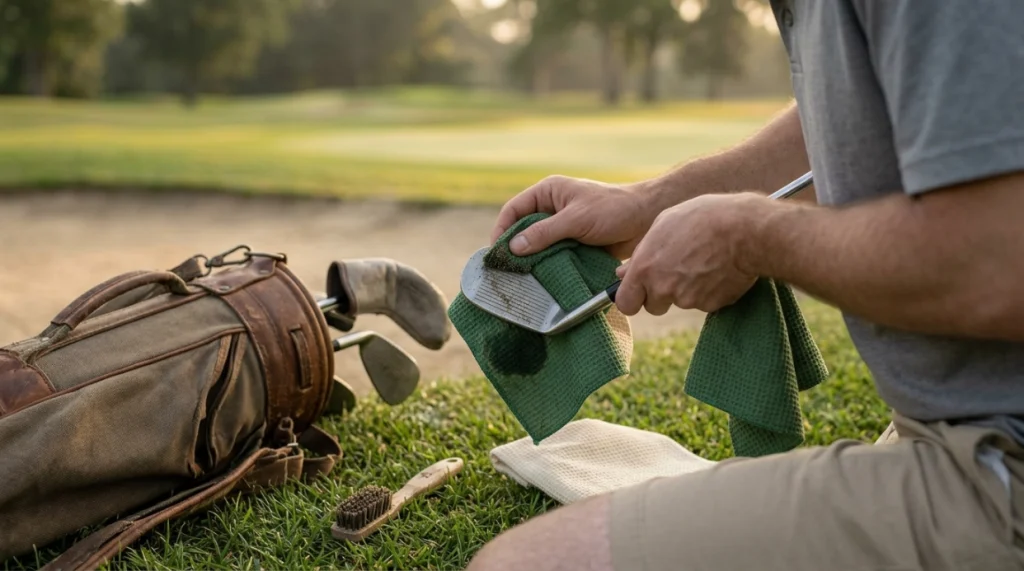
The safest approach is to remove loose abrasive material first and let moisture soften anything stubborn. Then wipe with a clean section using moderate or light pressure.
- Inspect the club: Look for sand, stones, dried soil, or other obvious contamination.
- Remove loose grit: Shake, brush, or rinse away particles before rubbing the surface.
- Dampen the towel: Use a small wet section to loosen mud and grass.
- Wipe gently: Work across the clubface without aggressive scrubbing.
- Clean the grooves: Use an appropriate brush if packed debris remains.
- Finish dry: Use a cleaner, drier section before returning the club to your bag.
Use a wet-zone and dry-zone system
I like dividing one larger towel mentally into sections. One end handles dirty clubheads, while the opposite end stays cleaner for drying.
That system also stops muddy water from spreading everywhere. On wet days, a second protected towel makes the routine even easier.
Do not forget the Rules when cleaning your ball
A microfiber towel is useful for cleaning golf balls, but the Rules control when a ball may be cleaned during play. The USGA’s Rule 14.1c guidance on cleaning a golf ball explains the situations where cleaning is restricted.
The corresponding R&A Rule 14 resource covers marking, lifting, cleaning, replacing, and dropping procedures. A ball lifted from the putting green may be cleaned, while several specific situations elsewhere restrict cleaning.
Section Takeaway: Remove grit first, use moisture instead of force, and keep wet, dirty, and dry towel areas separate. That routine protects clubs while keeping the towel useful throughout the round.
How Should You Wash and Inspect a Microfiber Golf Towel?
A dirty microfiber towel should not live permanently on your bag. Washing removes the grit and residue that can turn a soft cleaning cloth into an abrasive one.
Before washing
- Shake out loose grass and sand outdoors.
- Rinse away heavy mud rather than letting it dry into the fibers.
- Check the fabric for small stones, burrs, or foreign material.
- Inspect stitching and attachment hardware for rough or damaged areas.
During washing
Always follow the care label supplied with your towel. Club Glove specifies cold-water hand or machine washing with mild detergent for its current microfiber caddie towels.
Avoid assuming every microfiber product has identical care requirements. Construction, printing, edging, clips, and coatings can change the manufacturer’s instructions.
Before putting it back on the bag
Make sure the towel is clean enough that rubbing it between your fingers does not reveal obvious hard grit. I also let it dry rather than stuffing a wet towel into a closed pocket.
- Keep using it: Fabric is clean, soft, intact, and free from embedded grit.
- Wash it again: Dirt, sand, or oily residue remains.
- Replace it: Hard contamination cannot be removed or damaged parts could contact your clubs.
As of 2026, microfiber remains common across both compact golf towels and larger caddie-style models. Its popularity makes sense, but even premium material still needs basic maintenance.
Section Takeaway: Washing is part of protecting your clubs, not merely keeping the towel looking good. A clean towel keeps its biggest safety advantage.
Frequently Asked Questions
Can a dirty microfiber towel scratch a driver?
Yes, a dirty microfiber towel can potentially mark a driver if sand or another hard particle is trapped in the fabric. Use a clean section on glossy or painted surfaces and remove visible grit before wiping.
Is waffle-weave microfiber safe for irons?
Quality waffle-weave microfiber is commonly designed for club cleaning and works well around iron and wedge grooves. Club Glove, for example, specifically describes its waffle microfiber towels as non-abrasive for club care.
Should I wet a microfiber towel before cleaning my clubs?
For mud and dried grass, a slightly damp section usually makes cleaning easier and reduces the urge to scrub aggressively. Keep another section dry for the final wipe, grips, and hands.
Can I use the same towel on my wedges and driver?
You can, but use separate areas of the towel. The section used on sandy wedges may contain grit, so switch to a clean area before wiping a painted driver, fairway wood, or hybrid.
Does microfiber damage chrome golf clubs?
Clean microfiber is generally suitable for routine club care. The greater concern is abrasive contamination trapped in the towel, particularly sand or hardened debris being dragged across a polished surface.
How often should I wash my golf towel?
Wash it whenever it becomes muddy, gritty, heavily soiled, or unpleasant to use. Golfers playing soft or sandy courses may need to clean their towel after almost every round.
Is microfiber better than cotton for preventing scratches?
Neither fabric can protect a club when hard grit is trapped inside it. Microfiber is an excellent club-cleaning choice because quality golf versions are soft, lightweight, and often textured, but proper cleaning technique remains the deciding factor.
Bottom line: You do not need to avoid microfiber golf towels because you are worried about scratches. You need to avoid wiping expensive club finishes with a towel full of sand and hardened debris.
Keep one section damp, preserve one clean section, remove grit before wiping, and wash the towel when it gets dirty. Those habits give microfiber the chance to do exactly what it was designed to do: keep your clubs clean without unnecessary damage.