Impact Position in Golf: How to Create Solid, Consistent Contact
Quick Answer
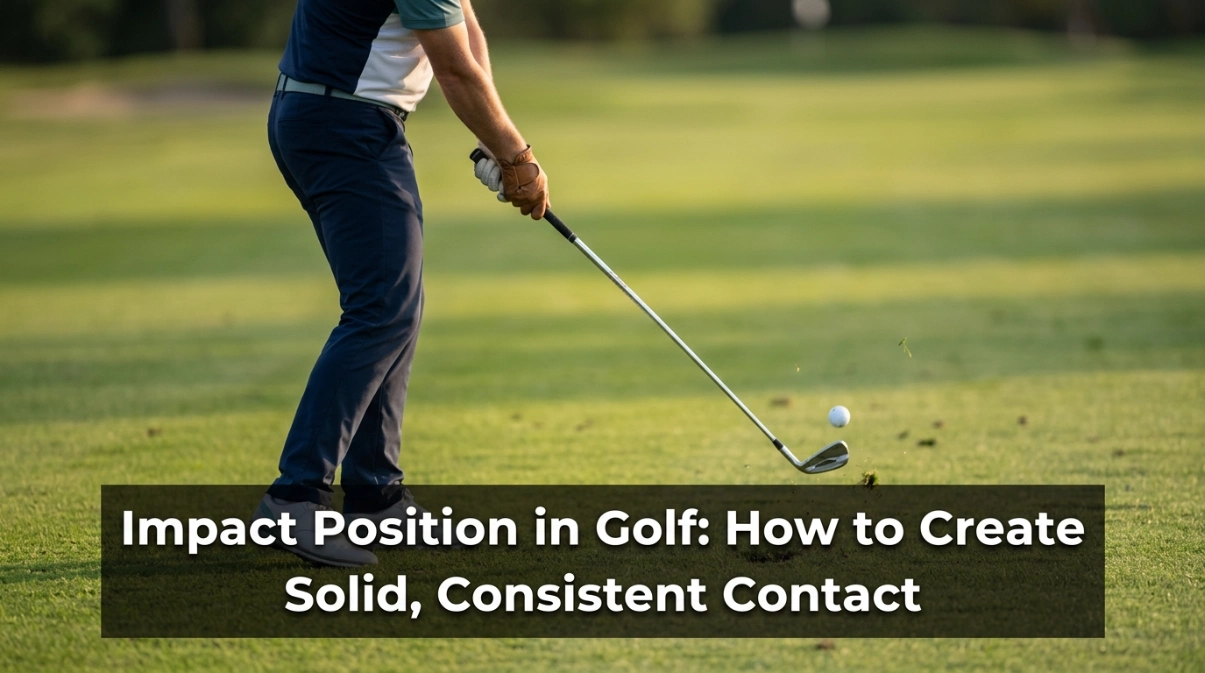
A good golf impact position delivers the clubface to the ball with controlled body rotation, stable wrists, and pressure moving toward the lead side. With irons, the hands normally lead the clubhead so the ball is struck before the turf; the PGA’s impact guidance also emphasizes forward hands and rotating hips rather than returning to the static address position.
Five Quick Impact Checkpoints
- 1. Move forward: Let pressure shift toward your lead side as the downswing develops.
- 2. Keep turning: Allow your hips and torso to continue rotating through the strike.
- 3. Control the wrists: Avoid an early scoop that lets the clubhead pass your hands too soon.
- 4. Deliver the face: Match the clubface to your intended starting direction rather than manipulating it at the last second.
- 5. Swing through: Treat impact as part of a continuous motion, not a position where the swing stops.
Best Way to Verify It
- Record a face-on half swing and compare your hand position, pressure shift, body rotation, strike location, and turf contact.
Impact lasts only an instant, yet it decides whether a swing produces a crisp iron, a weak scoop, or a shot that starts nowhere near the intended line. I prefer treating impact as the result of a good sequence rather than trying to manufacture a frozen pose.
This guide explains what a strong impact position looks like, how irons differ from drivers, which faults matter most, and how to practice the movement without overcomplicating your swing.
In This Guide
- What Is Impact Position in Golf?
- What Should a Proper Golf Impact Position Look Like?
- How Does Impact Position Change With Irons and Driver?
- What Impact Position Mistakes Cause Poor Contact?
- Which Drills Improve Golf Impact Position?
- How Can You Practice Impact Position Without Forcing It?
- Impact Position FAQ
What Is Impact Position in Golf?
Impact position is the arrangement of your body, hands, wrists, club shaft, and clubface at the moment the clubhead contacts the golf ball. It is different from address because your body has already moved, rotated, and transferred pressure during the downswing.
Definition: Golf impact position is not a separate pose you must force into place. It is the delivery created by your setup, backswing, transition, rotation, wrist action, and clubface control.
A common beginner mistake is trying to return every body part to its address position. That usually misunderstands how a golf swing works.
At address, you are balanced and relatively square. By impact, the lower body has started opening toward the target and the club is moving at speed.
Why does impact matter so much?
The ball only responds to what the club is doing when contact occurs. A beautiful backswing cannot rescue a clubface or strike that arrives poorly.
- Clubface orientation strongly influences the ball’s starting direction.
- Strike location affects energy transfer and consistency.
- Low-point control determines whether an iron reaches the ball before or after the ground.
- Dynamic loft influences launch conditions at impact.
- Club path works with face orientation to influence curvature.
I find this useful when diagnosing a bad range session. Instead of judging whether my backswing looks attractive, I first check contact, starting direction, and where the club touches the turf.
Impact is a moment, not the finish line
Trying to stop at impact often produces tension. The swing still needs to move through the hitting area into a balanced finish.
The PGA’s guidance on becoming a better ball striker makes the same practical point: the ball should not become the psychological finish line of the swing.
Section Takeaway: Build impact through a better motion. Do not try to assemble a perfect photograph while the club is moving at full speed.
What Should a Proper Golf Impact Position Look Like?

A productive impact position combines pressure shift, rotation, wrist control, face control, and balance. No single checkpoint works well when the rest of the motion breaks down.
For the descriptions below, assume a right-handed golfer. Left-handed players can reverse the directions.
1. Pressure favors the lead side
Your movement should be progressing toward the lead side by impact. Hanging excessively on the trail side makes controlling the bottom of the swing harder.
This does not mean lunging your entire upper body toward the target. You still need enough tilt and balance to deliver the club naturally.
2. The hips have started opening
Your hips should not look exactly as they did at address. They normally rotate toward the target as the downswing develops.
- Lead hip works behind you rather than only sliding sideways.
- Trail heel may begin releasing from the ground.
- Chest continues turning instead of stopping while the arms flip past.
3. The hands lead an iron strike
With a normal iron shot, the grip generally reaches impact before the clubhead catches up. This creates some forward shaft lean and helps move the low point beyond the ball.
Do not exaggerate this by dragging the handle toward the target. The club still has to release naturally after contact.
4. The lead wrist stays organized
A stable lead wrist makes clubface control easier. Excessive cupping near impact can accompany an early release or open clubface.
The trail wrist often retains some bend as the club enters the hitting zone. Those wrist conditions then change as the club releases after impact.
5. The clubface matches the intended shot
“Square” should not be interpreted as visually perfect in every swing. Your required face orientation depends on the target, swing path, and shot shape.
The goal is predictable delivery. A clubface you can repeatedly match to your intended start line is more useful than chasing a textbook still image.
Section Takeaway: Good impact is a coordinated package. Pressure, rotation, wrists, shaft, and clubface must support each other.
How Does Impact Position Change With Irons and Driver?
Iron and driver impact should not look identical. The club length, ball position, loft, tee height, and intended interaction with the ground change the delivery.
This distinction matters because golfers often copy an iron-impact photograph while trying to hit a driver.
| Impact Feature | Mid-Iron | Driver |
|---|---|---|
| Ball position | Usually around the middle to slightly forward of center | Usually much farther forward, commonly near the lead heel |
| Ground contact | Ball first, then turf on a normal fairway strike | Ball is teed; turf contact is not the goal |
| Shaft lean | Normally forward at impact | Usually less forward than with an iron |
| Swing low point | Ideally occurs after ball contact | Can occur before the teed ball when hitting upward |
| Main strike goal | Controlled ball-first contact | Centered face contact with suitable launch conditions |
Iron impact position
With an iron from the fairway, I look for the simplest feedback possible: ball first, turf second. A divot beginning well behind the ball immediately tells me something went wrong before impact.
Forward shaft lean can help produce that strike, but it should result from the motion. Trying to manufacture extreme lean with the hands can make the club too steep or leave the face open.
Golf Digest’s discussion of shaft lean and lag highlights this danger of chasing an exaggerated hand position instead of allowing body movement to create better delivery.
Driver impact position
A driver changes the geometry because the ball sits on a tee and farther forward. Many players therefore deliver the driver with less forward shaft lean and a more upward attack than an iron.
You still need rotation, face control, and balance. What you should not do is recreate a compressed 7-iron impact by driving the handle aggressively toward the target.
Section Takeaway: Keep the principles, but respect the club. Iron impact prioritizes ball-first turf contact, while driver impact prioritizes efficient centered contact from a forward, teed position.


What Impact Position Mistakes Cause Poor Contact?
The most useful impact faults are ones you can connect to a visible ball-flight or strike pattern. Avoid diagnosing your swing from appearance alone.
Flipping or scooping
A flip happens when the clubhead overtakes the hands too early. The lead wrist may cup while the trail wrist loses its bend before contact.
- High, weak iron shots
- Fat contact
- Thin contact
- Inconsistent carry distances
Many golfers scoop because they instinctively try to lift the ball. The loft built into the club already does that job.
Early extension
Early extension occurs when the pelvis moves toward the ball and the golfer loses posture during the downswing. That can crowd the hands and force last-second compensations.
The PGA’s explanation of early extension and posture notes that standing up through the strike can contribute to topped shots and inconsistent contact.
Hanging back on the trail side
If pressure never moves forward enough, the swing bottom can arrive too early. The club may strike the ground first or require a hand flip to reach the ball.
Do not fix this by throwing your head toward the target. Work on sequencing from the ground up while remaining balanced.
Forcing excessive shaft lean
More shaft lean is not automatically better. Excessive handle drag can reduce loft too much, create steep contact, or make squaring the face harder.
I use the ball flight as my referee. If a drill creates lower contact but also introduces repeated blocks or heavy strikes, I stop chasing the photograph.
Stopping body rotation
A stalled pivot forces the arms and wrists to do too much work through impact. Timing then becomes difficult because the clubhead must race past a body that has stopped turning.
- Possible sign: rapid hand flip through impact.
- Possible sign: trail foot remains planted while the upper body stalls.
- Possible sign: inconsistent face control from shot to shot.
Section Takeaway: Do not fix the appearance of impact before identifying the fault creating it. Ball flight, strike pattern, turf contact, and video give you better clues.
Which Drills Improve Golf Impact Position?
The best impact drills slow the motion enough for you to feel the sequence. Start with short swings before adding speed.
1. Hip-to-hip punch shots
This is my favorite starting drill when contact becomes inconsistent. The shorter motion removes speed and makes low-point control easier to judge.
- Use a wedge or short iron.
- Make a backswing to roughly hip height.
- Shift pressure toward the lead side.
- Turn through while keeping the strike compact.
- Finish around hip height on the target side.
- Check whether the ball was contacted before the turf.
The PGA also recommends developing controlled shorter motions, and its broader collection of golf performance drills shows how reduced-speed exercises can help golfers learn movement patterns.
2. Forward-turf-line drill
Draw a line on a grass practice area or use a natural reference point. Place the ball just behind that reference.
- Set the ball immediately behind the line.
- Make a controlled iron swing.
- Ignore the size of the divot.
- Check where the turf disturbance begins.
- Aim to move the start of the divot to the target side of the ball.
This gives you external feedback. You are training where the swing bottoms out rather than trying to consciously position five body parts at once.
3. Slow-motion impact rehearsal
Make a slow practice swing and stop just before impact. Check your body without hitting a ball.
- Pressure has moved toward the lead foot.
- Hips have begun opening.
- Chest is continuing to turn.
- Hands lead the clubhead with an iron.
- Trail wrist retains some bend.
Then continue all the way into the finish. That last step matters because you do not want to train impact as the end of the swing.
4. Step-through drill
Use the step-through drill when your pressure remains stuck on the trail foot. It exaggerates moving toward the target before the club reaches the ball.
- Begin with a narrow stance.
- Start a relaxed backswing.
- Step toward the target with your lead foot.
- Let the downswing follow that movement.
- Swing through to a balanced finish.
Begin without a ball. Add soft shots only after the motion feels coordinated.
Pro tip: If a drill causes pain, restricted movement, or repeated loss of balance, stop forcing the position and ask a PGA Professional or other qualified golf instructor to evaluate your motion.
Section Takeaway: Train impact with feedback. Short swings, turf location, slow rehearsals, and balanced movement are more useful than repeatedly posing at impact.
How Can You Practice Impact Position Without Forcing It?
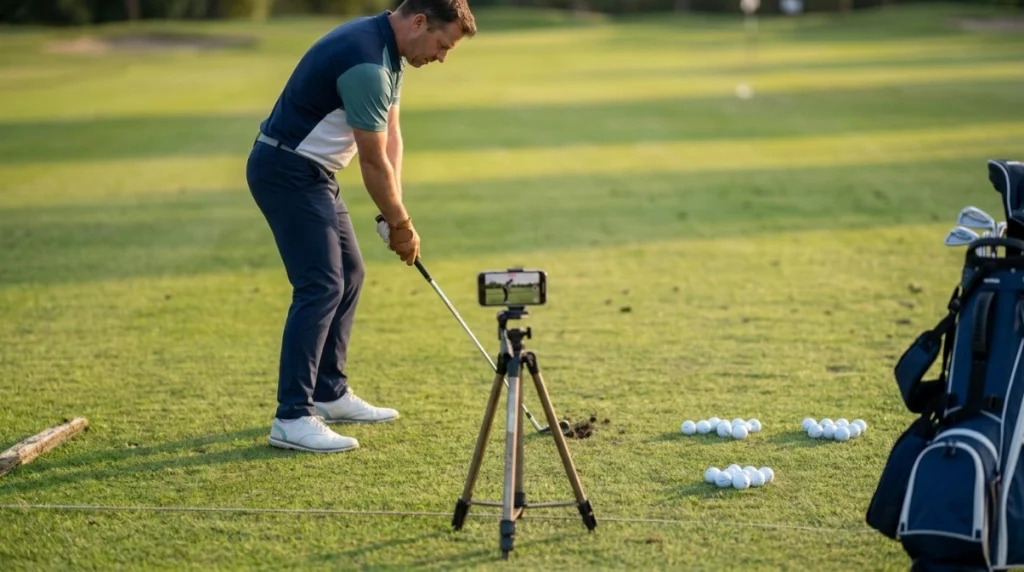
Impact improves faster when practice gives you measurable feedback. In 2026, a phone camera is still one of the simplest tools a golfer can use for this job.
Use face-on video
Place your phone safely several yards away, approximately hand height, and perpendicular to the target line. Record controlled swings rather than immediately filming full-speed drivers.
- Check whether pressure moves toward the lead side.
- Compare hand location at address and impact.
- Look for continued hip and torso rotation.
- Notice whether the upper body stands up suddenly.
- Check the club’s relationship to the hands.
Measure contact instead of appearance
A still frame can look impressive while the strike remains poor. Combine video with impact feedback.
- Irons: Observe where the turf disturbance begins.
- Driver: Use legal practice face spray or impact tape to locate contact.
- Ball flight: Record starting direction, curvature, and trajectory.
- Balance: Hold your finish after every controlled swing.
Use a simple 20-ball practice session
You do not need to hit hundreds of balls. Twenty focused swings can provide more useful feedback than an hour of rapid-fire practice.
- Balls 1-5: Hit half swings and judge contact only.
- Balls 6-10: Check the location of the swing’s low point.
- Balls 11-15: Add a target and monitor starting direction.
- Balls 16-20: Remove the technical thought and play five simulated course shots.
I like that final group because it reveals whether the change survives when the target matters. A swing correction has little value if it disappears as soon as I start trying to hit a golf shot.
Impact Position FAQ
Should your hands be ahead of the ball at impact?
With a standard iron shot, the hands normally lead the clubhead at impact, creating some forward shaft lean. Driver impact can look different because the ball sits farther forward and is teed, so you should not force the same amount of shaft lean with every club.
Should impact position look the same as address?
No. Address is a static setup position, while impact happens after pressure shift, rotation, and wrist movement have occurred. Your hips and torso should normally be more open at impact than they were before the swing started.
Where should your weight be at impact in a golf swing?
Your pressure should generally have moved toward the lead side by impact. The exact distribution varies with club, shot, player, and movement pattern, so avoid forcing your entire upper body forward just to create a specific number.
Why do I hit the ground before the golf ball?
Ground-first iron contact usually means the swing’s low point occurred too early. Hanging back, an early release, poor ball position, or disrupted body rotation can contribute, so use turf marks and face-on video before choosing a fix.
Do you need forward shaft lean at impact?
Forward shaft lean is common and useful with normal iron shots because the hands lead the clubhead through contact. The amount varies, and deliberately creating extreme shaft lean can produce steep strikes, blocks, or poor face control.
How do I stop flipping my hands at impact?
Start with short punch shots while moving pressure forward and continuing to rotate through the ball. Avoid trying to hold your wrists rigid; improve the sequence that lets the hands lead naturally before the club releases after impact.
Can an impact bag fix my golf swing?
An impact bag can provide a rehearsal feel, but it cannot confirm ball flight, clubface control, or low-point location. I prefer combining slow rehearsals with real shots, turf feedback, and video so the drill remains connected to actual ball striking.
Your next step: Start with ten hip-to-hip iron shots and watch the contact rather than chasing speed. Once ball-first contact becomes predictable, gradually lengthen the swing while keeping the same balanced motion through impact.
Impact is where the club finally meets the ball, but the solution usually begins earlier. Build a sound setup, sequence the downswing, keep rotating, and let a better impact position become the result.