
USGA Rules Overview: A Complete Guide to Golf Rules in 2026

Quick Answer
The USGA Rules of Golf explain how to play fairly, what to do when your ball gets into trouble, when relief is free, and when a penalty applies. As of 2026, golfers in the United States use the 2023 Rules of Golf, jointly governed by the USGA and The R&A, along with current clarifications available through the USGA Rules Hub.
Rules every golfer should know
- Play it as it lies: Normally, play your ball from where it comes to rest unless a Rule allows or requires another procedure.
- Lost or out: A lost ball or ball out of bounds normally requires stroke-and-distance relief.
- Penalty areas: Red and yellow penalty areas offer specific relief options for one penalty stroke.
- Free relief: Cart paths, temporary water, ground under repair, and certain other abnormal conditions can provide free relief.
- Drop correctly: When a Rule requires a drop, release the ball straight down from knee height into the required relief area.
- Check Local Rules: Course and competition committees can establish Local Rules that affect how you proceed.
Before you make a ruling
- Identify where the ball lies, determine what condition is causing the problem, and check whether a Local Rule applies.
If golf rules sometimes feel complicated, you’re not alone. Most rounds involve only a small group of Rules again and again.
This USGA Rules overview focuses on those situations first. It also explains the less obvious details that can turn a simple mistake into unnecessary penalty strokes.
In This Guide
- What Are the USGA Rules of Golf?
- What Rules Should You Know Before Teeing Off?
- What Happens When Your Ball Is Lost, Out of Bounds, or in a Penalty Area?
- How Do Free Relief, Drops, and Unplayable Lies Work?
- What Can You Do in Bunkers and on Putting Greens?
- How Do Penalties Differ in Stroke Play and Match Play?
- USGA Rules FAQ
What Are the USGA Rules of Golf?
The USGA Rules of Golf are the playing rules governing golf in the United States and Mexico. The USGA develops them jointly with The R&A, creating one common rules framework used around the world.
The current core edition is the 2023 Rules of Golf. As of 2026, official digital rules also incorporate subsequent clarifications.
You can review current educational material through The R&A Rules Hub. That matters because an older article or printed explanation may omit a later clarification.
What is the basic principle behind the Rules?
The simplest principle is this: play the course as you find it and play the ball as it lies. When you can’t, the Rules tell you what procedure to use.
Golf also relies heavily on the player’s responsibility. You are expected to apply penalties to yourself when you breach a Rule.
Definition: A penalty stroke is an additional stroke added to your score under a Rule. Some breaches instead carry the “general penalty,” which depends on your form of play.
What are the five areas of the golf course?
Knowing the area where your ball lies is crucial because different Rules can apply in each area.
- General area: Most of the course, including fairways and rough.
- Teeing area: The defined area where you start the hole you’re playing.
- Penalty areas: Areas normally marked with red or yellow stakes or lines.
- Bunkers: Specially prepared areas of sand.
- Putting green: The specially prepared green for the hole you’re playing.
Identifying the area is often the first step in solving a rules question. A procedure allowed in the general area might not be available in a penalty area.
What changed with the 2023 Rules?
The 2023 edition continued the effort to make common procedures easier to understand. Several changes are especially useful for everyday golfers.
- Players with disabilities: Modifications became part of Rule 25 rather than sitting outside the main Rules.
- Handicap on scorecards: In handicap stroke-play competitions, responsibility for handicap calculations shifted to the Committee.
- Damaged clubs: A club damaged during a round may generally be repaired or replaced if the player did not damage it through abuse.
- Natural forces: A new exception addressed certain balls moved by natural forces after being dropped, placed, or replaced.
- Back-on-the-line relief: The dropping procedure was simplified.
There have also been later clarifications. The official Rules resources listed an update dated July 1, 2026, so checking an official digital source is useful for competition questions.
Section Takeaway: The easiest way to understand the Rules is to identify where the ball lies, what happened, and which relief procedure applies. Current official digital resources should be your final authority.
What Rules Should You Know Before Teeing Off?

Before the opening shot, check the competition format and any Local Rules. Then make sure your equipment and ball meet any conditions imposed for that event.
For normal recreational golf, a few procedures prevent most avoidable mistakes.
Where can you place your ball on the tee?
The teeing area is a rectangle that extends two club-lengths behind the front edge defined by the tee markers. Your ball must be inside that area when beginning the hole.
Your feet can be outside it. The location of the ball is what determines whether you’ve played from inside the teeing area.
You can tee the ball or play it directly from the ground. Before playing, you generally must not move the tee markers to make your stroke easier.
What if the ball falls off the tee?
If the ball falls from the tee before you make a stroke, there is no penalty. You can simply put it back on the tee.
If you swing with the intention of hitting the ball and miss, that swing counts as a stroke. The ball may still be re-teed without penalty if it remains within the teeing area.
How quickly should you play?
The Rules encourage prompt play. A player is generally encouraged to make a stroke in no more than about 40 seconds once able to play without interference or distraction.
Most strokes should take less time. Good pace usually comes from preparing while others play, rather than rushing during the swing.
Is ready golf allowed?
Yes, responsible “ready golf” is encouraged in stroke play when it is safe. Playing out of turn simply to save time normally carries no penalty.
Match play works differently. Order of play matters more because an opponent may sometimes cancel a stroke played out of turn.
Can you use a rangefinder?
Distance-measuring devices are generally permitted under the Rules. A Committee can prohibit them through a Local Rule.
That is why I treat the scorecard, notice board, and competition sheet as part of my pre-round rules check. The printed Rules aren’t always the entire story for that day’s event.
Equipment that measures distance is different from using prohibited features to measure or interpret other conditions. Always check the specific function you’re using.
Can another player tell you the yardage?
Information such as distance is generally considered public information rather than advice. You can ask another player how far the ball is from the hole.
Advice about what club to choose or how to make a stroke is different. During an individual competition, you generally cannot ask another competitor which club you should hit.
For golfers who want structured rules education, the USGA provides Rules education and quizzes covering common situations.
What Happens When Your Ball Is Lost, Out of Bounds, or in a Penalty Area?
These situations cause some of the biggest scoring mistakes in recreational golf. The important point is that lost, out of bounds, and penalty area do not mean the same thing.
Each has its own procedure.
How long can you search for a lost golf ball?
You have three minutes to search after you or your caddie begins searching. If the ball is not found within that time, it is lost.
A ball lost outside a penalty area normally requires stroke-and-distance relief. You add one penalty stroke and play again from where the previous stroke was made.
What does out of bounds mean?
Out of bounds is beyond the boundaries of the course. White stakes, white lines, fences, or other objects may define that boundary.
A ball is out of bounds only when all of it lies beyond the boundary edge. A ball with any part still inside the course is not out of bounds.
The normal penalty is stroke and distance. That means returning to the previous stroke’s location, adding one penalty stroke, and playing again.
When should you hit a provisional ball?
Play a provisional when your original ball might be lost outside a penalty area or might be out of bounds. It can save a long walk back.
- Tell another player that you’re playing a provisional.
- Play it before going forward to search for the original ball.
- Search for the original within the allowed three minutes.
- If the original is lost or out of bounds, continue with the provisional under stroke and distance.
- If the original is found in bounds in time, normally abandon the provisional.
Don’t use a provisional simply because a ball may be lost inside a penalty area. The provisional-ball Rule is intended for a ball that might be lost outside a penalty area or out of bounds.
What is the difference between red and yellow penalty areas?
Both types allow you to play the ball as it lies. You can also take penalty relief for one penalty stroke.
| Situation | Main Relief Options | Penalty |
|---|---|---|
| Yellow penalty area | Stroke and distance or back-on-the-line relief | 1 stroke |
| Red penalty area | Stroke and distance, back-on-the-line, or lateral relief | 1 stroke |
| Lost outside penalty area | Normally stroke and distance | 1 stroke |
| Out of bounds | Normally stroke and distance | 1 stroke |
Red penalty areas provide an extra option: lateral relief within two club-lengths of the reference point where the ball last crossed the edge, no nearer the hole.
With back-on-the-line relief, keep the estimated crossing point between the hole and the location where you choose to drop farther back on that line.
Can you ground your club in a penalty area?
Yes. You may generally touch the ground with your club and take practice swings that touch the ground while your ball lies in a penalty area.
You may also remove loose impediments, although you must be careful not to cause the ball to move when the Rules don’t permit it.
What about the Local Rule for a lost ball or out of bounds?
A Committee may adopt an optional Local Rule that offers an alternative to returning to the previous spot. It is commonly intended for general or recreational play rather than high-level competition.
When that Local Rule is in effect, the procedure involves a broad relief area near where the ball was estimated to be lost or crossed out of bounds, with a two-stroke penalty.
Don’t assume your course uses it. Check before substituting this procedure for normal stroke and distance.
Section Takeaway: Lost or out of bounds normally means stroke and distance. Penalty areas use different procedures, and a red penalty area adds a lateral-relief option.


How Do Free Relief, Drops, and Unplayable Lies Work?
Relief is easier when you first decide whether you’re entitled to free relief or must take penalty relief. Don’t pick up the ball until you know which Rule you’re using.
When do you get free relief?
Free relief is generally available for interference from an abnormal course condition in an area where the Rule permits relief. Examples include a cart path, temporary water, ground under repair, or an animal hole.
Interference normally exists when the condition affects:
- Your ball’s lie.
- Your intended stance.
- Your intended swing.
Line-of-play interference alone does not normally give free relief from an abnormal course condition.
What is the nearest point of complete relief?
The nearest point of complete relief is the nearest location, no closer to the hole, where the condition no longer interferes with the lie, stance, or intended swing as required by the Rule.
It does not mean “the nicest lie.” Sometimes the nearest legal point is in rough, on a slope, or behind an awkward patch of grass.
Once the reference point is established, the normal relief area extends one club-length from it and cannot be nearer the hole.
How do you drop a golf ball correctly?
A correct drop under Rule 14 requires the player to release the ball straight down from knee height. You can’t throw, spin, or roll it.
- Identify the correct relief area.
- Hold the ball at knee height while standing.
- Release it straight down.
- Let it strike the ground without first touching you or your equipment.
- Make sure it comes to rest inside the required relief area.
You may stand either inside or outside the relief area while dropping. The important parts are where the ball is dropped and where it comes to rest.
What if the dropped ball rolls outside the relief area?
If a correctly dropped ball comes to rest outside the relief area, drop it correctly a second time. If it again comes to rest outside, the procedure changes to placing the ball as required by Rule 14.3.
A common recreational mistake is playing the first drop wherever it stops. The relief procedure isn’t complete unless the ball finishes where the applicable Rule requires.
When can you declare a ball unplayable?
You alone may decide your ball is unplayable. You can do this anywhere except when the ball lies in a penalty area.
For one penalty stroke, the normal options are:
- Stroke and distance: Play again from the location of the previous stroke.
- Back on the line: Use the line from the hole through the ball’s location and go back as far as needed.
- Lateral relief: Drop within two club-lengths of the ball’s location, no nearer the hole.
If I were deciding between punching sideways from tree roots and taking an unplayable, I would treat the Rules as part of the course-management decision. One penalty stroke can be far cheaper than damaging a club or turning one bad shot into three.
Pro tip: If a lie requires an awkward or potentially painful swing, protect yourself first. A PGA professional or qualified instructor can help you learn safer recovery-shot techniques.
Can you take an unplayable in a bunker?
Yes. The standard one-stroke unplayable options still exist, but back-on-the-line and lateral relief must normally keep the ball in the bunker.
There is also an additional option to take back-on-the-line relief outside the bunker for a total of two penalty strokes.
Section Takeaway: Free relief removes interference but doesn’t guarantee a good lie. For an unplayable ball, choose the option that produces the safest and most manageable next shot.
What Can You Do in Bunkers and on Putting Greens?
Bunkers and putting greens have special Rules because each is intended to present a different type of challenge. Several old rules myths also survive in these two areas.
Can you remove leaves or stones from a bunker?
Yes. Loose impediments such as leaves, twigs, and stones may generally be removed from a bunker.
Movable artificial objects can also be moved. Examples include a rake or discarded bottle.
Be careful when moving a loose impediment near your ball. If that action causes the ball to move and no exception applies, you will generally receive one penalty stroke and must replace the ball.
Can your club touch the sand?
Touching sand is not automatically a penalty. You can set clubs down and touch sand in several ordinary situations.
However, you must not deliberately test the condition of the sand to gain information for your next stroke.
You also must not touch the sand with your club:
- Right in front of or behind the ball before the stroke.
- During a practice swing.
- During the backswing for the stroke.
Do you get free relief from water in a bunker?
Temporary water is an abnormal course condition. Free relief can be available when your ball is in a bunker, but the free-relief procedure normally keeps the ball within the bunker.
Different penalty-relief options may be available if you want to get outside it.
Can you mark and clean your ball on the putting green?
Yes. When your ball is on the putting green, you may mark its spot, lift it, clean it, and replace it.
Mark the spot before lifting. A ball-marker can be a coin, tee, or another artificial object that meets the Rule’s definition.
What damage can you repair on a putting green?
You can repair most damage caused by people or outside influences. That includes ball marks, spike marks, scrapes, and many indentations caused by equipment or animals.
You cannot simply alter natural surface imperfections because you would prefer a smoother putting line.
Can you leave the flagstick in?
Yes. You may putt with the flagstick left in the hole.
There is no penalty merely because a ball played from the putting green accidentally strikes the flagstick that you’ve chosen to leave in place.
What if wind moves your ball on the putting green?
The answer depends on whether the ball had already been marked, lifted, and replaced. Once you have replaced it on the putting green, that spot becomes important.
- Already marked, lifted, and replaced: Replace the ball on its spot if natural forces move it.
- Not yet marked, lifted, and replaced: If natural forces move it, normally play it from its new location.
- Accidentally moved by you on the green: Normally replace it without penalty.
The USGA’s free Rules 101 course is useful if you want to practise applying distinctions like these to real situations.
Section Takeaway: Modern Rules give golfers more freedom in bunkers and on putting greens than many players realize, but testing conditions or deliberately improving the challenge can still bring penalties.
How Do Penalties Differ in Stroke Play and Match Play?
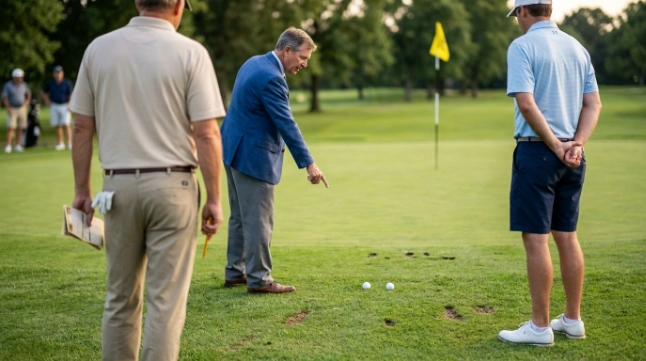
The underlying Rules are largely the same, but penalties and procedures can differ significantly. Always know your form of play before deciding what happens after a breach.
What is stroke play?
In regular stroke play, your total number of strokes determines your score. You normally must hole out on every hole.
The player with the lowest total score over the stipulated round or rounds wins.
What is match play?
Match play is head-to-head. You compete to win individual holes rather than simply comparing total strokes for the round.
A hole is normally won by the player who completes it in fewer strokes. The match ends when one player leads by more holes than remain.
| Rules Situation | Stroke Play | Match Play |
|---|---|---|
| General penalty | Two penalty strokes | Loss of hole |
| Wrong ball | Two-stroke penalty and mistake must normally be corrected | Loss of hole |
| Playing out of turn | Normally no penalty; safe ready golf is encouraged | Opponent may have the option to cancel the stroke |
| Scorecard required | Yes in regular competition procedures | Not required under normal match-play scoring |
What does “general penalty” mean?
The general penalty means two penalty strokes in stroke play and loss of hole in match play. Many significant Rules breaches use this standard penalty.
A one-stroke penalty is different. Stroke-and-distance relief, penalty-area relief, and standard unplayable-ball relief are common examples involving one penalty stroke.
What if you aren’t sure how to proceed in stroke play?
If a referee or Committee member isn’t immediately available, Rule 20.1 provides a procedure that can allow you to play two balls when genuinely uncertain how to proceed.
You must follow the requirements carefully and report the facts to the Committee before returning your scorecard when required.
Don’t use that two-ball procedure in match play. Match play has a different ruling process.
Can golfers agree to ignore a Rule?
No. Players cannot deliberately agree to ignore a Rule or a penalty they know applies.
That principle protects everyone in the competition. A casual agreement between players cannot rewrite the competition’s Rules.
Why do Local Rules matter?
A Committee may adopt authorized Local Rules for specific course conditions or competitions. That means two rounds on the same course can sometimes involve different procedures.
Common Local Rule topics may include:
- Preferred lies.
- Ground under repair.
- Drop zones.
- Alternative relief for a lost ball or ball out of bounds.
- Restrictions on distance-measuring devices.
- Specific course boundaries or penalty-area definitions.
Before a tournament, I would rather spend two minutes reading the Local Rules sheet than lose two strokes because I assumed the normal procedure applied.
The full international framework and supporting resources are also available from The R&A Rules resources.
Section Takeaway: Never assume the penalty is identical in stroke play and match play. Check your competition format and Local Rules before the round starts.
USGA Rules FAQ
What are the most important USGA golf rules for beginners?
Start with playing the ball as it lies, identifying the five areas of the course, stroke-and-distance relief, red and yellow penalty areas, free relief, unplayable-ball relief, correct dropping, and putting-green procedures. Those topics solve a large share of everyday rules situations.
How many minutes can you search for a lost golf ball?
You may search for three minutes after you or your caddie begins searching. If the ball is not found within that period, it is lost and you normally proceed under stroke and distance unless another Rule applies.
Is a lost ball a one-stroke or two-stroke penalty?
Under normal stroke-and-distance procedure, you add one penalty stroke and return to play from the previous stroke’s location. Because you also replay from that location, golfers sometimes describe the practical cost as “stroke and distance.”
Can I drop next to where my ball went out of bounds?
Not under the normal out-of-bounds Rule. You normally use stroke and distance. A Committee can adopt the optional Local Rule providing alternative relief for two penalty strokes, so check the course’s Local Rules before using it.
Can I ground my club in a bunker?
You can touch bunker sand in several circumstances, but you cannot ground your club immediately in front of or behind the ball before your stroke. You also cannot touch the sand during a practice swing, your backswing, or to test its condition.
Can I move leaves from a penalty area?
Yes. Loose impediments may generally be removed from a penalty area. However, be careful because causing your ball to move while removing a loose impediment can result in a penalty when no exception applies.
Where can I check an official ruling?
Use current USGA or The R&A digital Rules resources for the final answer, especially in competition. Official digital material includes current clarifications and is safer than relying on an old rules article, social-media post, or memory.
Final Takeaway: You don’t need to memorize every Rule to play confidently. Learn the common relief procedures, recognize the five course areas, read the Local Rules, and know where to check an official ruling when an unusual situation appears.
The biggest scoring advantage isn’t knowing obscure trivia. It’s knowing how to avoid turning a routine rules situation into an unnecessary penalty.