
Swing Drills: 12 Golf Drills for a Better, More Consistent Swing

Quick Answer
The best swing drills improve one specific part of your golf swing while giving you immediate feedback. Start with setup, contact, balance, and tempo before trying to add speed. If your swing problem keeps returning, a PGA golf coach can help identify the actual cause instead of relying on guesswork.
Best Swing Drills to Start With
- Alignment-stick drill: Checks whether your clubface, feet, and target line agree before the swing starts.
- Feet-together drill: Builds balance, rhythm, and centered contact without relying on excessive effort.
- Low-point drill: Teaches iron contact where the ball is struck before the turf.
- Step-through drill: Encourages pressure transfer and continued rotation toward the target.
- Towel drill: Helps coordinate the arms and torso during shorter swings.
- Pause drill: Improves transition control when you tend to rush from the top.
One Rule That Matters
- Choose the drill that matches your miss instead of cycling through every drill during one practice session.
I’ve wasted plenty of range balls trying random swing tips without knowing what I was fixing. Golf practice became far more useful once I treated drills as diagnostic tools instead of magic moves.
This guide covers practical golf swing drills for contact, path, balance, rotation, tempo, and consistency. You’ll also learn how to match each drill to the ball flight or strike problem you see.
In This Guide
- What Are Swing Drills and Why Do They Work?
- What Are the Best Swing Drills for Beginners?
- Which Swing Drills Improve Ball Striking and Contact?
- What Swing Drills Help Fix a Slice or Poor Swing Path?
- Which Drills Improve Tempo, Balance, and Rotation?
- How Should You Practice Swing Drills?
- Swing Drills FAQs
What Are Swing Drills and Why Do They Work?
Swing drills are controlled exercises designed to isolate a specific golf movement, position, or skill. A good drill creates feedback that tells you whether you completed the intended motion.
The important word is feedback. Repeating a movement without feedback can simply make the wrong movement more familiar.
Definition: A golf swing drill is a practice exercise that simplifies part of the swing so you can improve a specific skill through repetition and measurable feedback.
A Drill Should Solve a Specific Problem
I like to start with the shot pattern rather than the swing theory. The ball often tells you where to begin your investigation.
Common problems include:
- Fat shots: The club reaches the ground too early.
- Thin shots: The bottom of the swing may be inconsistent or too high.
- Slices: Clubface and swing-path relationships are producing excessive left-to-right curvature for a right-handed golfer.
- Pulls: The ball starts left of the intended target for a right-handed player.
- Poor balance: Your finish becomes unstable or your body falls away from the shot.
- Inconsistent direction: Setup, face control, strike location, or path may change between swings.
A drill should narrow the problem. It shouldn’t give you five new swing thoughts.
External Feedback Beats Guessing
An alignment stick, towel, line on the ground, mirror, or phone video can provide useful information. These tools make practice less dependent on feel alone.
Feel can be misleading. What feels like a huge change may look small when you watch the video.
The PGA of America regularly emphasizes simple drills that connect a clear movement with clear feedback. That approach works especially well for recreational golfers.
Section Takeaway: The best swing drill has a specific purpose and an obvious feedback mechanism. Diagnose the miss first, then choose the drill.
What Are the Best Swing Drills for Beginners?
The best beginner swing drills build setup, balance, contact, and rhythm before speed. Those four skills give you a foundation that transfers across clubs.
I’d rather see a new golfer hit ten balanced half-swings than ten uncontrolled drivers. Solid movement comes first.
1. Alignment-Stick Drill
This drill checks your target line before you blame the swing. Poor alignment can make a reasonable swing produce confusing results.
- Place one alignment stick on the ground toward your target.
- Place another parallel to it near your toes.
- Aim the clubface first.
- Set your feet, knees, hips, and shoulders around that target line.
- Hit short shots while keeping the sticks in place.
Don’t automatically aim your entire body directly at the target. Your body lines generally run parallel to the intended target line.
2. Feet-Together Drill
The feet-together drill reduces your ability to use wild lower-body movement. It makes balance and rhythm more important.
- Use a wedge or short iron.
- Place your feet close together.
- Make waist-high practice swings.
- Hit short shots at roughly half speed.
- Finish without falling toward either side.
Increase the length only when contact stays predictable. Distance is not the goal.
3. Half-Swing Contact Drill
Half-swings strip away unnecessary speed and make strike quality easier to monitor. I use them whenever my full swing starts feeling scattered.
- Grip the club normally.
- Use a narrow but comfortable stance.
- Swing back until the lead arm approaches parallel to the ground.
- Swing through to a matching position.
- Hold the finish for two seconds.
Watch ball flight, strike location, and balance. Those three clues matter more than total distance.
Pro tip: If a drill causes discomfort or you’re unsure whether a movement suits your body, work with a certified golf instructor rather than forcing the position.
Beginner Drill Comparison
| Drill | Main Purpose | Good Starting Club | Feedback |
|---|---|---|---|
| Alignment Stick | Aim and setup | 7-iron | Visible target lines |
| Feet Together | Balance and rhythm | 8-iron | Stable or unstable finish |
| Half Swing | Centered contact | Wedge | Strike and ball flight |
| Step Through | Pressure transfer | 7-iron | Movement into finish |
Section Takeaway: Beginners should prioritize setup, centered contact, balance, and rhythm. Build those skills before turning every practice session into a speed test.
Which Swing Drills Improve Ball Striking and Contact?
Contact drills work best when they teach you where the club meets both the ball and ground. With an iron, controlling the low point is especially important.
The low point is the lowest part of the clubhead’s swing arc. For a normal iron shot, the turf contact should generally occur on the target side of the ball.
4. Line-in-the-Ground Low-Point Drill
This is one of my favorite contact drills because the ground gives immediate feedback. You can practice it without trying to manufacture a complicated impact position.
- Draw a straight line on suitable practice turf or use an approved practice marking.
- Take your address with the line near the center of your stance.
- Make small swings without a ball.
- Try to brush the turf on the target side of the line.
- Add a ball only after the strike location becomes predictable.
Never damage a course practice area where marking the ground isn’t permitted. A range mat or other visual reference can provide the same concept.
5. Towel-Behind-the-Ball Drill
This drill gives a strong visual reminder when your club reaches the ground too early. It can be useful for golfers who regularly hit heavy iron shots.
- Place a small towel several inches behind the ball.
- Start with a short iron and a small swing.
- Hit the ball without touching the towel.
- Keep the speed moderate.
- Move to longer swings only after contact improves.
Don’t obsess over a universal towel distance. Club choice, swing geometry, and individual technique change the ideal spacing.
6. Clubface Strike-Location Drill
Low point isn’t the only contact variable. You also need to know where the ball meets the clubface.
Use an appropriate removable impact spray or impact tape according to its instructions. Then hit a small group of balls and inspect the pattern.
- Centered grouping: Your strike location is becoming repeatable.
- Mostly heel strikes: Check setup distance and delivery before making random swing changes.
- Mostly toe strikes: Look for a repeated setup or delivery pattern.
- Scattered strikes: Reduce swing length and speed until contact tightens.
I find a five-ball pattern more useful than judging one swing. Golfers can overreact to a single strange strike.
You can also review the USGA for authoritative information about golf equipment and the Rules of Golf when using training equipment or playing competitive rounds.
Section Takeaway: Better contact comes from controlling both low point and strike location. Use feedback that shows exactly where the club meets the turf and face.


What Swing Drills Help Fix a Slice or Poor Swing Path?
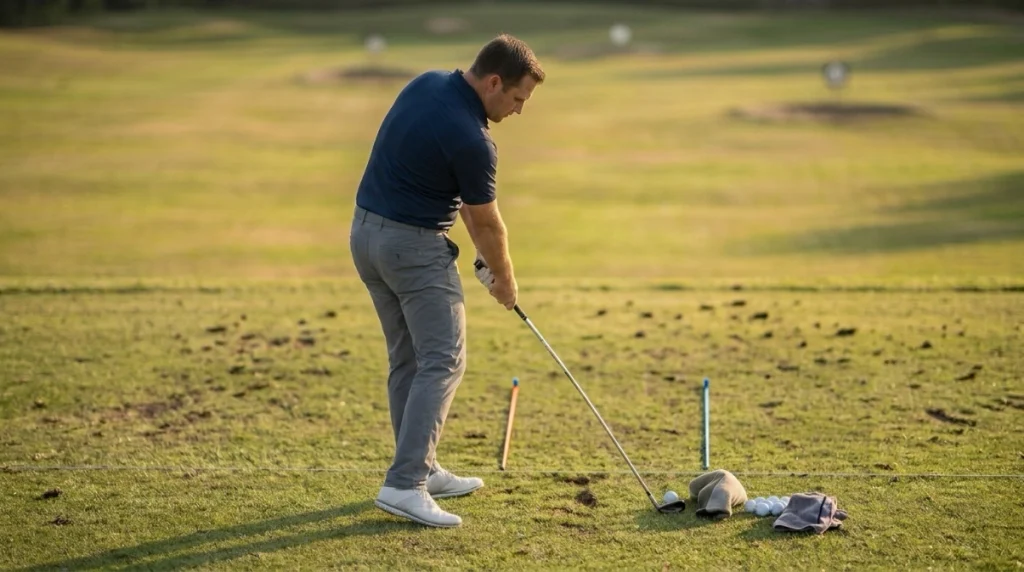
A slice cannot be diagnosed from swing path alone. The clubface angle relative to the swing path plays a major role in the resulting curvature.
That means a golfer shouldn’t blindly chase an “inside” swing. Start by identifying both starting direction and curvature.
7. Headcover Path Gate Drill
A soft headcover can act as an external obstacle without creating a complicated technical thought. The goal is to influence club delivery through a constraint.
- Start without a ball.
- Place a soft headcover outside the intended club path near the hitting area.
- Make slow practice swings without contacting it.
- Add small shots with a short iron.
- Adjust the obstacle position if it interferes with the intended shot rather than helping it.
Use only a soft object in a safe practice area. Never place a hard object where the club could strike it.
8. Trail-Hand Sidearm Drill
The sidearm motion helps some golfers understand a more athletic transition. Imagine skipping a stone instead of chopping vertically toward the ground.
- Stand without a club first.
- Use your trail hand as though throwing a ball sidearm.
- Notice how the arm works with torso rotation.
- Repeat the sensation with a club at low speed.
- Hit short shots only after the movement feels controlled.
This is a feel drill, not a universal mechanical blueprint. Different golfers need different sensations to create similar club delivery.
9. Start-Line Gate Drill
Start direction is valuable feedback because it gives you information about the clubface. You don’t need expensive technology to begin tracking it.
- Choose a clear target at the range.
- Create a wider visual gate several feet in front of the ball using safe markers.
- Hit controlled shots through the gate.
- Track where the ball starts.
- Track which direction it curves after starting.
Write down the pattern instead of relying on memory. Ten shots provide more useful information than one.
If you keep making major compensations, personalized instruction becomes more efficient. A trained coach can distinguish face-control problems from path, setup, or contact problems.
Pro tip: Work with a certified instructor before forcing exaggerated path changes. An extreme drill can replace one miss with another when the original diagnosis is wrong.
Section Takeaway: A slice drill should address the cause you actually have. Observe start direction, curvature, and strike before deciding that swing path alone needs fixing.
Which Drills Improve Tempo, Balance, and Rotation?
Tempo drills help your swing happen in a repeatable order rather than at one universal speed. A quick-looking swing can still have excellent rhythm.
Balance is an equally useful checkpoint. When I can’t hold my finish, I usually reduce effort before searching for a technical fix.
10. Step-Through Drill
The step-through drill encourages your motion to continue toward the target. It can help golfers who finish with too much pressure remaining on the trail side.
- Start with a mid-iron.
- Make a controlled backswing.
- Swing through the ball.
- Allow the trail foot to step toward the target after impact.
- Finish standing tall and balanced.
Begin without a ball if the movement feels unfamiliar. The drill should feel athletic, not forced.
11. Towel-Under-Arms Drill
A towel can help some players feel their arms and torso working together. I prefer using this drill with shorter swings rather than trying to trap the arms during a full driver swing.
- Place a small towel across your upper chest and lightly under both arms.
- Use a wedge or short iron.
- Make short practice swings.
- Keep the motion connected through the hitting area.
- Gradually lengthen the swing if the drill remains comfortable.
The arms must still move naturally. Connection does not mean pinning your elbows against your ribs throughout a full swing.
12. Pause-at-the-Top Drill
This drill is useful when transition becomes rushed. A deliberate pause exaggerates patience so your normal swing can eventually feel smoother.
- Make your normal backswing.
- Pause briefly near the top.
- Start down without throwing the hands immediately.
- Swing through at moderate speed.
- Hold a balanced finish.
You don’t need a visible pause in your normal golf swing. The exaggerated drill simply helps separate backswing completion from a rushed transition.
How Do Tempo and Swing Speed Differ?
Tempo describes the timing and pace of different swing phases. Swing speed measures how fast the club is moving.
You can therefore improve tempo without deliberately swinging slowly. The goal is repeatability.
The R&A is another useful authority for the Rules of Golf and broader information about the game. For technique, however, individual coaching remains more useful than trying to create one universal swing model.
Section Takeaway: Tempo, balance, and rotation support each other. If you cannot finish under control, reduce speed and rebuild the sequence before adding power.
How Should You Practice Swing Drills?
Practice one clear skill long enough to collect meaningful feedback. Constantly switching drills makes it difficult to know what caused the change.
My best range sessions usually feel simpler than my worst ones. I’ll often work on one movement with one club before testing whether it transfers.
Use a Simple Practice Progression
- Identify the miss: Record contact, start direction, curvature, and balance.
- Choose one drill: Match it to the most likely problem.
- Rehearse slowly: Begin without a ball when necessary.
- Hit short shots: Use less speed while learning the movement.
- Return to normal swings: Test whether the skill transfers without the drill.
- Change targets: Avoid becoming dependent on one perfect range setup.
How Many Repetitions Should You Do?
There is no perfect repetition count for every golfer. Quality drops quickly when fatigue or frustration takes over.
A practical session might alternate small sets:
- Five slow rehearsals.
- Five drill shots.
- Five normal shots.
- A short review of the results.
If the normal shots improve, keep testing. If they deteriorate, return to the simpler version rather than adding another tip.
Block Practice vs. Random Practice
Block practice means repeating the same task under similar conditions. It is useful when first learning a drill.
Random practice changes targets, clubs, or shot requirements more often. It better resembles the decisions you make during a round.
| Practice Type | Best Use | Example |
|---|---|---|
| Block Practice | Learning a new movement | Ten low-point drill swings with an 8-iron |
| Random Practice | Testing skill transfer | Change target and club after each shot |
Don’t Turn the Drill Into Your Golf Swing
Some drills deliberately exaggerate a movement. That doesn’t mean the exaggerated position belongs in your normal swing.
This distinction matters with path, pause, connection, and pressure-transfer drills. The drill creates a sensation, while the actual swing remains athletic and continuous.
Track Outcomes, Not Just Feel
A useful 2026 practice habit is recording a small amount of objective information. Even a simple notebook works.
- Club used.
- Primary miss.
- Drill practiced.
- Start direction.
- Curvature.
- Strike quality.
- Ability to hold the finish.
This helps you spot trends across sessions. You’ll also know whether a drill is producing results or only producing a different sensation.
For broader instruction and practice ideas, Golf Digest provides an established instruction section featuring coaches and players. Compare any general advice against your own ball flight before changing your technique.
Section Takeaway: Practice drills in small, focused sets, then return to normal shots. A drill has value only when the improved skill transfers to the golf course.
Swing Drills FAQs
What is the best golf swing drill for beginners?
The feet-together drill is a useful starting point because it encourages balance, rhythm, and controlled contact. Beginners should also use alignment sticks to confirm their setup. Start with a short iron and half-swings before increasing speed or swing length.
Can swing drills fix a slice?
Swing drills can help a slice when the drill addresses the correct cause. A slice involves the clubface relationship to swing path, so path-only drills may not solve every case. Check start direction, curvature, and strike pattern before choosing a drill.
What drill helps stop hitting behind the golf ball?
A low-point line drill can help golfers who regularly hit behind the ball. Make small swings and try to contact the ground on the target side of a visible reference line. Progress to hitting golf balls only after the strike location becomes more predictable.
How often should I practice golf swing drills?
Short, focused sessions are usually more useful than occasional marathon sessions. You might practice one drill several times per week while monitoring contact and ball flight. Stop when fatigue causes the quality of your movement or attention to decline.
Should I practice swing drills with a driver?
Not always. Many movement drills are easier to learn with a wedge or mid-iron because shorter clubs and lower speeds simplify the task. Once the movement becomes reliable, test whether it transfers to longer clubs and eventually the driver.
Can I practice golf swing drills at home?
Yes. Slow-motion rehearsals, mirror work, towel drills, and some balance exercises can be performed at home when you have enough safe space. Never make full swings indoors unless you have a purpose-built practice area with adequate clearance and protection.
How do I know whether a golf drill is working?
Look for changes in measurable outcomes rather than feel alone. Better strike location, improved start direction, predictable curvature, cleaner turf contact, and a balanced finish provide useful evidence. Then remove the drill and see whether the improvement remains during normal swings.
Build a Better Swing One Skill at a Time
Swing drills work best when they make practice simpler. Identify one problem, choose a drill with clear feedback, and test whether the improvement survives when you return to a normal swing.
Don’t judge progress by the prettiest practice swing. Judge it by contact, ball flight, balance, and your ability to repeat the shot under changing conditions.
If the same miss keeps returning despite focused practice, get another set of trained eyes on your swing. A qualified instructor can often identify the root problem faster than another week of random online tips.
Pick one drill from this guide that matches your most common miss. Give it a focused practice session, then take the improved movement back to real golf.