
Slow Motion Practice: How to Build a Better Golf Swing
Quick Answer
Slow motion practice is a golf training method where you rehearse your swing below normal speed so you can feel sequencing, balance, club movement, and body positions more clearly. Start without a ball, work on one movement at a time, and gradually increase speed only after you can repeat the motion comfortably. For hands-on help, you can also find a PGA Coach.
How to practice in slow motion
- Choose one change: Work on one swing feel instead of several mechanics at once.
- Start very slowly: Rehearse at roughly 25% of normal speed without a ball.
- Pause and check: Stop at the position connected to the movement you are learning.
- Blend the motion: Remove the pause and make one continuous slow swing.
- Add speed gradually: Progress toward half speed, three-quarter speed, and normal swings.
- Test with a ball: Keep the same feel while hitting short, controlled shots before full swings.
I use slow motion practice whenever a swing change feels clear in my head but disappears as soon as I hit a ball.
Slowing everything down gives you time to notice what your body and club are doing. This guide explains how to use that approach without turning your golf swing into a collection of frozen poses.
In This Guide
What Is Slow Motion Practice in Golf?
Slow motion practice means rehearsing your golf swing deliberately below normal speed. The goal is to make a movement easier to feel, observe, and repeat before adding full-speed demands.
It is not the same as trying to play every shot with a slow swing. It is a learning tool.
Definition: Slow motion golf practice is a reduced-speed rehearsal used to improve awareness of swing sequence, balance, positions, club movement, and transition patterns.
A normal downswing happens too quickly for most golfers to consciously control every detail. Reduced speed gives you more time to recognize what is happening.
- At 25% speed: You can exaggerate a completely new movement.
- At 50% speed: You can blend several positions into a flowing motion.
- At 75% speed: You can test whether the change survives added momentum.
- At normal speed: You can judge whether the movement transfers into your actual swing.
I find the method most useful when a fault keeps returning after several buckets of balls. More full-speed repetitions often reinforce the same old movement.
Slowing down changes the task. Instead of reacting to the ball, you can focus on how the motion is organized.
| Practice Speed | Best Use | Main Focus |
|---|---|---|
| About 25% | Learning a new pattern | Position and awareness |
| About 50% | Connecting movements | Sequence and balance |
| About 75% | Testing transfer | Timing and contact |
| Normal speed | Playing movement | Target and ball flight |
Why Does Slow Motion Golf Practice Work?
Slow practice works because it gives you enough time to recognize and rehearse movements that become difficult to monitor at full speed.
The benefit comes from deliberate feedback, not slowness by itself.
You can feel sequencing more clearly
A golf swing contains several connected movements. The body, arms, hands, and club must work together rather than fire randomly.
When your transition becomes rushed, that coordination can disappear quickly.
PGA coaching guidance regularly uses slower rehearsals when teaching movement, balance, rhythm, and swing changes. The PGA of America also emphasizes building rhythm rather than simply trying to move the club harder.
You can separate feel from ball flight
The ball can become a distraction during a technical change. One poor strike may make you abandon a useful movement immediately.
Removing the ball temporarily lets you judge the motion itself.
- Can you make the movement without losing balance?
- Can you stop at the intended checkpoint?
- Can you repeat it several times?
- Can you blend it into a continuous swing?
Those questions give you better feedback than simply asking whether one shot flew straight.
You can use video more effectively
Video becomes more useful when you know what movement you are testing. Record from the same angle and compare several repetitions.
For swing-change work, Golf Digest has also discussed using deliberately slow rehearsals and pauses before returning to full-speed motion.
You can explore broader instruction resources at Golf Digest.
Pro tip: If you are making a major technical change, ask a certified instructor to confirm the movement before repeating it hundreds of times.
Section Takeaway: Slow motion works best when it gives you clear feedback about one movement. It should eventually lead back toward normal-speed golf rather than remain a permanent rehearsal.
How Do You Practice a Golf Swing in Slow Motion?
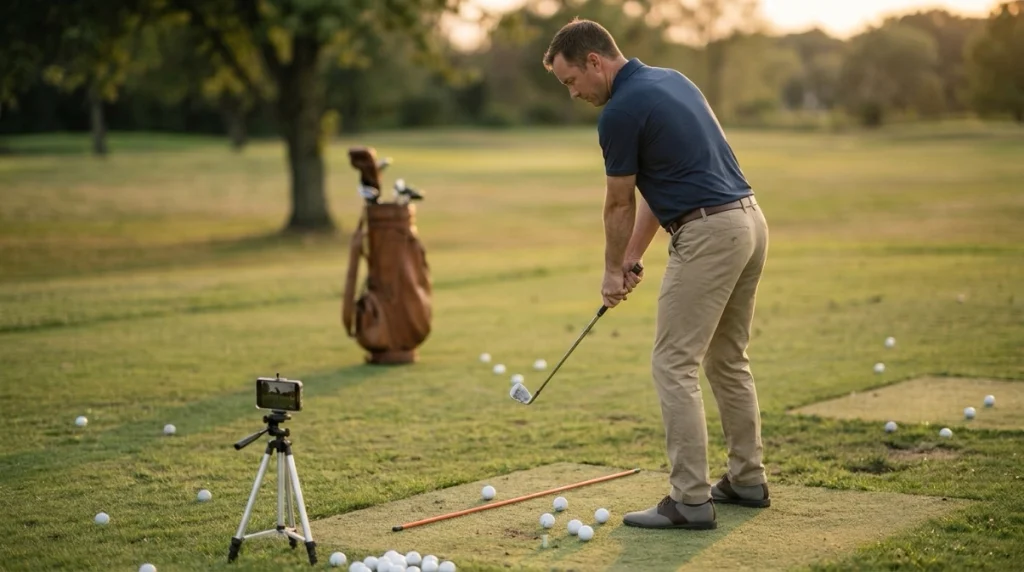
Begin without a ball and reduce your swing to a speed where you can control the movement. Then increase speed in stages instead of jumping directly to full power.
I like using a simple progression because it prevents me from rushing the change.
Step 1: Pick one movement
Choose one priority before starting. Examples include takeaway direction, transition sequence, pressure shift, chest rotation, or finish balance.
Do not try to fix six checkpoints in one swing.
Step 2: Rehearse at roughly 25% speed
Make five slow swings without a ball. Allow the entire motion to take several seconds if needed.
Exaggeration is acceptable here because you are learning a new feel.
Step 3: Add a checkpoint
Pause briefly where the movement matters most. If you are fixing the transition, for example, pause just after the backswing changes direction.
Check balance and club position without forcing yourself into an uncomfortable pose.
Step 4: Remove the pause
Make another five rehearsals as one continuous motion. Keep the same feeling while allowing the swing to flow.
If the old pattern immediately returns, slow down again.
Step 5: Hit short shots
Use a wedge or short iron and hit controlled shots at roughly half effort. Start with a small target rather than chasing distance.
- Hit five half-speed shots.
- Check contact and balance.
- Make two slow rehearsals between shots if needed.
- Increase speed only when the movement remains recognizable.
Step 6: Alternate rehearsal and normal swings
Alternating helps connect the training movement to the swing you will use on the course.
Try one slow rehearsal followed by one normal shot. Repeat that sequence five times.
By 2026, phone video makes this type of practice easy to check without expensive equipment. Film from face-on or down the target line and keep the camera position consistent.
Pro tip: A certified instructor can help you choose camera angles and checkpoints that match the specific fault you are working on.
Section Takeaway: Build the movement slowly, blend it, then test it with increasing speed. If your balance or contact collapses, return to the previous stage.
What Parts of the Golf Swing Should You Practice Slowly?
Slow motion can help with almost any technical part of the swing, but it is especially useful for movements that happen around the transition.
Pick the area connected to your actual ball-flight problem rather than copying a random position from another golfer.
Takeaway
Rehearse the first part of the backswing slowly enough to observe how your chest, arms, hands, and club start moving.
Stop when the shaft approaches parallel with the ground and check whether the motion feels organized.
Backswing
Use slow swings to explore turn, balance, arm structure, and the length of your backswing.
A longer backswing is not automatically better. You need a position you can transition from without rerouting the club dramatically.
Transition
The transition is one of the best reasons to use slow motion. A rushed change of direction can make almost every later movement harder.
Rehearse the first fraction of the downswing, pause, then continue.
Impact and low point
You cannot accurately recreate real impact by simply freezing in an impact pose. Impact is the result of motion.
Instead, make short slow swings and pay attention to where the club brushes the ground.
Follow through and finish
A balanced finish is an easy feedback tool. Make slow swings and hold the finish for about three seconds.
If you keep stepping, falling backward, or losing posture, reduce speed until you can finish under control.
The USGA remains a useful authority for broader rules and golf information, while technical instruction is better matched to a qualified coach.
Section Takeaway: Use slow motion where you need awareness, not everywhere at once. Transition, balance, and sequencing are especially useful areas for reduced-speed rehearsal.
What Slow Motion Practice Mistakes Should You Avoid?
The biggest mistake is practicing slowly without a clear goal. Slow repetitions can still reinforce the wrong movement.
Use the method as structured training rather than mindless rehearsal.
Trying to copy perfect positions
Golfers have different body proportions, mobility, grips, swing lengths, and playing styles.
Your goal is not to recreate one professional golfer frame by frame.
Never adding speed
A movement that works only at 25% speed is not yet ready for the course.
You need a progression toward realistic speed and ball striking.
Practicing too many changes
A new grip, takeaway, backswing, transition, and release at the same time creates too much information.
Choose one priority and give it enough repetitions to become familiar.
Ignoring ball flight
Slow rehearsals can improve awareness, but ball flight still matters. Eventually, the golf ball tells you whether your swing produces functional contact and direction.
Combine feel with outcome.
Forcing painful positions
Stop if a drill causes pain or unusual strain. A swing position that looks good on video may not fit your mobility.
The R&A is a trusted authority on the game, but individual physical or technical concerns belong with an appropriate instructor or medical professional.
Making every rehearsal extremely slow
Your practice should become progressively more athletic. Think of slow motion as the first gear, not the destination.
A useful session might look like this:
- 5 rehearsals at roughly 25% speed.
- 5 continuous swings around 50% speed.
- 5 controlled shots around 60–70% effort.
- 5 normal shots focused mainly on the target.
If the movement disappears, return one stage rather than hitting harder.
Pro tip: Ask a certified golf instructor to diagnose persistent slices, hooks, heavy shots, or physical limitations before building a long-term drill routine.
Section Takeaway: Slow practice must eventually connect to real shots. Use clear feedback, one priority, gradual speed, and functional ball flight to judge progress.
Slow Motion Practice FAQ
Does practicing a golf swing in slow motion really help?
Yes, slow motion can help you become more aware of sequencing, balance, positions, and club movement. It is most useful when you have one specific change to rehearse and gradually transfer that change into normal-speed swings.
How slow should a practice golf swing be?
There is no required percentage. I usually start around 25% of normal speed for a new movement, then progress toward 50%, 75%, and normal speed as control improves.
Should I hit golf balls while practicing slowly?
Start without a ball when learning a new movement. Once you can repeat it comfortably, add short shots at reduced effort before returning to normal swings.
How many slow motion swings should I do?
Quality matters more than a huge repetition count. Five to ten focused rehearsals followed by a transfer test can be more useful than making dozens of unfocused swings.
Can slow motion practice improve golf swing tempo?
It can help you notice where your rhythm changes or your transition becomes rushed. However, slow motion practice and normal swing tempo are different, so you still need normal-speed repetitions.
Can I practice slow motion swings at home?
Yes, if you have enough safe space. You can rehearse without a ball, use a mirror, or record video, but make sure the club cannot hit ceilings, furniture, people, or other objects.
Should beginners use slow motion golf practice?
Yes, but beginners benefit from knowing what they are trying to learn. A qualified instructor can provide a simple movement goal so slow practice reinforces useful fundamentals instead of random positions.
Final Takeaway
Slow motion practice is one of the simplest ways to make a golf swing change easier to understand. It gives you time to feel the motion before speed and ball striking take over.
Start with one change, rehearse it slowly, add a checkpoint if necessary, and then blend the movement into continuous swings.
From there, add a ball and increase speed in stages. Your goal is not to own a beautiful slow-motion swing.
Your goal is a movement that survives when the shot counts.