
Golf Swing Guide 99: A Complete Guide to a Better Golf Swing in 2026

Quick Answer
A reliable golf swing starts with grip, posture, alignment, ball position, balance, and a coordinated sequence through impact. Build those fundamentals first, then improve contact before chasing more speed. The PGA’s guidance on controlling the clubface through your grip is a useful starting point.
Seven Golf Swing Priorities
- Grip first: Hold the club securely without creating unnecessary tension in your hands and forearms.
- Set your posture: Bend from the hips and stay athletic rather than crouched or rigid.
- Aim correctly: Set the clubface first, then align your feet and body around that target line.
- Turn in balance: Complete your backswing without swaying excessively or forcing extra length.
- Sequence the downswing: Let pressure move toward the lead side as your body begins unwinding.
- Prioritize contact: Centered strikes and predictable direction matter more than maximum effort.
- Finish balanced: A controlled finish is one of the simplest checks for tempo and body control.
Best Way to Start
- Use a 7-iron and begin with half-swings until contact, starting direction, and balance become predictable.
This Golf Swing Guide 99 is designed to make the full golf swing easier to understand without burying you in technical language. My approach is simple: build a repeatable setup, understand the sequence, and use ball flight to guide your practice.
A good golf swing doesn’t need to look perfect. It needs to produce useful contact, predictable direction, and enough balance to repeat the motion under pressure.
In This Guide
- What are the most important golf swing fundamentals?
- How should you set up before making a golf swing?
- What is the correct golf swing sequence?
- What controls impact and golf ball flight?
- Should your golf swing change with different clubs?
- How do you fix a golf swing without overthinking?
- Golf Swing Guide 99 FAQs
What Are the Most Important Golf Swing Fundamentals?
The most important golf swing fundamentals are grip, clubface aim, posture, alignment, ball position, balance, and tempo. These basics influence almost every movement that follows.
I always check setup before making a major swing change. A golfer can spend an hour fixing the downswing when the real problem started before the club moved.
Definition: A golf swing is the coordinated motion that moves a golf club from address, through the backswing and impact, and into a balanced finish.
Grip connects your hands to the clubface
Your grip affects how easily you can control the clubface. It should feel secure without making your forearms rigid.
A grip that becomes excessively strong or weak can influence face orientation. However, hand position must also match the rest of your motion.
- Lead hand: Place it on the club so the grip sits securely through the fingers and hand.
- Trail hand: Let it support the lead hand without dominating the swing.
- Pressure: Hold firmly enough to control the club while keeping your wrists and arms responsive.
- Consistency: Build the grip before every shot using the same routine.
I prefer golfers to establish their grip while the clubface is already aimed. That reduces the chance of twisting the face while settling into the stance.
Posture creates room to move
Good posture gives your arms room to swing while your hips and torso rotate. Bend forward from the hips rather than rounding your upper back.
Keep modest knee flex and let your arms hang naturally. You should feel athletic, not frozen.
The PGA also emphasizes posture as a foundation for efficient movement. Their golf posture guidance offers a useful visual reference.
Alignment controls where the swing is organized
Alignment is often misunderstood because your clubface and body do different jobs. The clubface aims toward the intended starting line.
Your feet, hips, and shoulders usually sit roughly parallel to that line for a standard shot. Think about two railroad tracks running beside each other.
- Aim the clubface first.
- Choose an intermediate target a few feet ahead.
- Build your stance after the face is set.
- Check shoulder alignment as well as your feet.
At the range, I like placing one alignment stick outside the ball. Another can run along the toe line.
That simple setup removes guesswork. It also exposes whether a supposed swing problem is really an aiming problem.
Section Takeaway: Build the golf swing from the ground up. Grip, posture, alignment, ball position, and balance should be checked before changing moving parts.
How Should You Set Up Before Making a Golf Swing?
A good golf setup puts you in balance with enough room to rotate and return the club consistently. The exact stance changes with the club and shot.
The goal isn’t one rigid address position. It is a repeatable starting point that matches what you’re trying to hit.
Set the clubface before your body
Choose your target and stand behind the ball first. Find a leaf, discoloration, or blade of grass on the intended starting line.
Then walk in and aim the clubface toward that reference. Build the rest of your stance around the face.
The PGA’s explanation of golf alignment fundamentals uses the same parallel-lines concept many instructors teach.
Find a balanced stance width
Stance width should help you stay stable without restricting rotation. Shorter clubs usually need less width than a driver.
Your pressure should feel centered enough that you could react in either direction. Avoid sitting heavily on your heels.
- Wedges: Start around hip width for many standard shots.
- Mid-irons: Use a comfortable athletic width.
- Driver: A somewhat wider base can support the longer club and faster motion.
Place the ball for the club you’re using
Ball position changes how the club meets the ground and ball. There is no single location for every club.
For a normal right-handed shot, shorter clubs usually sit nearer the middle. The driver sits farther forward, near the lead heel.
| Club | Typical Ball Position | Stance Starting Point | Contact Goal |
|---|---|---|---|
| Wedge | Near center for a standard shot | Relatively narrow | Ball first, then turf |
| 7-Iron | Slightly forward of center | Athletic, moderate width | Ball first, low point ahead |
| Fairway Wood | Forward of a mid-iron | Moderate to slightly wider | Shallow strike from turf |
| Driver | Near the lead heel | Wider athletic base | Tee-supported strike with upward potential |
These are starting points, not laws. Your proportions, club specifications, shot shape, and swing pattern can change the ideal location.
A golfer with a poor ball position can create compensations throughout the swing. Always verify it before rebuilding mechanics.
Check balance before starting
Make two small movements before hitting. Rock slightly toward your toes, then toward your heels.
Settle into the middle. You should feel stable while still being able to move.
Section Takeaway: A repeatable setup removes variables. Aim the clubface first, choose the correct ball position, and start from balanced athletic posture.
What Is the Correct Golf Swing Sequence?

A useful golf swing sequence moves through setup, takeaway, backswing, transition, downswing, impact, release, and finish. These stages should blend into one continuous motion.
Do not try to consciously hit eight separate positions. Use them as checkpoints when practicing or reviewing video.
1. Address and setup
The swing begins before the club moves. Grip, face angle, posture, ball position, and alignment create the starting conditions.
Take one final look at the target. Then let your attention return to the shot rather than adding another mechanical thought.
2. Takeaway
Start the club smoothly rather than snatching it away with your hands. Let your chest, arms, and club begin working together.
An exaggerated inside or outside takeaway can force rerouting later. The first movement should feel calm.
3. Backswing
Continue turning while maintaining balance. Your trail hip gains depth as your torso rotates away from the target.
The length of your backswing depends on mobility, club choice, and swing style. More length isn’t automatically more power.
- Keep your trail foot grounded enough to stay stable.
- Avoid swaying far outside the trail leg.
- Let the wrists hinge naturally.
- Stop before extra motion damages balance.
4. Transition
Transition is the change from backswing to downswing. This is where many golfers rush.
A useful feel is allowing pressure to move toward the lead side as your backswing finishes. Your arms don’t need to attack immediately.
This sequence can help the club fall into a more functional delivery. It also reduces the urge to throw the clubhead from the top.
Pro tip: If transition work causes pain or makes your movement feel forced, ask a certified PGA instructor to assess your motion in person.
5. Downswing
The downswing should deliver the club rather than manufacture a pose. Your lower body, torso, arms, and club need to coordinate.
A common mistake is starting with an aggressive shoulder spin. Another is pulling the handle down without allowing the body to turn.
Instead, think about creating space for the arms while continuing to rotate. The exact appearance will vary from golfer to golfer.
6. Impact
Impact happens too quickly to consciously arrange during a full-speed swing. Your setup and sequence create the impact conditions.
With an iron, the low point of the swing normally occurs after the ball. That supports ball-first contact before the club reaches its deepest turf interaction.
7. Release and finish
After impact, allow the club and body to continue turning. Don’t artificially stop your hands or force them to roll.
Finish with your chest generally facing the target and most pressure on your lead side. Hold the finish for a moment.
I use that finish as a quick diagnostic. If I repeatedly lose balance, I check tempo before changing anything technical.
Section Takeaway: The golf swing is a sequence, not a collection of poses. Smooth transition, coordinated rotation, and balance matter more than copying one professional swing frame by frame.


What Controls Impact and Golf Ball Flight?
Impact is controlled mainly by clubface orientation, club path, strike location, low point, speed, loft delivery, and angle of attack. Ball flight gives you evidence about those conditions.
That makes the ball itself one of your best feedback tools. Learn to read the result before guessing at a swing fault.
Clubface strongly influences starting direction
The direction the clubface points at impact strongly affects where the ball starts. The exact influence changes with club and impact conditions.
If shots consistently start right, investigate face control before randomly changing your entire swing path.
Swing path contributes to curvature
Club path describes the direction the clubhead is moving through impact relative to the target line. The relationship between face and path helps determine curve.
- Face right of path: Tends to encourage left-to-right curvature for a right-handed golfer.
- Face left of path: Tends to encourage right-to-left curvature for a right-handed golfer.
- Face close to path: Produces less curvature when strike conditions are also centered.
This is why simply saying “I came over the top” isn’t a complete diagnosis. You need to know the face, path, and strike.
Strike location changes the result
Contact away from the center of the clubface can cost speed and alter ball flight. With a driver, heel and toe contact can also influence curvature.
Use impact spray or face tape during practice. A pattern of ten shots tells you more than one perfect strike.
Low point explains heavy and thin shots
Your low point is the lowest part of the clubhead’s swing arc. With normal iron shots, you want that point ahead of the ball.
A heavy shot occurs when the club reaches the ground too early. A thin shot often happens when the club bottoms out too early or never reaches the expected depth.
- Draw a line on the turf at a grass range.
- Place the ball just ahead of the line.
- Hit controlled shots.
- Check where the turf interaction begins.
This drill makes low-point control visible. You aren’t relying only on feel.
Speed matters after contact becomes reliable
More clubhead speed creates greater distance potential. However, faster swings only help when you can deliver useful contact and launch conditions.
I prefer building speed after a golfer can hit predictable shots at comfortable effort. Adding speed to poor contact often magnifies the miss.
Equipment also matters, but it should remain within golf’s rules. The USGA’s club rules and equipment guidance explains key requirements for clubs used during a round.
Section Takeaway: Diagnose impact from evidence. Starting direction, curvature, strike location, and turf contact reveal more than guessing from how the swing felt.
Should Your Golf Swing Change With Different Clubs?
Your core motion can remain recognizable across the bag, but setup and impact intentions change. A driver should not be treated exactly like a wedge.
Club length, loft, lie, ball position, and the shot you want all influence your setup.
Wedges favor control
A full wedge swing usually places more emphasis on distance control than raw speed. The shorter shaft also lets you stand closer to the ball.
- Use a relatively compact stance.
- Keep ball position near the middle for many standard shots.
- Prioritize predictable strike and carry distance.
- Avoid adding unnecessary backswing length.
Mid-irons are ideal practice clubs
I like a 7-iron for swing work because it sits in the middle of the bag. It is long enough to expose problems without demanding driver speed.
Use it for half-swings, three-quarter swings, contact drills, and normal full shots. That progression makes changes easier to evaluate.
Fairway woods need enough room
A fairway wood has a longer shaft and less loft than most irons. Give yourself enough stance width and space from the ball.
Do not try to lift the ball. Let the club’s loft and your impact conditions create the launch.
The driver changes the setup most
The driver is longer, typically lower lofted, and normally used from a tee. Ball position therefore moves forward compared with an iron.
A slightly wider stance can provide stability. Many golfers also benefit from a modest spine tilt away from the target at address.
- Tee the ball consistently.
- Position it near the lead heel as a starting point.
- Give your arms enough room to extend.
- Focus on centered contact before maximum speed.
A common mistake is trying to help the driver upward with the hands. That can disturb posture and face control.
Let the setup create favorable conditions instead. Then make an athletic swing through the ball.
Club fitting can change what feels natural
Shaft length, shaft flex, total weight, swing weight, lie angle, and grip size can influence how a club feels. They can also affect your delivery.
That doesn’t mean equipment fixes every swing problem. It does mean poorly matched equipment can make a good motion harder to repeat.
Pro tip: If you’re changing shaft length, lie angle, or other fitting variables, work with a qualified club fitter rather than guessing from online charts alone.
Section Takeaway: Keep the same basic athletic motion, but adjust setup for the club. Ball position, stance width, distance from the ball, and impact intention should change across the bag.
How Do You Fix a Golf Swing Without Overthinking?
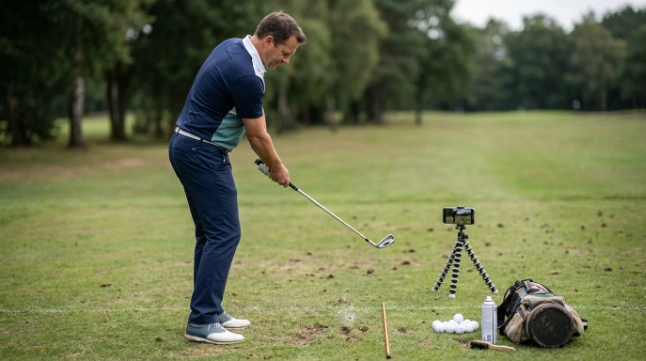
Fix your golf swing by identifying the earliest meaningful problem and changing one variable at a time. Avoid collecting five swing tips during one practice session.
A useful practice session has a clear question. For example: “Can I move my strike pattern closer to the center?”
Start with the ball flight
Write down your dominant miss before changing anything. Direction and contact patterns are more useful than one bad shot.
- Starts right: Check clubface orientation and alignment.
- Starts left: Check clubface orientation and alignment.
- Curves right: Examine the relationship between face and path.
- Curves left: Examine the relationship between face and path.
- Heavy contact: Investigate low point and pressure movement.
- Thin contact: Check posture, low point, and distance from the ball.
Film from useful angles
Video is helpful when the camera is positioned consistently. Random angles can make a normal swing look misleading.
For a down-the-line view, place the camera around hand height and approximately along the hand line. For face-on, position it perpendicular to the target line.
- Record normal swings before rehearsals.
- Use normal speed and slow motion.
- Check setup before moving parts.
- Find the earliest obvious issue.
- Work on one priority.
Use half-swings to learn changes
Full-speed swings leave little time to sense a new movement. Shorter swings reduce complexity.
Start with waist-high to waist-high motion. Then progress toward three-quarter and full swings when contact remains predictable.
Try a simple three-stage practice plan
- Block practice: Hit 10 to 15 controlled shots while working on one technical priority.
- Feedback practice: Use video, an alignment rod, strike spray, or a turf line to verify the change.
- Target practice: Remove extra tools and hit different shots toward different targets.
The last stage matters. A change must eventually work without constant technical monitoring.
Common mistakes I would fix first
Many recreational golfers lose shots before reaching complicated mechanics. These faults deserve attention first.
- Excessive grip tension: Tight arms can make natural club movement harder.
- Poor alignment: A good swing aimed badly still produces a bad result.
- Incorrect ball position: This changes where the club meets the ball and ground.
- Rushed transition: Starting down aggressively can disturb sequencing.
- Trying to lift the ball: The club’s loft should help create launch.
- Chasing speed: Maximum effort often reduces centered contact.
- Too many swing thoughts: Multiple corrections make cause and effect difficult to identify.
Use measurable feedback
I like practice goals that can be counted. “Swing better” is impossible to measure.
A target such as “seven centered strikes from ten swings” creates useful feedback. So does holding eight balanced finishes from ten attempts.
- Strike location on the face
- Starting direction
- Curve pattern
- Divot or turf location
- Balanced finish
- Carry-distance consistency
Do not expect every swing change to feel comfortable immediately. New movements can feel unusual before they become familiar.
However, pain is different from unfamiliarity. Stop if a drill causes pain or significant strain.
Pro tip: Persistent pain, restricted movement, or repeated failure to make a change should be assessed by an appropriate professional and a certified golf instructor.
Section Takeaway: Change one thing and measure the result. Use ball flight, strike location, video, and balance instead of judging improvement only by feel.
Golf Swing Guide 99 FAQs
What is the easiest golf swing for a beginner?
The easiest beginner swing is a balanced, compact motion built around a neutral setup and centered contact. Start with a wedge or 7-iron, use half-swings, and avoid maximum effort. Add backswing length only after you can repeatedly contact the ball and finish in balance.
What should start the golf downswing?
The downswing works best as a coordinated change of direction rather than one isolated body movement. Pressure generally begins moving toward the lead side while the body starts unwinding and the arms respond. Avoid aggressively throwing the hands or shoulders from the top.
Should I keep my head completely still during the golf swing?
No. Your head does not need to remain frozen in one exact position. Natural body rotation can create some movement. The better goal is maintaining enough posture, balance, and spatial control to return the club consistently to the ball.
Why do I hit the ground before the golf ball?
Heavy contact usually means the low point of your swing occurred too far behind the ball. Ball position, pressure movement, posture, and sequencing can all contribute. Use a turf-line drill to see where the club actually reaches the ground.
How can I stop slicing my driver?
Start by checking where the ball begins and how it curves. A slice usually involves a clubface that is open relative to the swing path for a right-handed golfer. Check grip, alignment, strike location, and face control before making major path changes.
How often should I practice my golf swing?
Practice frequency depends on your schedule, but shorter focused sessions can be more useful than occasional marathon sessions. Even 20 to 30 minutes can help when you work on one priority and use feedback instead of hitting balls without a plan.
How many swing thoughts should I have on the golf course?
Keep on-course swing thoughts minimal. One simple cue is usually easier to manage than several technical instructions. Do detailed mechanical work on the range, then shift attention toward your target, shot shape, routine, and balance while playing.
Build a Swing You Can Repeat
A better golf swing doesn’t come from memorizing every position. It comes from building dependable fundamentals, reading your ball flight, and practicing one priority at a time.
Start with grip, posture, alignment, ball position, and balance. Then work through sequence, contact, and speed in that order.
Use a 7-iron, make controlled swings, and measure what happens. Centered contact and predictable direction are stronger signs of progress than one unusually long shot.
Most importantly, build a swing that works for your body. A repeatable motion that produces predictable shots is more valuable than a swing that simply looks good on video.