
How Do You Remove Golf Club Stains and Black Marks From a Towel?

Quick Answer
To remove golf club stains and black marks from a towel, rinse away loose dirt, pre-treat the stained area with liquid laundry detergent or a small amount of grease-cutting dish soap, gently work it into the fibers, then wash according to the towel’s care label. For microfiber towels, avoid fabric softener and chlorine bleach because they can reduce cleaning performance, as explained in these microfiber care instructions.
Fast stain-removal steps
- Shake off debris: Remove dried sand, soil, and grass before adding water.
- Rinse the stain: Flush ordinary mud and clubface grime with cool or warm water.
- Pre-treat marks: Apply liquid detergent directly and gently massage it into the fabric.
- Degrease if needed: Use a few drops of mild dish soap on oily or stubborn black residue.
- Wash correctly: Follow the towel’s care label and use a normal amount of detergent.
- Check before drying: Repeat the treatment if marks remain instead of exposing them to high dryer heat.
Best rule to remember
- Start with the mildest cleaning method that works, especially on microfiber or printed golf towels.
If your golf towel comes home looking like you dragged it through every bunker on the course, you’re not alone. Clubfaces collect soil, grass, sand, moisture, oils, and dark residue, and much of that eventually ends up in the towel.
I prefer treating those marks soon after a round. Fresh grime is much easier to remove than a black patch that has been washed and dried several times.
In This Guide
What Causes Black Marks on a Golf Towel?
Black marks usually come from a combination of soil, grass, oils, moisture, and dark residue transferred from clubheads. Wedges and irons are especially good at loading a towel with material trapped around the face and grooves.
Golf towel stain definition: A golf towel stain is residue transferred to the fabric while cleaning clubs, balls, grips, hands, or other equipment during a round.
Mud and fine soil
Wet soil often looks brown when fresh but can dry into dark gray or nearly black patches. Fine particles work deep into waffle-weave and microfiber fabric.
That is why I shake or brush dried dirt from the towel before washing it. There is little benefit in forcing loose grit farther into the fibers.
Grass and organic residue
Fresh grass leaves chlorophyll and plant material behind. Once mixed with wet dirt, it can create dark green, brown, or black-looking marks.
Liquid laundry detergent works well as the first treatment because detergents are designed to lift several common soil types during washing.
Oil and equipment grime
Some stubborn marks feel slightly greasy instead of dusty. Oils from hands, grips, carts, bags, maintenance equipment, and other surfaces can collect on a towel during eighteen holes.
For those spots, a small amount of dishwashing liquid can help break down the oily residue. Tide’s grease-stain guidance also recommends dish soap as an initial treatment for greasy fabric stains.
Why keeping clubs clean matters
A dirty towel is usually evidence that it has been doing useful work. Dirt left in clubface grooves can interfere with the clean contact golfers want around the course.
Golf Digest has tested clean versus dirty clubfaces and discussed how debris and moisture can affect spin behavior. So I would rather wash a heavily marked towel than leave that same material packed into my wedges.
How Do You Remove Fresh Golf Club Stains?
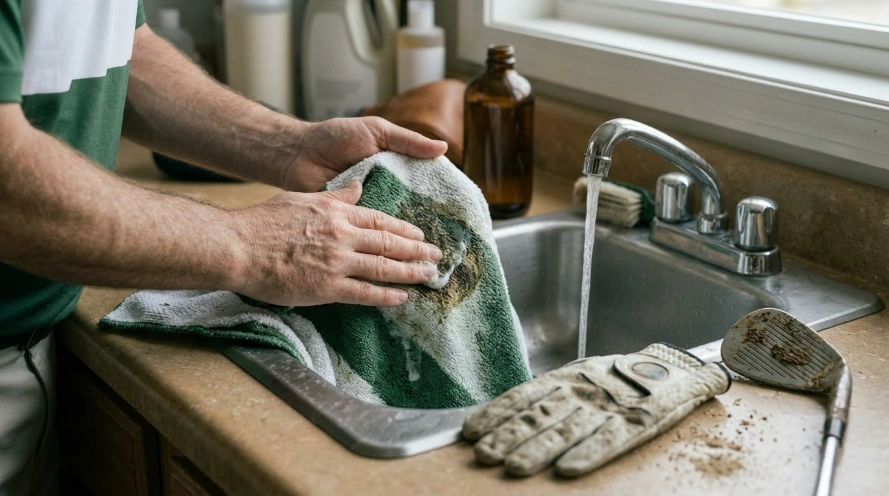
Fresh golf towel stains are usually the easiest to remove. Treat them before the towel sits damp in your golf bag or goes through a hot dryer.
- Remove loose material. Shake out sand, grass, and dried soil outdoors or over a sink.
- Rinse dirty areas. Run cool or warm water through the back of the stained fabric when practical.
- Add liquid detergent. Put a small amount directly on the mark and gently massage the fabric.
- Wait several minutes. Give the detergent time to loosen embedded grime.
- Wash normally. Follow the towel manufacturer’s temperature and cycle instructions.
- Inspect before drying. Treat the area again when a visible stain remains.
Don’t attack the stain with aggressive scrubbing immediately. On a waffle towel, I gently work detergent through the textured pockets using my fingers.
A soft laundry brush can help on durable material, but heavy scrubbing may damage printing or decorative embroidery. Always treat those areas cautiously.
What if the mark feels oily?
Apply only a few drops of mild dishwashing liquid to the affected area. Work it in gently, rinse thoroughly, then launder the towel according to its label.
The important part is removing the dish soap before the final wash. You don’t need a large amount to treat a small golf towel stain.
How Do You Remove Set-In Black Marks?
For old black marks, repeat treatment is usually safer than immediately reaching for a harsh chemical. A stain that survived one wash may need more contact time with detergent.
- Start dry if the mark seems oily. Apply a few drops of dish soap directly to the affected patch.
- Use detergent for soil-based marks. Cover the stained fibers with liquid laundry detergent.
- Work gently. Massage the cleaner into the towel instead of aggressively scraping the fibers.
- Let it sit briefly. Follow the cleaner’s directions rather than leaving products on indefinitely.
- Wash again. Choose the warmest temperature permitted by the towel’s care label.
- Air-dry for inspection. Check the stain before using high heat.
One lesson I’ve learned with golf towels is that appearance is not always the same as cleanliness. A light-colored towel can retain faint gray marks even after the actual grime has been removed.
If the towel smells clean, feels normal, and no longer transfers dirt, a faint cosmetic shadow may simply remain. Repeated aggressive bleaching may cause more harm than that harmless discoloration.
Should you soak a heavily stained towel?
A short soak can help some washable cotton towels, but check the care label first. Printed graphics, special coatings, magnets, clips, or mixed materials can change what is safe.
I am more conservative with performance microfiber. I usually pre-treat the spots and wash the towel rather than experimenting with strong homemade soaking mixtures.


Does the Towel Material Change the Cleaning Method?
Yes. Microfiber, cotton, and specialty golf towels should not automatically receive identical treatment.
As of 2026, many golf towels use microfiber or textured synthetic material because it grabs moisture and debris effectively. Others use cotton, while some weather-oriented models combine several materials.
| Towel Type | Good First Treatment | Main Caution | Drying Approach |
|---|---|---|---|
| Microfiber | Liquid detergent and gentle spot treatment | Avoid fabric softener and chlorine bleach unless the manufacturer specifically permits them | Low heat or air-dry when recommended |
| Cotton | Detergent pretreatment and normal laundering | Check colors, embroidery, and printed designs | Follow the care label |
| Waffle weave | Work detergent gently into the textured areas | Avoid harsh brushing that damages texture | Low heat or air-dry according to label |
| Specialty/weather towel | Manufacturer-approved cleaning only | Waterproof layers, magnets, or special construction | Follow manufacturer instructions closely |
Why microfiber needs extra care
Microfiber works because very fine synthetic fibers grab dirt and moisture. Coating those fibers with fabric softener can reduce the characteristics that make the towel useful.
High heat can also be a problem for some synthetic towels. Use the manufacturer’s instructions instead of assuming a golf towel should be washed like a heavy cotton bath towel.
Special golf towels can be different
Some models have waterproof shells or separate cleaning surfaces. For example, the Titleist StaDry Performance Towel combines a weather-resistant outer construction with a microfiber interior and groove-cleaning feature.
With a towel like that, construction matters as much as the stain itself. Check product-specific care directions before soaking or using aggressive stain removers.
What Should You Avoid When Cleaning a Golf Towel?
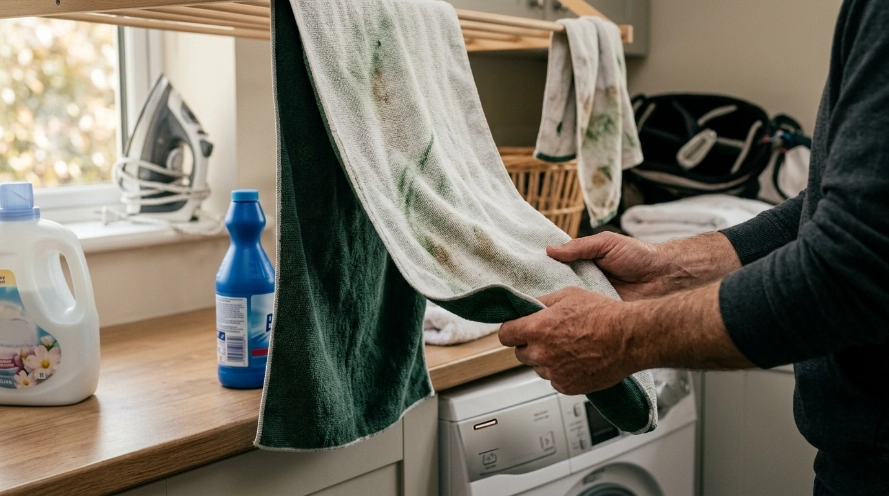
The biggest mistake is assuming stronger chemicals always produce a cleaner towel. Golf towels are working accessories, so protecting their absorbency and texture matters more than making them look factory-new.
- Don’t automatically use chlorine bleach: It may damage microfiber and can affect colored fabric.
- Skip fabric softener on microfiber: It can coat fine fibers and reduce their useful cleaning characteristics.
- Avoid excessive detergent: More soap does not automatically mean better rinsing or cleaner fibers.
- Don’t iron microfiber: Heat can damage synthetic fibers.
- Avoid high heat unless approved: Check the care label before selecting the hottest dryer setting.
- Don’t leave wet towels in the bag: Remove them after the round and let them dry.
How can you stop black marks becoming permanent?
Clean the towel regularly instead of waiting until every usable section is dark. I also keep one area damp for clubheads and another area protected for drying.
Cleaning the clubface soon after a muddy shot prevents dried debris from accumulating. That habit also makes the towel easier to manage because grime stays concentrated in one working area.
If you also use the towel on a golf ball, remember that the Rules control when a lifted ball may be cleaned. The USGA’s Rule 14.1c guidance explains the situations when cleaning is and is not permitted.
Frequently Asked Questions
Can black golf club marks come out of a white towel?
Often, yes. Pre-treat the marks with liquid detergent, wash according to the care label, and inspect the towel before drying. A faint gray shadow may remain after repeated use even when the towel itself is clean.
Can I use dish soap on a golf towel?
A small amount of mild dish soap can help with oily or greasy black marks. Apply only enough to cover the stain, work it in gently, rinse thoroughly, and then launder the towel according to its care instructions.
Can I use bleach on a microfiber golf towel?
It’s better not to use chlorine bleach unless the towel manufacturer specifically says it is safe. Microfiber-care guidance commonly warns that chlorine bleach can break down fine fibers and reduce their performance.
Why does my golf towel still look dirty after washing?
Fine soil and dark residue can become deeply embedded, especially in pale waffle-weave fabric. Pre-treat visible spots before another wash and avoid drying the towel on high heat until you’re satisfied with the result.
Should golf towels be washed separately?
Heavily soiled towels are worth separating from delicate clothing. Microfiber towels also benefit from washing with compatible, low-lint materials because lint from other fabrics can collect in the fine fibers.
How often should I wash my golf towel?
Wash it when it becomes heavily soiled, develops an odor, or no longer gives you a clean working area. On muddy or rainy weeks, that may mean washing it after each round rather than following a fixed schedule.
Can I put a golf towel in the dryer?
Many can go in a dryer, but the temperature matters. Follow the care label, and use low heat when recommended for microfiber or synthetic material rather than assuming high heat is safe.
Final Takeaway
Removing golf club stains and black marks from a towel usually does not require an aggressive cleaner. Start by removing loose dirt, pre-treat stains with detergent, use a little dish soap for oily residue, and wash the towel according to its care label.
For microfiber, protect the fibers by avoiding fabric softener, chlorine bleach, ironing, and unnecessary high heat. Treating stains early also gives you a much better chance of keeping the towel functional and presentable.
My rule is simple: let the towel get dirty while the clubs get clean, then take care of the towel when the round is over.