
Putter Explained: Types, Parts, Fitting, and How to Choose the Right One

Putting looks simple, but it often causes the most frustration on the golf course. A golfer may reach the green in two good shots and then need three or four putts to finish the hole.
This Putter Explained guide covers how a putter works, the main putter types, important fitting specifications, typical costs, and practical ways to choose one. You will also learn how to improve your setup, avoid common mistakes, and recognize when professional help may be worthwhile.
Quick Answer
A putter is a golf club designed primarily for rolling the ball across the putting green. Blade, mallet, and mid-mallet designs offer different levels of forgiveness and alignment help. The right putter should match your stroke, posture, preferred feel, and ability to aim the face consistently.
What Is a Putter?
A putter is the club most golfers use on the putting green. Unlike irons and wedges, it is designed to roll the ball rather than launch it high into the air.
Under the USGA Equipment Rules, a putter is a club with no more than 10 degrees of loft that is designed primarily for use on the putting green. Most modern putters have approximately 2 to 4 degrees of loft.
That small amount of loft helps lift the ball out of its resting position before it begins rolling. Too much or too little effective loft can make the ball bounce, skid, or dig into the grass.
Although putters are mainly used on greens, golfers can also use them from closely cut areas around a green. Putting from the fringe can be a safer option than attempting a difficult chip.
Why the Putter Matters
The putter does not hit the longest shots, but it has a major influence on scoring. A typical golfer may use a putter more often than any other individual club during a round.
A suitable putter can help you:
- Aim the face more accurately
- Start the ball on your intended line
- Control speed over long distances
- Strike the ball closer to the center
- Feel more confident over short putts
However, a new putter cannot automatically correct poor green reading, inconsistent contact, or weak speed control. Equipment and technique must work together.


Parts of a Putter Explained
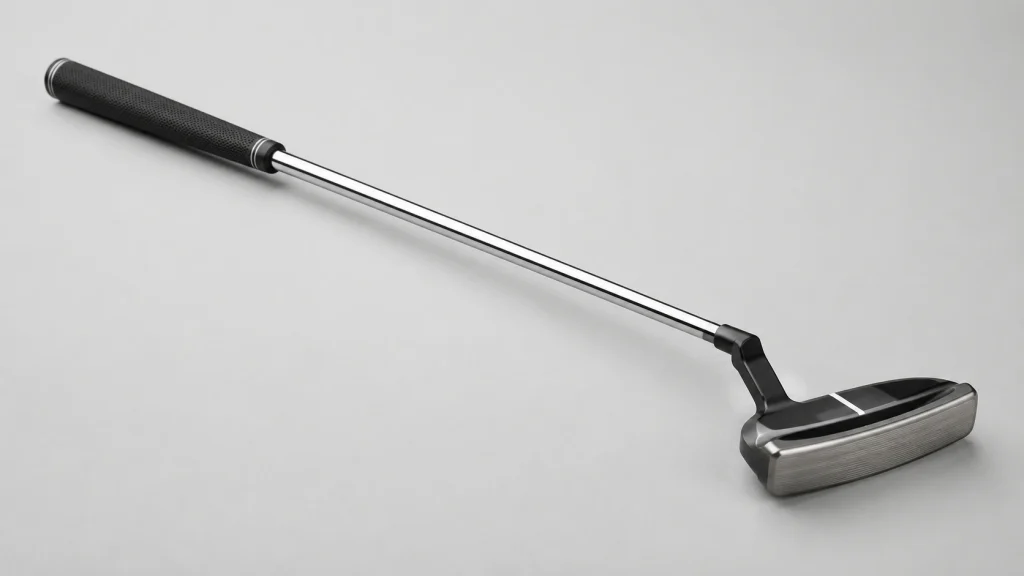
Understanding the basic parts makes it easier to compare models.
Putter Head
The head is the section that contacts the ball. Its shape influences forgiveness, alignment, sound, and overall appearance.
Small heads usually provide a traditional look. Larger heads can place more weight away from the center, helping the putter resist twisting on off-center strikes.
Face
The face is the flat striking surface. It may be milled directly from metal or contain an insert made from another material.
Face construction affects sound and feel. It may also influence how quickly the ball begins rolling, although consistent impact remains more important than marketing claims about a particular face pattern.
Alignment Aid
Alignment aids include lines, dots, contrasting colors, or shapes on the top of the putter.
Some golfers aim more accurately with one short line. Others prefer a long line or a clean head without markings. The most useful design is the one that helps you return the face square to the intended starting line.
Hosel and Neck
The hosel or neck connects the shaft to the head. Its shape affects toe hang, offset, appearance, and how the putter responds during the stroke.
Common designs include:
- Plumber’s neck
- Short slant neck
- Flow neck
- Double-bend shaft
- Center-shafted connection
Shaft
The shaft influences putter length, balance, and feel. Steel is common, but graphite and multi-material putter shafts are also available.
A premium shaft may change feedback or stability. It does not guarantee better results unless the putter’s overall setup suits the golfer.
Grip
Putter grips come in many shapes and sizes. A larger grip may reduce excessive hand action, while a slimmer grip can provide more face awareness.
A grip that is too large can reduce feel, and one that is too small may encourage unwanted wrist movement. Comfort should be balanced with control.
Main Types of Putters
Blade Putters
A blade has a narrow, compact head with a traditional appearance. It generally provides clear feedback when the ball misses the center of the face.
Blade putters often suit golfers who:
- Prefer a simple look at address
- Consistently strike the center
- Want more feedback from impact
- Use a noticeable face-opening and face-closing stroke
Traditional blades are sometimes less forgiving than large mallets. However, modern weighting has made many blade designs more stable than older versions.
Mallet Putters
A mallet has a larger head that extends farther behind the face. Its size allows designers to move weight toward the perimeter.
This generally increases resistance to twisting when contact occurs away from the center. Mallets also provide more space for long alignment lines and contrasting shapes.
A mallet may suit golfers who want:
- More stability on mishits
- Strong visual alignment assistance
- A larger, more reassuring shape
- Consistent performance across more of the face
The main limitation is personal preference. Some golfers find a large head distracting or harder to control on delicate putts.
Mid-Mallet Putters
A mid-mallet sits between a blade and a full mallet. It provides more stability than many traditional blades while maintaining a relatively compact appearance.
It can be a sensible choice for a golfer who wants forgiveness without an oversized clubhead.
Center-Shafted Putters
On a center-shafted putter, the shaft connects near the middle of the head. This creates a direct visual relationship between the hands, shaft, ball, and face.
Some golfers aim these putters well. Others find that the centered shaft blocks their view of the ball or target line. Testing is important because the visual effect is highly personal.
Blade vs Mallet vs Mid-Mallet
| Feature | Blade | Mid-Mallet | Mallet |
|---|---|---|---|
| Head size | Small | Medium | Large |
| Forgiveness | Low to moderate | Moderate to high | Usually high |
| Alignment help | Minimal to moderate | Moderate | Often extensive |
| Feedback | Strong and direct | Balanced | Can feel more muted |
| Best suited to | Consistent contact and traditional preferences | Golfers wanting balance | Golfers needing stability and alignment help |
| Possible limitation | Less stable on mishits | May not excel at one extreme | Size may distract some golfers |
Do not assume every blade suits an arcing stroke or every mallet suits a straight stroke. Neck design, shaft position, weighting, and toe hang can change how an individual model behaves.
Toe Hang and Face Balance
Toe hang describes how the putter face sits when the shaft is balanced horizontally.
A putter with significant toe hang allows the toe to point downward. It may feel natural to golfers whose putter face rotates more during the stroke.
A face-balanced putter points more toward the sky when balanced. It is often associated with a stroke that has less face rotation.
These categories are useful starting points, not strict rules. A golfer’s setup, release pattern, aim tendency, and visual preference may matter more than the general label.
Important Putter Fitting Specifications
Length
Putter length affects posture, eye position, arm hang, and contact. Common off-the-rack lengths include 33, 34, and 35 inches, but those numbers do not fit everyone.
A putter may be too long if:
- Your elbows feel crowded
- Your hands sit unusually far from your thighs
- Your eyes are well inside the ball
- You grip down several inches
- The toe sits noticeably in the air
It may be too short if:
- You feel excessively bent over
- Your arms reach stiffly toward the ground
- Your eyes move too far beyond the ball
- The heel rises at address
Height alone does not determine putter length. Arm length, posture, hand position, and personal comfort also matter.
Lie Angle
Lie angle describes how the shaft sits relative to the ground. With an appropriate lie angle, the putter’s sole rests naturally and the face points where you expect.
If the toe or heel sits too high, the putter may aim differently from what your eyes perceive. It can also make center contact harder to repeat.
Loft
Static loft is built into the club, but the loft delivered at impact also depends on hand position and shaft lean.
A golfer who presses the hands far forward may remove too much loft. A golfer who leans the shaft backward may add excessive loft. Both patterns can produce bouncing or skidding.
Head Weight and Balance
A heavier putter can feel stable and may help smooth a short, quick stroke. A lighter putter may provide more awareness of the head and make long putts feel easier to control.
Green speed also influences preference. Some golfers like more head weight on slow greens, while others prefer a lighter touch on fast surfaces. There is no universal answer.
Grip Size
Grip size affects how actively the hands and wrists work. Large grips are popular, but they are not automatically better.
Test whether the grip helps you start the ball on line and control distance. Comfort without performance is not enough.
Expert Tip: Test putters with the same ball from short, medium, and long distances. A putter that feels excellent on five-foot putts may give you poor speed control from 30 feet.
How Much Does a Good Putter Cost?
Putters range from inexpensive basic models to premium milled designs. Price often reflects materials, manufacturing, finish, adjustability, branding, and fitting options.
| Price range | What to expect | Best for |
|---|---|---|
| Under $100 | Basic construction and fewer options | Beginners or occasional golfers |
| $100–$250 | Better finishes, inserts, and head choices | Most recreational golfers |
| $250–$450 | Premium materials and extensive configurations | Frequent golfers with clear preferences |
| Over $450 | Boutique designs, custom work, or specialized manufacturing | Golfers seeking precise customization |
A well-fitted $150 putter can outperform a poorly fitted $500 putter. Fit, aim, and distance control matter more than prestige.
Used putters can offer excellent value because the heads usually remain usable for many years. Check the face, shaft, hosel, grip, and any adjustable weights before buying.
How to Choose the Right Putter
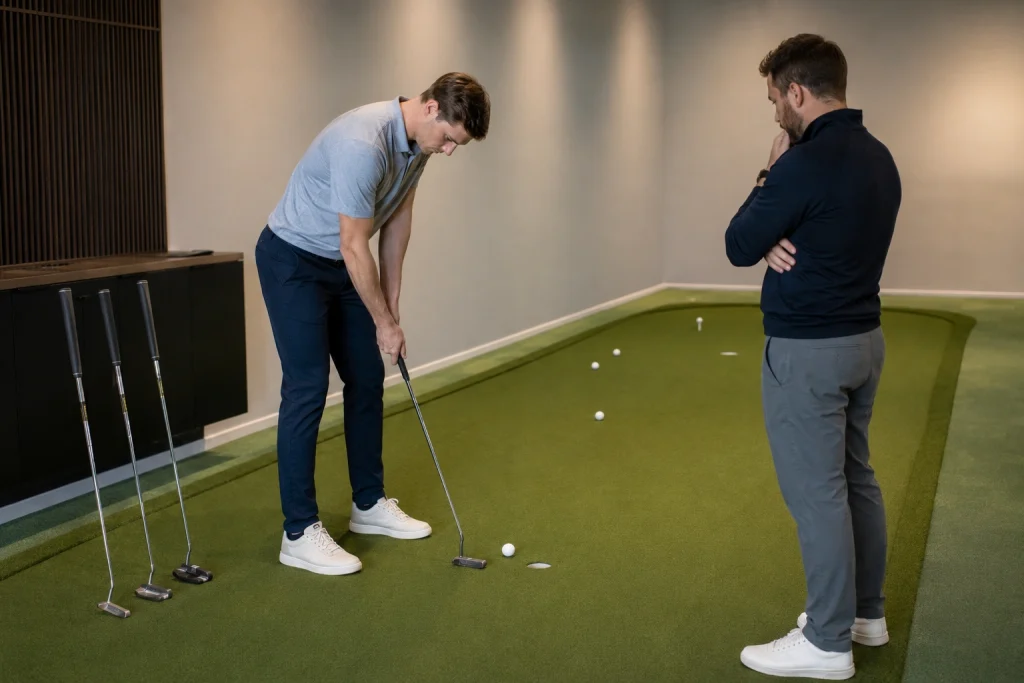
Use a simple testing process instead of choosing only by appearance.
- Set a realistic budget. Include the cost of a new grip or fitting if needed.
- Choose several head shapes. Test at least one blade, mid-mallet, and mallet.
- Check your setup. Your posture should feel balanced, with the arms hanging naturally.
- Test your aim. Set the putter down without repeatedly correcting it. See where the face points.
- Measure strike consistency. Use impact tape or removable face spray during practice.
- Test speed control. Hit putts from 20, 30, and 40 feet, not only short putts.
- Test short-putt confidence. Finish with several straight putts from three to six feet.
- Compare results. Consider dispersion, starting line, distance control, and comfort.
Do not judge a putter from five rushed strokes on artificial turf. If possible, test it on a real green or use a store that offers a reasonable return or trial policy.
Basic Putting Technique
Good equipment performs best with a repeatable setup and stroke.
Build a Balanced Setup
Stand comfortably with your feet approximately shoulder-width apart or slightly narrower. Bend forward from the hips and allow your arms to hang without tension.
Your eyes can be over the ball or slightly inside it. The correct position is one that helps you see the intended line accurately and return the face consistently.
The PGA’s putting fundamentals emphasize aiming the face at the target, positioning the putter behind the ball, and developing a controlled setup.
Control the Face
The face direction at impact strongly influences the ball’s starting line. Focus on returning the face square to your intended target rather than forcing the stroke to travel perfectly straight.
A small amount of natural arc is normal for many golfers.
Develop Speed Control
Distance control depends on predictable contact and stroke length. Try to maintain a steady rhythm while allowing the stroke to become longer for longer putts.
Avoid striking the ball sharply with your hands. A smooth stroke usually produces more reliable speed.
Practice With a Start-Line Drill
Place two tees slightly wider than the putter head. Set the ball between them and make strokes without touching either tee.
You can also create a small gate several inches in front of the ball. If the ball passes through the gate, it started close to your intended line.
Putter Rules and Fair-Play Considerations
Golfers must use conforming equipment during rounds played under the Rules of Golf. The player is responsible for ensuring the club meets the regulations.
The USGA rule covering player equipment also limits a player to 14 clubs. A putter counts as one of those clubs.
Long and arm-lock putters can be legal, but the method of using them matters. A player must not anchor the club or a gripping hand against the body during a stroke, except where a specific Rules modification applies.
Avoid adding temporary materials to the face to change how the ball reacts. If you are uncertain about a modified, unusually shaped, or self-standing putter, confirm its status before using it in competition.
Putter Care and Durability
A well-made putter can last for decades if it receives basic care.
- Wipe the face after playing, especially after using it from wet grass or sand.
- Dry the head and shaft before storing the club.
- Use a headcover to prevent dents and finish damage.
- Inspect adjustable weights periodically.
- Replace a slick, cracked, or hardened grip.
- Do not leave the putter in a wet bag or extremely hot car for long periods.
Normal cosmetic marks rarely affect performance. Deep face damage, a bent shaft, a loose head, or a moving insert deserves professional inspection.
Common Mistakes Golfers Should Avoid
- Buying only for appearance: A beautiful putter is not helpful if you cannot aim it properly.
- Assuming expensive means better: Price does not guarantee suitable length, loft, or balance.
- Testing only short putts: Long putts reveal speed-control problems that short putts may hide.
- Copying a professional golfer: A tour player’s setup and fitted specifications may not suit you.
- Ignoring putter length: The wrong length can force uncomfortable posture and inconsistent contact.
- Choosing by stroke label alone: “Straight stroke” and “strong arc” recommendations are only starting points.
- Changing equipment too often: Constant switching can prevent you from developing confidence and touch.
- Neglecting the grip: A worn or poorly sized grip can change hand action and face control.
- Practicing without a target: Repeatedly rolling balls without checking the starting line provides limited feedback.
When to Get Help From a Golf Pro or Fitter
Consider a lesson if your strike location changes constantly, you struggle with short-putt direction, or you regularly leave long putts far from the hole. A qualified golf professional can identify whether the main problem is setup, face control, speed, or green reading.
A professional fitting may be worthwhile when:
- You are uncertain about putter length or lie angle
- Your current putter does not sit flat
- You consistently aim left or right
- Contact frequently misses the center
- You are considering an expensive putter
- Physical limitations affect your posture or grip
- Several putters feel comfortable but produce different results
A good fitter should measure performance and explain the recommendation. Be cautious if the session focuses only on selling the most expensive model.
FAQs
What is the main purpose of a putter?
A putter is designed to start the ball on a chosen line and control its rolling speed, primarily on the putting green. It can also be used from closely cut areas around the green.
Is a blade or mallet putter better for beginners?
Many beginners benefit from a mallet’s stability and visible alignment features. However, a blade can work well if it helps the golfer aim and control distance. Testing both is better than relying on a general rule.
What putter length should I use?
The correct length lets you stand comfortably with relaxed arms and consistent eye position. Many adults use putters between 33 and 35 inches, but height alone should not determine the choice.
How much loft does a putter have?
Most putters have approximately 2 to 4 degrees of loft. The best amount depends on your hand position, impact pattern, ball position, and the type of greens you usually play.
Can I carry two putters?
Yes. You may carry two putters as long as your total number of clubs does not exceed 14. Carrying two reduces the number of spaces available for other clubs.
Are expensive putters more accurate?
Not automatically. Premium putters may offer better materials, finishes, and fitting options, but accuracy depends mainly on suitable specifications, sound technique, and consistent contact.
How often should I replace my putter?
There is no fixed replacement schedule. Keep using it while the club remains undamaged and continues to suit your setup and stroke. A new grip or fitting adjustment may be more useful than replacing the entire putter.
Conclusion
A putter’s job is simple: help you start the ball on the intended line with the correct speed. Choosing the right one requires more than selecting an attractive head or copying a tour professional.
As this Putter Explained guide shows, head shape, length, lie angle, loft, balance, grip size, alignment aids, and feel all influence performance. The best putter is the model that produces repeatable contact, dependable distance control, and confidence over the ball.
Test several designs from different distances, record the results, and arrange a professional fitting if the correct specifications remain unclear. Then commit to your choice and practice both starting direction and speed control before your next round.