
Golf Tee Guide: Types, Sizes, Heights, and Rules

Quick Answer
This golf tee guide covers a simple rule: choose a tee that holds the ball at a repeatable height without distracting you. A 2¾-inch tee suits many drivers, while 3¼-inch tees offer more adjustment for deep-faced drivers. Under the USGA Equipment Rules for tees, a conforming tee cannot exceed four inches.
A Practical Starting Setup
- Driver: Start with roughly half the ball above the driver’s crown.
- Fairway wood: Raise the ball modestly, leaving most of it below the crown.
- Hybrid: Tee it just above the grass, similar to a favorable fairway lie.
- Iron: Use a short tee and place the ball barely above ground level.
- Best material: Choose wood or bamboo for simplicity and plastic for durability.
Best Buying Tip
- Carry one longer tee for your driver and several short tees for irons, hybrids, and par-3 shots.
I’ve used everything from basic wooden tees to large plastic cup designs. The best option has always been the one I can set at the same height without thinking.
This guide explains tee materials, lengths, setup, ball-flight effects, rules, and common mistakes. It also separates a golf tee from the course’s teeing area, which beginners often confuse.
In This Guide
What Is a Golf Tee, and What Does It Do?
A golf tee is a small device that raises a ball above the ground for a stroke from the teeing area. It gives you a cleaner, more repeatable starting lie.
Definition: A golf tee supports the ball above the ground. The teeing area is the rectangular part of the course where you begin a hole.
Why does teeing the ball help?
A tee removes grass and uneven ground from the immediate contact area. That makes your starting conditions easier to repeat.
With a driver, the raised ball also gives the clubhead space to meet it while traveling level or upward. That can support a higher launch when your swing and impact position match the setup.
- Cleaner contact: Less grass sits between the clubface and ball.
- Repeatable height: You can begin each tee shot from a similar position.
- More setup options: Height can be adjusted for different clubs and intended trajectories.
- Better confidence: A familiar visual makes alignment and commitment simpler.
Does the tee create distance?
The tee does not supply energy to the shot. Club delivery, strike location, ball speed, launch, and spin still determine the result.
However, a suitable tee height can make centered contact easier. Poor height can encourage contact too high, low, or near an edge of the clubface.
I treat the tee as a setup tool rather than a distance gadget. Its job is to make my intended strike easier to reproduce.
Section Takeaway: A golf tee creates a consistent starting lie. Its value comes from repeatability, not a guaranteed distance increase.
Which Type of Golf Tee Should You Use?
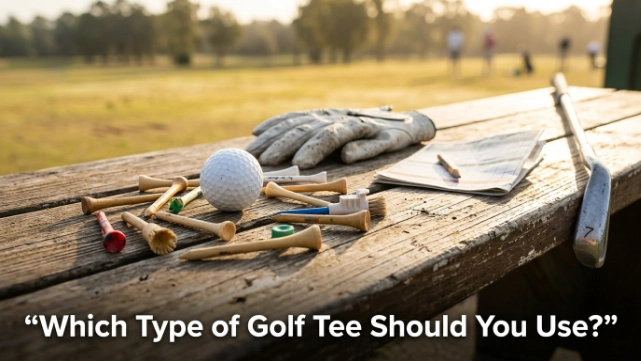
Most golfers can play well with an inexpensive wooden, bamboo, or plastic tee. Specialized shapes mainly change durability, visibility, and how easily you repeat the height.
How do the main golf tee types compare?
| Tee Type | Main Advantage | Possible Drawback | Best Fit |
|---|---|---|---|
| Wood | Simple, inexpensive, and easy to push into firm turf | Can snap after one or several swings | Golfers who want a traditional option |
| Bamboo | Natural material with a familiar shape | Still breakable and quality varies | Golfers seeking an alternative to standard wood |
| Plastic | Durable, reusable, and available in bright colors | Can bend and may be difficult to insert into hard ground | Golfers who dislike replacing broken tees |
| Step or castle | Stops at a preset depth for repeatable height | Offers less height adjustment | Beginners building a consistent setup |
| Brush or pronged | Distinct support shape and good visibility | Costs more and may feel unfamiliar | Golfers who prefer reusable specialty tees |
| Wide-cup | Makes balancing the ball easy | Bulky shape takes more pocket space | Golfers with limited hand steadiness |
Are wooden tees better than plastic tees?
Neither material is automatically better. Wooden tees feel firm and insert easily, while plastic tees usually survive more shots.
I keep wooden tees in my bag because they work in most conditions. I add one bright plastic tee when visibility matters or the ground is soft.
- Choose wood: If you want low cost, firm insertion, and a traditional feel.
- Choose bamboo: If you prefer a natural material but still want a classic design.
- Choose plastic: If durability and reuse matter most.
- Choose a wide cup: If balancing the ball on a narrow tee is uncomfortable.
- Choose a step design: If repeating one preset height is your priority.
Do low-friction tees add distance?
Be careful with distance claims printed on packaging. Small differences in strike location, face angle, wind, and turf can outweigh any tee-design effect.
A specialty tee may still help if it improves your confidence or setup. That practical benefit is different from promising extra yards.
Try two tee types during the same practice session. Judge them by setup speed, height consistency, visibility, durability, and comfort.
Section Takeaway: Start with a basic tee and change designs only when you can name the problem you want to solve.
What Length of Golf Tee Do You Need?
The right length depends on the clubhead, desired ball height, and how deeply the tee enters the ground. Most golfers need one long driver tee and one short tee.
What are common golf tee sizes?
| Approximate Length | Typical Use | What to Consider |
|---|---|---|
| 1½ inches | Irons, hybrids, and some fairway woods | Limited adjustment on soft ground |
| 2⅛ inches | Fairway woods and smaller driver setups | May be too short for a high driver setup |
| 2¾ inches | General driver use | A practical all-purpose driver length |
| 3¼ inches | Modern deep-faced drivers | Provides more adjustment on soft turf |
| 4 inches | Maximum conforming length | Usually unnecessary for a standard setup |
These are common commercial sizes, not mandatory pairings. A golfer may use a longer tee for an iron as long as the ball sits at the intended height.
Is a 2¾-inch or 3¼-inch tee better for a driver?
A 2¾-inch tee works for many drivers on firm or normal ground. A 3¼-inch tee offers extra insertion depth while keeping the ball high enough.
That extra half-inch helps on soft tee boxes. You can push more of the tee into the ground without losing your preferred ball height.
A longer tee does not mean you must tee the ball higher. Tee length and visible ball height are separate measurements.
How many tee sizes should you carry?
Two sizes cover most situations. Carry a longer driver tee and a short tee for clubs with shallower faces.
- Driver tee: About 2¾ to 3¼ inches provides useful adjustment.
- Short tee: About 1½ to 2⅛ inches works for irons, hybrids, and fairway woods.
- Backup option: A broken wooden tee often works for a low iron setup.
I also mark my driver tee with a thin permanent-ink line. The mark gives me a quick depth reference when tee-box conditions change.
Section Takeaway: Tee length provides adjustment room. Choose it according to the height above the ground, insertion depth, and clubface size.

How High Should You Tee the Ball?
Match tee height to the club’s face depth and your intended strike. Start with a neutral height, check contact, and adjust in small steps.
What is the best tee height for a driver?
A dependable starting point leaves about half the ball above the driver’s crown at address. This setup also appears in PGA driver guidance on tee height.
The exact height still depends on your swing. Impact tape or foot-powder spray can show whether the ball meets the face too high or low.
| Club | Starting Height | Setup Goal |
|---|---|---|
| Driver | About half the ball above the crown | Create room for centered contact with an upward or level delivery |
| Fairway wood | Roughly one-quarter of the ball above the crown | Copy a clean, slightly raised fairway lie |
| Hybrid | Just above the grass | Encourage a normal hybrid swing instead of a driver swing |
| Iron | Barely above ground level | Provide a perfect lie while preserving a downward strike |
Should irons be teed up?
Yes, you may tee an iron shot when playing from the teeing area. Set the ball only slightly above the turf so it resembles a clean lie.
Iron shots usually need a downward clubhead movement at impact. TrackMan defines attack angle as the clubhead’s upward or downward movement at maximum compression.
A high iron tee can move the strike toward the top of the face. It may also tempt you to scoop instead of making your normal iron swing.
Does tee height change ball flight?
Tee height can influence where the ball meets the face. Impact location then affects launch, spin, speed, and the resulting trajectory.
- Higher setup: May support a higher-face strike and higher launch when paired with suitable delivery.
- Lower setup: May produce a lower-face strike or encourage a steeper-looking setup.
- Too high: Can lead to contact near the crown or underneath the ball.
- Too low: Can lead to thin contact low on the driver face.
Do not use tee height as the only fix for a slice, hook, or major launch problem. Face angle, swing path, strike location, and club setup may all contribute.
Pro tip: Ask a certified PGA professional or qualified club fitter to check your delivery if contact remains inconsistent after simple height adjustments.
How can you find your ideal driver tee height?
Test three heights during one range session. Keep your target, ball position, driver setting, and swing intention unchanged.
- Set a baseline: Place half the ball above the driver crown.
- Hit a small group: Use five controlled shots instead of chasing one perfect swing.
- Check impact: Record face contact with impact tape or removable foot spray.
- Adjust slightly: Test about one-quarter inch higher and lower.
- Compare patterns: Favor the height producing the tightest contact area and useful flight.
- Create a reference: Mark the selected insertion depth on your tee.
During my own practice, the face-contact pattern matters more than the longest ball. A repeatable group near the center is more useful on the course.
Section Takeaway: Use half the ball above the driver crown as a baseline, then let face contact and flight determine the final height.
How Do You Use a Golf Tee Consistently?
A consistent tee routine controls location, height, alignment, and commitment. It should take only a few seconds once practiced.
What is the correct way to tee a golf ball?
- Choose your club: Decide on the shot before placing the ball.
- Find level ground: Avoid severe slopes, bare patches, and old divots when possible.
- Pick a starting line: Use a distant target and a nearby natural reference.
- Insert the tee: Push it straight enough to hold the ball securely.
- Set the height: Compare the ball with the club’s crown or top line.
- Build your stance: Align the clubface before settling your feet.
- Commit to the shot: Make your normal swing without trying to hit the tee.
The tee may lean slightly and still support the ball. Stability and repeatable height matter more than visual perfection.
Where should you place the ball in the teeing area?
Look for a flat section with healthy turf. A level stance makes balance and ball position easier to repeat.
You can also use the teeing area to improve your angle into the fairway. However, do not aim so aggressively that trees, rough, or hazards remove your safe miss.
- Right-side trouble: Consider starting from the right to create a more open-looking angle left.
- Left-side trouble: Starting from the left may improve the view toward the safer right side.
- Curved hole: Choose an angle that fits your normal shot rather than an imagined perfect shape.
- Uneven ground: Prioritize a level stance over gaining a few feet of angle.
What tee-height mistakes cause poor contact?
The most common error is changing height without noticing. Soft ground, hurried setup, and tees without markings can create unwanted variation.
- Guessing every time: Use a mark, step, stripe, or finger-depth reference.
- Copying another player: Their clubhead, delivery, and ball position may differ from yours.
- Teeing irons too high: Keep the ball close to ground level.
- Changing two variables: Test height before moving ball position or changing swing intention.
- Ignoring impact marks: Ball flight alone may hide a poor strike during calm conditions.
Should you aim the tee toward the target?
A standard tee’s direction does not aim the ball. Your clubface, body alignment, impact conditions, and swing path shape the starting direction and curve.
Some tee designs include directional features. Avoid any design or setup intended to indicate the line of play or otherwise provide prohibited assistance.
Section Takeaway: Build a short routine and use a visible depth reference. Consistent setup gives you better information about the swing that follows.
What Golf Tee Rules and Etiquette Should You Know?
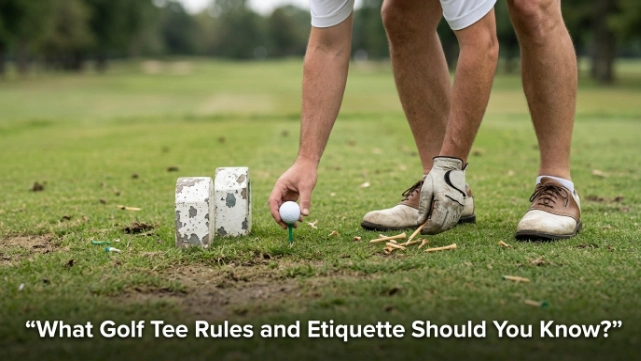
A legal tee must meet equipment requirements, and the ball must begin from within the correct teeing area. Course etiquette also calls for removing broken or discarded tees.
How long can a legal golf tee be?
A conforming golf tee cannot exceed four inches, or 101.6 millimeters. It also cannot indicate the line of play, unduly influence ball movement, or otherwise assist the stroke.
That rule covers conventional and specialty tees. Product shape and marketing language do not override the equipment requirements.
Where can you place the ball between the tee markers?
The teeing area is a rectangle extending two club-lengths behind the front line of the markers. The outside edges of those markers define its width.
Any part of the ball must touch or sit above part of that rectangle. Your feet may stand outside it while the ball remains inside.
- Ball position: Keep at least part of the ball within the defined area.
- Stance: Your feet may be outside the rectangle.
- Ground: The ball may sit on a tee or directly on the ground.
- Tee markers: Do not move them to improve your conditions before playing.
What happens if you play outside the teeing area?
The outcome depends on the format. The official R&A Rule 6 guidance explains the full procedure.
In match play, the opponent may cancel the stroke and require it to be replayed. If the opponent does not cancel it, play continues without penalty.
In stroke play, the player receives the general penalty of two strokes and must correct the mistake. Failing to correct it before the required deadline can lead to disqualification.
Can you re-tee a ball that falls off?
If the ball falls or gets knocked off before you make a stroke, you may re-tee it without penalty. A practice movement that accidentally dislodges it is not automatically a stroke.
If you swing intending to strike the ball and miss, the stroke counts. Because the ball remains in the teeing area, the rules may still allow it to be lifted and re-teed there.
Can you use a broken or borrowed tee?
Yes. You may use a borrowed, abandoned, or broken conforming tee when playing from the teeing area.
A broken tee is often ideal for an iron or hybrid. Check that it remains stable and does not have a sharp edge that could cut your hand.
What should you do with broken tees?
Pick them up and use any container supplied beside the markers. The USGA notes that discarded tees can create maintenance problems, including possible mower damage.
- Collect fragments: Do not leave pieces scattered across the turf.
- Use provided bins: Many courses place small containers near the markers.
- Keep play moving: Retrieve the tee only when it is safe and quick.
- Avoid littering: Reusable plastic tees still need responsible handling.
Golfers also use “tee” to mean a set of course markers, such as forward or back tees. That course-selection meaning is different from the small device supporting the ball.
Section Takeaway: Use a conforming tee, keep the ball within the teeing area, leave the markers in place, and collect broken pieces.
Golf Tee FAQs
What golf tee is best for beginners?
A durable 2¾-inch or 3¼-inch tee with a height mark is a practical driver option. Add short tees for irons and hybrids. Beginners gain more from a repeatable height than from an expensive specialty design.
Can you use a golf tee on every shot?
No. A tee may normally be used when playing from the teeing area. Once the ball is in play elsewhere on the hole, you cannot create a teed lie unless a specific rule or authorized format allows it.
Do professional golfers use wooden or plastic tees?
Professionals use different materials and shapes based on personal preference. Their choice does not make one material universally better. A conforming tee that provides the intended height can work at any skill level.
Should you tee up a par-3 shot?
You may tee the ball on a par 3, even when using an iron. Set it barely above the grass to create a clean lie while preserving your normal iron delivery.
Can a golf tee fix a slice?
A tee cannot directly correct a slice. Height may change strike location, but slices often involve face angle, swing path, or both. Use impact feedback and seek qualified instruction if the pattern continues.
Does tee color matter?
Color does not directly change ball flight. Bright colors are easier to find, while a color band can create a useful depth reference. On courses, colored tee markers may identify different playing distances.
How many golf tees should you carry?
Carry enough for several breakages without filling your pocket. Around 10 to 15 wooden tees or two reusable tees plus backups will cover most rounds. Include at least two lengths.
Can a golf tee be longer than four inches?
Not in a round played under standard USGA or R&A equipment rules. A conforming tee cannot exceed four inches, or 101.6 millimeters.
Final Takeaway: Start with a straightforward 2¾-inch or 3¼-inch driver tee and a shorter tee for other clubs. Set a neutral height, inspect face contact, and make small adjustments instead of chasing equipment claims.
Test your setup during practice, mark the height that works, and use the same reference on the course. That simple habit can make every tee shot feel more familiar.