
What Is a Golf Rangefinder? How It Works, Types, and Golf Rules

Quick Answer
A golf rangefinder is a distance-measuring device that helps golfers determine how far away a target is, such as the flagstick, a bunker, or another point on the course. Laser models measure the distance to a target you can see, while GPS devices use course maps to provide yardages to greens and hazards. A rangefinder helps you make better-informed club selections, but it doesn’t replace your judgment about wind, lie, elevation, or shot execution.
What should golfers know first?
- Laser measurement: A laser rangefinder measures the distance to the specific target you aim at.
- GPS yardages: GPS devices show distances to mapped points, often including the front, middle, and back of the green.
- Slope compensation: Some models adjust the displayed yardage to account for uphill or downhill shots.
- Pin-lock technology: Target-priority features help distinguish the flagstick from trees or objects behind it.
- Club selection: Yardages help you compare the target distance with your typical carry distance for each club.
- Competition rules: Distance-measuring devices may be allowed, but course and competition rules can restrict their use and certain functions.
A useful first step
- Before choosing a club, measure your target, check your lie and the wind, then compare the yardage with your own club-distance records.
A golf rangefinder can take much of the guesswork out of choosing a club, especially when the flag looks closer or farther away than it really is. In this guide, I’ll explain how rangefinders work, how they compare with GPS devices, which features matter, and what to know before using one on the course.
In This Guide
What Is a Golf Rangefinder, and What Does It Measure?
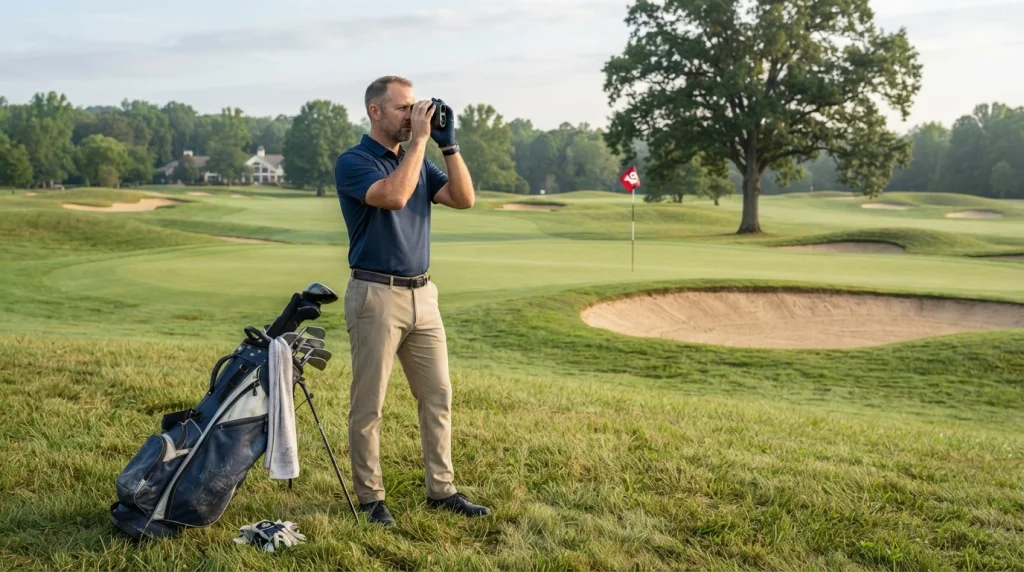
A golf rangefinder is a device that measures the distance between your position and a selected target on the golf course. Golfers commonly use one to find the yardage to a flagstick before an approach shot.
The reading gives you a more reliable starting point for club selection than estimating distance by eye alone. You still need to consider the lie, wind, elevation, and the distance you typically carry the ball.
What distances can a golf rangefinder measure?
A laser rangefinder can measure the distance to many visible targets, provided it can acquire a reliable reading. Useful targets include:
- Flagstick: Helps establish the distance to the pin on an approach shot.
- Bunker edge: Helps you decide how far you need to carry the ball to clear a hazard.
- Fairway landmark: Gives you a reference point when planning a tee shot or layup.
- Tree or other obstacle: Helps estimate the distance to a visible feature that affects your shot.
Not every target provides an equally easy reading. Rain, fog, poor visibility, unstable aim, and targets that are difficult to distinguish can make measurement less reliable.
Why does accurate yardage matter?
Golf clubs produce different distances, and those distances vary between players and even between swings. Knowing the distance to your target helps you choose a club based on your own performance instead of relying on a generic yardage chart.
For example, suppose a flag sits 145 yards away. If your reliable carry distance with a particular iron is around 140 yards, you may need a different club or a different shot plan.
The number doesn’t make the decision for you. It gives you a useful fact to combine with course conditions and your own playing experience.
Section takeaway: A golf rangefinder measures target distance so you can plan shots with better information. Its greatest value comes from combining accurate yardage with realistic knowledge of your own club distances.
How Does a Golf Rangefinder Work?
A laser golf rangefinder sends a brief pulse of laser light toward a target and measures the returning signal. Its electronics use the signal’s travel time to calculate the distance and display the result, usually in yards or metres.
This method is known as time-of-flight measurement. Golf-specific models also use optics and target-selection features to help you measure a small flagstick against a busy background.
How does a laser rangefinder find the flag?
When you look through a laser rangefinder, you see a magnified view of the target area. You aim the device at the flagstick and press its measurement button.
The device then processes the returning laser signal and displays a distance. Depending on the model, a pin-seeking feature may prioritize a nearby flagstick over trees or other objects farther away.
Some models provide a vibration or visual confirmation when they lock onto the target. That feedback can help, but you should still check that the reading makes sense for the hole.
What is the difference between actual distance and playing distance?
Actual distance is the measured distance between you and the target. Playing distance describes the distance a shot may effectively require after accounting for factors such as elevation.
An uphill shot can require more effort or a different club than a level shot with the same measured distance. A downhill shot can play shorter, although wind, landing conditions, and the type of shot can change the result.
Some rangefinders estimate a slope-adjusted, or “plays-like,” distance using elevation measurements. This is an estimate of playing difficulty, not a guarantee of how far your ball will travel.
How accurate is a golf rangefinder?
Accuracy depends on the device, target, conditions, and how steadily you aim. Check the manufacturer’s stated accuracy and rated measurement range rather than assuming every model performs identically.
For practical use, aim carefully at the intended target and take another reading if the number seems unusual. Comparing the reading with known course markers can help you catch an obvious targeting error.
Section takeaway: Laser rangefinders calculate distance from reflected light, while target-lock and slope features add useful information. A sensible reading still depends on aiming at the correct object and interpreting the result in context.
What Are the Different Types of Golf Rangefinders?
Golfers can choose between laser rangefinders, GPS devices, and hybrid systems that combine both technologies. The right option depends on whether you value exact target measurements, quick course-wide yardages, or a mixture of both.
Laser rangefinders
A laser rangefinder measures the distance to the target you aim at, making it useful for approach shots and precise layup decisions. Most handheld models have a viewing lens, measurement button, and display that shows the reading.
Laser models work on courses without requiring a downloaded course map. However, you generally need a clear line of sight to the target, and measuring each new target requires you to aim the device again.
GPS golf watches and handheld GPS devices
GPS golf devices use satellite positioning and mapped course information to estimate distances to important points. Many show front, middle, and back green yardages, along with selected hazards and layup points.
A GPS watch is convenient because you can check distances from your wrist. A handheld GPS device offers a larger screen for golfers who prefer a map of the hole.
Hybrid laser and GPS devices
Hybrid models combine laser measurements with GPS information. Depending on the model, you might measure the flag with a laser while using GPS to see the green’s broader layout or distances to other course features.
This combination can be helpful on unfamiliar courses. It can also cost more than a basic laser or GPS-only device, so consider whether you’ll use the additional features.
Golf rangefinder vs. GPS: Which is better?
Neither option is automatically better for every golfer. A laser suits players who want to measure a visible target, while GPS is often more convenient for golfers who want several distances without repeatedly aiming a device.
| Feature | Laser rangefinder | GPS device |
|---|---|---|
| How it measures | Laser reflection from a visible target | Satellite positioning and mapped course data |
| Flagstick distance | Measures the flag when successfully targeted | Usually provides mapped green distances rather than a direct measurement to the pin |
| Hazard information | Can measure visible hazard features individually | Can display mapped hazards and layup points |
| Line of sight | Generally needed for the selected target | Not needed to view a mapped point |
| Course mapping | Not usually required | Requires suitable course data |
| Typical advantage | Specific target measurement | Quick access to multiple mapped distances |
| Potential drawback | Requires aiming and a readable target | Mapped distances may not match the exact pin position |
Section takeaway: Choose a laser for direct measurements to visible targets, GPS for convenient course-wide yardages, or a hybrid model if you want both.
Which Golf Rangefinder Features Matter Most?
The most useful golf rangefinder features are reliable distance readings, easy target acquisition, a clear display, and comfortable handling. Slope compensation and other extras can help in specific situations, but they shouldn’t distract you from the basics.
What is slope compensation on a golf rangefinder?
Slope compensation estimates how an uphill or downhill target affects the distance you should consider when selecting a shot. The device combines its measured distance with elevation information to produce a modified yardage.
For example, a target measured at 150 yards uphill may play longer than a level 150-yard shot. A slope-enabled device may display an adjusted distance, but the result remains an estimate rather than a guarantee.
Look for a model that lets you clearly disable slope compensation if you play competitions. The important distinction is between owning a device with slope capability and accessing that function during a round when the rules prohibit it.
What do pin-lock and vibration features do?
Pin-lock features help the device distinguish a nearby flagstick from background objects. A vibration alert or visual indicator may confirm that the rangefinder has acquired the target.
These features can be particularly useful when trees sit behind the green or the flag is difficult to isolate. They don’t eliminate every targeting error, so check the reading if the result seems inconsistent with the hole.
Does magnification matter?
Magnification makes distant targets appear closer through the viewing lens. Many golf laser rangefinders offer approximately 6x magnification, although specifications vary by model.
More magnification isn’t always better. Image clarity, display readability, and how steadily you can hold the device also affect your ability to acquire the flag.
Which other features are worth considering?
- Display visibility: Check whether the yardage is easy to read in bright sunlight and overcast conditions.
- Weather resistance: Consider protection against rain and moisture if you regularly play in changeable weather.
- Battery type: Check how the device is powered and how convenient replacement or recharging will be.
- Size and grip: Choose a shape that feels comfortable to hold and easy to use with one hand.
- Measurement units: Make sure you can select yards or metres as needed.
- Range and accuracy specifications: Compare the manufacturer’s stated limits rather than relying on broad marketing claims.
As of 2026, golfers can find basic laser models, slope-enabled units, GPS watches, and connected hybrid devices across a wide range of prices. Paying for extra technology makes sense only when it solves a problem you regularly encounter on the course.
Section takeaway: Prioritize dependable measurements and easy operation first. Buy slope, GPS integration, and premium optics when those features fit your course conditions and playing habits.
How Do You Use a Golf Rangefinder?
Using a golf rangefinder is straightforward: aim at a suitable target, take a reading, and use that distance alongside your own club yardages. The key is to measure the right target and avoid treating the number as a complete shot recommendation.
How to measure the flagstick
- Find a stable position: Stand where you can see the flag clearly and hold the device steadily.
- Look through the lens: Center the flagstick in the viewing area rather than aiming at the trees or green behind it.
- Press the measurement button: Follow the device’s instructions to obtain the distance.
- Confirm the target: Check any pin-lock indicator or vibration alert if your model offers one.
- Repeat if necessary: Take another reading if the number seems inconsistent or the device may have locked onto the wrong object.
- Choose your shot: Compare the distance with your carry yardages, lie, wind, elevation, and the safe landing area.
How should you use yardage for club selection?
Start with your typical carry distance, which is how far the ball travels through the air before landing. Carry distance is particularly important when a bunker, water hazard, or other obstacle lies between you and your target.
Suppose you measure 160 yards to a flag. Your next step is to consider which club can cover that distance under the current conditions, not simply choose a club because its maximum distance matches the number.
- Check the lie: Grass, rough, sand, and uneven ground can change the strike and resulting distance.
- Assess the wind: A headwind or tailwind can affect how far the ball travels.
- Consider elevation: Uphill and downhill shots may require different clubs.
- Choose a landing area: The safest target may be the center of the green rather than a tucked pin.
What common rangefinder mistakes should you avoid?
Most errors come from poor targeting or misinterpreting the displayed number. A rangefinder can provide a precise measurement to the wrong object just as easily as it can measure the intended target.
- Aiming beyond the flag: Trees behind the green can interfere with target acquisition.
- Ignoring carry distance: Total distance and carry distance are not interchangeable.
- Overlooking the lie: A clean fairway lie and a difficult rough lie may call for different decisions.
- Trusting slope blindly: An adjusted yardage doesn’t account for every factor affecting a shot.
- Delaying play: Take readings efficiently and avoid repeatedly measuring the same target without a reason.
Section takeaway: Measure the intended target, confirm the reading, and combine it with your own carry distances and course conditions. Good distance management supports sound decisions; it doesn’t replace them.
Are Golf Rangefinders Legal in Tournaments?
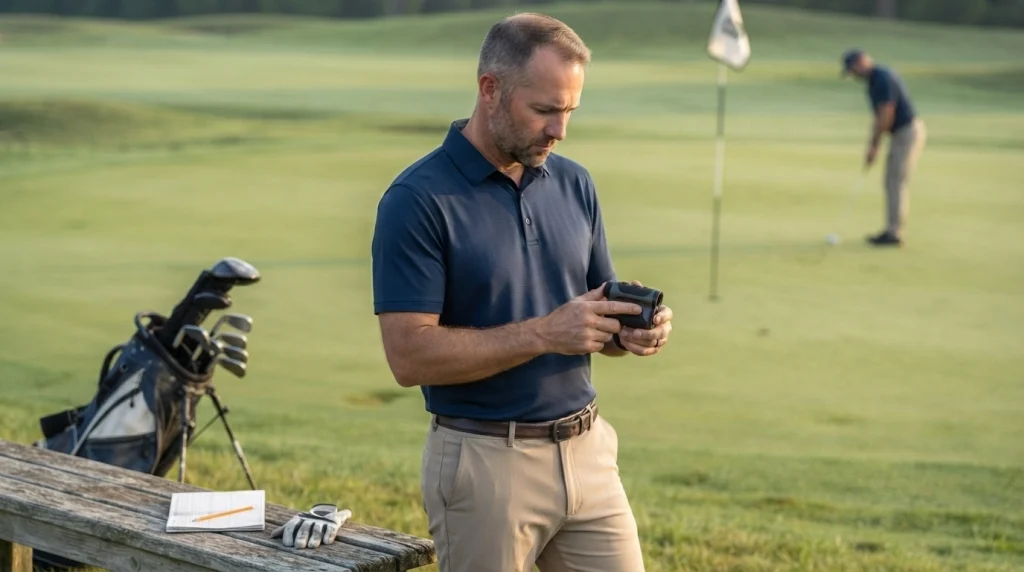
Golf rangefinders are generally permitted under the Rules of Golf, but a committee can prohibit distance-measuring devices through a Local Rule. Players must also follow restrictions on slope compensation and other features that provide information beyond permitted distance or direction information. USGA Rule 4.3 explains the relevant equipment restrictions.
Can you use slope mode during a competition?
Under Rule 4.3a, players must not access prohibited functions such as measuring elevation changes or using slope-adjusted playing distances during a round governed by the Rules of Golf. A rangefinder can have slope capability, but you must not use that function when it is prohibited.
Many models include a tournament mode or physical switch that disables slope compensation. Check the device instructions and the event’s conditions before playing rather than assuming a particular setting guarantees compliance.
What about GPS watches and golf apps?
GPS watches, handheld GPS devices, and phone-based distance-measuring applications can also qualify as distance-measuring devices. Their use remains subject to the applicable Rules of Golf and any Local Rules adopted by the committee.
The R&A Rules of Golf provide the international rules reference. For an event, check its specific conditions because the committee may impose restrictions beyond the general permission to measure distance.
How can you check before your round?
- Read the competition notice and Local Rules on the scorecard or event website.
- Confirm whether distance-measuring devices are permitted at all.
- Disable prohibited slope, wind-measurement, or other restricted functions.
- Ask the tournament committee if the device’s features or settings are unclear.
Section takeaway: A rangefinder is not automatically legal in every competition simply because it measures distance. Check the event rules and use only permitted functions during the round.
Golf Rangefinder FAQs
1. What is the main purpose of a golf rangefinder?
A golf rangefinder measures the distance between your position and a target, such as the flagstick or a visible hazard. Golfers use that measurement to compare the required shot distance with their club carry distances and make better-informed decisions about club selection.
2. Is a golf rangefinder worth it for beginners?
Yes, a rangefinder can help beginners learn course distances and make more informed club choices. It’s particularly useful when paired with a simple record of carry distances for each club. However, beginners can also benefit from course markers or a GPS device if they prefer a simpler way to check yardages.
3. What is the difference between a golf rangefinder and a GPS watch?
A laser rangefinder measures distance to a specific visible target, while a GPS watch uses satellite positioning and mapped course data to show distances to greens and hazards. A laser is useful for measuring a visible flagstick; GPS is convenient when you want several mapped distances without aiming a device.
4. Does a golf rangefinder measure slope?
Some golf rangefinders include slope compensation, which estimates how elevation changes affect the effective playing distance. Basic models may provide only the measured distance. During a competition, players must not access slope-adjusted distances when the Rules of Golf prohibit that function.
5. Can a golf rangefinder measure the distance to a bunker?
Yes, a laser rangefinder can measure the distance to a visible bunker edge or another suitable target. Measuring the near or far edge can help you plan a carry or layup. Make sure you aim at the intended feature, because the reading depends on which object the device acquires.
6. Do you need a golf rangefinder for every round?
No. You can play golf using course markers, scorecards, GPS devices, or other permitted distance information. A rangefinder is useful if you want to measure specific targets, but it is optional equipment rather than a requirement for playing well.
7. What should you look for when buying a golf rangefinder?
Start with dependable distance measurement, clear optics, straightforward controls, and comfortable handling. Then consider pin-lock feedback, slope compensation with a suitable tournament setting, weather resistance, and battery convenience. Choose features that match your needs rather than paying for extras you won’t use.
Final Takeaway: Is a Golf Rangefinder Right for You?
A golf rangefinder is a practical tool for golfers who want to replace distance estimates with more reliable measurements. It can help you plan approach shots, judge carries over hazards, and compare target yardages with your own club distances.
If you prefer measuring a specific target, a laser rangefinder is a sensible starting point. If you want front, middle, and back green distances without aiming, consider GPS; if you want both, explore a hybrid device.
My advice is to prioritize easy operation and dependable readings over a long list of features. Learn your own carry distances, use yardage as one part of your shot decision, and check the competition rules whenever you play a formal round.
Once you understand what a rangefinder measures—and what it cannot tell you—you can use it to make more informed decisions without slowing down your round or overcomplicating your game.