
Golf Iron Explained: Types, Parts, Uses, and How to Choose the Right Irons

Golf irons can be confusing when you are learning the game. A typical set contains several clubs that look similar, yet each one produces a different distance, height, and amount of control.
This golf iron explained guide breaks the subject into simple parts. You will learn how irons work, what the numbers mean, which designs suit different skill levels, and what to consider before buying a set. You will also learn basic iron technique and when professional fitting may be worthwhile.
Quick Answer
A golf iron is a club designed mainly for approach shots, tee shots on short holes, and controlled shots from the fairway or rough. Lower-numbered irons generally travel farther with a lower flight. Higher-numbered irons are shorter, more lofted, easier to control, and commonly used closer to the green.
What Is an Iron in Golf?
An iron is a golf club with a relatively thin head, a flat-looking face, and angled grooves. Most golfers use irons when accuracy and distance control matter more than maximum yardage.
Traditional iron sets run from the 3-iron through the 9-iron. Modern sets often begin with a 5-iron or 6-iron because many golfers replace harder-to-hit long irons with hybrids.
A typical beginner-friendly set might include:
- 5-iron
- 6-iron
- 7-iron
- 8-iron
- 9-iron
- Pitching wedge
Although wedges are technically related to irons, they are usually discussed as a separate club category because they are designed for shorter specialty shots.
What Do the Numbers on Golf Irons Mean?
The number identifies the iron’s general loft, length, and intended distance. As the number increases, the club normally becomes shorter and more lofted.
A 5-iron is usually longer and less lofted than a 9-iron. It should produce more distance but may be harder to strike consistently.
| Iron | Typical Use | Normal Ball Flight | Difficulty for Beginners |
|---|---|---|---|
| 3-iron | Long approaches and low tee shots | Low and long | Very difficult |
| 4-iron | Long approaches and tee shots | Low to medium | Difficult |
| 5-iron | Longer fairway shots | Medium | Moderate |
| 6-iron | Medium-length approaches | Medium | Moderate |
| 7-iron | Approach shots and practice | Medium to high | Beginner-friendly |
| 8-iron | Short approaches | High | Easier |
| 9-iron | Short approaches and controlled shots | High | Easier |
| Pitching wedge | Short approaches and basic pitches | Very high | Beginner-friendly |
These are general descriptions rather than fixed rules. Your swing speed, quality of contact, club design, weather, and course conditions all affect ball flight.


The Main Parts of a Golf Iron
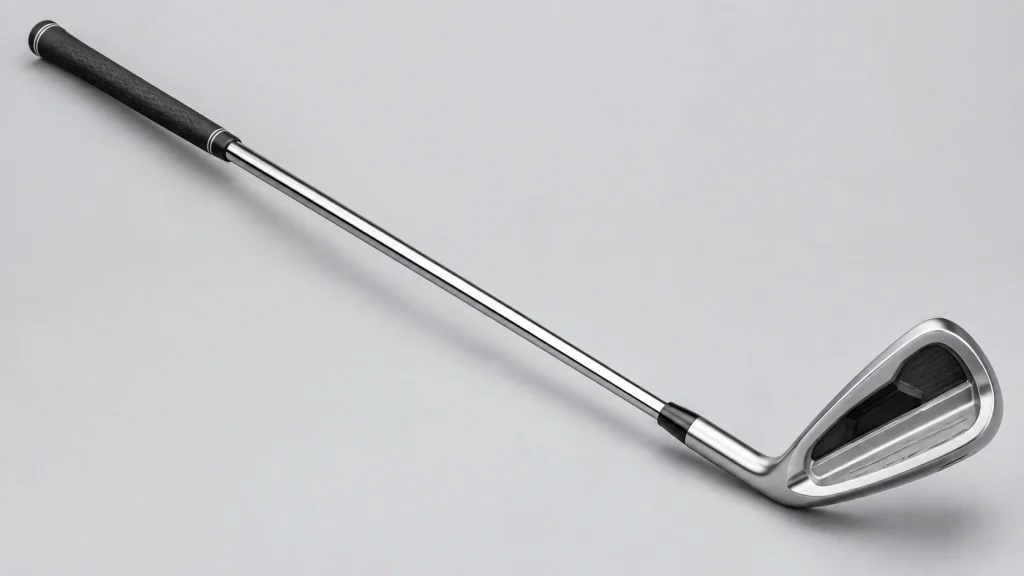
Understanding the basic components makes iron specifications easier to compare.
Clubhead
The clubhead is the metal section that strikes the ball. Its size, shape, weight distribution, and construction influence forgiveness, feel, launch, and control.
Larger heads often provide more confidence and stability. Compact heads usually appeal to experienced golfers who want precise feedback and shot-shaping control.
Clubface and Grooves
The face is the striking surface. Its grooves help manage the interaction between the ball, grass, moisture, and clubface.
Grooves do not simply “grab” the ball and create unlimited spin. Their performance depends on clean contact, ball condition, club speed, and the lie.
The USGA Equipment Rules regulate clubface features and other equipment characteristics. Golfers entering serious competitions should confirm that unusual, modified, or older clubs conform to applicable rules.
Sole
The sole is the bottom of the clubhead. A wider sole can help the club move through the turf without digging too deeply.
This can be useful for beginners, golfers with steep swings, and players who frequently hit behind the ball. A narrow sole may offer more control from firm turf but usually provides less help on heavy contact.
Hosel
The hosel connects the clubhead to the shaft. Its position and shape can influence weight distribution and appearance at address.
Shaft
The shaft affects the club’s total weight, feel, timing, launch, and consistency. Iron shafts are commonly made from steel or graphite.
Grip
The grip is the rubber or synthetic covering at the top of the shaft. Correct grip size helps the golfer hold the club securely without excessive hand pressure.
Replace grips that are shiny, cracked, hardened, or slippery. Worn grips can encourage extra tension and reduce control.
Loft, Length, and Lie Angle Explained
Three measurements have a major effect on iron performance.
Loft
Loft is the angle of the clubface relative to a vertical position. More loft normally produces a higher, shorter shot. Less loft generally produces a lower, longer shot.
However, there is no universal loft for each iron number. One company’s 7-iron may have the same loft as another company’s 6-iron.
Do not compare irons by number alone. Check the actual loft and observe the complete ball flight, including launch, carry distance, spin, and stopping ability.
Club Length
Lower-numbered irons are generally longer. A longer shaft can create more speed, but it also makes center-face contact more difficult.
Club length should allow you to address the ball comfortably without standing excessively upright, bending too far forward, or changing your natural posture.
Lie Angle
Lie angle describes how the shaft and sole sit when the club is placed at address. An unsuitable lie angle can affect the direction in which the clubface points at impact.
Static measurements are only a starting point. Your posture, swing, hand position, and impact pattern also matter. PING’s iron fitting guidance notes that shaft length and lie angle are important fitting variables because they can influence shot direction.
Main Types of Golf Irons
Game-Improvement Irons
Game-improvement irons usually have larger heads, wider soles, more offset, and weight positioned around the head’s perimeter.
They are designed to make ordinary mishits more playable. This does not mean every poor swing will produce a good shot, but the loss of distance and accuracy may be smaller.
These irons generally suit:
- Beginners
- High-handicap golfers
- Players who struggle with launch
- Golfers who value forgiveness over shot shaping
Super Game-Improvement Irons
These models take forgiveness further. They may have very wide soles, lightweight shafts, strong lofts, and hybrid-like construction.
They can help golfers who have slower swing speeds or difficulty getting the ball airborne. The tradeoff is a larger appearance and potentially less precise feedback.
Players-Distance Irons
Players-distance irons combine a relatively compact appearance with technology intended to increase ball speed and forgiveness.
They can work well for improving golfers who strike the ball reasonably consistently but still want help on slight mishits. Distance can be impressive, although golfers must check whether the set produces useful height and even yardage gaps.
Players Irons and Blades
Players irons have smaller heads, thinner toplines, less offset, and less visible help behind the face. Traditional muscle-back blades are the least forgiving version.
They provide detailed feedback and can give skilled golfers more control over trajectory. However, off-center hits often lose noticeable distance.
Beginners should not choose blades simply because they look clean or because professional golfers use them. A forgiving iron normally supports faster improvement and more enjoyable play.
Cast Versus Forged Irons
Cast and forged describe manufacturing processes, not automatic performance levels.
Cast heads are made by pouring molten metal into a mold. The method allows manufacturers to create complex shapes and reposition weight efficiently.
Forged heads begin as a solid piece of metal that is shaped under pressure. Many golfers associate forged irons with a soft or solid impact sensation.
A forged iron is not automatically better, and a cast iron is not automatically harsh. Head structure, face thickness, materials, internal damping, shaft choice, and ball type all affect feel.
Choose based on measurable performance and personal preference rather than the manufacturing label alone.
Steel Versus Graphite Iron Shafts
Steel shafts are common because they are durable, consistent, and available in many weights. They often provide a stable feel and clear impact feedback.
Graphite shafts are generally lighter and may reduce the vibration reaching a golfer’s hands. They can help some golfers create more speed or play with less physical strain.
Neither material is limited to a particular age or gender. The correct choice depends on:
- Comfortable total weight
- Swing tempo
- Desired launch
- Strength and mobility
- Feel at impact
- Consistency of contact
- Existing hand, wrist, elbow, or shoulder discomfort
Shaft flex labels are not standardized across all manufacturers. A “regular” shaft from one product line may feel different from another. Testing is more reliable than choosing from the label alone.
How to Hit an Iron Shot
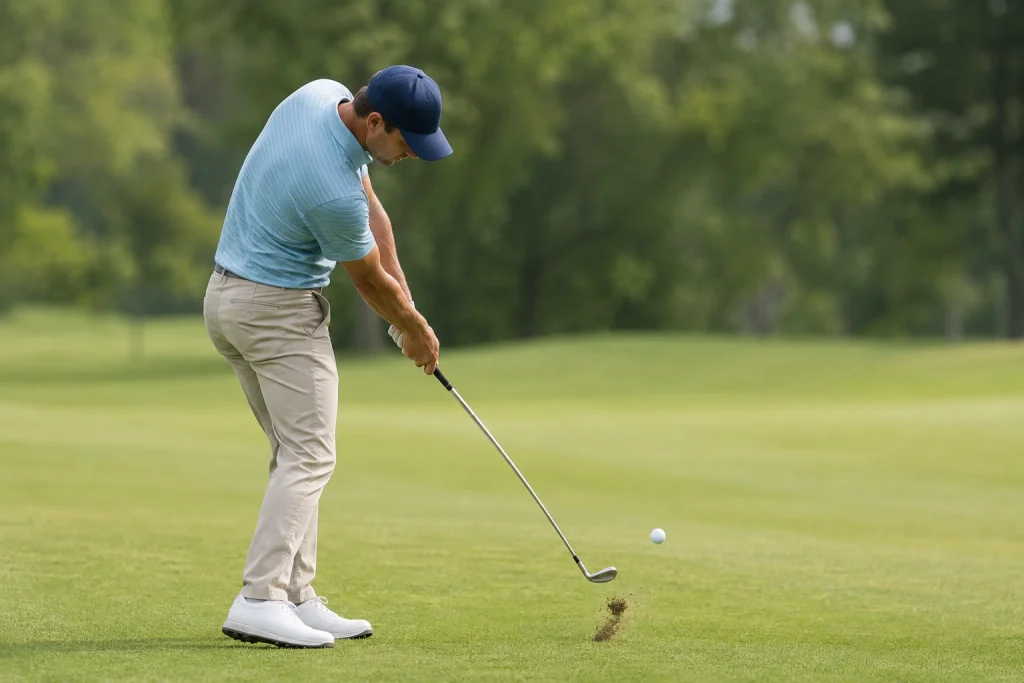
A basic iron swing should prioritize solid contact and balance rather than maximum effort.
- Choose a realistic target. Aim for a safe part of the green or fairway, especially when hazards surround the flag.
- Position the ball correctly. A short iron is commonly played near the center of the stance. Longer irons are generally placed slightly farther forward.
- Set your posture. Bend from the hips, soften the knees, and let your arms hang naturally.
- Use light grip pressure. Hold the club securely without squeezing it.
- Make a balanced backswing. Turn your upper body while maintaining stable posture.
- Strike the ball before the turf. With most normal iron shots, the lowest point of the swing occurs just after contact.
- Finish in balance. Your chest should face the target, with most of your weight on the lead side.
You do not need to force the club sharply downward. A severely steep motion can cause deep divots, fat shots, and unnecessary strain.
The PGA’s beginner golf guidance recommends starting with short irons before progressing to mid-irons, long irons, and woods. Shorter clubs make it easier to develop contact and control.
How Far Should Each Iron Go?
There is no required distance for any iron. Your useful number is your average carry distance, not your single longest shot.
Many recreational golfers have approximately 8–15 yards between neighboring irons, but personal gaps can be smaller or larger. Strong lofts, inconsistent contact, and low launch can cause two clubs to travel nearly the same distance.
Track several solid shots with each club and record the average carry. Ignore severe mishits when building your initial chart, but do not use only your best result.
Expert Tip:
Build your iron set around consistent yardage gaps. If your 5-iron and 6-iron carry almost the same distance, replace the harder-to-hit club with a hybrid instead of keeping it solely to complete the numbered set.
Choosing Irons for Your Skill Level
Beginners
Most beginners benefit from a forgiving cavity-back or game-improvement design. Look for a comfortable head size, wider sole, sufficient loft, and a shaft you can swing without strain.
A smaller set may be enough at first. A 6-iron through pitching wedge, combined with one or two hybrids, can cover many common shots.
Intermediate Golfers
Intermediate players should decide what they want to improve. One golfer may need higher launch, while another needs tighter distance control.
Players-distance irons can be attractive, but they are not automatically the right step forward. Compare them with game-improvement options using the same ball and realistic targets.
Skilled Ball Strikers
Consistent players may prefer compact heads, less offset, and more feedback. Some create a combo set, using forgiving long irons and compact short irons.
The change between designs must preserve sensible loft and distance gaps.
Cost, Quality, and Durability
Iron prices vary according to the number of clubs, materials, shaft options, brand, and customization.
General buying categories include:
- Used or older sets: Often the lowest-cost option
- Entry-level sets: Designed for value and straightforward forgiveness
- Current game-improvement sets: Commonly mid-priced
- Premium forged or players sets: Usually more expensive
- Custom builds: May cost more depending on shafts, grips, and adjustments
A higher price does not guarantee lower scores. Fit, forgiveness, and reliable distance gaps matter more than cosmetic finish or launch-year status.
Quality irons can remain playable for many years. Inspect used clubs for:
- Deep face damage
- Excessive groove wear
- Rust or pitting
- Bent or dented shafts
- Loose heads or ferrules
- Cracked graphite
- Hardened grips
- Mixed or altered specifications
Do not play with a cracked shaft or loose clubhead. Stop using the club and take it to a qualified repair professional.
Common Mistakes Golfers Should Avoid
- Buying irons based only on distance: A longer 7-iron is not helpful if shots launch too low or cannot stop on the green.
- Choosing blades too early: Compact irons can punish the inconsistent contact common among developing golfers.
- Copying another golfer’s specifications: Height alone does not determine length or lie angle. Swing characteristics matter.
- Ignoring the long end of the set: If a 4-iron rarely produces a useful shot, a hybrid may be more practical.
- Using shaft flex as the only fitting factor: Shaft weight and overall feel can be just as important.
- Trying to lift the ball: Scooping adds inconsistency. Let the club’s loft launch the shot.
- Swinging every iron at maximum effort: A controlled swing normally produces better contact and more predictable distance.
- Practicing without a target: Randomly hitting balls develops less skill than changing targets and tracking results.
- Ignoring club condition: Slippery grips, damaged shafts, and loose heads can reduce performance or create a safety risk.
When to Get Help From a Golf Pro or Fitter
Consider taking a lesson when you consistently hit behind the ball, top shots, struggle with balance, or cannot identify why your contact varies.
A professional fitter may help when:
- You are buying an expensive new set
- Your clubs feel unusually long, short, heavy, or light
- Your typical starting direction is difficult to explain
- Neighboring irons travel similar distances
- You cannot launch the longer irons
- You have physical limitations or recurring discomfort
- Your swing and contact have become reasonably repeatable
A fitting should compare ball speed, launch, spin, carry distance, descent, dispersion, and strike location. The goal is not simply to identify the combination that produces one exceptionally long shot.
The PGA of America’s club-fitting guidance explains that fitting can benefit higher-handicap players as well as accomplished golfers. Even so, a fitting cannot replace instruction when the main problem is unstable technique.
For complete beginners, a short lesson before purchasing a premium set can be a sensible investment. The instructor can identify basic setup issues and provide useful guidance about suitable club types.
Caring for Golf Irons
Simple maintenance protects both appearance and performance.
- Wipe the face after muddy or sandy shots.
- Clean grooves with water and a soft brush.
- Dry the head before returning it to the bag.
- Avoid leaving wet clubs inside a closed vehicle or storage area.
- Inspect graphite shafts for splinters or cracks.
- Check grips regularly for smooth or hardened areas.
- Use a towel during the round to keep the face reasonably clean.
Avoid aggressive grinding or unauthorized groove-altering tools. Modifying a face can damage the club and potentially make it non-conforming. The USGA provides an informational club database for golfers checking whether submitted irons comply with applicable groove specifications.
FAQs
Is an iron easier to hit than a driver?
A short or mid-iron is usually easier for a beginner to control because it has a shorter shaft. A driver has a larger head but requires a longer swing and a different setup.
Which iron should a beginner learn first?
A 7-iron or 8-iron is an excellent starting point. Both are short enough to control while providing enough loft to help the ball get airborne.
Do beginners need a 3-iron or 4-iron?
Usually not. Many beginners hit hybrids more consistently because hybrids have wider soles, lower centers of gravity, and more forgiving head shapes.
Why do two 7-irons travel different distances?
They may have different lofts, shaft lengths, head designs, or shaft weights. Testing actual ball flight is more useful than assuming every club with the same number performs identically.
Should I choose steel or graphite iron shafts?
Choose the material that provides comfortable weight, consistent contact, and suitable ball flight. Graphite can feel lighter and reduce vibration, while steel often provides a stable, familiar feel.
How often should golf irons be replaced?
There is no fixed replacement schedule. Replace or repair them when damage, poor fit, severe wear, or unsuitable distance gaps affect play. Well-maintained irons can last many years.
Can I use an iron from the tee box?
Yes. An iron is often a smart choice on short par-3 holes or narrow holes where control matters more than maximum distance. You may place the ball on a low tee within the teeing area.
Conclusion
A golf iron is designed to produce controlled shots at specific distances. Lower-numbered irons are longer and usually harder to hit, while higher-numbered irons provide more loft and control.
The most important lesson from this iron explained guide is that the best irons are not necessarily the newest, longest, or most expensive. They are the clubs that help you make consistent contact, achieve useful ball flight, and maintain predictable distance gaps.
Start by learning with a short or mid-iron, record your real carry distances, and choose forgiveness that matches your current ability. If you are investing in a full set or struggling with persistent contact problems, book a lesson or professional fitting before you buy.